
Why Emotional Regulation Is So Damn Difficult
It requires neurological maturity and a complex set of skills

Self-regulation is the ability to notice and change the energy in our bodies. — Dr. Robyn Gobbel
Emotional self-regulation requires three things:
- The ability to recognize when our energy doesn’t match what’s needed for the situation;
- An ability to notice (be aware of) the energy in our bodies and how it’s impacting our external behaviour; and
- The skills to actually regulate that energy to better fit our needs
Once upon a time…
When I was about 9 or 10 years old I was signed up for Girl Guides against my will. I loved the outdoors and camping, so it was assumed I would enjoy this program. I did not.
There weren’t a lot of traditional scouting activities like orienteering, hiking, camping, canoeing, and outdoor survival skills. I remember a lot of games involving running around the school gymnasium, crafts, and singing songs.
Those were not my cup of tea, so to speak.
There was one camping trip, but it was winter camping and I didn’t have a winter weight sleeping bag. I slept in my snowsuit and was still cold. That was miserable, but altogether beside the point.
I don’t remember a lot of specifics about my short-lived Guiding career, but I do vividly recall one particular evening. I think it was near the end of the night when the leaders try to gather everyone into a circle so we can sing taps and go home.
For one reason or another, I was running around the gym and acting — well, like a 10 year old child with undiagnosed ADHD, probably. The leader must have been trying unsuccessfully to get my attention (did I mention I also had undiagnosed hearing loss? yeah…), because she suddenly yelled at me to “SIT DOWN!”
I sat down.
Lack of awareness
A lot of neurodivergent (ND) folks — especially kids with ADHD, but NDs of all ages too — struggle with “reading the room” and recognizing when our energy doesn’t match what is considered “appropriate” for the situation.
At that point in the evening, the expectation was the troop would be winding down and gathering in the circle, but I was still flying from the last game we played.
A lot of ND folks struggle with transitions as well, so it’s a lot harder to dial down our energy level when we’ve just been engaged in a high-energy activity, for example.
While the other Guides started to notice the leaders calling everyone into the circle, and then others (seemingly) noticed the leaders starting to get frustrated, I was oblivious. I was off in my own world, but I certainly wasn’t ignoring the leader on purpose, that’s just how my brain is wired.
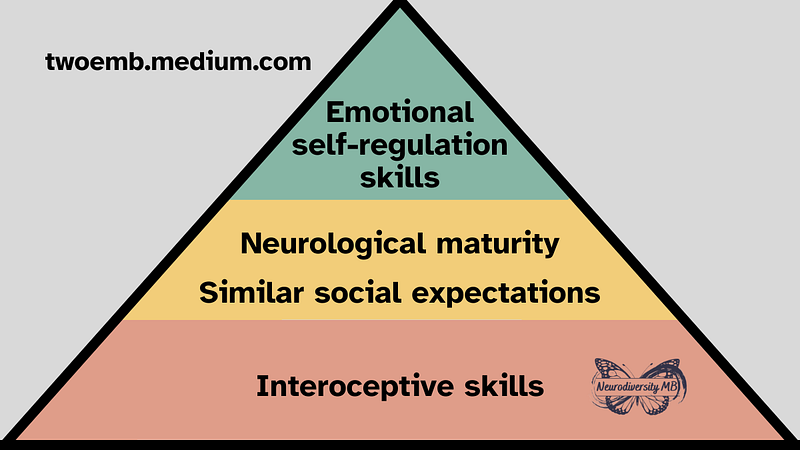
Why is regulating so difficult?
Emotional self-regulation requires a series of complex skills within skills.
First, the ability to notice the energy in our bodies requires interoceptive skills. Interoception is what allows us to recognize sensations and process signals from within our bodies.
A lot of neurodivergent folks struggle with interoception — meaning, we tend to miss those signals. We may not notice them until they’ve reached a state of urgency, or we may have difficulty interpreting what our body is trying to tell us (a form of alexithymia).
Secondly, the ability to recognize when our energy doesn’t match what’s needed for the situation requires social maturity and a common understanding.
We aren’t able to recognize that our energy doesn’t match the situation unless we have the neurological development and knowledge which allows us to accurately read the relevant social cues and understand what is expected of us.
We also won’t be able to recognize when our energy doesn’t match what is needed unless we have the same understanding as others about what is expected.
Lastly, once all of those conditions are met, the ability to regulate our energy to better fit our needs requires emotional regulation skills.
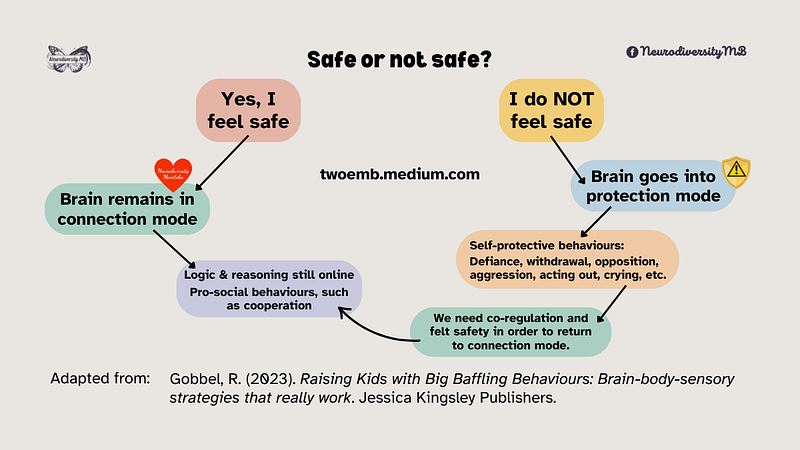
Emotional self-regulation
Our capacity regulating our emotions develops out of a myriad factors, beginning in infancy.
(I won’t go into the complexities of neurological development and attachment theory, but please check out the books in my reference section if you’re interested in learning more).
Briefly, how adept we are at self-regulating depends on our neurological development, learning and attachment history (childhood, upbringing, role-models, etc.), present level of tolerance (external stressors, illness, etc.), and the level of safety we experience in our relationships.
In particular, our ability to keep cool (or dial back the intensity of our emotions) depends on how safe and connected we feel at that very moment.
Safety is a subjective feeling which is determined by an individual’s nervous system. That’s important to remember the next time someone we love is flipping their lid — although it’s not easy to maintain perspective in the heat of the moment.
The more we learn about and understand that meltdowns, tantrums, “freak outs” — whatever we want to call them — are not intentional, malicious behaviours. They’re a person reacting to a perceived threat.
We may not even have a conscious awareness of feeling unsafe, but our nervous system sure does.
© Jillian Enright, Neurodiversity MB
Related Articles
Ways to support my work
You can leave a “tip” on Ko-Fi at https://Ko-Fi.com/NeurodiversityMB
Become a paid subscriber to my Substack publication
Check out my online store at https://NeurodiversityMB.ca/shop
Read and share my articles from twoemb.medium.com
Learn more
References
Delahooke, M. (2022). Brain-Body Parenting: How to stop managing behaviour and start raising joyful, resilient kids. Harper Collins. https://goodreads.com/book/show/58385697-brain-body-parenting
Gobbel, R. (2023). Raising Kids with Big Baffling Behaviours: Brain-body-sensory strategies that really work. Jessica Kingsley Publishers. https://goodreads.com/book/show/122825102-raising-kids-with-big-baffling-behaviors
Goodall, E., & Brownlow, C. (2022). Interoception and Regulation: Teaching skills of body awareness and supporting connection with others. Jessica Kingsley Publishers. https://goodreads.com/book/show/63281651-interoception-and-regulation
Hoffman, K., Cooper, G., Powell, B., Benton, C. M. (2017). Raising a secure child. Guilford Publications. https://goodreads.com/book/show/29993569-raising-a-secure-child
Mahler, K. (2016). Interoception: The Eighth Sensory System. AAPC Publishing. https://goodreads.com/book/show/27503067-interoception
Siegel, D. & Bryson, T. (2011). The Whole-Brain Child. Random House. https://goodreads.com/book/show/10353369-the-whole-brain-child


