
How Emotional Regulation is Like Bike Riding
Skills need to be taught and supported, they don’t come pre-programmed

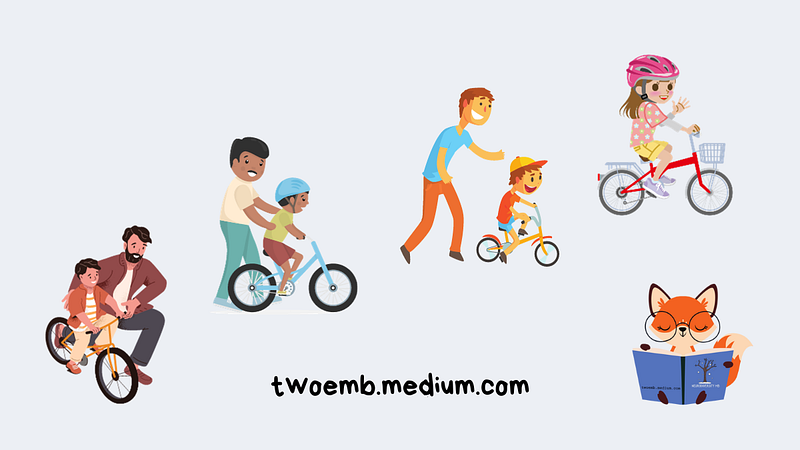
It’s like riding a bike
Think of teaching regulation skills like teaching children to ride a bicycle. We don’t just put a kid on a bike and expect them to figure it out for themselves.
First, we might teach them how to balance and explain the mechanics of keeping the bike upright. Next, we might hold on to the back of the bike as they practice pedalling and work on finding their balance.
After lots of practice with a lot of adult support and coaching (and possibly many falls, scrapes, and bruises), involving lots of patience, help, and encouragement with a trusted adult right by their side…
They gain increasingly more skill and confidence, and eventually are proudly zipping around without fear.
Regulation isn’t inborn
We aren’t born with the ability to regulate ourselves. Newborn babies are completely reliant on a loving caregiver to meet all of their needs, including their need to feel safe and cared for.
When babies cry, they need an adult to figure out what’s wrong and provide for them. They need an adult to comfort them when they’re sad or scared. Babies and children develop healthy attachment when we show them we will respond to their distress and meet their needs.
When a loving caregiver comforts a baby, the baby’s developing brain begins to form a mental blueprint for what regulation and soothing feel and look like.
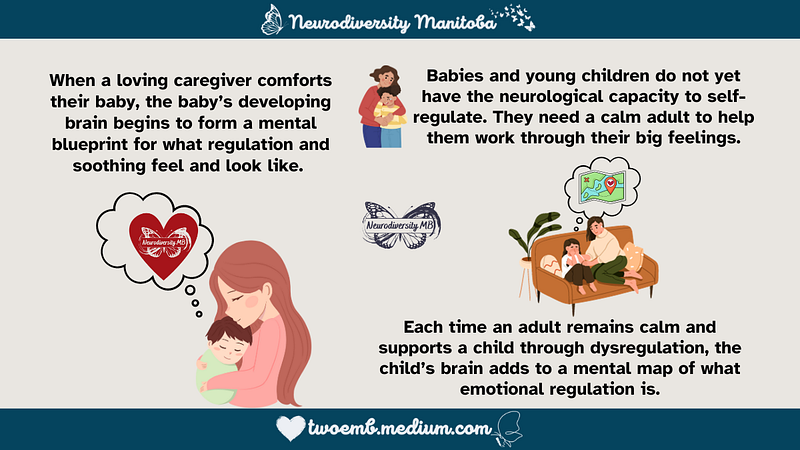
Babies and young children do not yet have the neurological capacity to self-regulate. They need a calm adult to help them work through their big feelings.
Each time an adult remains calm and supports a child through dysregulation, the child’s brain adds to a mental map of what emotional regulation is.
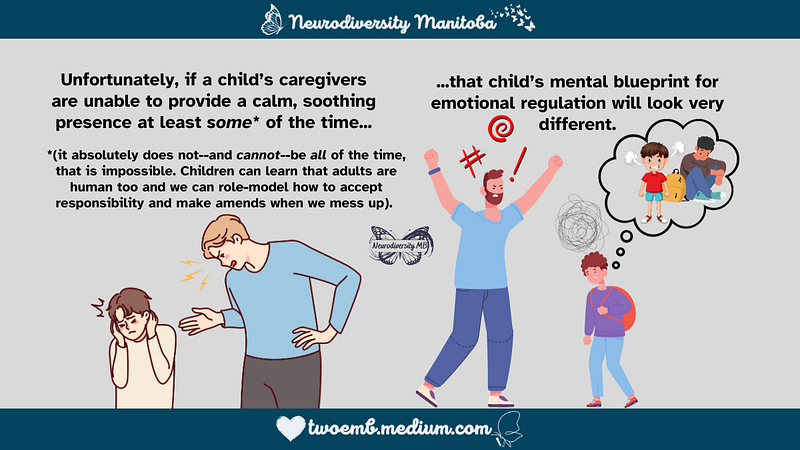
Sometimes a child’s caregivers are unable to provide a calm, soothing presence at least some* of the time.
(*It will not — and cannot — be all of the time, that’s impossible. Children can learn that adults are human too and we can role-model how to accept responsibility and make amends when we mess up).
When the adults in the child’s life cannot respond compassionately most of the time, that child’s mental blueprint for emotional regulation will look very different.
Individual differences
The style of parenting isn’t the only reason a child may have or develop a highly sensitive nervous system.
Some children are born with hypersensitivities, like neurodivergent kids, kids with disabilities, and children with complex medical issues.
There can also be other traumatic events in the child’s life (at school or in their community, for example) which may cause their internal alarm system to become hypervigilant.
Our mental map
When we grow up with caregivers who are unable to consistently provide co-regulation, or we experience traumatic events, our brains create an association between emotions (as well as certain environmental cues) and lack of safety.
Our nervous systems will spend a lot more time in survival mode, and our ‘baseline’ for what being regulated feels like will be much higher — meaning we’ll go from regulated to dysregulated much faster.
When we try to teach social-emotional and regulation skills from an academic standpoint, we’re trying to teach skills to the Prefrontal Cortex (PFC), which is the logic and reasoning centre of the brain.
But someone in a state of hyper-arousal or chronic stress is living primarily in their limbic system and hind brain: the areas responsible for emotions and survival.
When someone’s mental blueprint tells them that emotions lead to feeling unsafe, their nervous system is hyper-vigilant because it’s used to having to look out for danger.
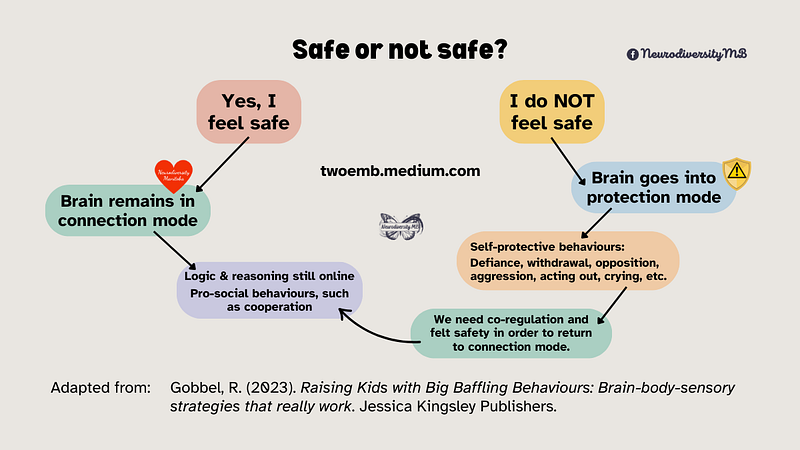
Being in survival mode without a mental map for healthy regulation means we can go from a state of chronic stress to fully dysregulated very easily.
We cannot internalize intellectual knowledge, nor learn social-emotional skills in an academic way until we have a foundation on which to build.
We first need the internal experience of co-regulation so we can relate new information to our inner experience.
We also need to experience co-regulation in order to increase the distance between our ‘baseline’ and dysregulation. This way we will have time to access those skills before we become too dysregulated to use them.
But how will they learn??
Dysregulated people behave in less than ideal ways. Children who are dysregulated may act out and “misbehave”.
This is because our rational, adaptive behaviours come from the part of our brain responsible for reasoning and logic, which is unavailable when we are in survival mode.
I often get questions along the lines of, “…but if we don’t punish ‘bad’ behaviour, how will they learn”, or “They’ll think it’s okay if they just get away with it!”
Learning — including learning from rewards or punishment — requires access to our Prefrontal Cortex (PFC). When a person is dysregulated, their PFC is essentially “offline” because the brain is prioritizing the areas responsible for safety.
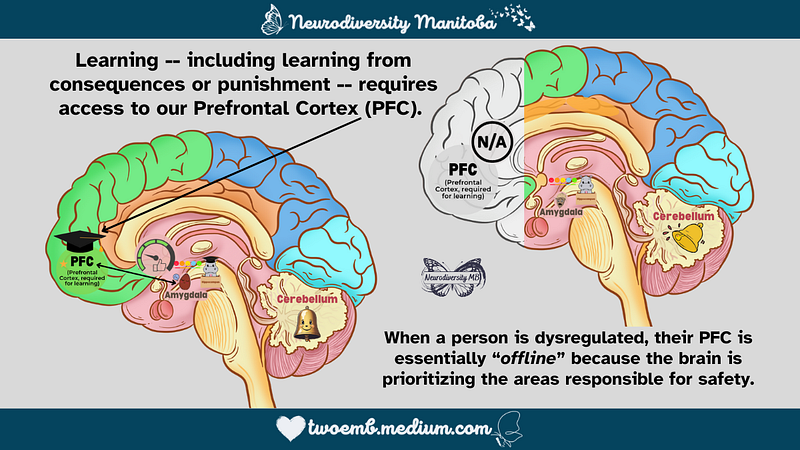
In order to learn new skills, take accountability for our actions, understand the impact of our behaviour, or learn from our mistakes, our nervous system first needs to be regulated.
In order to regulate, we need to feel safe. Our sense of felt safety is subjective. It is impacted by our environment, relationships, inner processes, and our experiential history.
Safety is determined by an individual’s nervous system: What feels safe for one is different from what feels safe for another.
© Jillian Enright, Neurodiversity MB
Related Articles
Ways to support my work
You can leave a “tip” on Ko-Fi at https://Ko-Fi.com/NeurodiversityMB
Become a paid subscriber to my Substack publication
Check out my online store at https://NeurodiversityMB.ca/shop
Read and share my articles from twoemb.medium.com

Learn more
References
Delahooke, M. (2019). Beyond Behaviors: using brain science and compassion to understand and solve children’s behavioral challenges. PESI Publishing.
Delahooke, M. (2022). Brain-Body Parenting: How to stop managing behaviour and start raising joyful, resilient kids. Harper Collins.
Desautels, L. (2020). Connections Over Compliance: Rewiring our perceptions of discipline. Wyatt-MacKenzie Publishing.
Gobbel, R. (2023). Raising Kids with Big Baffling Behaviours: Brain-body-sensory strategies that really work. Jessica Kingsley Publishers.
Hoffman, K., Cooper, G., Powell, B., Benton, C. M. (2017). Raising a secure child. Guilford Publications.
Siegel, D. J., & Bryson, P. T. (2012). The whole-brain child. Random House.