
I Shouldn’t Have To Read Your Damn Mind
A harmful myth about Autism persists
(Actually, quite a few harmful myths and stereotypes persist, but today I’m talking about one in particular)
Theory of Mind (ToM)
Despite extensive evidence to the contrary, many “professionals” continue to perpetuate this harmful stereotype that Autistics lack theory of mind.
ToM is defined as,
“The understanding that others have intentions, desires, beliefs, perceptions, and emotions different from one’s own and that such intentions, desires, and so forth affect people’s actions and behaviors.”
ToM is also more simply defined as,
“the ability to understand and take into account another individual’s mental state”.
On a subjective note, I know a lot of Autistic people, and every single one of us has a varying ability to ascribe mental states to others, including individuals who have more significant social challenges.
While Autistic brains work differently from neurotypical brains, therefore we process and express thoughts and emotions differently, this does not mean Autistics lack ToM altogether.
A more accurate way to conceptualize this is akin to cultural and communication differences.
Cultural differences
Where social and communication norms vary between cultures, social and communication styles or expectations vary amongst different neurotypes as well.
Note, this does not mean one culture or style is superior to another, it simply means there are differences.
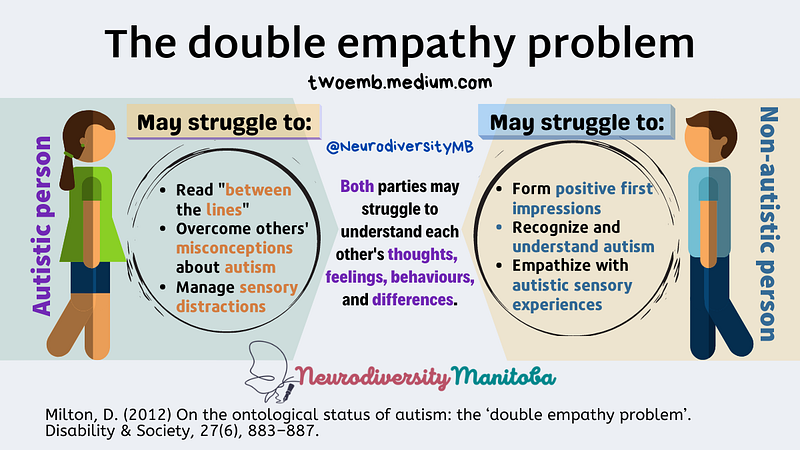
Dr. Damian Milton described this as The Double Empathy Problem.
While Autistics may have difficulty figuring out what a Neurotypical (NT) person is thinking or feeling, this is not for lack of ToM, this is due to our differences in how we perceive, process, and express our thoughts and feelings.
As Dr. Milton, and other Autistic scholars have pointed out, NTs often have difficulty understanding the ‘mental states’ of Autistics just as often as we have trouble decoding them.
Why is our ability to understand a different neurotype pathologized as a deficit in ToM, whereas their inability to do the same is overlooked?
It’s ableism
The word you’re looking for is ableism. Ableism with a side of neuronormativity. The assumption being the way the majority perceive, process, and express thoughts and feelings are inherently superior to the way those in the minority do.
Have you ever?
Have you ever had an experience you tried to explain to others, but no one else seemed to understand what you were thinking, feeling, or describing? Or conversely, have you ever had someone try to tell you about something they experience that you couldn’t come close to understanding?
Imagine most things in life being like that.
For example, cognitive rigidity. If something is planned to happen a certain way, I have a really hard time with unexpected changes. A lot of people (including my NT spouse) have difficulty understanding why I can’t just ‘go with the flow’.
I would if I could, folks.
If I try to explain this experience to my husband, or another NT person, they essentially scratch their head and look at me with a confused expression on their face.
(You see, I do have theory of mind, because I can tell they’re confused when they wrinkle their eyes and tilt their head like a puppy! Q.E.D. — quod erat demonstrandum).
Emotional intelligence
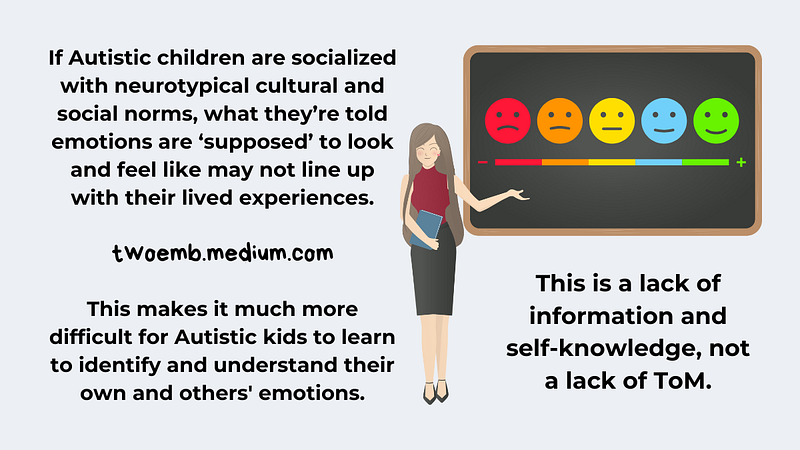
If Autistic children are taught social-emotional curricula by neurotypical teachers and are socialized with neurotypical cultural and social norms, what they’re told emotions are “supposed” to look and feel like often won’t line up with their lived experiences.
When they are asked to name what they are feeling, or interpret the emotions a neurotypical person is conveying, they might misunderstand or misinterpret because they’ve never been taught what those emotions feel or look like from the perspective of an Autistic person.
This is a lack of information and self-knowledge, not a lack of theory of mind. It is the result of ableism and neuronormativity on the part of our education system, and society as a whole, not a deficit intrinsic to being Autistic.
I can’t read between the lines
Neurotypicals have this way of communicating wherein their actual meaning is encoded, buried under layers of superfluous doublespeak. They couch and mince their words with subtleties.
I don’t do subtle. I don’t do vague. I don’t obfuscate. I say what I mean and mean what I say.
It’s not my fault if NTs have been taught they must be “nice” and polite at all times, to the point where they are afraid to speak plainly lest they be accused of rudeness.
Perish the thought.
I’m not saying I go around insulting people for shits and giggles (I don’t), but I see no value in sending messages that would require Bletchley Park and the Turing Machine to decipher.
I may have difficulty reading the room and I may be a little too blunt for some people’s tastes, that’s fine. I can acknowledge where my strengths and weaknesses are, and I have no problem admitting that playing politics is not my strong suit.
That said, neurotypicals seem to have a lot of misunderstandings amongst themselves as a result of not being clear in their communication, of expecting others to decode their messaging or somehow know what they’re thinking.
Like any variations, there are pros and cons with each side of the communication coin. So instead of labelling Autistics as being deficient and lacking, let’s just agree that neurotypicals are hella confusing.
Right?
© Jillian Enright, Neurodiversity MB
When you join medium, as a member you’ll have access to unlimited reads for only $5 per month. If you use my referral link, I’ll earn a small commission, and you’ll earn my undying gratitude.
If you’d prefer give a one-time tip, you can support my writing on Ko-Fi — also, it’s free to follow me on Facebook and LinkedIn!
Related Articles
References
Crompton, C. J., Ropar, D., Evans-Williams, C. V., Flynn, E. G., & Fletcher-Watson, S. (2020). Autistic peer-to-peer information transfer is highly effective. Autism, 24(7), 1704–1712. https://doi.org/10.1177/1362361320919286
Milton, D. (2012). On the ontological status of autism: the ‘double empathy problem’. Disability & Society, 27(6), 883–887. https://doi.org/10.1080/09687599.2012.710008


