
I Prefer Blunt People
I thought it was just a personal preference
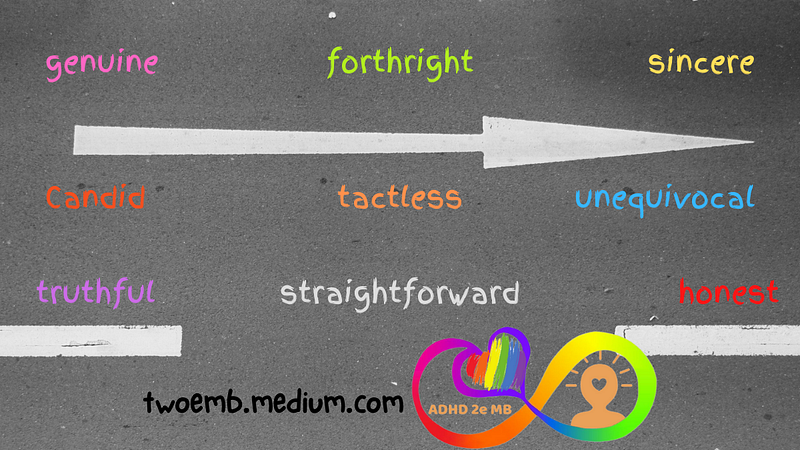
When I say I prefer blunt people, I’m referring to the characteristics of being forthright, straightforward, and candid — not slang for a joint you smoke.
This is sort of a personal preference, but the more I learn about myself, the more I learn these things are not that simple.
I used to say I’m not good at playing politics. Well, that’s true, but not simply because I refuse to go along to get along, or because I’m not good at picking my battles.
Those are both also true, but my brain is wired differently, such that diplomacy, tact, and the ability to “fake it to make it” are neurologically a much greater challenge for me than for most neurotypical people.
Deception and the brain
Autistic and ADHD brains have weaker connections between the Prefrontal Cortex (PFC) and the amygdala. The PFC is responsible for executive functions like planning, decision-making, and impulse-control. The amygdala is a primary brain region involved in processing emotions.
Neural imaging and research on deception have shown that when people lie, they exert more cognitive effort to suppress the impulse to tell the truth, a process which is primarily controlled by the PFC.
Interestingly, research has also shown a decrease in activation of the amygdala, presumably suppressing the emotions associated with lying.
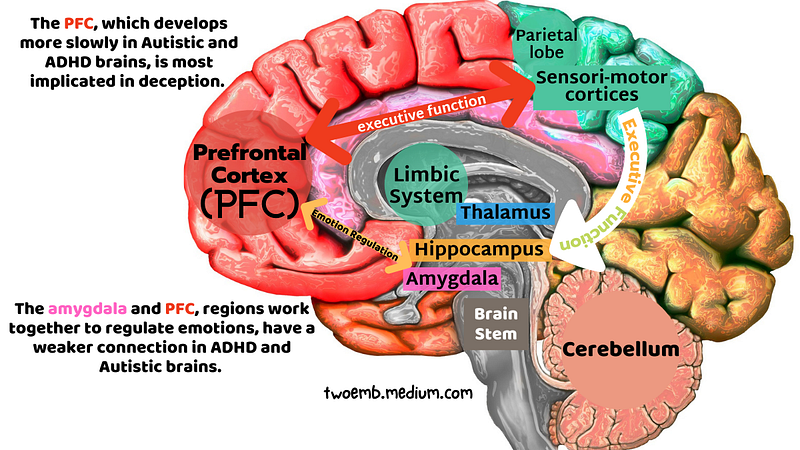
The regions of the brain implicated in effective deception are the same regions that work in the exact opposite way in Autistic and ADHD brains.
To be clear, this does not mean that ADHD or Autistic people never lie.
…or does it?
In fact, impulsivity may cause neurodivergent people to lie more, well, impulsively. However, the lies we tell are less likely to be premeditated, and frankly, less likely to be believable.
So there’s that.
Social cues & anxiety
Research has shown that ADHD and Autistic people have very similar deficits in reading social cues. Or as I like to call it, cultural differences in communication styles, when compared to neurotypical people.
Rather than “communication deficits”, I prefer the phrase ‘cultural differences in communication styles’.
This is likely another reason I prefer blunt people. In addition to, or more likely because of, being ADHD and Autistic, I also have social anxiety.
The research confirms my belief, as many studies have concluded that being ADHD and Autistic increases one’s risk of developing social anxiety. It is theorized that this is a result of social challenges, which are believed to be inherent with these neurodivergences.
Some studies have attributed this to challenges with Theory of Mind (ToM), the ability — or lack thereof — to attribute mental states to ourselves and others. However, other experts dispute the contention that neurotypical people are actually good at attributing mental states to others in the first place, and question the validity of ToM research thus far.
I don’t know about you, but I’ve seen plenty of miscommunication and misunderstandings between neurotypical people, often because they are afraid to be blunt lest they hurt someone’s feelings or commit a social faux pas.
People frequently make incorrect judgements or assumptions about the other person’s intentions or thought processes, a problem I feel could be prevented by more straightforward and direct communication.
In fact, one very cool study found that Autistic people share information (i.e. utilize social communication) with other Autistic people just as effectively and accurately as neurotypical people share information with other neurotypical people.
Conversely, that same study demonstrated that both Autistic and neurotypical people experienced increased communication challenges and decreased rapport when communicating with someone of a different neurotype.
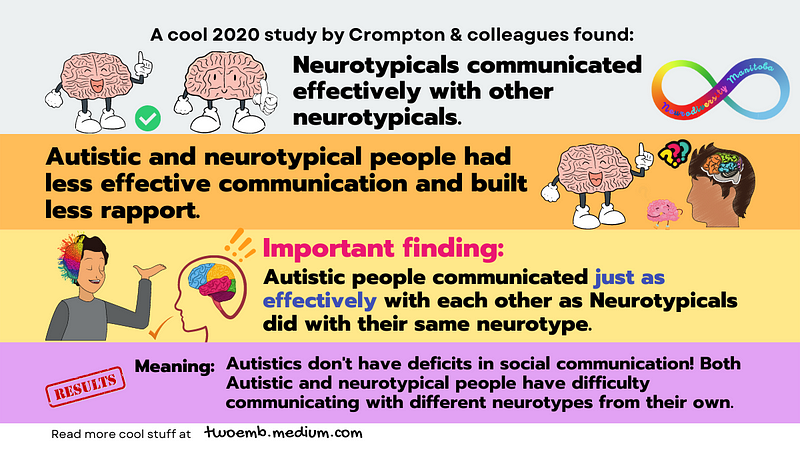
It would seem there really is a cultural and communication style mismatch, rather than Autistic people having “social deficits”. We’re simply the minority, so the blame and responsibility fall on us, despite the fact that NT folks have the exact same problems when the roles are reversed.
It’s never that simple
So, if you prefer a blunt, straightforward style of communication, does that mean you’re also Autistic?
In a word, no.
Sharing a single trait in common does not make a person Autistic, there are a myriad of complex factors involved in making a diagnosis, something I am not qualified to do anyway.
What I can say definitively is that we need to stop expecting everyone to conform to the majority, and start making room for people who fall outside of the statistical norm, in whatever form that may be.
Autistics have been adjusting, adapting, and masking our authentic selves for most (if not all) of our lives to make others comfortable, and often as an act of self-preservation. I think it’s well past time to meet somewhere in the middle.
I can promise to work on tact, if neurotypicals would please try to accept that Autistic people communicate differently, and we could use some understanding and acceptance. Autistics are not deficient or disordered, we’re just different. Simple as that.
When you meet someone who doesn’t speak the same language as you, the hope is that you each make efforts to bridge the gap and learn a little about how the other communicates.
If you develop a long-term relationship, you will likely learn some of each other’s language in order to improve communication.
That’s all I’m asking for, really.
© Jillian Enright, Neurodiversity MB
Related Stories
When you join medium, as a member you’ll have access to unlimited reads for only $5 per month. If you use my referral link, I’ll earn a small commission, and you’ll earn my undying gratitude.
If you’d prefer give a one-time tip, you can support my writing on Ko-Fi — also, it’s free to follow me on Facebook and LinkedIn!
Learn more
References
Baribeau, D.A., Dupuis, A., Paton, T.A. et al. (2019). Structural neuroimaging correlates of social deficits are similar in autism spectrum disorder and attention-deficit/hyperactivity disorder: analysis from the POND Network. Translational Psychiatry 9(72). https://doi.org/10.1038/s41398-019-0382-0
Crompton, C. J., Ropar, D., Evans-Williams, C. V., Flynn, E. G., & Fletcher-Watson, S. (2020). Autistic peer-to-peer information transfer is highly effective. Autism, 24(7), 1704–1712. https://doi.org/10.1177/1362361320919286
Kellen, B., François, J.. Ali, J., Marie-Maude, G., Moal, L. M., Umbricht, C., Chatham, C., Murtagh, L… Anouck, A., et al. (2020). Social Anxiety in Children and Adolescents With Autism Spectrum Disorders Contribute to Impairments in Social Communication and Social Motivation. Frontiers in Psychiatry, 11, 710. https://doi.org/10.3389/fpsyt.2020.00710
Ofen, N., Whitfield-Gabrieli, S., Chai, X. J., Schwarzlose, R. F., & Gabrieli, J. D. (2017). Neural correlates of deception: lying about past events and personal beliefs. Social cognitive and affective neuroscience, 12(1), 116–127. https://doi.org/10.1093/scan/nsw151
Pearcey, S., Gordon, K., Chakrabarti, B., Dodd, H., Halldorsson, B., Creswell, C. (2020). Research Review: The relationship between social anxiety and social cognition in children and adolescents: a systematic review and meta-analysis. The Journal of Child Psychology and Psychiatry, 62(7). https://doi.org/10.1111/jcpp.13310
Pitskel, N. B., Bolling, D. Z., Kaiser, M. D., Pelphrey, K. A., & Crowley, M. J. (2014). Neural systems for cognitive reappraisal in children and adolescents with autism spectrum disorder. Developmental cognitive neuroscience, 10, 117–128. https://doi.org/10.1016/j.dcn.2014.08.007


