
I Had Another ‘A-HA!’ Moment
Alternatively, a “duh, why didn’t I realize that sooner?” moment

Facepalm
One of my most popular articles ever is I Was Masking For So Long, I Lost Myself. I wrote it back in June, about seven months ago. At the time, I knew I had ADHD, but had know idea I’m also Autistic.
The opening quote of that article is a line about me, spoken by a bully from my elementary school days:
“She doesn’t have her own personality, she just acts like whoever she’s with.”
Still with me so far?
Good.
A few months later, in November, I wrote a piece about my Lightbulb Moments, describing all the realizations I put together to figure out I’m Autistic.
I just realized I missed one…
Scripting
Scripting is repeating back speech, or using lines that we have heard or read in other places. Many Autistics use scripting to help with unfamiliar social situations, to communicate information when we’re not sure how else to do so, and sometimes as part of masking when trying to fit in.
I didn’t realize until now that what I was doing back then was a form of scripting.
I used social mirroring and scripting to try to fit in with classmates who relentlessly tormented and mocked me throughout my elementary school years. It was a desperate attempt to blend in so they would stop bullying and harassing me.
It didn’t work.
Instead, one of the bullies picked up on my attempts and used it as yet another reason to humiliate me.
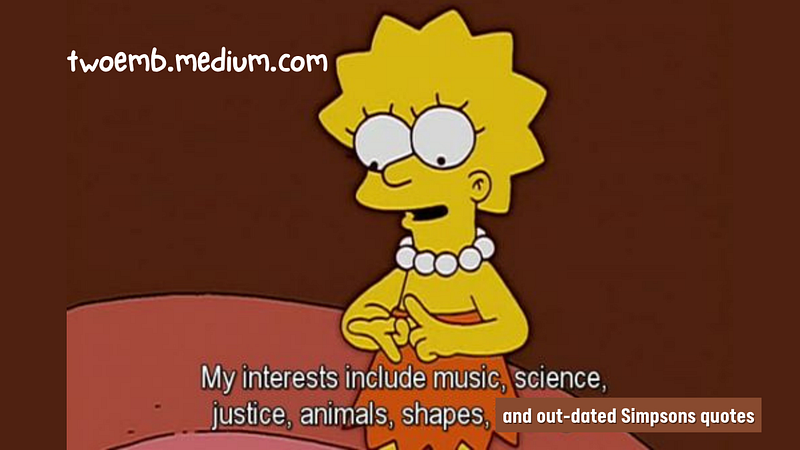
Even now, as an almost-40-year-old adulty-type person, I regularly quote The Simpsons. I persist, despite the fact that other people my age have forgotten these pop culture references, and most people younger than me haven’t even heard of The Simpsons.
Most just give me a confused look rather than laughing along with me.
Something’s missing
Those who have read my past articles may have noticed I usually include a lot of peer-reviewed sources, complete with extensive reference sections at the ends of my articles. You may also notice a distinct lack of such references at the end of this story, and there’s a good reason for that.
When I tried to do research on autistic scripting and social mirroring, I found a lot of “advice” on how to reduce these behaviours in autistic children.
What in the actual — why, because scripting isn’t neurotypical enough?
I’ve worked in various settings with children, including autistic children, long before I recognized myself as being autistic. When an autistic person is scripting, they’re communicating. Sometimes it’s a form of vocal stimming, repeating a sound or phrase that feels good or is soothing, perhaps as a form of stress relief.
Here’s the thing though, it’s not just an autism trait.
Neurotypicals script too
When any children use scripts, it is a way of trying to communicate something they don’t know how to express another way. Children of all neurotypes use imaginary play, role-playing, and other forms of scripting to work through real-life feelings and experiences.
Autistics do this more often than neurotypicals, and to a greater degree, but everyone uses turns of phrase, mannerisms, and expressions they’ve learned from popular media or from interacting with other people.
Sometimes children will say that their dolly feels sick when, in actuality, the child themselves isn’t feeling well. These children may play out scenes wherein they take on the caregiver role and help their dolly feel better.
This is a child’s way of regaining some control over a situation where they feel none, making their dolly feel better the way they want someone to help them feel better, or the way a caring adult has helped them feel better in the past.
These are important ways for people to process their feelings and experiences, and to communicate them to others.
Scripting is important
One day, an autistic boy I know was telling me about a favourite character of his. The child said that character had a tummy ache, so he had to stay home from school that day.
Upon further discussion I came to understand the child himself had a tummy ache, but didn’t know how to tell us in the way we might expect, through speaking in the first person.
If I hadn’t listened, if I had discouraged scripting, or if I hadn’t engaged with the child’s imagination and special interest, I wouldn’t have learned he wasn’t feeling well.
Scripting doesn’t have to be about communicating illness, of course. It can be about anything, and it can be an important way for people to connect, share interests, and interact.
I allowed myself this digression
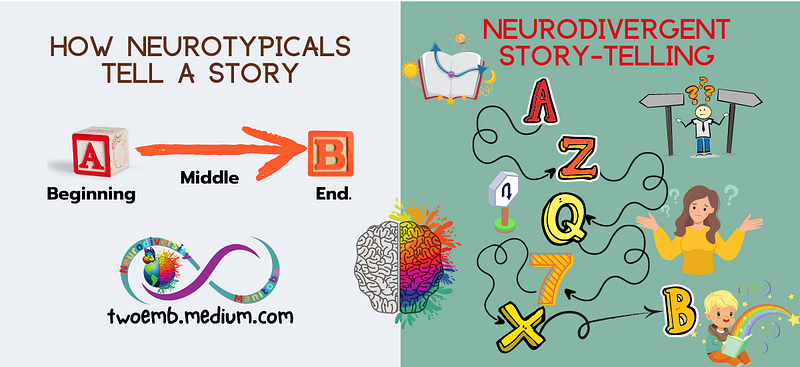
This started out as a piece describing another autistic trait I had discovered in myself, but it turned into something more important than that, so I didn’t bother reigning in my wandering brain this time.
If you care about an autistic person, listen to them, in whatever way they prefer to communicate.
You’ll learn something important, and they’ll learn they are someone important.
© Jillian Enright, Neurodiversity MB
Related stories
When you join medium, as a member you’ll have access to unlimited reads for only $5 per month. If you use my referral link, I’ll earn a small commission, and you’ll earn my undying gratitude.
If you’d prefer give a one-time tip, you can support my writing on Ko-Fi — also, it’s free to follow me on Facebook and LinkedIn!


