avatarJillian Enright

Free AI web copilot to create summaries, insights and extended knowledge, download it at here

6349

Abstract

have redefined PDA as <a href="https://www.frontiersin.org/research-topics/40032/pathological-extreme-rational-demand-avoidance-reviewing-and-refining-its-contested-terrain-through">Rational Demand Avoidance</a> (RDA).</p><p id="bd62">RDA is <a href="https://doi.org/10.1177/2043610619890070">described as</a> an understandable and rational response to demands which cause distress, anxiety, discomfort, or are overwhelming to the individual.</p><p id="d2c5">In their <a href="https://doi.org/10.1177/2043610619890070">recent paper</a>, Autistic researcher Allison Moore explains that when Autistic people do exercise agency and engage in self-advocacy, we are at risk of being labelled demand avoidant.</p><p id="b8b3">Autistics are less likely to concern ourselves with <a href="https://doi.org/10.1177/2043610619890070">social norms</a>, and when we engage in independent decision making that resists or challenges these <a href="https://readmedium.com/neurotypical-privilege-690f0e14d370"><i>neuronormative</i></a> expectations, we are more likely to attract the PDA label.</p><p id="18b1">In <a href="https://doi.org/10.1136/adc.88.7.595">their own paper</a>, the person who coined the term PDA describes PDAers as Autistics who have an atypical and surface-level “<i>degree of sociability that allowed social manipulation as a major skill</i>”.</p><p id="3cd7">One <a href="https://www.merriam-webster.com/dictionary/manipulate">definition of manipulation</a> is <i>to control or play upon by artful, unfair, or insidious means especially to one’s own advantage</i>.</p><p id="e836"><a href="https://www.merriam-webster.com/dictionary/insidious"><i>Insidious</i></a> is something which is subtle yet harmful — so labelling someone with PDA is to assume their social skills are only developed such that the person uses them to get their way at the expense of others.</p><h2 id="9235">Take what you need from it</h2><p id="6ff8">Some Autistics have found the PDA profile tremendously helpful. Some parents of Autistic children have also expressed relief at finding an autism subtype (although it is not a formal diagnosis) that accurately describes their child.</p><p id="4cbc">I fully respect people’s right to identify how they choose, to use terms and concepts which make sense for them, that may help them find supports or accommodations they need. I have no interest in gate-keeping which identities people choose to use for themselves.</p><p id="0d22">The tragedy is when people, especially children, are labelled inaccurately and that inaccurate diagnosis or label causes them harm. Perhaps just as harmful would be missing out on a more appropriate diagnosis that may have opened the door to helpful information and supports.</p><p id="2edc">If you’re an allistic (non-Autistic) parent of an Autistic child, I urge you to proceed with caution and critical thinking, please. While it can be incredibly validating to find something that fits your experience, take care not to pathologize reasonable avoidance of demands which cause distress.</p><p id="9f40">As <a href="https://doi.org/10.1177/2043610619890070">Moore explains</a>, many Autistics experience incredible sensory sensitivities. If a child is <a href="https://readmedium.com/supporting-students-through-task-avoidance-9df09c14154b">resisting attending school</a>, or avoiding an activity or environment that is loud, crowded, or one which has bright lights or strong smells, this sensory input may genuinely cause the child physical or psychological distress.</p><p id="1b02">Trying to avoid demands which cause anxiety, confusion, or are overwhelming is a perfectly reasonable response.</p><figure id="ebde"><img src="https://cdn-images-1.readmedium.com/v2/resize:fit:800/1*QyW-XEA52sFBOtaVnvmcNg.png"><figcaption>Image created by author — based on work by Milton (2012)</figcaption></figure><h2 id="dfa9">Assumptions vs understanding</h2><p id="2e11">If you’re a neurotypical person reading this, try to think of something that causes you to feel similarly.</p><p id="906f">If you were lactose intolerant, for example, and consuming dairy products caused you extreme physical discomfort, wouldn’t it be reasonable to avoid doing so?</p><p id="9145">I have <a href="https://readmedium.com/adhd-and-celiac-walk-into-a-bar-245641d6f185">Celiac disease</a> (CD) and eating anything which contains gluten causes me serious health issues. If someone were demanding I eat a sandwich made with wholewheat bread, it would be entirely understandable for me to “refuse” — to be uncooperative, noncompliant, or defiant.</p><p id="64f3">Yet knowing that I have CD, it would seem unfair for someone to call me difficult or manipulative, or to pathologize my avoidance of gluten. Yet this is <i>exactly</i> what happens to Autistics on a regular basis, whether under the umbrella or PDA, or one of many other unhelpful and unfair labels.</p><p id="ad35">Behaviourally-based diagnoses such as ADHD, autism, PDA, <a href="https://readmedium.com/o-d-d-does-not-exist-4cca512e27ec">O.D.D.</a>, and others are based on neurotypical assumptions about how one <i>should</i> behave.</p><figure id="8994"><img src="https://cdn-images-1.readmedium.com/v2/resize:fit:800/1*Ajk4Zad0RB7YbntlZtsYaA.png"><figcaption>Image created by author — study by Crompton et al. (2020)</figcaption></figure><p id="18bc">Assessments include questionnaires which, for children, are usually filled out by parents or guardians (who are often themselves neurotypical). The answers to the questions are given based on the neurotypical adult’s <a href="https://doi.org/10.1177/2043610619890070">interpretations</a> of the child’s behaviour.</p><p id="9595">A neurotypical person may have difficulty understanding the reasons for an Autistic person’s behaviour they perceive as unusual, just as an Autistic would have difficulty understanding a neurotypical’s behaviour they perceive as unusual.</p><figure id="7992"><img src="https://cdn-images-1.readmedium.com/v2/resize:fit:800/1*oRX2d9eCqUXiEDhacRwFwA.png"><figcaption>Dialogue written by Michael McCreary — (image created by author)</figcaption></figure><p id="da63">Because allistic people struggle to understand Autistics (<i>mostly</i> <i>because they won’t listen to us, but I digress</i>) does not automatically mean Autistic “behaviours” are pathological.</p><p i

Options

d="072d">Different does not equal deficient.</p><p id="a83c">© Jillian Enright, Neurodiversity MB</p><figure id="ec45"><img src="https://cdn-images-1.readmedium.com/v2/resize:fit:800/1*aJ-Tc--UEAjJOM70kdPr3A.png"><figcaption></figcaption></figure><p id="c38e"><i>When you join medium, as a member you’ll have access to unlimited reads for only $5 per month. If you use <a href="https://twoemb.medium.com/membership">my referral link</a>, I’ll earn a small commission, and you’ll earn my undying gratitude.</i></p><p id="b096"><i>If you’d prefer give a one-time tip, you can <a href="https://ko-fi.com/neurodiversitymb">support my writing on Ko-Fi</a> — also, it’s free to <a href="https://facebook.com/NeurodiversityMB">follow me on Facebook</a>!</i></p><h1 id="143e">Related Articles</h1><div id="9bc1" class="link-block"> <a href="https://readmedium.com/anxiety-its-not-what-it-looks-like-c9df6d583c2d"> <div> <div> <h2>Anxiety: It’s Not How It Looks</h2> <div><h3>Seriously, it’s time to get the image of a quiet, fearful person biting their nails in the corner out of your mind.</h3></div> <div><p>medium.com</p></div> </div> <div> <div style="background-image: url(https://miro.readmedium.com/v2/resize:fit:320/1*QxDO5ZdR2yrI1AJwDT9qXA.jpeg)"></div> </div> </div> </a> </div><div id="7f30" class="link-block"> <a href="https://readmedium.com/stop-calling-children-defiant-just-stop-2f77df540df6"> <div> <div> <h2>Stop Calling Children “Defiant”</h2> <div><h3>It’s a harmful, inaccurate label that often stigmatizes developmentally and situationally appropriate behaviour</h3></div> <div><p>medium.com</p></div> </div> <div> <div style="background-image: url(https://miro.readmedium.com/v2/resize:fit:320/1*I7g_entq-v_iL03BBvxueg.jpeg)"></div> </div> </div> </a> </div><div id="ef89" class="link-block"> <a href="https://readmedium.com/most-social-norms-are-arbitrary-283db0b477af"> <div> <div> <h2>Most Social Norms Are Arbitrary</h2> <div><h3>Social expectations and making room for people to just be themselves</h3></div> <div><p>medium.com</p></div> </div> <div> <div style="background-image: url(https://miro.readmedium.com/v2/resize:fit:320/1*p2z1mZlLCWXSGaZ6kuwiKA.png)"></div> </div> </div> </a> </div><div id="51c2" class="link-block"> <a href="https://readmedium.com/cultural-and-communication-differences-f87158533c04"> <div> <div> <h2>Communication Differences Are Not Deficits</h2> <div><h3>Thinking about neurodiverse people as a cultural group, rather than as being disabled by our neurotype</h3></div> <div><p>medium.com</p></div> </div> <div> <div style="background-image: url(https://miro.readmedium.com/v2/resize:fit:320/1*UB_A9_2Q7J7oQL8BssYtxg.jpeg)"></div> </div> </div> </a> </div><div id="6e2a" class="link-block"> <a href="https://readmedium.com/autistic-people-are-not-emotionless-robots-91ae8df7c05c"> <div> <div> <h2>Autistic People Are Not Emotionless Robots</h2> <div><h3>Untangling and explaining alexithymia</h3></div> <div><p>medium.com</p></div> </div> <div> <div style="background-image: url(https://miro.readmedium.com/v2/resize:fit:320/1*807lOGIz8eCHI5FMdU8Mlw.png)"></div> </div> </div> </a> </div><h2 id="c81c">References</h2><p id="5ec6">Milton, D. (2013). <i>‘Natures answer to over-conformity’: deconstructing Pathological Demand Avoidance. </i>Autism Experts. [Online]. <a href="https://kar.kent.ac.uk/62694/">https://kar.kent.ac.uk/62694</a></p><p id="4614">Damian E.M. (2012). On the ontological status of autism: the ‘double empathy problem’. <i>Disability & Society, 27</i>(6), 883–887. <a href="https://doi.org/10.1080/09687599.2012.710008">https://doi.org/10.1080/09687599.2012.710008</a></p><p id="5540">Moore, A. (2020). Pathological demand avoidance: What and who are being pathologised and in whose interests? <i>Global Studies of Childhood, 10</i>(1), 39–52. <a href="https://doi.org/10.1177/2043610619890070">https://doi.org/10.1177/2043610619890070</a></p><p id="cd6c">Newson, E., Le Maréchal, K., & David, C. (2003). Pathological demand avoidance syndrome: a necessary distinction within the pervasive developmental disorders. <i>Archives of disease in childhood</i>, <i>88</i>(7), 595–600. <a href="https://doi.org/10.1136/adc.88.7.595">https://doi.org/10.1136/adc.88.7.595</a></p><p id="080a">Wilding, Tomlin. (2020, February 23). Pathological avoidance is distinct from autistic avoidance. <i>Wilding Blog</i>. <a href="https://tomlinwilding.com/pathological-avoidance-is-distinct-from-autistic-avoidance/">tomlinwilding.com/pathological-avoidance-is-distinct-from-autistic-avoidance</a></p><p id="bea6">Wilding, Tomlin. (2019, July 31). What is demand avoidance, and when is it pathological? <i>Wilding Blog</i>. <a href="https://tomlinwilding.com/what-is-demand-avoidance-and-when-is-it-pathological/">https://tomlinwilding.com/what-is-demand-avoidance-and-when-is-it-pathological</a></p><p id="2d55">Williams, R. (2018). Autonomously Autistic: exposing the locus of autistic pathology. <i>Canadian Journal of Disability Studies 7</i>(2), 60–82. <a href="https://doi.org/10.15353/cjds.v7i2.423">https://doi.org/10.15353/cjds.v7i2.423</a></p><p id="0ff8">Woods, R. (2018). Rational (Pathological) Demand Avoidance: what it is not, what it could be & what it does. <i>Critical Perspectives on Pathological Demand Avoidance (PDA). </i>[Keynote Speech]. Participatory Autism Research Collective. <a href="https://openresearch.lsbu.ac.uk/item/8v10w">https://openresearch.lsbu.ac.uk/item/8v10w</a></p></article></body>

Autistic Persistent Drive For Autonomy

Is the PDA Autism profile helpful, or does it further pathologize Autistics?

Created by author on Canva

I mean, the word pathological is right in the name…

Pathological vs. Rational Demand Avoidance

PDA stands for Pathological Demand Avoidance, RDA stands for Rational Demand Avoidance, and an alternative for the PDA acronym is Pervasive Drive for Autonomy.

I’ll explain what each means and why some approaches may be more beneficial and accurate than the other.

Disclaimer

Before I proceed, I want to make something clear. I am not in any way intending to question how a person chooses to identify themselves. The critiques that follow are aimed at the deficits-focused approach inherent in the PDA profile.

The primary concern is when people are labelled avoidant, defiant, oppositional, and manipulative (manipulative being a word the person who coined the term PDA includes in their “diagnostic” criteria) without genuine and meaningful attempts to understand why they are resistant.

If we label someone as O.D.D. or PDA, for example, that may become an easy explanation for any time they are standing up for themselves — oh, they’re just being “avoidant” or “defiant” — the cause is always the person and their disorder or pathology, not the environment or the unreasonable demands being made of them.

According to Elizabeth Newson, two key features of PDA are:

  1. Intolerance of uncertainty, and
  2. Extreme avoidance of basic demands.

This extreme avoidance extends to the basic demands of everyday living, not just the avoidance of unpleasant, difficult, specific anxiety-provoking or unappealing tasks.

Someone with a PDA profile may also have tremendous difficulty complying with their own self-imposed expectations and with doing things that they really want to do.

Pervasive and Persistent Drive for Autonomy

The alternative PDA term, Pervasive Drive for Autonomy, was coined by Tomlin Wilding in 2019. They have since expanded upon and provided further differentiation between similar yet distinct types of avoidance.

Some prefer the term pervasive drive for autonomy over “rational” demand avoidance for this reason: their nervous system triggers warning signals whenever there is a demand made of them, even when it’s something they want or need to do.

In this case, PDAers feel their avoidance is not rational, and the RDA terminology does not fit their experience. Please, use whatever works for you and most accurately reflects your own experiences.

My point here is not to dismiss or invalidate those who do not experience their demand avoidance (or drive for autonomy) as rational, my intent is to challenge the perception that PDA is “manipulative” and merely a play at being in control.

The distinctive features of a demand avoidant profile include:

  • Resists and avoids the ordinary demands of life.
  • Uses social strategies as part of avoidance, for example, distracting, giving excuses.
  • Appears sociable, but lacks some understanding.
  • Experiences excessive mood swings and impulsivity.
  • Appears comfortable in role play and pretence.
  • Displays obsessive behaviour that is often focused on other people.

People with this profile can appear excessively controlling and dominating, especially when they feel anxious. However, they can also be confident and engaging when they feel secure and “in control*”.

Anxiety quite often presents as controlling behaviour, irritability, and yes — avoidance.

It’s important to acknowledge that people with PDA have a hidden disability. Every neurodivergent person lives with an invisible disability. Just because we cannot directly see its impact does not mean it doesn’t exist.

But wait!

When clinicians or other adults use the term “in control”, what they are often insinuating is the person is being manipulative and controlling.

If we replace the word control with autonomy, agency, independence, self-determination, and respect — well, that paints a very different picture.

While autism comes with many assets and strengths, the lack of acceptance and accommodation in our society leads me to identify myself as Disabled — not by my Autistic brain, but by society’s lack of understanding.

PDAers, especially children, are often given unhelpful, stigmatizing labels such as noncompliant, stubborn, difficult, oppositional, defiant, manipulative, unmotivated, uncooperative, etc.
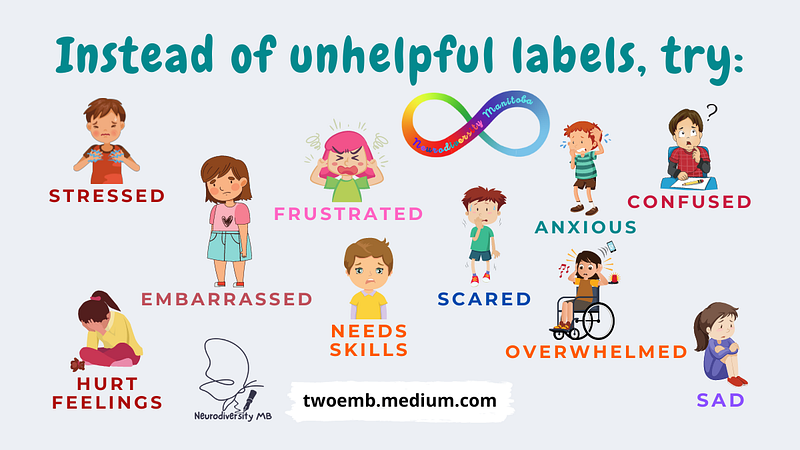
Created by author

Pathological or rational?

Other Autistic experts, such as Damian Milton and Richard Woods, have redefined PDA as Rational Demand Avoidance (RDA).

RDA is described as an understandable and rational response to demands which cause distress, anxiety, discomfort, or are overwhelming to the individual.

In their recent paper, Autistic researcher Allison Moore explains that when Autistic people do exercise agency and engage in self-advocacy, we are at risk of being labelled demand avoidant.

Autistics are less likely to concern ourselves with social norms, and when we engage in independent decision making that resists or challenges these neuronormative expectations, we are more likely to attract the PDA label.

In their own paper, the person who coined the term PDA describes PDAers as Autistics who have an atypical and surface-level “degree of sociability that allowed social manipulation as a major skill”.

One definition of manipulation is to control or play upon by artful, unfair, or insidious means especially to one’s own advantage.

Insidious is something which is subtle yet harmful — so labelling someone with PDA is to assume their social skills are only developed such that the person uses them to get their way at the expense of others.

Take what you need from it

Some Autistics have found the PDA profile tremendously helpful. Some parents of Autistic children have also expressed relief at finding an autism subtype (although it is not a formal diagnosis) that accurately describes their child.

I fully respect people’s right to identify how they choose, to use terms and concepts which make sense for them, that may help them find supports or accommodations they need. I have no interest in gate-keeping which identities people choose to use for themselves.

The tragedy is when people, especially children, are labelled inaccurately and that inaccurate diagnosis or label causes them harm. Perhaps just as harmful would be missing out on a more appropriate diagnosis that may have opened the door to helpful information and supports.

If you’re an allistic (non-Autistic) parent of an Autistic child, I urge you to proceed with caution and critical thinking, please. While it can be incredibly validating to find something that fits your experience, take care not to pathologize reasonable avoidance of demands which cause distress.

As Moore explains, many Autistics experience incredible sensory sensitivities. If a child is resisting attending school, or avoiding an activity or environment that is loud, crowded, or one which has bright lights or strong smells, this sensory input may genuinely cause the child physical or psychological distress.

Trying to avoid demands which cause anxiety, confusion, or are overwhelming is a perfectly reasonable response.
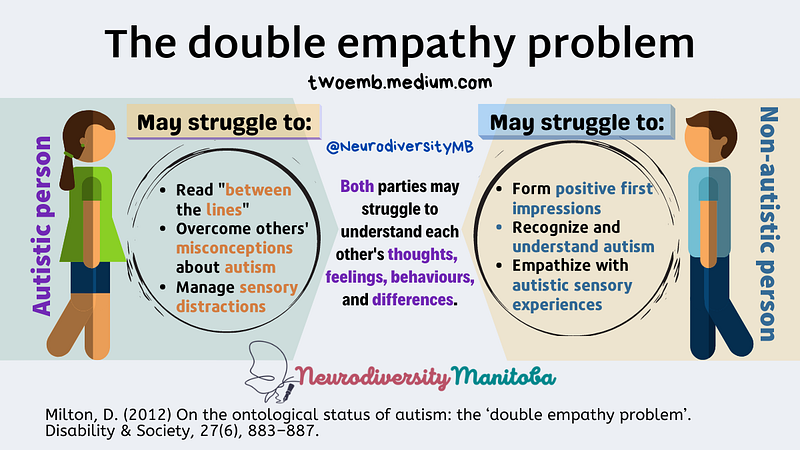
Image created by author — based on work by Milton (2012)

Assumptions vs understanding

If you’re a neurotypical person reading this, try to think of something that causes you to feel similarly.

If you were lactose intolerant, for example, and consuming dairy products caused you extreme physical discomfort, wouldn’t it be reasonable to avoid doing so?

I have Celiac disease (CD) and eating anything which contains gluten causes me serious health issues. If someone were demanding I eat a sandwich made with wholewheat bread, it would be entirely understandable for me to “refuse” — to be uncooperative, noncompliant, or defiant.

Yet knowing that I have CD, it would seem unfair for someone to call me difficult or manipulative, or to pathologize my avoidance of gluten. Yet this is exactly what happens to Autistics on a regular basis, whether under the umbrella or PDA, or one of many other unhelpful and unfair labels.

Behaviourally-based diagnoses such as ADHD, autism, PDA, O.D.D., and others are based on neurotypical assumptions about how one should behave.
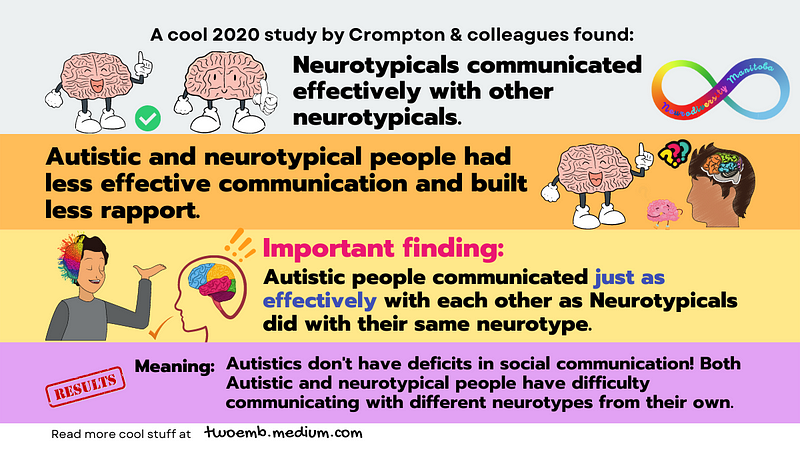
Image created by author — study by Crompton et al. (2020)

Assessments include questionnaires which, for children, are usually filled out by parents or guardians (who are often themselves neurotypical). The answers to the questions are given based on the neurotypical adult’s interpretations of the child’s behaviour.

A neurotypical person may have difficulty understanding the reasons for an Autistic person’s behaviour they perceive as unusual, just as an Autistic would have difficulty understanding a neurotypical’s behaviour they perceive as unusual.
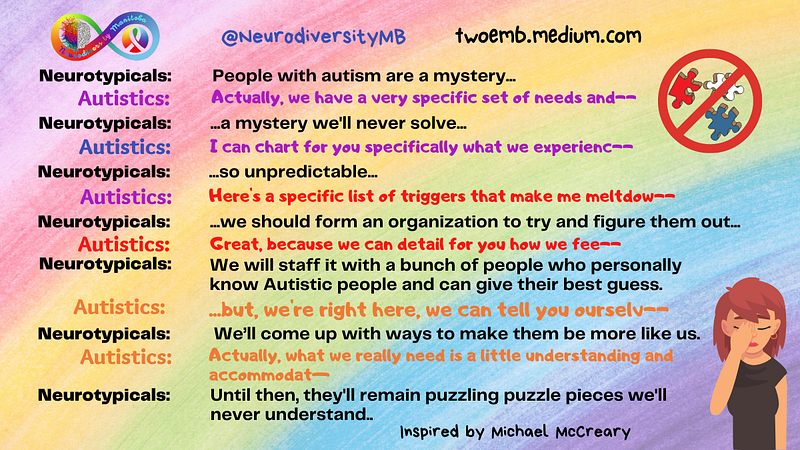
Dialogue written by Michael McCreary — (image created by author)

Because allistic people struggle to understand Autistics (mostly because they won’t listen to us, but I digress) does not automatically mean Autistic “behaviours” are pathological.

Different does not equal deficient.

© Jillian Enright, Neurodiversity MB
When you join medium, as a member you’ll have access to unlimited reads for only $5 per month. If you use my referral link, I’ll earn a small commission, and you’ll earn my undying gratitude.

If you’d prefer give a one-time tip, you can support my writing on Ko-Fi — also, it’s free to follow me on Facebook!

Related Articles

References

Milton, D. (2013). ‘Natures answer to over-conformity’: deconstructing Pathological Demand Avoidance. Autism Experts. [Online]. https://kar.kent.ac.uk/62694

Damian E.M. (2012). On the ontological status of autism: the ‘double empathy problem’. Disability & Society, 27(6), 883–887. https://doi.org/10.1080/09687599.2012.710008

Moore, A. (2020). Pathological demand avoidance: What and who are being pathologised and in whose interests? Global Studies of Childhood, 10(1), 39–52. https://doi.org/10.1177/2043610619890070

Newson, E., Le Maréchal, K., & David, C. (2003). Pathological demand avoidance syndrome: a necessary distinction within the pervasive developmental disorders. Archives of disease in childhood, 88(7), 595–600. https://doi.org/10.1136/adc.88.7.595

Wilding, Tomlin. (2020, February 23). Pathological avoidance is distinct from autistic avoidance. Wilding Blog. tomlinwilding.com/pathological-avoidance-is-distinct-from-autistic-avoidance

Wilding, Tomlin. (2019, July 31). What is demand avoidance, and when is it pathological? Wilding Blog. https://tomlinwilding.com/what-is-demand-avoidance-and-when-is-it-pathological

Williams, R. (2018). Autonomously Autistic: exposing the locus of autistic pathology. Canadian Journal of Disability Studies 7(2), 60–82. https://doi.org/10.15353/cjds.v7i2.423

Woods, R. (2018). Rational (Pathological) Demand Avoidance: what it is not, what it could be & what it does. Critical Perspectives on Pathological Demand Avoidance (PDA). [Keynote Speech]. Participatory Autism Research Collective. https://openresearch.lsbu.ac.uk/item/8v10w

Autism
Pda
Psychology
Parenting
Education
Recommended from ReadMedium