
Optimise Your Workouts to Build More Muscle
Science-based fitness content to help you get great results in the gym.
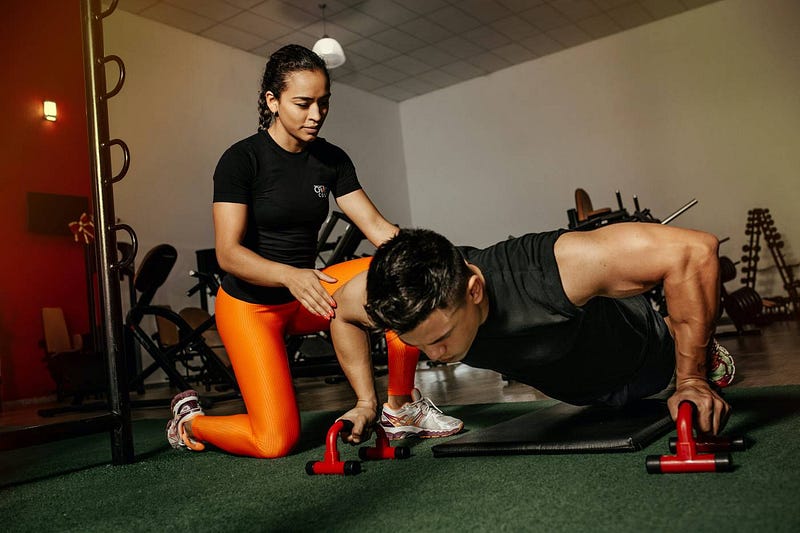
Q: How do we maximise our chances of building muscle with each of our workouts?
A: Through effective programming and maximal performance in the gym.
Simple, right?
But how do we know all this stuff?
Luckily these days, there is a bunch of science available on the fundamentals of exercise science and training methodology. There are also a bunch of people who synthesize and summarise the research online.
Like me!
If you follow my content, you probably know I’m passionate about fitness. I’m passionate about providing people with the very best information available to empower them to reach their fitness goals.
I’m not going to try and sell you some gimmick.
Backed by what the current scientific literature suggests is best practice, this article summarises the training fundamentals such as how to structure an individual workout and exercise choice.
You’ll learn what you need to understand and incorporate into your workouts to maximise your muscle-building gains.
Just quickly — how do we build muscle?
Just quickly, how is muscle “built”?
In short, we have to force our muscles to adapt to a new stimulus. Therefore, muscle cells grow bigger.
Hypertrophy is an increase and growth of muscle fibres/cells, stimulated through resistance exercise, such as weight training.
“It is well known that resistance training induces muscular hypertrophy” — Kraemer, Ratamess, & French, 2002
Structural damage to the muscle stimulates the body’s repair response to the damaged muscle fibres, fibres growing back stronger and larger over time.
I won’t cover diet in this article, I talk about that in depth in this article.
Quickly, eat around .8–1 gram of protein per 1 pound of bodyweight (1.6-2g per kg) and fuel your workout an hour or two before with an energy-dense meal including carbs, fats and protein.
To force adaption and improvement in the gym, we progressively overload.
Progressive Overload
To improve our performance in the gym and therefore make visible changes in body composition/physique aesthetics, we have to force our bodies to adapt to the stimulus of resistance training.
“Resistance training is effective if the human body is continually required to exert a greater magnitude of force to meet higher physiologic demands.” — Kraemer, Ratamess, & French, 2002)
Progressive overload is gradually getting stronger over time by lifting more weight or doing more reps and thus, damaging our muscle fibres. Our body repairs these damaged muscle cells/fibres and they grow back bigger and stronger.
How to create an exercise programme
Making progress in the gym is more than just turning up.
We design and structure a workout to optimise it for building muscle (or another specific fitness goal).
If you want to reach the next level with your training and body composition, you need to educate yourself on the variables that influence a workout.
Moreover, your exercise routine needs to be enjoyable, so you stick to it long-term. But firstly, it should empower you to reach your fitness goals!
Several variables dictate our workout structure, such as the exercise routine/training split, exercise choice, workout length, number of repetitions, weight, and rest periods.
For more depth, I touch on many of these workout variables in the individual articles below.
Exercise split
What’s the best exercise routine or split to maximise muscle-building?
There probably isn’t a decisive answer.
In the below article, I explore the strengths and weaknesses of four common workout splits.
If your goal is to build muscle, you should give all four of these routines a try. You can then see what works best for you.

Workout length
How long should a workout last? For some people, time is a limiting factor in how long they can work out.
So, how little can you get away with?
It all depends on what your goals are and the amount of volume required (total sets) to maximise your chances of reaching these goals.
A key variable dictating workout length is your rest periods between sets.
To attain the ideal amount of weekly volume, another variable that impacts workout length is the frequency of our workouts. How many times a week do we target a particular muscle group? It could range from one to four or even five times a week!
The more experienced a person is in the gym, the more volume they can sufficiently recover from. And finally, genetics and age — an athlete in their 20s can recover from more volume than somebody later in life with more average genetics.
So, the ideal workout length will vary from person to person!
In the article below, I explore the minimum amount of time that the average person can spend in the gym and still get fantastic results.
Number of sets
How many sets should we do in the gym to maximise our ability to build muscle? More is better, right? Well, no…There becomes a point where our body can’t recover effectively from the volume of exercise — maximal recoverable volume.
Anything above this number of sets we experience diminishing returns. This is increasingly being referred to in fitness circles as “Junk Volume”.
There’s also a minimum dose required (minimum effective volume) to simulate our maximal muscle-building potential.
A 2017 meta-analysis found that roughly 10–20 sets per muscle per week are optimal to maximise muscle building.
But, what’s the optimal number of sets per workout? There are many variables such as exercise split and frequency. For an in-depth rundown, check out the below article.
Number of reps
How many reps per set is optimal to maximise our ability to build muscle?
Recent research (check out this article and this article) suggests that there is little difference in our ability to build muscle between high and low reps (light or heavy loads), as long as we’re in the 6–25 rep range.
“Muscle hypertrophy can be equally achieved across a spectrum of loading ranges.” — Schoenfeld et al., 2015
What’s more important than the number of reps is the proximity to failure when we stop our sets. We will achieve similar muscle growth as long as we stop one or two reps shy of failure, regardless of the total reps.
Failure means we cannot physically do one more rep.
If our focus is strength, we should lift heavier loads (60–90% of your one-rep max) in the lower rep ranges (1 to 6 reps).
Length of rest periods
How long should we rest between each exercise set?
If our main goal is to build muscle, as a general rule of thumb, rest periods should be longer than a minute (60 seconds).
Isolation exercises won’t require as much rest between sets as compound exercises. Compound lifts such as squat are usually done in a lower rep range with heavy weights and therefore, are highly fatiguing.
We should increase our rest periods for heavy compound exercises to 3–5 minutes.
For a more in-depth discussion about rest periods, check out the below article.
Weight on the bar
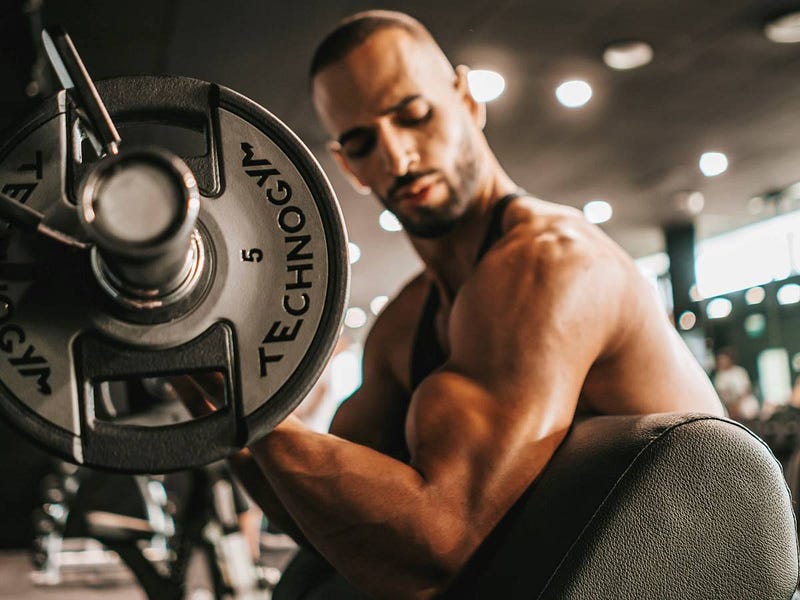
How much weight should we lift to optimise our ability to build muscle? As much as possible? Well, not quite.
We need to choose a weight/load that we can “just” lift for a set number of reps, within the optimal rep range to build muscle.
For example, we might do 12 reps of weight around 70% of our one-rep maximum.
As discussed with reps, what’s most important is the proximity to failure when we stop a set. If we’re stopping several reps short of failure, we won’t get optimal results. The intensity of sets is the key.
“Both HL and LL training to failure can elicit significant increases in muscle hypertrophy among well-trained young men.” — Schoenfeld et al., 2015
For more about calculating the weight to lift for a given number of reps, check out the article below.
The intensity/effort of our sets is commonly measured by RPE, or ‘rating of perceived exertion’.
Prescribed on a scale of 1 to 10 for intensity level, 1 represents a lift that requires little to no effort and 10 is the absolute maximum a person can lift before failing a rep. An RPE of 8 would mean stopping two reps short of failure.
For more information about calculating optimal load weight based on our 1RM and RPE, check out the below article.
The best time to train
To maximise our muscle-building potential, what’s the best time of the day to train?
Recent research (here and here) suggests that training in the late afternoon or evening is best for building muscle.
“In the evening, improvements in maximal strength performance seemed to be accompanied by increased neuromuscular activity in the group that performed strength training constantly before endurance training.” — Küüsmaa-Schildt et al., 2017
Perhaps, this is because of the performance improvements from having improved glycogen stores and hydration later in the day.
However, the difference isn’t significant. So, if mornings allow you to more consistently, choose a time that suits your lifestyle best,
The training session
To make the best possible muscle-building and strength gains, we must make the most of our time in the gym.
Obviously!
Before we get into the specific components of a workout, here are eleven rules to follow to make sure you have a great workout and maximise your results.
Technique
A key component of both progressive overload and injury prevention is our exercise technique.
If our form is always changing, it’s hard to monitor and track progress. For example, 6 sets of 100 kg on the bench press of half reps aren’t the same as a full paused rep.
Injury prevention should go without saying — bad technique increases your chances of getting all f**ked up.
Furthermore, using textbook technique means it’s easier to develop a “mind-muscle connection”, referred to in the literature as an internal focus of attention.
We create a conscious and deliberate muscle contraction by concentrating on the muscle group we’re targeting and keeping it under tension. For more, check out the below article.
Time under tension
Keeping a muscle under tension for an extended period means we’re more likely to damage it and force an adaption, growing bigger muscles.
Through the mind-muscle connection, we should focus on keeping the targeted muscle under load. We can do this by counting to three on the eccentric (negative) portion of an exercise.
But what about 1 second for the eccentric portion, or 5 seconds?
Well, there isn’t a definitive answer for the optimum time under tension to build muscle — all we know is that a super-slow tempo lasting longer than 10 seconds per rep is worse than reps lasting between 1–8 seconds.
For more discussion about time under tension, read the below article.
Intensity
What’s just as important to our results in the gym as turning up? Training intensity.
You see so many people regularly turn up to the gym, barely dripping sweat and not making any progress?
Why? Because they don’t train hard enough to create an adaption.
Research (this study and this study) indicates that many of us underestimate where our limits are in the gym. People are bad at guessing their maximum effort and many don’t seem willing to push themselves past discomfort in the gym.
This is a problem because there is an intensity threshold that we have to pass to stimulate muscle hypertrophy (growth) effectively. This intensity threshold seems to be around 1–2 reps short of failure.
To read more about these studies and training intensity, check out the below article.

Attitude
When it comes to exercise and elite performance, the difference-maker is often the soft skills — hard work, commitment, consistency… All that good stuff.
When it comes to bodybuilding or shaping a physique, the same dedication applies.
You have to set goals in the gym and then reach them. Or, your physique won’t ever visibly change.
You could have all the knowledge in the world and the perfect exercise plan and diet. But, if you don’t consistently train, you won’t reach your goals. It takes commitment to regularly smash your body in the gym and eat the right foods. It takes the right attitude.
Pursuing a passion for fitness requires long-term sacrifice and a lot of patience. Injuries will happen and other things will get in the way of training. So, how you deal with the ups and downs of life and training is a difference-maker.
For more about the mental side behind training, check out the below article.
Exercise choice
A key component of reaching your fitness goals is choosing the most appropriate exercises.
It becomes a problem when social media feeds are full of fitness influencers doing showy and useless exercises, portraying the wrong message about exercise selection to their followers.
Don’t waste time and energy doing ineffective exercises (we’ll get to that soon).
The best possible advice for exercise choice is to keep it simple and choose the fundamental movements.
Five foundational exercises for building muscle
If you could only do five exercises for the rest of your life to build a great overall physique, what should they be?
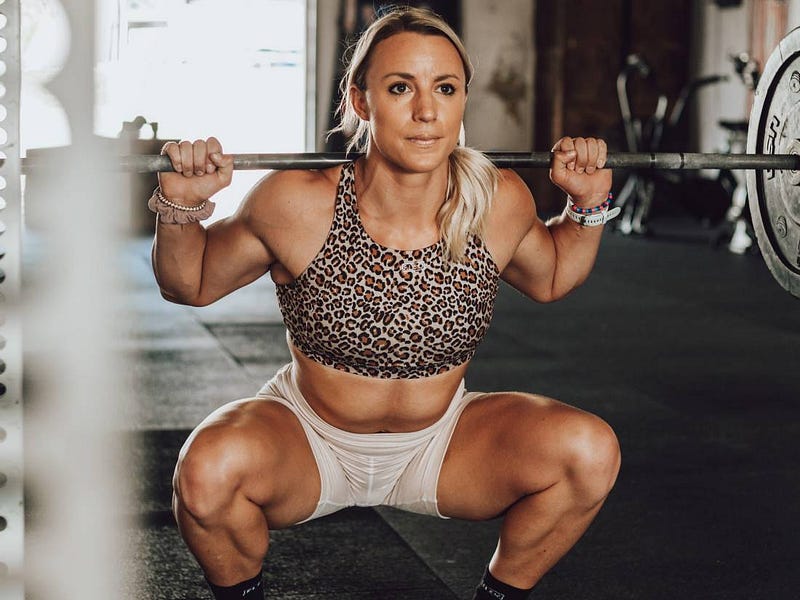
To give ourselves the best chances of building muscle, we have to get strong at the big three compound exercises — the squat, bench press and deadlift.
Getting stronger doesn't necessarily mean muscle-building is optimal. But, we will build some muscle, and we’ll be able to lift more weight on our exercise designed to build muscle, such as a curl. Therefore, we’ll stimulate more hypertrophy.
I just mentioned three of them— in the article below, I discuss the five exercises that should be the basis of your muscle-building gym routine.
The best isolation exercises
Compound lifts should be the foundation of any resistance training routine. However, isolation training will be necessary to optimise muscular development.
Why? Because there are dozens of muscles in the body, key to physique development.
Some of our smaller muscles won’t be maximally activated through one of the compound lifts. Moreover, if we spend our whole workout doing compound exercise, we’re going to fatigue quickly and increase our injury risk as well as decrease our intensity.
Here are the best isolation exercises to target thirteen key muscles, to help us build a symmetrically muscular or ‘toned’ physique.
Build bigger arms
Men tend to want bigger arms, while women want ‘toned’ arms.
Either way, we need to do exercises to target our arms.
The five exercises should be part of the foundation for any gym routine and regularly doing these means that you’ll build impressive arm muscles that people can’t help but notice.
If you want to increase arm size, include these exercises
Build a v-tapered upper torso
Many men (and some females), want to have a v-tapered upper body. Many females (and some men) find this physique masculine.
The two key muscle groups we need to build to achieve the V-shaped physique are the deltoids (shoulders), and the lats in our upper backs (Latissimus Dorsi).
I identify five key exercises to grow these muscles in the article below.
Mistakes to avoid in the gym
When most of us first start going to the gym, we have no idea what we’re doing. We just kind of copy somebody else or learn some basics from the internet.
The availability of quality exercise science information has come a long way in the last decade, so it has become easier — but, it’s still easy to pick up bad advice.
In the below article, I identify seven common exercise mistakes that both newbies and experienced gym-goers make. Avoid these!
Exercises to avoid
Above, I provided content about what exercises you should choose to empower you to reach your goals.
Exercise choice is key when it comes to maximising our performance and making the biggest changes in our physique.
Now, what exercises suck? What exercises should we avoid?
If you’re making enough effort to regularly get to the gym, you don’t want to waste your time doing the wrong exercises!
These exercises might provide an injury risk, or just activate the targeted muscle group poorly.
Here are ten exercises that you shouldn’t bother doing in the gym and an alternative for each that’s a better use of your time.
Summary
This article has explored everything you need to know about the training fundamentals for building muscle.
We have explored what you need to know about creating an exercise programme, including variables like the exercise split, number of sets, reps, rest period length, load (weight) and workout time.
I also discussed the training session itself, and variables like technique, time under tension, intensity, attitude, exercise choice and mistakes to avoid.
If you are interested in fitness and want to build more noticeable muscle or “tone up”, I hope you found the content valuable.
Thank you for reading.
I hope you found the content useful!
If you enjoyed the read, you might be interested in this article on how I have built over 40 pounds of muscle.
How I’ve Gained Over 40 Pounds of Muscle
My training and diet, and the science behind it.
medium.com
If you want to read more articles like this one, subscribe to be notified when I publish new content.


