
Sculpt Muscular Arms With These 5 Exercises
Sun’s out, guns out. Do these five exercises to sculpt biceps and triceps that people can’t help but notice.

Defined arms are often the first thing we notice about a “fit” person. Would you like to fill out a t-shirt better or look toned on the beach?
Do you want arms that people can’t help but notice?
The answer is most probably “yes” if you’re reading an article about fitness… (which you obviously are)
Believe it or not, 10 sets of bicep curls every workout isn’t the answer. Stop wasting your time.
But if you carry on reading, you’ll learn five essential exercises you should be doing in the gym for more muscular arms.
Incline dumbbell curl — Biceps Long-Head
The biceps are maybe the most noticeable muscle on somebody with big arms.
So perhaps predictably, the first exercise I recommend is a bicep curl. But it’s not just any bicep curl…
It’s an incline dumbbell curl.
Before we get into it, some quick anatomy 101.
Mechanically, our biceps have three functions — elbow flexion (curling), forearm supination (turning palm up) and shoulder flexion (lifting shoulder). So, to best activate the bicep, we need to incorporate all three of these movements.
The biceps are comprised of two heads, the short head sitting on the inner portion of the upper arm, and the long head sitting on the outer portion of the upper arm.
Research indicates that to best target both bicep heads, we should do curls with the upper arm positioned behind our torso along with curls with our upper arms in front of our torso.
“During performance of exercises where the upper arm is held behind the body, the long head is placed in a greater position of stretch compared to the short head and therefore is able to generate maximal force.” — Schoenfeld, 2010
Curls with the upper arm in front of the torso target the short head, whilst to target the peak of the bicep (the long head), we need to perform a curl with our upper arm behind the body where we place the muscle in a more stretched position.

Exercise tips: do an incline curl towards the end of a workout after your key compound exercises on arms or pull day.
The aim is to do higher reps to fatigue the bicep, so choose a lighter weight so that you can finish 15–20 reps. However, it shouldn’t be too easy! The last few reps should be a push.
Set a bench up on an incline of around 60 degrees.
Sit down with your upper back against the bench and your elbows back and shoulder extended forward. Our arms should be approximately 20–30 degrees behind the body.
Do both arms at once to save time and generate fatigue in a more efficient manner and from a metabolic stress standpoint, you’re allowing tension to completely stop as you switch arms.
Start each rep from a dead hang, squeezing your ring finger and pinky as you curl the weight up. Pause quickly at the top, before slowly releasing the weight down for the eccentric.
Activation of the bicep is highest at the top of the range of motion for an incline curl and lowest at the bottom. Therefore, don’t worry too much about the bottom half of the exercise, but really focus on squeezing the bicep with a quick pause at the top of the concentric phase.
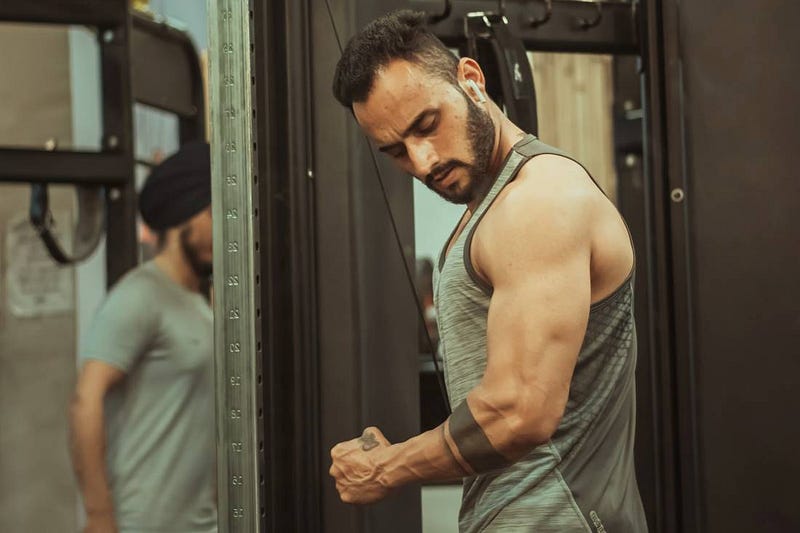
Skull crushers — Triceps Long-head
Although it often doesn’t get as much attention as the bicep, the triceps actually contribute more to overall arm size.
There are three heads to the triceps, a lateral or outer head, a medial head that runs down the middle and a long head that sits on the inside of the arm.
Since all three heads cross the elbow joint, the primary function of all three triceps heads is to straighten the elbow out through extension.
Of all three heads, the long head contributes most to overall triceps size — especially from behind.
The long head of the triceps crosses both the elbow and the shoulder joints, so it becomes stretched and more active with the shoulder in a flexed and extended position. The optimal activity of the long head is at 90 degrees of shoulder flexion.
The skull crusher is therefore perfect to target the triceps long head as it provides around 90 degrees of shoulder flexion. Moreover, exercises with our arms extended overhead to provide a greater position of a stretch than an exercise where we’re standing.

Exercise tips: The skull crusher should come after your main compound exercises on a push or arms day.
Use a light to moderate weight, between 8 to 20 reps. An EZ bar with a semi-pronated grip should put less strain on your wrists than a straight bar.
Lay down with your head slightly off the end of the bench. Using a shoulder-width grip, use your lats to pull the bar up overhead.
Your shoulder blades should be retracted and depressed before each rep, to create upper-body tightness and shoulder stability.
Move the bar back over your face to initiate the first rep and help pull tension onto the long head of your triceps. Maintain a slight bend in the elbows which should be comfortably tucked into your sides.
As you lower the weight to begin a rep, try and maintain constant tension on the triceps through the range of motion. Avoid excessively flaring out your elbows as you extend them.
A 2017 study found that triceps extensions with a partial range of motion through the mid-range of reps led to almost twice as much hypertrophy (muscle growth) than a full range with tension. This is because tension is lost at the top of the movement.
The path of the weight should be in an arc rather than straight down to your forehead, allowing you to overload the triceps by increasing torque at the elbow joint. Aim to bring the weight down just above your head.
At the bottom of the eccentric phase (lowering) just above the back of your head, pause and squeeze your triceps to initiate the concentric movement. Bring the weight up and slightly forward.
Keep your shoulder stable during the concentric to keep the tension on the triceps through elbow extension as opposed to shoulder extension.
Barbell overhead press — Shoulders
You may be thinking, hold on — this is an article about bigger arms and your shoulders are a separate muscle group.
Well, you’d be correct. But, if you have big shoulders, your arms will look bigger.
Moreover, you’ll have more capacity to build bigger arms as there are a lot of crossovers in muscle activation between our triceps and shoulders especially.
“The exercise with the greatest stability requirement (standing and dumbbells) demonstrated the highest neuromuscular activity of the deltoid muscles.” — Saeterbakken & Fimland, 2013
The barbell overhead press is by far the best exercise for building our shoulders. Moreover, it activates multiple joints and muscles, such as the upper pectorals (chest) and triceps.

Exercise tips: The overhead press should be your first exercise and key compound lift on shoulders or push day.
Set up the bar in a squat rack at the same height you would use for a squat at around armpit height. Load the bar with a moderate-to-heavy weight, doing sets in the 5–10 rep range.
Unrack the weight with a slightly wider than shoulder-width grip. Get your shoulders under the bar whilst slightly bending your knees and hips. I like to squeeze my lats as tight as possible to help stabilise the bar — this is especially important at heavy loads.
Stand up straight and take a couple of steps back from the rack. Firmly plant your feet about shoulder-width apart, toes slightly out.
The standing overhead press requires a solid foundation to lift the weight above our head, therefore our core muscles need to be engaged to generate a stabilising force in the movement.
Externally rotate the shoulders, with the elbows pointing slightly outwards.
A 2010 study suggests that a full range of motion is most effective for the barbell overhead press. Therefore, the movement begins with the barbell resting on the top of our chest, directly over our wrist joint.
Flex your glutes to keep the spine neutral, take a deep breath, and then press the bar straight up and then back to lock out your elbows at the top. When the movement is initiated, tilt the head back to allow the bar to move past your chin. Once the bar moves past your chin, push your head forward back to the neutral position.
Your knees, hips and shoulders should be kept motionless, to reduce momentum taking over the movement.
To bring the weight back down, drop your elbows down to your sides at a 45-degree angle to come to a complete stop at the top of your chest. Take a full breath before the next rep.
Barbell Bench Press — Triceps
Although primarily targeting our chest, the bench press is a great exercise to build our arms. Being a compound movement, it also activates the front deltoids (shoulders) and the triceps as secondary muscles to build a solid foundation of muscle and strength to build bigger arms.
The bench press involves lying on a bench and lowering the weight down to the chest and then extending the arms to push the weight upwards.
A huge benefit of the barbell bench press can be safely loaded with a lot of weight and we can easily progressively overload it.
“The barbell bench press is often performed as a means to assess as well as enhance upper body strength, power, and endurance for athletic, occupational, and functional performance as well as muscle development.” — Ronai, 2018
Variations of the bench press include the dumbbell bench press, incline bench press, decline bench press and close-grip bench press.
Using an incline of 15 to 30 degrees on the bench will activate more of the upper chest and shoulders in the movement. Using a closer grip will target the triceps more. However, don’t bring them too close together as you’ll reduce your ability to load the movement. Your hands should be no narrower than shoulder-width apart.
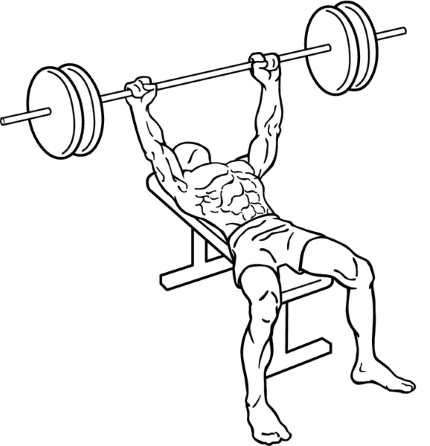
Exercise tips: Use the bench press as the first heavy movement on a push/chest/arms day. Use a low to moderate rep range of 5–10 reps.
Lay down on the bench and grab the bar with a shoulder-width grip. Lift your hips up high and arch your back. Retract your shoulder blades (scapular) back, placing them on the bench.
Drop your hips down, bringing your butt back down to the bench and maintaining the arch in your back. Plant your feet firmly to the ground, your legs squeezing the sides of the bench and feet positioned back as far as you comfortably can. Your toes should be slightly pointed outward. Your eyes should be directly under the barbell.
Adjust your hand position to a width that feels strongest and most comfortable for you.
Avoid hyperextending your wrists — they should be directly below your knuckles.
Before beginning the rep, breathe in and puff your chest out to expand your ribcage as much as possible. Make sure your body feels tight and secure before lifting the bar.
When lowering the bar for the eccentric phase, bend your elbows at a 45-degree angle relative to your torso. Touch the bar just below the nipple line and pause before exploding the bar off your chest powerfully and driving your heels into the floor for the concentric phase. Think about pressing the bar back toward your face. That’s one rep!
Pull-ups — Biceps
Similarly to the bench press, the pull-up primarily targets muscles that aren’t in our arms — instead, it’s our back.
However, the pull-up is an equally important exercise as the bench press to build a solid foundation of overall strength and muscularity to help build our arms. As many as 21 muscles are engaged with pull-ups, recruiting muscles both concentrically (on the way up) and eccentrically (on the way down).
“The pull-up is a closed kinetic chain, multi-joint upper-body exercise that can improve an athlete’s shoulder girdle strength, stability, and ability to produce high forces during pulling activities, such as (but not limited to) rope climbing, rock climbing, gymnastics, rowing, and swimming.” — Ronai & Scibek, 2014
Our biceps and forearms are two of those secondary muscle groups highly activated during a pull-up.
As we’re lifting our whole-body weight during a pull-up, it can be a difficult exercise to perform, requiring an above-average strength-to-bodyweight ratio. If you’re overweight or a female, you’ll likely struggle with an unassisted pull-up. For lean people, it’s much easier.
We can add a resistance band under the foot and bar, to give assistance and make the exercise easier. Your gym may have a pull-up machine with an assist platform.
Once you can lift your own body weight for more than a few reps, you can hang weight to provide extra resistance and provide a powerful overloading stimulus.

Exercise tips: the pull-up should be your focus exercise on a pull, back or arms day.
Aim for around 6–10 reps for each set. Eight good reps are far better than struggling for a couple of bad reps.
With a full range of motion, aim to pull your chin up to the bar from a full hanging position with the arms being fully extended. Our palms face away with a pronated grip.
You should incrementality add more weight to the exercise over time to progressively overload (or do more reps).
From the hanging position, squeeze the bar as hard as possible to secure your grip. To help activate the lats, imagine pulling it outwards on both the eccentric and concentric phases.
Keeping your abs and butt engaged (tight), pull yourself up until your chin is above the bar and your chest almost touching. Then, control the descent to slowly lower yourself back down to the starting position, allowing elbows to move up and out.
A chin-up is a common variation on the pull-up, where our palms instead face towards us. Many people will find a chin-up easier to master than a pull-up and it will also activate the biceps more than a standard pull-up.
Summary
In conclusion, this article has explored five exercises you should be doing to build muscular arms.
Those exercises are:
- Incline dumbbell curl
- Skull crushers
- Barbell overhead press
- Barbell bench press
- Pull-ups
If you’re thinking, “I’m a woman, these exercises are all for men”, you’re wrong
Luckily for you, women and men should both train their arms exactly the same way! Our anatomies work the same, and women aren’t physiologically wired to put on huge amounts of muscle.
So don’t be afraid that suddenly you’ll look all bulky from lifting heavy.
These exercises should be part of the foundation for any gym routine and regularly doing these means that you’ll build impressive arm muscles that people can’t help but notice. But remember, you must progressively overload!
Thank you for reading.
If you enjoyed the content, you might be interested in this article about the best isolation exercises to build each muscle group.
If you would like to read more articles like this one, subscribe to be notified when I publish new content.


