
5 Exercises You Should Be Doing to Maximise Muscle Growth
If you could only do five exercises for the rest of your life, make it these.
Do you want to get stronger and build muscle? If you go to the gym, you have probably pondered the most effective exercises for building your physique.
Maybe you know what these best exercises are?
Maybe you think you know, but still spend half your workout doing bicep curls?
You might have been sucked in by social media videos of fitness influencers doing crazy exercises and you waste precious muscle-building time trying to master those?
If you don’t want to waste your time doing ineffective exercises, you’re reading the right article.
These are the five exercises that should be the basis for your gym workout.
Squat
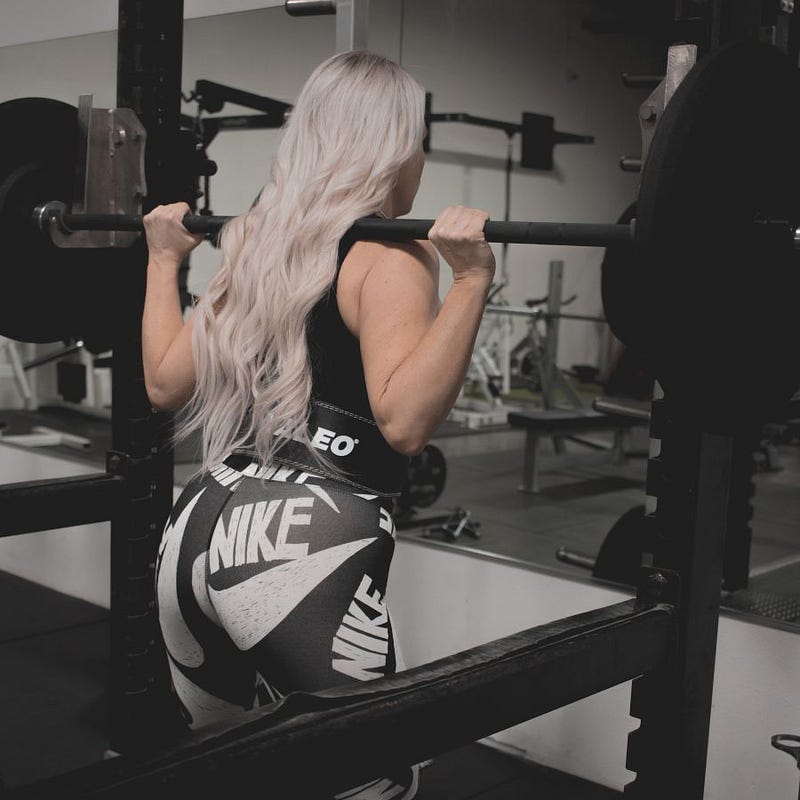
The first exercise we should be doing to build muscle and increase strength is the squat.
The squat is one of the most effective exercises for enhancing athletic performance and should be the foundation of your legs day.
“The back squat is widely regarded as one of the most effective exercises used to enhance athletic performance as it necessitates the coordinated interaction of numerous muscle groups and strengthens the prime movers needed to support explosive athletic movements such as jumping, running, and lifting. “— Myer et al., 2014
Squats recruit a large number of muscles and can lift a heavy load — key for hypertrophy, building strength and increasing power. Squats target our gluteal and quadricep muscles, whilst also activating the calves, hamstrings, adductors, hip flexors, obliques and other core muscles.
Squats will also strengthen the tendons, bones, and ligaments around our leg muscles.
To squat, stand with our feet about shoulder-width apart, toes forward and slightly outward. Driving the hips back, we lower down into the squat position, knees outward and at an approximate 90-degree angle. Pressing our heels down and driving our hips forward, we return to a standing position.
Variations of the squat include:
- Goblet squat
- Front squat
- High-bar
- Low-bar
- Hack squat (machine)
- Jump squats
Barbell Bench Press
“How much can you bench?”
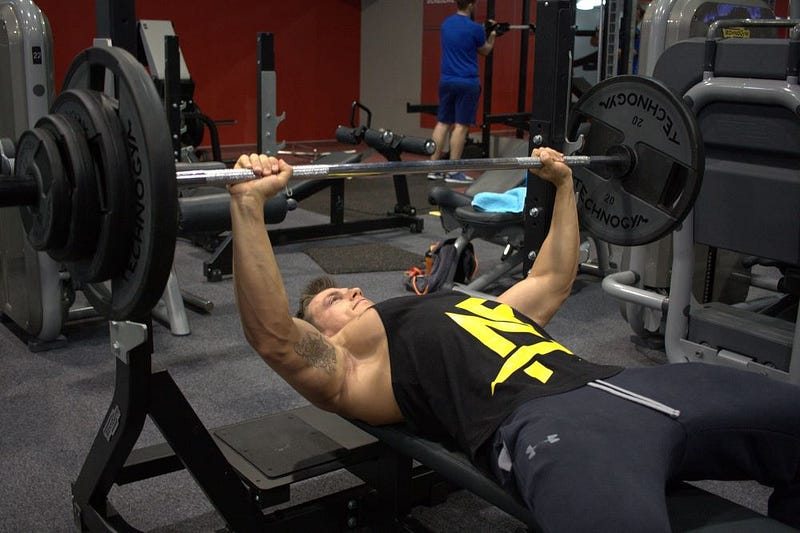
The second key exercise to maximise muscle growth and increase our strength is the bench press.
The foundation of a push or chest day, the bench press develops the anterior (front) of our upper bodies.
“The barbell bench press is often performed as a means to assess as well as enhance upper body strength, power, and endurance for athletic, occupational, and functional performance as well as muscle development.” — Ronai, 2018
A huge benefit of the barbell bench press can be safely loaded with a lot of weight and we can easily progressively overload it.
The chest press is a compound movement, meaning it works out more than one muscle group at once. As well as targeting the pectoral major and minor muscles of the chest, the bench press activates many other muscles in the upper body, including the triceps (arms), and front deltoids (shoulders).
The bench press involves lying on a bench and lowering the weight down to the chest and then extending the arms to push the weight upwards.
Using an incline of 15 to 30 degrees on the bench will activate more of the upper chest and shoulders in the movement.
Popular variations of the bench press include:
- Dumbbell bench press
- Incline bench press
- Decline bench press
- Close-grip bench press
Deadlift
The third of the “big three” powerlifting exercises is the deadlift. The squat and bench press are the first two.
“The deadlift recruits many large muscle groups in the lower body and trunk, making it an ideal exercise selection when targeting whole-body strength.” — Vecchio, Daewoud & Green, 2018
Deadlifts can be loaded with a lot of weight, so alongside the squat, the deadlift is a key exercise for increasing leg strength and muscle size.
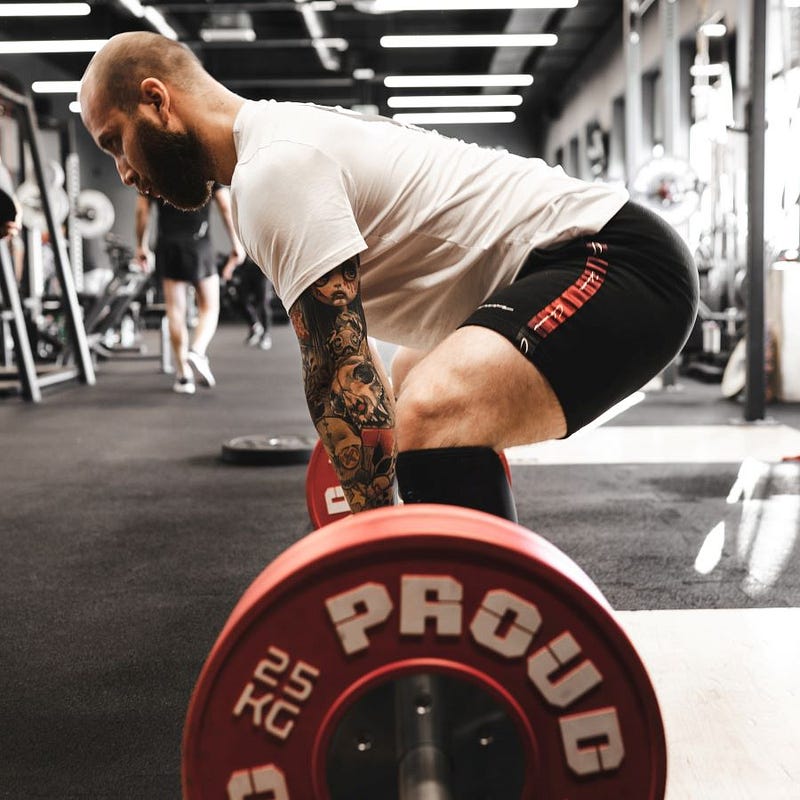
The deadlift involves picking up a barbell off the floor and putting it back down. Activating many of our largest lower body muscles, key muscles activated by a deadlift are the glutes, hamstrings, and quadriceps.
The movement involves hinging at the hips and bending over with a braced and neutral spine, whilst lifting the weight we drive our feet through the floor.
The deadlift could be considered a full-body exercise, as by gripping the bar to lift the weight, our back and arm muscles are also recruited.
The functional strength gained by deadlifting also transfers over to athletic activities requiring power such as sprinting and research suggests that deadlifts are very effective for improving maximal jump performance.
Common variations of the deadlift include:
- Deficit deadlift
- Stiff-legged deadlift
- Romanian deadlift
- Sumo deadlift
- Single-leg deadlift
Barbell Overhead Press
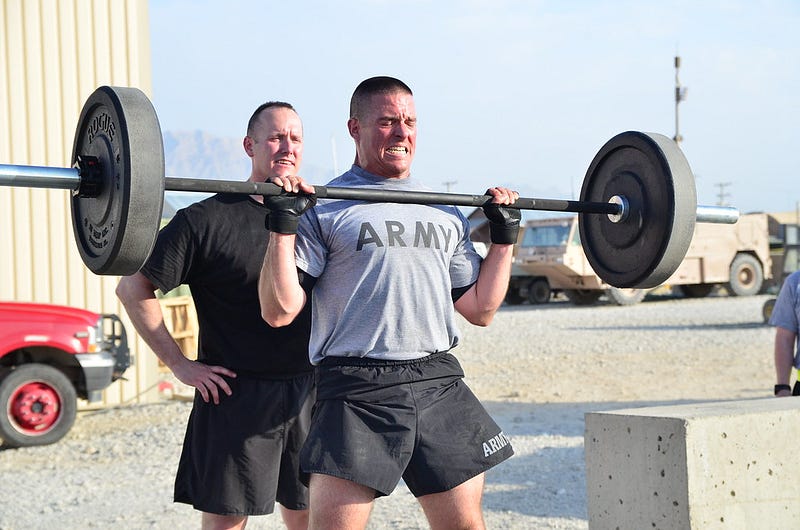
The fourth exercise you should be doing to maximise strength gains and muscle growth is the overhead press.
A key movement for a shoulder or push workout, the barbell overhead press can be completed from a seated or standing position.
“Overhead pressing motions are a vital component to a strength program for developing upper extremity strength and explosive pushing ability.” — Waller, Piper & Miller, 2009
To recruit the most muscle groups, the movement is more effective from the standing position. Standing overhead presses activate many of our large muscles in the upper body.
Muscles activated in the overhead press include the pectorals (chest), deltoids (shoulders), triceps and trapezius (upper back)
Moreover, standing upright with a proper foundation to lift the weight above our head requires balance and stability through the spine. Thus, to generate a stabilising force in the movement, we recruit all of our core muscles, including the abdominals and lower back.
Pull-ups
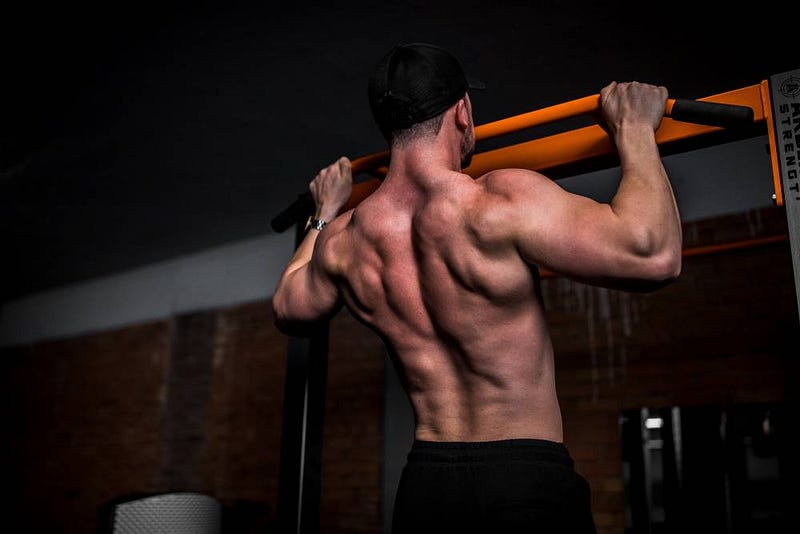
The pull-up is one of the most effective exercises for strengthening and developing the back of our upper bodies, providing a great muscular base for back and bicep exercises.
“The pull-up is a closed kinetic chain, multi-joint upper-body exercise that can improve an athlete’s shoulder girdle strength, stability, and ability to produce high forces during pulling activities, such as (but not limited to) rope climbing, rock climbing, gymnastics, rowing, and swimming.” — Ronai & Scibek, 2014
As it is a compound movement, the pull-up recruits muscles both concentrically (on the way up) and eccentrically (on the way down). As many as 21 muscles in your back arms, shoulders, chest and core are engaged with pull-ups, including the infraspinatus (rotator cuff), latissimus dorsi, trapezius, thoracic erector spinae, and forearms.
We can progressively overload on the pull-up by adding weight (hanging from our body through a belt and chain) or doing more reps.
As we are required to lift our body weight, pull-ups require a good upper-body strength-to-body mass ratio. If a person cannot complete a full rep (common for females), the movement can be assisted by a machine, bands or a spotter.
To do a pull-up, hang from a pullup bar with your palms facing away from your body (pronated grip). The movement starts from the arms being fully extended. Pull yourself up until your chin is above the bar and then slowly lower yourself back down to the starting position.
A chin-up is a variation on the pull-up with the difference being that our palms face towards us in a chin-up. Many people will find a chin-up easier to master than a pull-up.
Before we end, here are 10 exercises that you should avoid.
Final Thoughts
In this article, we’ve discussed the five best exercises you should be doing to increase your strength and build muscle.
Those exercises are:
- Squat
- Barbell Bench Press
- Deadlift
- Barbell Overhead Press
- Pull-ups
If you want to build your physique, these exercises should be the basis of your gym routine. Don’t get caught up exerting time and effort into crazy exercises you see influencers using on social media. Chances are, the foundation of their training is the above five exercises, and their social media content is just for show.
We should focus our energy on compound exercises that activate multiple muscle groups.
If you do nothing but these five exercises, you can still build a lot of muscle and achieve a great figure.
Thank you for reading.
If you enjoyed the content, you might be interested in this article about the best isolation exercises to build muscle.
Read More Medium Articles
Non-Medium members can only read 3 articles a month — become a Medium Member for unlimited access.
If you would like to read more articles like this one, sign up to become a Medium member for only $5 a month.
Subscribe to be notified when I publish new content.


