
How Many Repetitions Is Optimal in the Gym?
Optimise your exercise to maximise your results!

Do you go to the gym? If the answer is yes, do you have a structured workout programme?
If you do have a workout programme, have you ever wondered why you’re doing a specific number of reps?
If you don’t have a workout programme, are you just doing a random number of reps each set?
How many reps you do of a given exercise during your workout is influential in whether you will achieve your fitness goals.
Here’s all you need to know about the reps of an exercise in the gym.
What is a rep?
In the context of exercise, a rep is short for repetition. Repetitions are the number of times you repeat an exercise movement.
For example, a squat would be from the standing position, down into the squat and back to the standing position. Or on a bench press, bring the bar down to the chest and then back up to the starting position.
A rep has two portions — the negative or eccentric; and the positive or concentric portion of the exercise.
A general rep range
In simple terms, a general rep range is around 3–20 reps. If you stay in this zone, you can’t go wrong.
There are two key factors here when it comes to rep ranges.
First, we want to do enough reps to maximise muscle growth. Secondly, we want to reduce our injury risk and fatigue.
Accumulating volume in heavy low ranges is difficult because far more sets are required for the same muscle-building potential. For example, a 2014 study from Schoenfeld and colleagues found that 3 sets of 10 reps build a similar amount of muscle to 7 sets of 3 reps.
As we’re going to reduce our injury risk, but build the same amount of muscle, it makes sense to have most of our exercises in higher rep ranges as it requires fewer sets and the accumulation of fatigue is reduced.
The heavier loads become taxing on our joints. Therefore, to minimise fatigue and injury risk, most of our sets should be in the higher rep ranges. We’ll talk more about fatigue shortly.
Moreover, because low-rep workouts require more total sets and rest periods, they end up taking far longer. Fewer than a quarter of our total workout sets should be in the 1–6 rep range.
The precise number of reps we do for each exercise depends on the exercise itself, how we structure our workout, and what our goals are.

Varying your rep ranges
To get the best possible results in the gym in terms of increasing strength and building muscle (or, “toning up”), we should vary our rep range between our exercises.
Some exercises are more effective in the low rep range (1–6) and for other exercises, we’ll see better results in the higher rep ranges (10–20 reps).
Strength vs hypertrophy training
If strength is a key goal, you will do a fair amount of volume in the low rep ranges (1–6). Use compound exercises at a high percentage of your one rep max weight (60–90%) to “shock” your central nervous system by exposing it to weight you’re not typically used to.
Two popular strength training methodologies are three sets of three reps (3x3) and five sets of five reps (5x5).
Strength exercises should be at the start of our workout, when your energy and strength are at their highest.
“Both bodybuilding- and powerlifting-type training promote similar increases in muscular size, but powerlifting-type training is superior for enhancing maximal strength.” — Schoenfeld et al., 2014
Hypertrophy training, or “the enlargement of an organ or tissue from the increase in the size of its cells” as defined by Oxford, is slightly different to training for maximal strength.
Although recent research (check out this article and this article) suggests that we can build muscle about equally with low or high reps, it's far more fatiguing and time-consuming to take the low-rep approach. So, most of these sets should be in the 6–25 rep range.
“Muscle hypertrophy can be equally achieved across a spectrum of loading ranges.” — Schoenfeld et al., 2015
Compound exercises
Compound lifts are highly fatiguing, especially with heavy loads in the lower rep ranges. Therefore, we should stop 2–4 reps short of failure — we’ll get to training to failure shortly.
Start your workout with compound exercises in the low to moderate rep ranges as recommended below.
Reps are generally fast and explosive on the concentric portion, focusing on efficiency and optimal form.
- Deadlifts — 3 to 8 reps
- Squat — 3 to 10 reps
- Leg Press — 6 to 12 reps
- Lunge — 10 to 15 reps
- Bench Press — 3 to 8 reps
- Overhead Press — 3 to 10 reps
- Dip — 6 to 15 reps
- Pull-Up — 6 to 12 reps
- Barbell Row — 6 to 10 reps

Isolation exercises
As a general rule of thumb, we should use a rep range of around 8 to 25 reps on isolation exercises.
Less fatiguing, we can take isolation exercises closer to failure and even past failure. Repetitions are slower and more controlled, focusing on time under tension and the mind-muscle connection.
Be wary of doing too many reps, which is probably anything over 30, which goes below 50% of our 1RM.
Muscle growth is impaired at around 20% or less of our 1 rep max, so it’s dangerous territory going above 30–40 reps per set. Moreover, we’re limited by our cardiovascular ability in these ultra-high reps, not the muscle group we’re trying to take close to failure.
Some general rep ranges for isolation exercises are:
- Bicep Curl — 8 to 20 reps
- Lateral Raise — 10 to 20 reps
- Face Pull — 12 to 20 reps
- Hanging Leg Raise — 8 to 15 reps
- Calf Raise — 12 to 25 reps
- Hamstring Curl — 12 to 20 reps
- Leg Extensions — 12 to 20 reps
- Lat Pulldown — 8 to 15 reps
- Barbell Shrug — 6 to 12 reps
- Rear delt fly — 15 to 25 reps
Fatigue and training to failure
Fatigue is the enemy when it comes to getting results in the gym. Fatigue means we can’t train at the optimum intensity required to achieve results…
If we can’t recover from the intensity of a previous workout, our next workout will suffer.
The heavier we lift, the higher the recovery demand.
The more muscle groups that have to work hard during a lift, same again — the more fatiguing that exercise is.
For example, a barbell squat for 3 reps at 80–90% of your one rep max (1RM) is far more fatiguing than a set of 15 reps on the leg extension machine at 40–60% of your 1RM.
Finally, training to failure is also highly fatiguing. Failure means we cannot physically do one more rep.
“A single RT session leading to failure produces fatigue that decrease the 1-RM in bench press (7.2%) and half-squat (11.1%) on the following day. However, this parameter did not decrease after an RT session, with an intensity with two repetitions in reserve.” — Ramos-Campo et al., 2020
Research indicates that the last two reps are disproportionately more fatiguing, but don’t seem to create much additional muscle-building benefit.
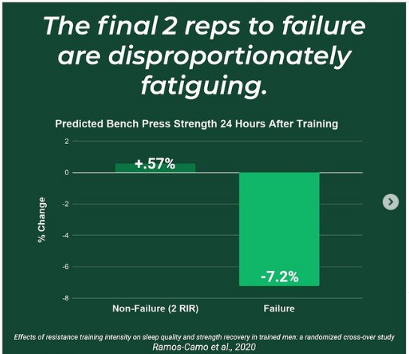
It doesn’t make sense to grind out every set because it is detrimental to our recovery as we accumulate fatigue. Plus, our potential to build muscle is very similar between failure and stopping a couple of sets shy, so there is not a huge additional hypertrophic benefit.
The risk-to-reward ratio of training to failure has too much impact on our ability to train at a high intensity in the following sessions.
How close to failure should we train? RPE and RIR
The Borg rating of perceived exertion (RPE) is commonly used by bodybuilders and strength athletes to measure the intensity level of a set, in terms of how close to failure you train.
We use RPE alongside “reps in reserve”, or RIR, meaning how many more reps could you do before failing. For example, an RPE of 8 would leave you with 2 RIR — both are used on a scale of 10.
An RPE of 0 would be you could do many more reps. At 10, you couldn’t do another repetition, no matter how hard you try. This point is failure.
Seminal fitness researcher Dr Brad Schoenfeld recommends a general rule of thumb of leaving 1–3 reps in the tank for the best stimuli-to-fatigue ratio.
The trick to RPE is learning what a 10 feels like. I’ve discussed in a previous article how people usually underestimate how many reps they can do, leaving several “reps in the tank”. So, many people rarely actually reach a true RPE of 8 or 9, let alone 10.
When reps completely slow down to a grind, you’re probably close enough to failure. If your reps don’t slow down at all, you probably have several reps left in the tank.
Variances in RPE between compound and isolation exercises
Compound exercises in the 1–6 rep range should very rarely be taken to failure because of the high level of fatigue and high recovery demands. For something like a squat or bench press, we should sit at an RPE of around 6–8, meaning leaving 2–4 reps in the tank.
However, isolation exercises can be trained closer to failure and sometimes beyond failure, as long as it’s the last exercise of the workout, using techniques such as forced reps or drop sets.
Single joint movements aren’t as fatiguing, especially if we can rest that muscle group the next day. We should stop 0–2 reps shy of failure on most isolation exercises such as a bicep curl or leg extension.
Conclusion
In summary, this article has explored everything you need to know about how many reps you should do for different exercises during a workout.
Generally, the practical rep range is around 6–20 reps.
However, we should use some compound exercises in the low rep range (1–6) to increase our strength but stopping 2–4 sets should of failure to minimise fatigue and the potential for overtraining.
Higher rep ranges (10–20) accumulate less fatigue so, therefore, should make up most of our workout volume.
Thank you for reading.
I hope you enjoyed the content!
If you liked the article, you may be interested in reading about optimising your workout to build more muscle.
If you want to read more articles like this one, subscribe to be notified when I publish new content.