
How to Use RPE to Optimise Your Training Intensity
If you want to build muscle, why does RPE matter?
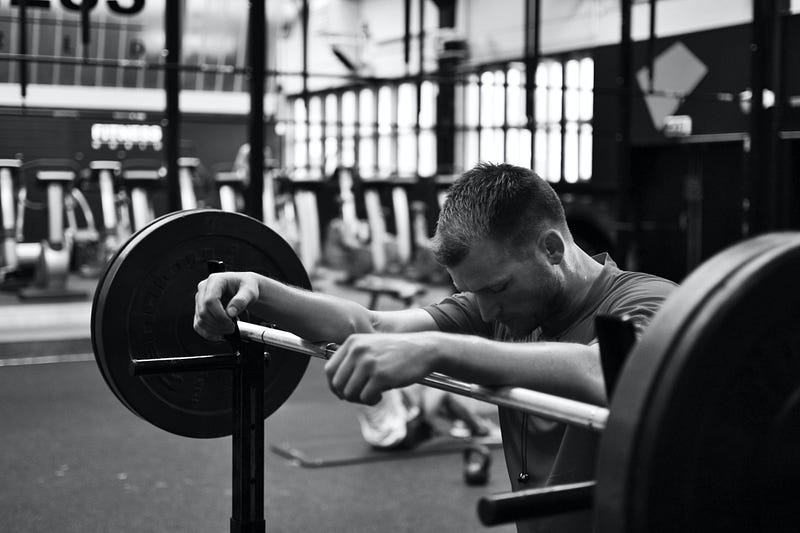
If you want to build muscle and get stronger, how hard should you train in the gym?
Should you go all out? Or, should it be more like 90% all out?
That’s where we find the rate of perceived exertion (RPE) useful.
In this article, we explore RPE, how it works, and how it impacts our training in the gym.
What is RPE?
RPE (rating of perceived exertion) is an effort-based scale that measures the intensity of an exercise set.
“The RPE scale is used in exercise science primarily to monitor exercise intensity and is most often used as a method to quantify exercise intensities during aerobic training.” — Day et al., 2004
Developed by Swedish researcher Gunnar Borg, the fitness community people use RPE to quantify exercise intensities. Essentially, it’s a difficulty and effort guide for a set.
The Borg rating of perceived exertion (RPE) was initially over a 6 to 20 rating scale but later changed to a more practice 0–10.
At zero, you could do many extra reps after the set stops. At 10, you couldn’t do another repetition during a set, no matter how hard you try.
We use RPE alongside RIR — reps in reserve. RIR is how many more reps you could do before you fail.
An RPE of 10 is 0 reps from failure, meaning you have zero reps in reserve. Or, an RPE of 9 leaving one rep in the tank gives an RIR of 1.
Therefore, an RPE 8 and 2 RIR are equal.
Why does RPE matter?
RPE provides a structured guide to know how “hard” to train.
“RPE scale has become a standard method to evaluate perceived exertion in exercise testing, training, and rehabilitation and has been validated against objective markers of exercise intensity.” — Day et al., 2004
Researchers, strength coaches, athletes, and recreational lifters benefit from using RPE to assess resistance training exercise intensity.
Why?
Overtraining.
Research indicates that the last two reps are disproportionately more fatiguing.
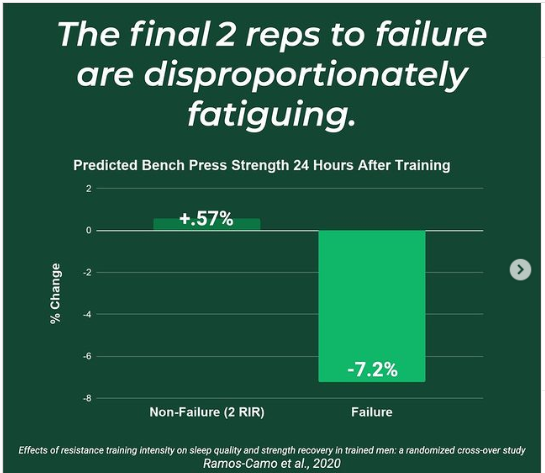
The final 1–2 reps do not seem to provide any additional hypertrophy (muscle-building) benefit but instead, induce more fatigue on a rep-to-rep basis.
“A single RT session leading to failure produces fatigue that decrease the 1-RM in bench press (7.2%) and half-squat (11.1%) on the following day. However, this parameter did not decrease after an RT session, with an intensity with two repetitions in reserve.” — Ramos-Campo et al., 2020
As we probably have the same muscle-building benefit from stopping short of failure, it doesn’t make much sense to train to failure.
It is much harder to recover from training to failure.
Stopping short of failure means that we have fewer recovery demands, and thus there is less impact on our ability to train at a high intensity in the following sessions.
Moreover, if stopping short of failure allows us to increase our total affective weekly volume, we should have more muscle-building potential.
Stopping around two reps short of failure seems to provide the best stimulus-to-fatigue ratio. Accordingly, internationally renowned fitness researcher Dr Brad Schoenfeld recommends that a good rule of thumb for RPE is leaving 1–3 reps in the tank.
Heavy compound lifts are more fatiguing to our body than isolation exercises because we lift more weight and use more muscle groups.
We can train to failure (RPE 10) more often for isolation exercises. For example, on a max deadlift, we should avoid an RPE of 10 in most cases.
Finally, when getting used to a new movement or developing power, leaving several “reps in the tank” (RPE 4–6) is recommended.
How do you use RPE?
RPE monitors our event on a scale of 0 to 10.
If 10 is our maximum effort, how do we know exactly how many reps we have left in the tank?
Firstly, a feeling of breathlessness is a good indicator of effort. But, it’s hardly scientific.
Getting used to using RPE takes experience and trial and error. Take the occasional set to failure so you know what failure “feels” like on a given exercise.
Move the weight up or down, depending on how close to failure you feel in a given rep range.
Rep speed can also indicate how close to failure you are. A 2019 study in the Journal of Sports Biomechanics found that during a bench press exercise, by the time subjects were halfway through a set, rep speed had reduced by 30%. By the last rep, reps were moving 80% slower.
The graph below from that study indicates the slowing of rep speed during a set.
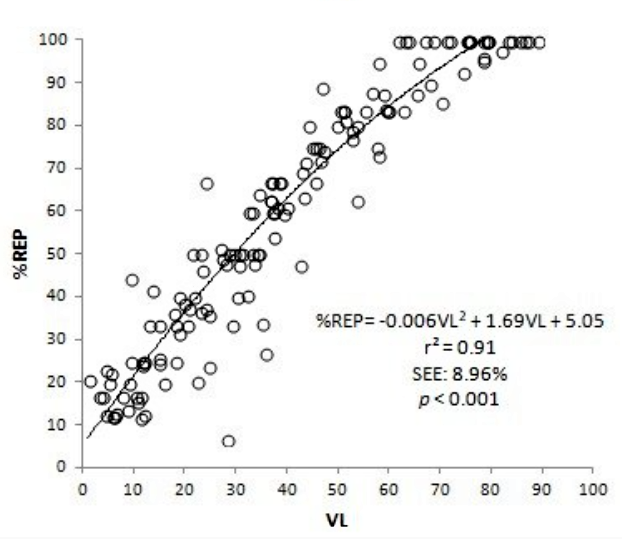
When reps completely slow down to a grind, you’re probably close enough to failure. If your reps don’t slow down at all, you probably have several sets left in the tank.
It’s important to note that the given weight you use for an RPE of 8 can vary depending on factors such as your nutrition, sleep and recovery practices. It’s up to you to auto-regulate.
How much weight should you lift?
Use a repetition percentage chart (see image below) to calculate how much weight to lift for a given rep range based on RPE and your one-rep max (1RM).
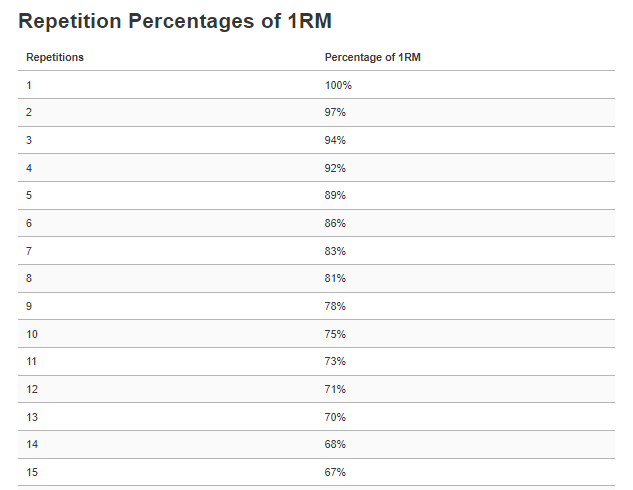
For example, if we’re doing 6 reps and leaving two in the tank, 8 reps give us 81%. If your 1RM is 100kg, you should do 6 reps of 81 kg.
In Conclusion
RPE is used to quantify the intensity level of an exercise. We rate each set on a scale of 0–10, based on how close you go to failure.
The current scientific knowledge suggests that we should finish most sets with two reps left in reserve to optimise our ability to build muscle and increase strength, but not compromise our recovery.
When we do train to failure, we should leave it until the last set of an exercise for a specific muscle group.
That means that we shouldn’t train to failure most of the time.
We can accumulate and recover from more total training volume by staying away from failure.
More effective training volume means that we can build more muscle!
Thank you for reading.
If you enjoyed the content, you might be interested in this article about 15 high-protein foods that help build muscle.
If you want to read more articles like this one, subscribe to be notified when I publish new content.


