
Key Considerations for Maximising Hypertrophy
Optimising your time in the gym to grow more muscle.

Many of us desire the bodies of our favourite athletes, movie stars, and influencers. So, we join a gym to build some muscle and sculpt our desired physique.
Unfortunately, building muscle gets increasingly difficult with the more time we spend in the gym. After five years of training, the average lifter will be lucky to add just a kilogram (2 pounds) of muscle per year. Some people won’t build much muscle at all, despite all their years of trying!
Why? Because they do not provide their bodies with a suitable stimulus to force an adaption. This adpation is building muscle mass.
In this article, we explore how to optimise a workout to maximise our ability to build muscle (hypertrophy).
This is part two of a deep dive into hypertrophy. You can read part one here, and part three here.
Hopefully, you will take some helpful tips away to help you to maximise your muscle growth.
Technique: range of motion, tempo & time under tension, and mind-muscle connection
If building muscle is one of your main goals for working out, you should train specifically to promote muscle growth.
In the previous article, I explored the science behind muscle hypertrophy. I discussed how mechanical tension, metabolic stress, and muscle damage are the key drivers of hypertrophy. This article will explore how these concepts apply practically in the gym.
An underlying foundation of results in the gym is high-quality training. The first thing that we need to master to ensure high-quality training is our technique.
Our technique when exercising is crucial at a few levels.
Firstly, injury prevention. By reducing load and focusing on technique, we will lessen the impact of resistance training on our joints. We are also less likely to injure ourselves during exercise.
Secondly, a good technique provides the building block from which we can progress with high relative effort rep after rep, set after set.
Another reason technique is crucial to get right is that the same exercise could be completely different depending on our goal. For example, a powerlifter will squat differently than a bodybuilder and again from an athlete training for explosive power like a football player.
Finally, a consistent technique makes it easier to monitor progress and make objective goals to improve.
Range of motion
Do we need a full range of motion (ROM) to maximise muscle growth?
A common site in any mainstream gym is people half-repping exercises like a squat or bench press. Often, they are lifting an amount of weight that they cannot put through a full ROM.
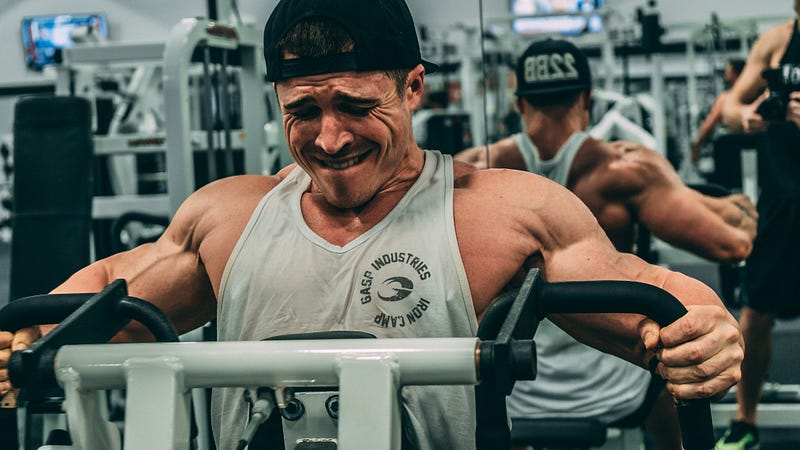
This kind of behaviour should be avoided. By cheating reps, you are just cheating yourself out of the results you have worked for. We should control each repetition through a full range of motion to stimulate all the motor units within the targeted muscle groups.
Muscles have groups of fibres located throughout them, each connected to a nerve. When under load, nerves activate those muscle fibres, and they experience metabolite increases. The more nerves activated within a muscle, the more potential it has for growth.
However, not all the nerves/motor units within a muscle are active through all portions of the range of motion. Therefore, by only using a partial range of motion, we risk never activating some motor units and exposing all the muscle fibres to hypertrophy.
In simple terms, the more ROM we engage, the higher the potential is for simulating muscle growth.
Another reason we should employ a full range of motion in the gym is for our safety. Using a weight that we can control means we reduce our risk for injury and put less fatigue on our joints.
Tip: Invest in Olympic Weightlifting shoes to improve your depth on squats and get the best possible hypertrophic activation of your quad muscles.
Additional tip: There is a time and place for using a limited range of motion called lengthened partials. However, the eccentric phase should go through a full range of motion, focusing on the lengthening of the muscle to feel a deep stretch under tension.

Tempo and time under tension
How fast or slow should each repetition be?
The tempo of an exercise is the speed at which we complete each rep.
Tempo is typically illustrated by four numbers — one for the concentric phase (positive), one for the eccentric phase (negative) and two for the isometric (when the motion of an exercise stops at the halfway point and start/end of a rep).
For example, 2/0/2/0 is a commonly used tempo by bodybuilders, indicating two seconds for both the concentric and eccentric, with no pause for the isometric portion.
There is not one specific tempo most beneficial to building muscle. A 2015 meta-analysis indicated that similar hypertrophic responses occur when repetitions range between 0.5 and 8 seconds. However, these studies did not control the duration of the eccentric vs. concentric phases — for example, prolonged eccentrics, which is important for reasons that I will get to shortly.
Our tempo must be slow enough to perform reps in a controlled manner to place the targeted muscle group under mechanical tension for an extended period. Slow and controlled repetitions will engage a better mind-muscle connection and increase the time targeted muscles are placed under load, recruiting more muscle fibres.
One thing to consider is that slowing down your reps will reduce the number you can complete compared to usual, so you may also have to reduce the load to stay within the optimum rep ranges for building muscle.
“Changes in the movement tempo during RT impacts the maximal number of repetitions performed in a set, the maximal time under tension, and the final exercise volume.”— Krzysztofik et al., 2019
Over recent years, new research suggests a prolonged eccentric could provide more stimulus for muscle growth.
For example, for an exercise starting with the eccentric, such as a squat or bench press, we might use a tempo like 5/1/2/2. This indicates a slow descent, pause, and explosive concentric before pausing before the next rep.
Mind-muscle connection
Do you mentally connect with the targeted muscle group during an exercise?
The mind-muscle connection is an internal focus of attention. With typical athletic performance, such as playing sports, focusing on external cues of the activity itself leads to the best improvements. However, an internal focus of attention is most optimal for building muscle.
An internal focus is concentrating on our specific bodily movements when we perform an activity.
Think about it like concentrating on “feeling” a muscle group as you squeeze or stretch it during an exercise. It’s a conscious and deliberate effort to contract the target muscle.
Developing a mind-muscle connection is easier when we mentally concentrate on our technique, slow everything down, and focus on our form rather than the load. In other words, don’t put a weight on the bar that you cannot do for several reps through a full range of motion.
This muscle-muscle connection helps ensure we’re keeping the targeted muscle under mechanical tension and reducing how much assistance secondary movers provide. To learn more, check out the below article.
Effort: intensity and progressive overload
To get results in the gym, application is just as important as our technique for maximising muscle growth.
It takes more to achieve results in the gym than just turning up. We need to put the effort in.
I have divided the application of our workouts into two categories — the intensity of our training and the tangible improvements we make, such as increasing our strength.

Intensity
Are you training hard enough to build muscle?
There is an intensity threshold that we have to surpass to stimulate muscle hypertrophy. We could have perfect technique, choose great exercises, and have consistency and great nutrition, but we won’t grow if our training lacks effort.
Just 1 in 5 people train at the optimum intensity level to build muscle. Many of us will finish off a set despite physically being able to complete many more reps. This is because many people either underestimate their maximal effort in the gym or are unwilling to push themselves past discomfort.
“Evidence indicates that significant muscle growth occurs when the majority of training sets are performed with ~3–4 repetitions in reserve (with moderate to high-loads).” — Krzysztofik et al., 2019
This is where our proximity to failure is crucial, which is how close we are to physically failing a rep during a set.
We measure proximity to failure through RPE — the rating of perceived exertion. RPE provides a measurement of how close we are to our maximal effort. If we typically stop an exercise set several reps short of failure, then we are not training hard enough to stimulate hypertrophy.
In fact, the last few reps before failure are disproportionally hypertrophic, meaning these provide far more muscle-building stimulus than the early reps. Hence, people who always stop well short of failure will struggle to build muscle.
RPE uses a scale of 1 to 10, with 1 representing little or no effort and 10 being our maximum effort before failing a rep. An RPE of 8 would be two reps left in reserve.
For more about using RPE as a control for workout intensity, check out the below article.
The intensity threshold seems to be around 2–4 reps short of failure.
The endpoint for a set typically should not be when we physically cannot complete another rep. We should save our failure sets until the last one or two exercises.
We are still training with high intensity but reduce the cumulative fatigue that compromised our performance towards the end of our workout. Moreover, consistently training to failure means our recovery time after our workout increases, reducing our future capacity to train at optimal intensity.
Progressive overload
How do we know we’re making progress with muscle growth?
Intensity can be subjective. That is why we have elite athletes and part-timers. This does not mean the elite athlete loves their sport any more — it could be natural talent and application.
How do we train at an intensity that gets results and gives ourselves an objective goal to keep striving for with exercise? Progressive overload.
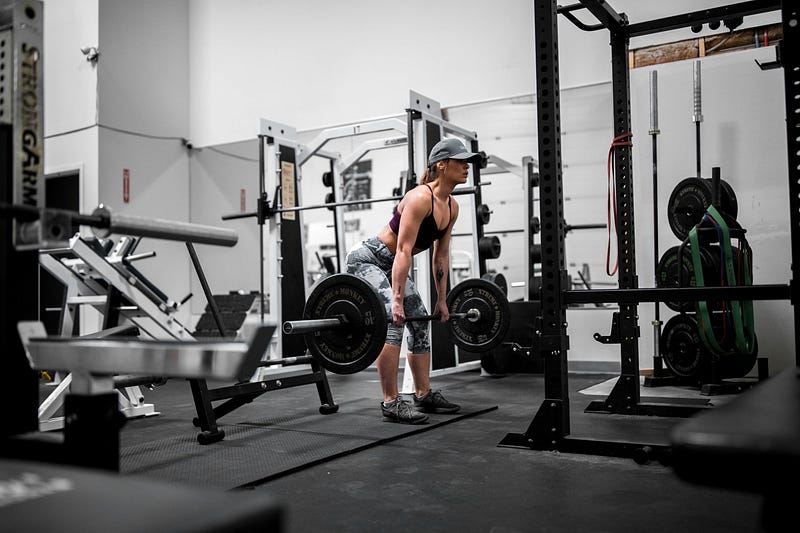
Progressively overloading is gradually increasing resistance to exercise to force our bodies to adapt and improve.
Strength training is a great benchmark to use as a baseline for progressive overload. For example, we can increase the number of reps we do for the same weight. Or increase the weight for the same number of repetitions. This is measurable. For example, in week 1 of a training block, we might max out on a given exercise by doing 50 kilograms for ten reps. In week 2: 52.5 kilograms for ten reps.
In bodybuilding terms (hypertrophy), another way to progressively overload increased volume. For example — Week 1: 6 sets for chest. Week 20: 8 sets for chest.
This kind of linear progress will not be infinite, however. We have many muscles, and we cannot just keep increasing how many sets for every muscle group. There is a point where fatigue exceeds stimulus, and we start overtraining.
And that is a wrap for this article. Stay tuned for part two — subscribe to receive an email when it is available!
Final Thoughts
In conclusion, there are a few things that we must get right to maximise the hypertrophic (muscle-building) potential of our workouts.
Firstly, to stimulate maximal hypertrophy, a workout must prioritise optimal technique, including the range of motion, tempo & time under tension, and mind-muscle connection.
Secondly, we must consistently exercise with maximal effort, as intensity and progressive overloading will also dictate our results in the gym.
Thanks for reading!
If you enjoyed the content, check out part two about programming your workouts for maximal hypertrophy.
If you want to read more articles like this one, subscribe to be notified when I publish new content.


