A Guide to Programming Workouts That Maximise Hypertrophy
Part three of a deep dive into building muscle.

Do you want to build muscle? It is a simple question with a simple answer. Most of us will probably say yes.
In the age of social media feeds filled with steroid-enhanced fitness influencers, many assume it is easy to stack on some muscle.
Unfortunately, maximising our ability to build muscle is far more complicated than simply going to the gym. The reality is that even if they work out regularly, most people will struggle to build noticeable muscle. It might not be for a lack of consistency or effort but instead, a lack of knowledge and application.
This article is part three of a series of articles exploring hypertrophy and best practices for increasing muscle size. In part one, we discussed the science behind muscle hypertrophy.
Part two looked at some critical considerations for optimising a workout for maximal muscle growth. I discussed that to stimulate maximal hypertrophy, we must prioritise optimal technique, including range of motion, tempo and time under tension, and the mind-muscle connection. Moreover, we must consistently exercise with maximal effort, as intensity and progressive overloading will also dictate our results in the gym.
This article will explore programming a workout to maximise hypertrophy, such as load, rep ranges, volume, rest periods, frequency and exercise selection.
This information will provide you with a platform to build muscle, despite what genetics you may have been gifted!
Workout programming — load, rep ranges, volume, rest periods, frequency, and exercise selection
Bodybuilders have long thought that moderate weight and moderate repetitions are best to maximise muscle growth. And there is an element of truth to this, but there is far more to it than that.
We need to be able to take these sets and consistently apply them to optimal exercises and build different muscle groups in a manner that allows us to train with high effort session after session.
“Foundations for individuals seeking to maximize muscle growth should be hypertrophy-oriented RT consisting of multiple sets… moderate intensity of effort (60−80% 1RM) with subsequent increases in training volume (12–28 sets/muscle/week).” — Krzysztofik et al., 2019
Load
How much weight should we lift to maximise hypertrophy?
The optimal weight to lift for muscle growth is relative to other crucial variables discussed in this article. Essentially, we need to choose a weight challenging to lift for multiple reps within the optimal rep range to build muscle.
But what is the optimal rep range to build muscle? Is it better to do high-rep or low-rep workouts? Current research indicates that high reps (low loads) result in similar hypertrophy to low reps (heavy loads) when taken close to failure.
“Both HL and LL training to failure can elicit significant increases in muscle hypertrophy among well-trained young men.” — Schoenfeld et al., 2015
However, there is an intensity threshold to maximise hypertrophy of above 60% of our one rep maximum.
Our one-rep maximum (1RM) is the most weight we can lift for one repetition on any given exercise. It’s important to know approximately what our 1RM is for various lifts to help calculate the optimal load for a given number of reps.
It can be tough to test our 1RM (and unsafe), but we can use a one-rep max calculator to estimate this by inputting the maximum number of reps that we can do for a given weight (e.g. 60 k.g. on the bench press for 20 reps).
Exercise plans usually provide a set number of repetitions for each exercise but not the load. In this case, the table below is a helpful guide to how much weight to put on the bar for a given number of reps.
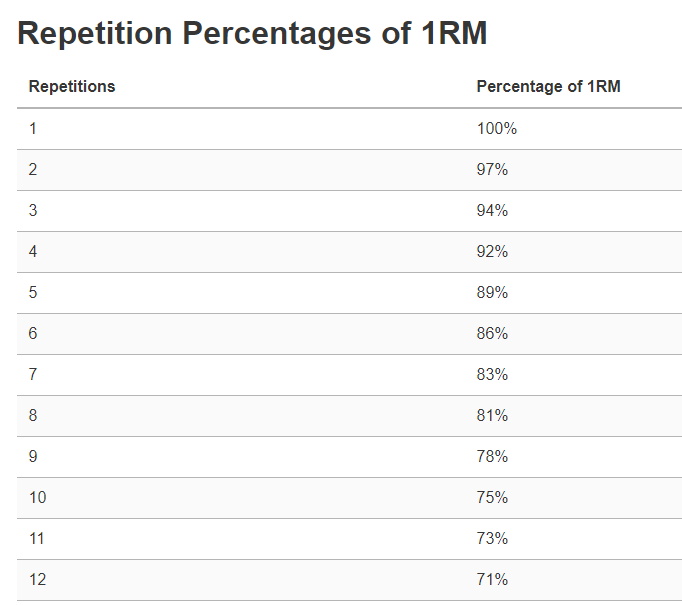
For example, for 12 reps, we should use 71% of our 1RM. If my Squat 1RM is 170kg, 71% of this would be 120kg.
An important thing to keep in mind is that if we never train close to muscular failure, this 1RM calculation will not be accurate.
Rep ranges
How many reps will maximise muscle growth?
Recent research (check out this article and this article) suggests that there is little difference in our ability to build muscle between high and low reps (light or heavy loads), as long as we are in the approximate 6–25 rep range.
A moderate rep range of approximately 8 to 20 reps typically provides the best trade-off between stimulus and fatigue, injury risk, slow and fast muscle fibre specificity, and mind-muscle connection. Therefore, from 50 to as high as 90 percent of our volume should sit in these rep ranges.
However, some of our rep ranges should be strength-focused, using heavier loads at around 60–90% of your one-rep max in the lower rep ranges of 1 to 6 reps.
“Muscle hypertrophy can be equally achieved across a spectrum of loading ranges.” — Schoenfeld et al., 2015
Try not to overthink how many repetitions you do for different exercises because how close we train failure is far more influential for muscle growth than the number of reps we complete.
If you want to learn more about the optimal rep ranges for strength or hypertrophy, check out this article.
Volume
How many sets are optimal to maximise muscle growth?
Training volume is one of those things that gives us diminishing returns. After a certain number of sets, our bodies can not recover effectively. This is called maximal recoverable volume, and any sets above this limit increase our injury risk and should be considered junk volume.
On the flip side to a maximal limit on volume, there is also a minimum dose required (minimum effective volume) to maximise hypertrophy.
A 2017 meta-analysis found that the optimal number for maximal muscle growth is roughly 10–20 sets per muscle per week. That is around six sets per workout if you train each muscle group twice weekly.
For example (chest): Monday: Bench press (3 sets) and dips (3 sets). Thursday: Incline dumbbell press (3 sets) and cable crossovers (3 sets).
Beginners should start at the lower end (ten sets) and gradually increase their volume. If you are always sore after workouts and struggle to recover, do fewer total weekly sets because you could be overtraining.

Rest periods
How long should we rest between sets?
During a workout, we rest between sets to restore energy for the next. Rest periods that are too short mean we cannot recover adequately to perform our next set at an appropriate intensity level to stimulate results.
If our primary goal is to build muscle, rest periods should be around one to two minutes. However, advanced training techniques like drop sets, supersets, and myo-reps will not require as much rest (10–30 seconds).
We typically learn how long we should rest between sets through experience. We know if we have recovered sufficiently because our energy is restored, and our performance is not diminished from the previous set. If our heart rate is still high, we can not focus and feel weak; we should rest longer.
Generally, isolation exercises will not require as long rest between sets as compound exercises.
If you have good cardiovascular fitness, 30 seconds may be enough. We need enough rest to start the next set with enough energy to train at the optimal intensity,
Compound lifts such as squats are usually done in a lower rep range with heavy weights and, therefore, are highly fatiguing.
We should increase our rest periods for heavy compound exercises to 3–5 minutes.
“Hypertrophy-style protocols typically involve short rest intervals (30–90 seconds), whereas strength-style protocols typically involve longer rest intervals (3–5 minutes).” — Gonzalez, 2016

Frequency
How often should we train to maximise muscle growth?
The minimal number of workouts we need per week to maximise muscle growth is not easy to answer.
A range of variables dictate how optimal a workout might be, such as how long we must spend in the gym, what exercises we choose, how many sets we do, how often we train each muscle group and how hard we train.
Old-school bodybuilders tended to train each muscle group just once a week. But, they would “hit that muscle really hard”, often doing dozens of sets during one workout targeting just one or two muscle groups. But then that muscle group would have a whole week to recover before the next workout targeting it.
This exercise routine is vastly used by bodybuilders, often called the bro-split. The idea is we spend one workout smashing one or two muscle groups, leaving them to recover for the rest of the week.
As science has expanded our knowledge over the years, there is now some evidence that frequency could be a driver of hypertrophy. Training the same muscle group twice, three, or even four times a week could provide more stimulus for muscle growth than just once a week.
“Meta-regression analysis of non-volume-equated studies showed a significant effect favoring higher frequencies, although the overall difference in magnitude of effect between frequencies of 1 and 3+ days per week was modest. In conclusion, there is strong evidence that resistance training frequency does not significantly or meaningfully impact muscle hypertrophy when volume is equated. Thus, for a given training volume, individuals can choose a weekly frequency per muscle groups based on personal preference.” — Schoenfeld et al., 2018
The total sets targeting a muscle group is the crucial variable here. For example, one workout of 20 sets targeting a muscle group, or we could spread this over four sessions with five sets each.
The volume is matched, but we are likely to train with higher intensity in the high-frequency option, as we do not experience the accumulative fatigue of a long single workout. If we do 30 sets of legs, our energy and effort will likely decline throughout the second half of our session.
Finally, when we consider how often we exercise, we should also consider how we order our workouts over the week. If we train a muscle group twice or even three or four times a week, which days are most logical to provide adequate recovery with a day off?
One example of a popular twice-a-week exercise split is push, pull, and legs. Depending on how you want to order your workouts, it looks something like this:
- Mon — Push (Chest, Triceps, Shoulders)
- Tues — Pull (Back, Traps, Biceps)
- Wed — Legs
- Thurs — Push (Chest, Triceps, Shoulders)
- Fri — Pull (Back, Traps, Biceps)
- Sat — Legs
- Sun — Rest
For more about workout splits that build muscle, check out this article.
Exercise selection
How do we know what exercises are best for building muscle?
Lastly, choosing suitable exercises is the final variable significantly impacting our hypertrophy results. Some are excellent for stimulating muscle growth. Others, not so much.
We can exercise to build muscle in several ways, such as resistance training, bodyweight training, or callisthenics.
Resistance training with gym equipment is most effective for building muscle. Most gyms offer a range of free weights like barbells, dumbells and kettlebells, machines and cable-loaded equipment.
Exercises are split into two main categories: multijoint (compound) and single-joint (isolation).
Research suggests that isolation and compound exercises have similar hypertrophic benefits. Therefore, we should use a variety of both.
“The selection between single joint and MJ exercises should be based on individual and practical aspects, such as, equipment availability, movement specificity, individual preferences and time commitment.” — Gentil et al., 2015
Firstly, compound lifts should be the foundation of any resistance training routine and are the best exercises for increasing our strength. Getting stronger will give us the best chance of building muscle.
Getting stronger doesn’t necessarily mean hypertrophy is optimal, but this foundational strength will allow us to lift more weight on hypertrophy-focused exercises, enhancing muscle growth long-term.
Therefore, part of the focus in the gym for people wanting to build muscle should be strength training. Start your workouts with two or three compound exercises in the lower rep ranges (3–8 reps).
Exercises that are the building blocks for strength include squats, deadlifts, bench presses, pull-ups, and overhead presses. This will build a solid foundation of strength and muscularity and strengthen our joints.
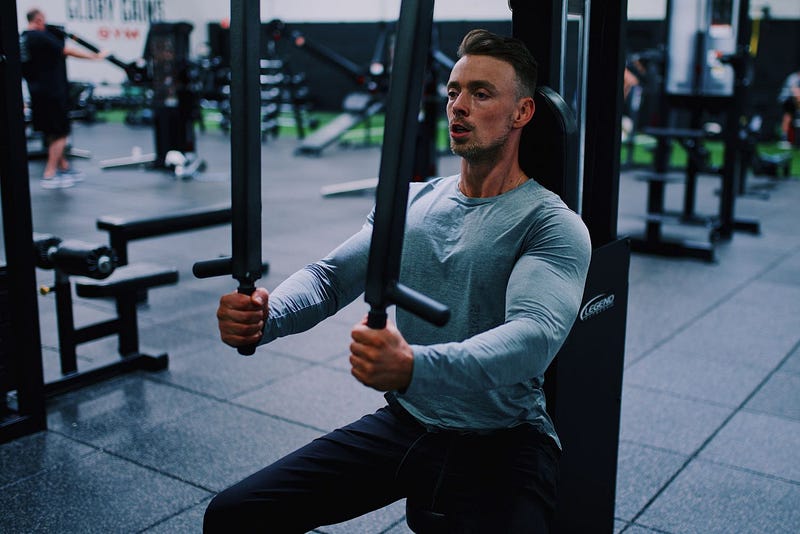
Next, our workouts should include single-joint exercises to ensure we target every major muscle group for a symmetrical physique. This is where the machines in the gym provide us with benefits.
There are dozens of individual muscles in the body, and not all of them will be optimally activated by compound exercises, such as our lateral deltoids (side shoulder muscles).
“If the goal is to optimize your muscular potential, it appears necessary to include single-joint exercises as part of a comprehensive training program. This will help to ensure that all the body’s major muscles, as well specific subdivisions of a given muscle, are maximally stimulated for development.” — Schoenfeld, 2022
We should structure the second half of our workout around hypertrophy-focused training using isolation exercises on machines and cables, with lower loads (50–70% 1RM) in high rep ranges (8–25 reps).
Some great isolation exercises for muscle growth are:
- Shoulders: machine shoulder press, lateral raises (dumbbell or cable), face pulls, rear delt flies
- Chest: Hammer press, pec deck, flies (cable or dumbbells), dips
- Back: lats pull-downs, bent-over row, seated cable row
- Arms: bicep curls (bar or dumbbells), skull crushers, triceps push downs, preacher curls, incline seated dumbbell curls
- Legs: hack squats, stiff leg deadlifts, leg extensions, leg curls, split squats, hip thrusts
Another consideration of exercise selection is how we order our workout.
Take this example — If we are doing a push day, training chest, shoulders, and triceps, we should not start our workout with three consecutive chest exercises. By the third exercise, our chest would be highly fatigued. It’s smarter to do a shoulder exercise and a triceps exercise before a second exercise targeting the chest.
Finally, fatigue can impact our ability to maximise hypertrophy in our workouts by reducing our ability to train at the optimal intensity to build muscle.
Compound exercises are typically great for muscle growth but are also highly fatiguing on our joints due to using heavy loads and activating multiple muscle groups.
We want to avoid fatigue in the gym as it can decrease our short and long-term performance and increase our injury risk. The cumulative fatigue of heavy compound exercises is something we should consider when constructing an exercise plan.
The comparison of the growth potential of an exercise versus its fatigue is called the stimulus-to-fatigue ratio.
An exercise is only worth doing if we can recover from it effectively. Do not do it if it negatively impacts our training performance.
Or we can reduce how frequently we perform that exercise. Think about it like the risk-to-reward ratio.
Along with choosing the exercises that are both effective for stimulating the motor units of the targeted muscle and progressive overload, we need to choose options that we do consistently.
For more content about exercise choice, check out the below article exploring the best isolation exercise for each muscle group.
Final Thoughts
In conclusion, there are several considerations for optimising our workouts and performance in the gym for maximal muscle growth.
This article was part three of a deep dive into hypertrophy and has explored some crucial variables of programming a workout for hypertrophy. These are load, rep ranges, volume, rest periods, frequency, and exercise selection.
If we get these things right and train with optimal technique and intensity, we will sufficiently provide a suitable stimulus for our bodies to adapt by building muscle.
There are variations from person to person depending on muscle inserts, genetics, and how trained they are.
You might not ever look like your favourite professional athlete or movie star.
However, applying the knowledge from these articles to your training will provide a platform to help you build muscle and sculpt a physique you can be proud of!
Thank you for reading.
To read more articles like this one, subscribe to be notified when I publish new content.
If you enjoyed the content, you might be interested in parts one and two of this deep dive into hypertrophy.