
Increase Time Under Tension to Build More Muscle
Use the mind-muscle connection and varying lifting tempos to enhance hypertrophy.
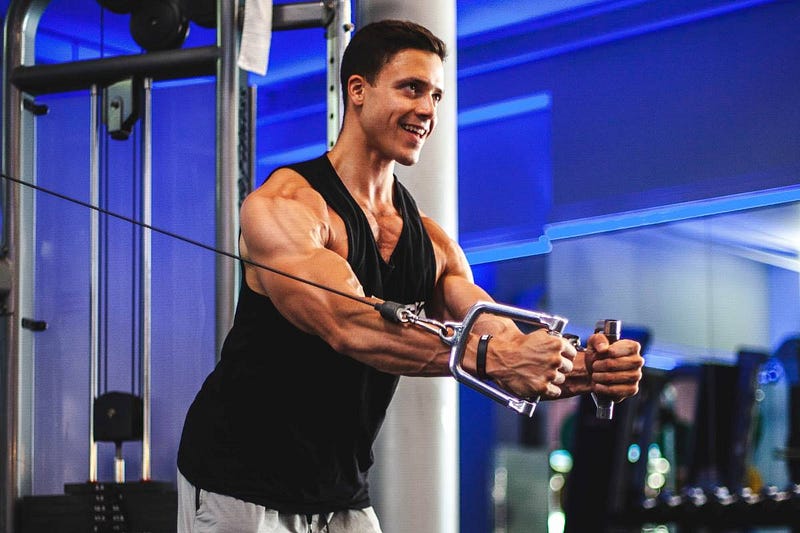
We hear all sorts of advice on how to build muscle, from gym hacks to the apparently forgotten methods that some jacked guy from 1946 used.
One thing that has stayed consistent in the bodybuilding community for several years is the idea of time under tension.
Essentially, how long we spend doing a set and/or rep for a given exercise during a workout.
But, is there any validity to this method of building muscle? Is there any science behind time under tension?
In this article, we explore the idea of time under tension. We also look at available science and explore rep (repetition) tempo.
What is time under tension?
Time under tension is the length of time that we place force on a muscle/muscle group during an exercise set.
As the muscle contracts against a load, tension is produced by force generation and the stretch, referred to as concentric and eccentric phases of a lift.
Theoretically, the more time under tension we put on a targeted muscle, the more metabolic stress we create to force an adaption.
To maximise this tension on a muscle, we need to complete reps in a controlled manner. Time under tension can be varied through the tempo of the repetitions during a set of an exercise. We can decrease or increase the speed of the eccentric or concentric phase of an exercise, or the rest in the middle or at the end of a rep,
Often, the tempo of the concentric portion should be performed at moderate to fast speeds (1–3 seconds), and the eccentric at slightly slower speeds (2–4 seconds).
“An often overlooked variable that also may impact muscle growth is repetition duration. Duration amounts to the sum total of the concentric, eccentric, and isometric components of a repetition, and is predicated on the tempo at which the repetition is performed.” — Schoenfeld et al., 2015
Why does time under tension matter?
We can build muscle doing heavy compound lifts such as squats or the barbell bench press, but these really sap our energy. If we spent our whole session doing compound lifts in the <5 rep range, our central nervous system would become greatly fatigued. Thus, compromising our ability to recover and train at sufficient intensity during our next session/s.
Isolation exercises, on the other hand, increase how many hard sets (training volume) you can do without creating extra recovery demand on muscles and joints.
During isolation exercises, time under tension is the key technique to master to maximise the activation of the targeted muscle group. To keep tension on the muscle, we want to both minimise activation of other muscle groups and reduce the use of momentum.
Research on rep tempo
A recent 2015 meta-analysis from Schoenfeld and colleagues looked at the available research on lifting tempos.
They found that as you go above that ten-second rep duration mark you tend to see a reduction in hypertrophy. This is likely because you have to reduce the weight so much to do such exaggerated slow repetitions that last longer than ten seconds.
But, from a 0.5-second lifting tempo up to an 8-second lifting tempo, the research shows statistically similar results in terms of hypertrophy (muscle growth). Thus, we can be pretty creative with our lifting tempo within this time frame.
“…Hypertrophic outcomes are similar when training with repetition durations ranging from 0.5 to 8 s.” — Schoenfeld et al., 2015
The researchers concluded that “from a practical standpoint it would seem that a fairly wide range of repetition durations can be employed if the primary goal is to maximize muscle growth.”
An example of an eight-second rep might be a four-second lowering phase (eccentric), followed by a one-second pause, a two-second concentric phase and a one-second rest before the next rep (4:1:2:1).
We’ll get to more about tempo notations soon.
When and how do we apply time under tension?
So does time under tension actually matter?
Yes, it does. But, exactly how it is applied to achieve the best results is less black and white.
As long as we prevent or minimise the tension on the targeted muscle group to stop during a set.
Using an internal focus to really hone in on the targeted muscle group and feeling a squeeze in the muscle on contraction. After a few sets, we should feel a “pump” in the targeted muscle group, as it fills up with blood.
Most of the time, we should aim for a full range of motion. But in certain situations, using a partial range of motion through the mid-range of a movement can keep the muscle under a more prolonged time under tension. Every time we begin and end a set, we usually lose the tension on the targeted muscle group. Starting each rep without coming to a complete stop can help keep tension on the targeted muscle.
We use an internal focus to “feel” the reps. Internal focus means visualising and focusing on the mind-muscle connection to feel a strong squeeze/contraction and then lengthening/stretching of the targeted muscle.
Research indicates that the effectiveness of an internal focus is reduced by using heavier weights. Therefore, choose a weight that allows you to feel the movement's stretch and contraction in a controlled manner, yet is still challenging enough to force adaption in the long run.
If we push as much weight as possible, we compromise our form. So you should typically choose a low-to-moderate weight that you can do for around 10 to 20 reps.
As I have just mentioned, the total amount of time spent under load/tension for each rep doesn’t really matter — as long as it’s around eight seconds or less per rep. Trial different methods depending on your training goal and what exercise you’re doing. See what “feels” best to you.
An example for 12 reps of bicep curls might be 48 seconds under tension, using a tempo of one second for the concentric phase and three seconds for the eccentric phase. You can also pause each rep at peak contraction or the end of each rep.
Tempo notation is the speed/rhythm of each phase of one repetition of an exercise, expressed as a sequence of four numbers.
Four examples of different notations are as follows:
- 4:0:1:2
- 2:0:2:0
- 3:0:1:0
- 3:1:3:1
The first number refers to the eccentric — so if we’re doing a dumbbell chest press, for example, it might be 2:0:2:1.
The first number refers to the two-second lowering phase (eccentric) and at the bottom of the range of motion, you wouldn’t have any pause. Immediately reverse the movement for your concentric phase for two seconds and then pause for a second before beginning the next rep.

When do we not use time under tension?
When training to build strength or power, the goal is to move as much weight as possible efficiently. This means an explosive concentric and we generally don’t try to resist gravity on the eccentric, as it requires energy and it won’t make us more efficient at lifting the weight.
Therefore, we should use an external focus and concentrate on how the weight is going to move and how our body in general can perform the movement correctly and efficiently. We don’t try and keep tension on the muscle with an internal focus.
“Adopting an internal attentional focus with very heavy loads (above 85–90% of 1RM) is unnecessary because it might limit force production without enhancing muscle activation.” — Schoenfeld & Contreras, 2016
Parting Thoughts
In conclusion, this article explored the training technique of “time under tension” and the role it plays in enhancing our ability to build muscle.
Time under tension focuses on feeling a contraction within a targeted muscle group, with a focused mind-muscle connection.
Scientific research suggests hasn’t provided a definitive answer for the optimum time under tension to build muscle. All we know is that a super-slow tempo lasting longer than 10 seconds is worse for building muscle than reps that last between one and eight seconds.
Thus, you should feel comfortable being creative with your rep ranges to find something that feels good for you!
Good luck!
Thank you for reading.
If you enjoyed the content, you might be interested in this article about the best isolation exercises to build each muscle group.
Subscribe to be notified when I publish new content.