avatarDaniel Hopper

Free AI web copilot to create summaries, insights and extended knowledge, download it at here

6494

Abstract

m_medium=referral&utm_content=creditCopyText">Alora Griffiths</a> on <a href="https://unsplash.com/s/photos/deadlift?utm_source=unsplash&amp;utm_medium=referral&amp;utm_content=creditCopyText">Unsplash</a></figcaption></figure><h1 id="42b5">Push-Pull-Legs (PPL)</h1><p id="a257">The Push-Pull-Legs split is a popular exercise routine, ideal for both intermediate (2–5 years experience) and advanced lifters (5 years plus).</p><p id="a0f8">Related muscle groups are trained together in the same workout.</p><ul><li>A “push” workout trains the upper body pushing muscles, i.e. the chest, shoulders and triceps.</li><li>A “pull” workout trains all the upper body pulling muscles, i.e. the back, biceps and rear delts.</li><li>In a “legs” workout, you train your entire lower body, i.e. the quads, glutes, hamstrings, calves and abdominals.</li></ul><p id="85be">Alternate between the three routines. For example, cycle through twice a week over six days, with one rest day. However, you could do 4 or 5-day splits — it just means your workouts won’t be on the same day every week (which can be confusing).</p><p id="93a0">The routine is so effective because some of the best compound movements overlap on which muscle groups they work, creating synergy with your exercises in a given workout.</p><p id="d0a2">For example, when bench pressing, the chest is the primary muscle targeted. But, we also work our anterior (front) deltoids (shoulder) muscles and triceps as secondary muscles. Lumping all three of these muscle groups into one workout makes sense.</p><p id="2706">However, the legs are slightly different. There are several muscle groups in our legs, and we activate them with different movements. For example, the quad's primary role is leg extension, whilst the hamstring contracts with a curl movement.</p><p id="bb00">Training legs at least twice a week allows us to focus more energy on the Quads one day and on the Hamstrings the other day.</p><p id="ae43"><b>Example of the push-pull-legs split:</b></p><ul><li><b>Monday </b>— Push</li><li><b>Tuesday</b> — Pull</li><li><b>Wednesday</b> — Legs</li><li><b>Thursday</b> — Push</li><li><b>Friday </b>— Pull</li><li><b>Saturday</b> — Legs</li></ul><p id="3e07">Doing the PPL split twice a week is far more optimal for building muscle than only training each muscle group once.</p><p id="ac87">A <a href="https://pubmed.ncbi.nlm.nih.gov/27102172/">2016 systematic review and meta-analysis</a> from Schoenfeld and colleagues concluded that training a muscle group twice a week is better than once. If the volume is equal, it’s unknown that increasing the training frequency of a muscle group more than twice a week will lead to more gains.</p><p id="1cfe">Therefore, as far as we currently know, twice a week is enough to maximise muscle growth.</p><p id="7856" type="7">“The current body of evidence indicates that frequencies of training twice a week promote superior hypertrophic outcomes to once a week. It can therefore be inferred that the major muscle groups should be trained at least twice a week to maximize muscle growth; whether training a muscle group three times per week is superior to a twice-per-week protocol remains to be determined.” — Schoenfeld et al., 2016</p><figure id="0bbc"><img src="https://cdn-images-1.readmedium.com/v2/resize:fit:800/1*M7hRI_JwhP192Wo8GybnqA.jpeg"><figcaption>Photo by <a href="https://unsplash.com/@demoya?utm_source=unsplash&amp;utm_medium=referral&amp;utm_content=creditCopyText">Michael DeMoya</a> on <a href="https://unsplash.com/s/photos/bench-press?utm_source=unsplash&amp;utm_medium=referral&amp;utm_content=creditCopyText">Unsplash</a></figcaption></figure><h1 id="448f">Upper and Lower Body Split</h1><p id="f618">The upper and lower body split is the final exercise routine to help you build muscle. It could be perfect for you if you have precisely four days in the gym each week.</p><p id="fe6d">The benefit of an upper and lower body split is similar to a push-pull-legs split as you can easily hit your largest muscle groups twice a week. As discussed, hitting a muscle group twice a week is more effective for building muscle than just once.</p><p id="8f5e">A downside of this split is that if only have a small window of time for a workout, you might struggle to fit in enough volume. The upper body has several muscle groups, which is why it is usually split up into push and pull exercises.</p><p id="bcb4">According to a <a href="https://www.mdpi.com/2075-4663/6/1/7">2018 study</a> out of Sydney, Australia, each muscle group requires at least ten sets a week to maximise muscle growth. Therefore, to hit each muscle group (Chest, Back, Traps, shoulders (front, side and back), Biceps, and Triceps) with ten sets a week, that’s a total of 70 sets over two workouts.</p><p id="12f4">Doing 35 sets is a lot of training volume to fit into one session. 15 to 20 sets will be far less fatiguing, allowing us to train at a high intensity throughout the workout.</p><p id="ab9b">However, if you only have four days to spend in the gym, the upper body split will still allow you to build a good amount of muscle. Just bear in mind that your workouts might take a little bit longer.</p><p id="8399">An example of an upper and lower body split:</p><ul><li><b>Monday </b>— Upper body</li><li><b>Tuesday</b> — Lower body</li><li><b>Wednesday </b>— rest</li><li><b>Thursday</b> — Upper body</li><li><b>Friday</b> — Lower body</li></ul><figure id="ed25"><img src="https://cdn-images-1.readmedium.com/v2/resize:fit:800/1*t0HgVbpHLn1liW3gm9IRXw.jpeg"><figcaption>Photo by <a href="https://unsplash.com/@sxoxm?utm_source=unsplash&amp;utm_medium=referral&amp;utm_content=creditCopyText">Sven Mieke</a> on <a href="https://unsplash.com/s/photos/squat?utm_source=unsplash&amp;utm_medium=referral&amp;utm_content=creditCopyText">Unsplash</a></figcaption></figure><h1 id="b42b">Discussion: What’s the best workout routine to build muscle?</h1><p id="3fb2">There is going to be no definitive answer to this question.</p><p id="b4d8">The best exercise routine to build muscle is something to easily fit into your lifestyle — something that becomes a routine.</p><p id="045e">A push-pull-legs split MAY be better than an upper and lower body split for building muscle… But, if you can’t stick to it, it’s no better.</p><p id="1ca9">Six days in the gym is a lot to commit to.</p><p id="34b9">Your exercise split also needs to be a routine that you enjoy. Something that will push you to imp

Options

rove.</p><p id="355d">Some people might enjoy a full-body workout. It may be boring for them to work out the same group of muscles for a whole hour.</p><p id="9719"><b>In terms of choosing the best exercise routine for you:</b></p><p id="c92c">If all else is equal and you want the absolute best plan to build muscle, you should work out each muscle group at least twice a week.</p><p id="e12b">Therefore, the bro-split should probably get the kick.</p><p id="2c2b">However, it’s unclear whether hitting a muscle group more than twice a week will lead to more muscle growth. So, twice a week should be enough to maximise your muscle growth.</p><p id="b750" type="7">These effects (muscle growth) seem to be primarily driven by training volume because when the volume is equated, there was no significant effect of resistance training frequency on muscular strength gains. — Grgic et al., 2018</p><p id="a93a">Unless you REALLY enjoy a full-body training split, it’s probably not optimal for most people wanting to build muscle.</p><p id="2a68">Finally, allow for enough total sets for each workout to target each muscle group with at least ten sets a week. Twenty total weekly sets are probably slightly better than ten</p><p id="31f4">The more advanced you become as a lifter, the more volume is required to keep progressing forward. However, a newbie lifter won’t be able to manage the same amount of training volume without fatiguing.</p><p id="1c32">A newbie lifter will get great results from a three-day full-body split. An advanced lifter, not so much.</p><p id="df85">The two options that are probably best for building muscle for most people are the PPL and the upper and lower body split.</p><p id="806a">However, what’s most important is actually attending the gym regularly, with a plan and a purpose. The total training volume is the ultimate driver of muscle growth, along with the rep ranges, exercise choice and <a href="https://readmedium.com/youre-probably-not-training-hard-enough-to-build-muscle-772afbbd87b6">training intensity</a>.</p><div id="90de" class="link-block"> <a href="https://readmedium.com/youre-probably-not-training-hard-enough-to-build-muscle-772afbbd87b6"> <div> <div> <h2>You’re Probably Not Training Hard Enough to Build Muscle</h2> <div><h3>Want that beach body? You have to train harder!</h3></div> <div><p>medium.com</p></div> </div> <div> <div style="background-image: url(https://miro.readmedium.com/v2/resize:fit:320/1*ozVerCdXAyYSzXoKbk-tDA.jpeg)"></div> </div> </div> </a> </div><p id="14f1">For a basic guide on what exercises and rep ranges will be most beneficial to your goals of building muscle, check out the list below.</p><p id="52c7">Focus your energy on these exercises, and the compound lifts in particular, to give yourself the best possible chance to build muscle and increase strength.</p><p id="bbe1"><b>Compound lifts:</b></p><ul><li>Deadlifts (3–6 reps)</li><li>Squat (3–6 reps)</li><li>Bench Press (3–8 reps)</li><li>Overhead Press (3–8 reps)</li><li>Dips (8–15 reps)</li><li>Pull-Ups (6–12 reps)</li><li>Barbell Rows (6–10 reps)</li></ul><p id="f922"><b>Isolation exercises:</b></p><ul><li>Bicep Curls (8–15 reps)</li><li>Lateral Raises (10–15 reps)</li><li>Face Pulls (10–15 reps)</li><li>Hanging Leg Raises (6–15 reps)</li><li>Calf Raises (12–20 reps)</li><li>Hamstring Curls (12–20 reps)</li><li>Leg Extensions (12–20 reps)</li><li>Lat Pulldown (10–15 reps)</li><li>Barbell Shrug (8–12 reps)</li></ul><p id="2f4a">If you want to know what <b>exercises that you shouldn’t be doing</b>, read the article below.</p><div id="a964" class="link-block"> <a href="https://readmedium.com/dont-waste-your-time-in-the-gym-on-these-10-exercises-95e24b78a44e"> <div> <div> <h2>Don’t Waste Your Time in the Gym on These 10 Exercises</h2> <div><h3>Do you want to maximise strength gains and muscle growth in the gym, but avoid injuries? Then don’t do these exercises!</h3></div> <div><p>medium.com</p></div> </div> <div> <div style="background-image: url(https://miro.readmedium.com/v2/resize:fit:320/1*PNod0sIjqTsXT8Elle6_mA.jpeg)"></div> </div> </div> </a> </div><h1 id="3dea">Final Words</h1><p id="f0bd">In this article, we have explored four popular exercise routines/splits to help build muscle.</p><p id="8506">These exercise splits are <i>the bro-split, the full-body split, push-pull-legs, </i>and an <i>upper and lower body split.</i></p><p id="1089">If your goal is to build muscle, you should give all of these routines a try. You can then see what works best for you.</p><p id="242e">What matters most is that you enjoy your exercise, train at a high intensity, and hit each muscle group with enough volume (10 sets a week) to force your body to adapt by building more muscle.</p><p id="048e">Good luck!</p><p id="16aa"><b>Thank you for reading.</b></p><p id="8972">If you enjoyed the content, you might be interested in this article about 15 high-protein foods that help build muscle.</p><div id="351b" class="link-block"> <a href="https://readmedium.com/15-high-protein-foods-that-help-build-muscle-49013d17c683"> <div> <div> <h2>15 High Protein Foods That Help Build Muscle</h2> <div><h3>Eating these high-protein foods will also help to reduce cravings for weight loss! It’s a win-win.</h3></div> <div><p>medium.com</p></div> </div> <div> <div style="background-image: url(https://miro.readmedium.com/v2/resize:fit:320/1*cV_Ua72QxGaW6iaIk2TB8Q.jpeg)"></div> </div> </div> </a> </div><h1 id="b0d1">Read More Medium Articles</h1><p id="2cde"><i>Non-Medium members can only read 3 articles a month.</i></p><p id="599a"><a href="https://danielhopper.medium.com/membership"><b><i>Become a Medium Member</i></b></a><i> for unlimited access to my content and articles from thousands of other writers, for just<b> $5 a month.</b></i></p><p id="34df"><a href="https://danielhopper.medium.com/subscribe"><b><i>Subscribe</i></b></a><b><i> </i></b><i>to be notified when I publish new content.</i></p></article></body>

4 Workout Splits That Build Muscle

If you want to build muscle, follow one of these four exercise routines.
Photo by Youcef Chenzer on Unsplash

Have you been training for a while, but your results have long plateaued, leaving you frustrated with your exercise regime?

Maybe, you have just started working out and don’t know how to structure your workout.

Do you want to build muscle?

An exercise/training/workout split is how we divide up a week in the gym to target different muscle groups on specified days.

In this article, we explore four popular training splits that will help you to build muscle.

The Bro-Split

The bro-split is probably the most common exercise routine for any gym newbie trying to build muscle. Bodybuilders commonly used it for decades before science was around to tell us that perhaps it’s not the best approach for many of us.

It is a training split when a person focuses on one or two key muscle groups during a workout. Therefore, to target every muscle group during a week, we must train at least 5 or 6 days a week.

It’s a simple routine to follow, and another benefit for newbies is that they start to build a mind-muscle connection.

A whole session focused on one or two key muscle groups allows an individual to really lock in that connection with the target muscle and hit it with a lot of training volume. They can recover over a full week before hitting that same muscle group again.

A disadvantage of the bro-split is that you only target most muscle groups once a week, which perhaps isn’t optimal for maximising muscle growth.

Another con of the bro-split is that you need to be able to train five or six days a week, or you’ll miss muscle groups completely.

Recent research (which we’ll get into soon) suggests that a frequency of twice a week or even more is far superior to only working out a muscle group once a week.

Example of a 5-day bro-split:

  • Monday — Chest
  • Tuesday — Back
  • Wednesday — legs
  • Thursday — Arms
  • Friday — Shoulders & Abs

Full-Body Split

A full-body training split involves a routine where a person trains all or most of their muscle groups during each workout.

It could be a 2, 3, 4, or even 5-day split.

The full-body split contrasts with other training methodologies we explore, where we split up an exercise routine to focus on different muscle groups on a given day.

A benefit of a full-body routine is you can get a lot done with limited time in the gym. Moreover, it’s not such a big deal if you miss a workout as your major muscle groups have already received some training stimulus during previous workouts that week.

If you can only train three days a week, a full-body training split still allows you to hit every muscle group at least a couple of times a week.

Recent research suggests that training frequency is a crucial driver of muscle growth. A 2018 Systematic Review and Meta-Analysis from Grgic and colleagues found that higher training frequencies translate into “greater muscular strength gains.”

Increasing frequency allows you to increase training volume without having to increase the time of sessions.

“Higher training frequencies are translated into greater muscular strength gains. Thus, from a practical standpoint, greater training frequencies can be used for additional resistance training volume, which is then likely to result in greater muscular strength gains.” — Grgic et al., 2018

Training just 3–4 days a week allows us to take the weekends off or train on fewer days during the week if we’re busy with work or family. There’s no excuse for not being able to fit three gym sessions into a week!

If you’re training 5 or 6 days a week, you probably shouldn’t be doing a full-body split. Hitting all your major muscle groups on almost every single day of the week could lead to inadequate recovery and the potential for overtraining.

Example of a 3-day full-body split:

  • Monday: Full Body 1
  • Tuesday: off
  • Wednesday: Full Body 2
  • Thursday: off
  • Friday: Full Body 3
  • Saturday: off
  • Sunday: off

In terms of training every muscle group in each session, this probably isn’t necessary. Although we train most muscle groups during each workout, each workout should use a different key muscle group as a key focus.

For example:

  • Full-Body 1: Legs (Squats and Deadlifts)
  • Full-Body 2: Front of the upper body (Bench press, Shoulder Press, Bicep curls)
  • Full-Body 3: Back of the upper body (Pull-ups, Barbell Row, Dips)
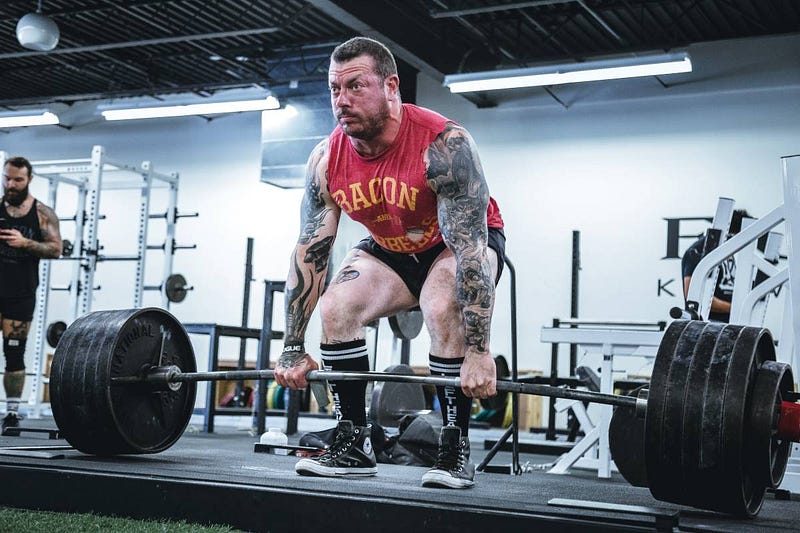
Photo by Alora Griffiths on Unsplash

Push-Pull-Legs (PPL)

The Push-Pull-Legs split is a popular exercise routine, ideal for both intermediate (2–5 years experience) and advanced lifters (5 years plus).

Related muscle groups are trained together in the same workout.

  • A “push” workout trains the upper body pushing muscles, i.e. the chest, shoulders and triceps.
  • A “pull” workout trains all the upper body pulling muscles, i.e. the back, biceps and rear delts.
  • In a “legs” workout, you train your entire lower body, i.e. the quads, glutes, hamstrings, calves and abdominals.

Alternate between the three routines. For example, cycle through twice a week over six days, with one rest day. However, you could do 4 or 5-day splits — it just means your workouts won’t be on the same day every week (which can be confusing).

The routine is so effective because some of the best compound movements overlap on which muscle groups they work, creating synergy with your exercises in a given workout.

For example, when bench pressing, the chest is the primary muscle targeted. But, we also work our anterior (front) deltoids (shoulder) muscles and triceps as secondary muscles. Lumping all three of these muscle groups into one workout makes sense.

However, the legs are slightly different. There are several muscle groups in our legs, and we activate them with different movements. For example, the quad's primary role is leg extension, whilst the hamstring contracts with a curl movement.

Training legs at least twice a week allows us to focus more energy on the Quads one day and on the Hamstrings the other day.

Example of the push-pull-legs split:

  • Monday — Push
  • Tuesday — Pull
  • Wednesday — Legs
  • Thursday — Push
  • Friday — Pull
  • Saturday — Legs

Doing the PPL split twice a week is far more optimal for building muscle than only training each muscle group once.

A 2016 systematic review and meta-analysis from Schoenfeld and colleagues concluded that training a muscle group twice a week is better than once. If the volume is equal, it’s unknown that increasing the training frequency of a muscle group more than twice a week will lead to more gains.

Therefore, as far as we currently know, twice a week is enough to maximise muscle growth.

“The current body of evidence indicates that frequencies of training twice a week promote superior hypertrophic outcomes to once a week. It can therefore be inferred that the major muscle groups should be trained at least twice a week to maximize muscle growth; whether training a muscle group three times per week is superior to a twice-per-week protocol remains to be determined.” — Schoenfeld et al., 2016
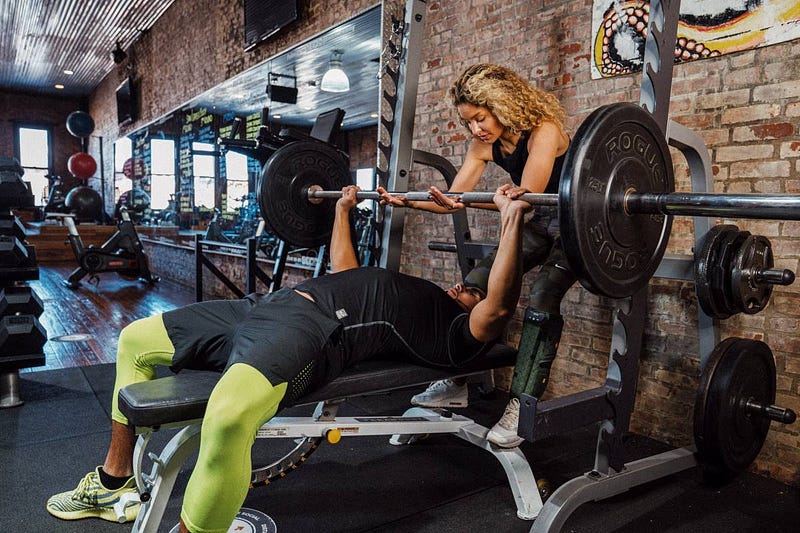
Photo by Michael DeMoya on Unsplash

Upper and Lower Body Split

The upper and lower body split is the final exercise routine to help you build muscle. It could be perfect for you if you have precisely four days in the gym each week.

The benefit of an upper and lower body split is similar to a push-pull-legs split as you can easily hit your largest muscle groups twice a week. As discussed, hitting a muscle group twice a week is more effective for building muscle than just once.

A downside of this split is that if only have a small window of time for a workout, you might struggle to fit in enough volume. The upper body has several muscle groups, which is why it is usually split up into push and pull exercises.

According to a 2018 study out of Sydney, Australia, each muscle group requires at least ten sets a week to maximise muscle growth. Therefore, to hit each muscle group (Chest, Back, Traps, shoulders (front, side and back), Biceps, and Triceps) with ten sets a week, that’s a total of 70 sets over two workouts.

Doing 35 sets is a lot of training volume to fit into one session. 15 to 20 sets will be far less fatiguing, allowing us to train at a high intensity throughout the workout.

However, if you only have four days to spend in the gym, the upper body split will still allow you to build a good amount of muscle. Just bear in mind that your workouts might take a little bit longer.

An example of an upper and lower body split:

  • Monday — Upper body
  • Tuesday — Lower body
  • Wednesday — rest
  • Thursday — Upper body
  • Friday — Lower body
Photo by Sven Mieke on Unsplash

Discussion: What’s the best workout routine to build muscle?

There is going to be no definitive answer to this question.

The best exercise routine to build muscle is something to easily fit into your lifestyle — something that becomes a routine.

A push-pull-legs split MAY be better than an upper and lower body split for building muscle… But, if you can’t stick to it, it’s no better.

Six days in the gym is a lot to commit to.

Your exercise split also needs to be a routine that you enjoy. Something that will push you to improve.

Some people might enjoy a full-body workout. It may be boring for them to work out the same group of muscles for a whole hour.

In terms of choosing the best exercise routine for you:

If all else is equal and you want the absolute best plan to build muscle, you should work out each muscle group at least twice a week.

Therefore, the bro-split should probably get the kick.

However, it’s unclear whether hitting a muscle group more than twice a week will lead to more muscle growth. So, twice a week should be enough to maximise your muscle growth.

These effects (muscle growth) seem to be primarily driven by training volume because when the volume is equated, there was no significant effect of resistance training frequency on muscular strength gains. — Grgic et al., 2018

Unless you REALLY enjoy a full-body training split, it’s probably not optimal for most people wanting to build muscle.

Finally, allow for enough total sets for each workout to target each muscle group with at least ten sets a week. Twenty total weekly sets are probably slightly better than ten

The more advanced you become as a lifter, the more volume is required to keep progressing forward. However, a newbie lifter won’t be able to manage the same amount of training volume without fatiguing.

A newbie lifter will get great results from a three-day full-body split. An advanced lifter, not so much.

The two options that are probably best for building muscle for most people are the PPL and the upper and lower body split.

However, what’s most important is actually attending the gym regularly, with a plan and a purpose. The total training volume is the ultimate driver of muscle growth, along with the rep ranges, exercise choice and training intensity.

For a basic guide on what exercises and rep ranges will be most beneficial to your goals of building muscle, check out the list below.

Focus your energy on these exercises, and the compound lifts in particular, to give yourself the best possible chance to build muscle and increase strength.

Compound lifts:

  • Deadlifts (3–6 reps)
  • Squat (3–6 reps)
  • Bench Press (3–8 reps)
  • Overhead Press (3–8 reps)
  • Dips (8–15 reps)
  • Pull-Ups (6–12 reps)
  • Barbell Rows (6–10 reps)

Isolation exercises:

  • Bicep Curls (8–15 reps)
  • Lateral Raises (10–15 reps)
  • Face Pulls (10–15 reps)
  • Hanging Leg Raises (6–15 reps)
  • Calf Raises (12–20 reps)
  • Hamstring Curls (12–20 reps)
  • Leg Extensions (12–20 reps)
  • Lat Pulldown (10–15 reps)
  • Barbell Shrug (8–12 reps)

If you want to know what exercises that you shouldn’t be doing, read the article below.

Final Words

In this article, we have explored four popular exercise routines/splits to help build muscle.

These exercise splits are the bro-split, the full-body split, push-pull-legs, and an upper and lower body split.

If your goal is to build muscle, you should give all of these routines a try. You can then see what works best for you.

What matters most is that you enjoy your exercise, train at a high intensity, and hit each muscle group with enough volume (10 sets a week) to force your body to adapt by building more muscle.

Good luck!

Thank you for reading.

If you enjoyed the content, you might be interested in this article about 15 high-protein foods that help build muscle.

Read More Medium Articles

Non-Medium members can only read 3 articles a month.

Become a Medium Member for unlimited access to my content and articles from thousands of other writers, for just $5 a month.

Subscribe to be notified when I publish new content.

Fitness
Health
Bodybuilding
Exercise
Self Improvement
Recommended from ReadMedium