
How Much Weight Should We Lift for Different Exercises?
Choosing the optimal weight for maximising our muscle-building and strength gains.
Do you go to the gym and half-heartedly lift a bunch of random weights for a random amount of reps?
If the answer is no, good.
If you answered yes, well that’s probably why people probably can’t tell that you lift.
To get stronger and build muscle, you need to train with intensity.
And, you need to train smarter.
To get the best results at the gym, we need to calculate and then lift the optimum amount of weight for a set number of reps
Picture this…
You arrive at the gym for your workout.
You are going to start with the bench press. You do a few warm-up reps.
Then, you put 80kg on the bar. Your workout plan says 3 sets of 8 reps.
Last week, you did 70 kg for 10 reps, so this should be about right.
The 1st set feels good and moves smoothly. After finishing, you feel like you could have completed 3 to 4 more reps. So, you add another 5 kg on each side, making 90kg.
You’re going to aim for 8 reps again. The last set was easy!
But, 90kg feels way heavier than anticipated and you can only squeeze out 5 rough reps.
You’re feeling a little fatigued now. So you take the 5 kg off each side.
For the final set, you complete 8 “half reps” of the 80 kg.
Then, you move on to the next exercise…
Do you see the problem?
Although the reps were lower, the second set was the only one trained at suitable intensity. But, it probably didn’t have enough reps to stimulate muscle growth.
If we know our optimal weight on the bench press for 8 reps is 87.5kg, then we can go straight to that weight, doing three really effective sets.
If we do effective sets consistently, we make progress!
Calculating the optimal weight to lift
In some workout plans, we might be provided with a percentage of our 1RM.
For example, it might be 3 sets of 3 reps at 80% of 1RM.
But, what does this even mean? And how do we calculate it?
One-Rep Max calculator
1RM is our one-rep maximum — the most amount of weight we can lift for one rep.
To calculate our 1RM, we can use a one-rep max calculator. Enter the maximum number of repetitions you know you can achieve for a particular weight and the calculator will estimate your one-rep maximum.
For example, you might be able to squat 100 kg for 10 reps before you fail.
Bear in mind that if we never train close to true failure, this figure won’t be accurate. Therefore, RPE is important when it comes to calculating your 1RM.
RPE
Only approximately 1 in 5 people train at the optimum intensity level to build muscle. Many of us leave several “reps in the tank”, meaning, we could probably physically complete many more reps before we end a set.
The rate of perceived exertion (RPE) guides the intensity level of a set. On a scale of 1 to 10, an RPE of 1 represents a set with little-to-no effort and 10 is a person pushing to their physical limit.
Repetitions in reserve (RIR) sit alongside RPE. After we finish a set, it is the number of reps we could still physically complete before we fail.
At a very basic level, adding both RPE and RIR together should result in 10 — for example, an RPE of 8 is an RIR of 2.
The majority of our sets should be at an RPE of 8. We’re training hard, but leave some energy to reduce fatigue before the end of the workout. We don’t want to compromise recovery.
Therefore, to calculate a true 1RM (without actually physically testing it), we must use a weight we lifted at an RPE of 10.
Otherwise, our 1RM could be much higher than we think. If we use a figure that is lower than our true 1RM, we’re not going to be training heavy enough to make strength and muscle gains.
How to calculate your lifts when a 1RM% isn’t provided
Once we know our one-rep max, we can calculate the weight we should lift for a set number of reps. For example, a program might say 3 sets of 10 reps for bent-over rows.
But, what if a percentage of your 1RM isn’t provided? How do we know the optimum weight to progress in different rep ranges?
We might choose a weight too heavy that you can’t finish the set number of reps. Or, the weight may be far too light to be effective.
StengthLevel.com provides a great guide on what percentage of your 1RM is optimum for different numbers of reps.
If your plan doesn’t provide an RPM percentage, use the table below as a guide.
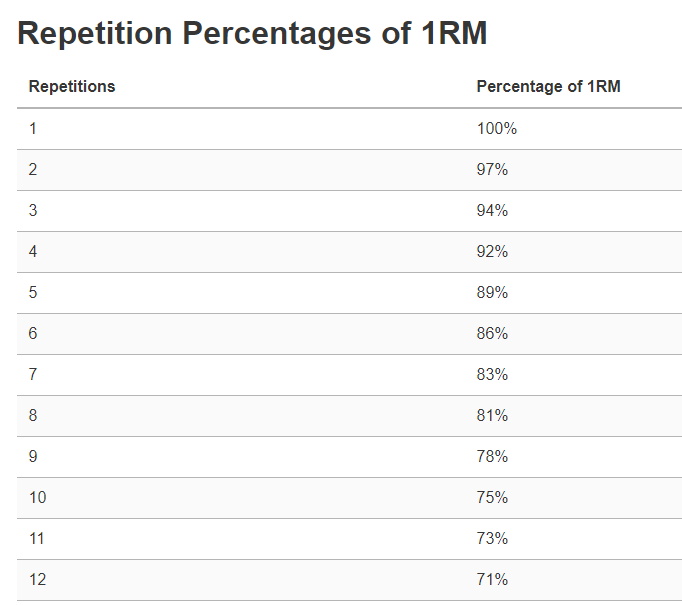
Then, use a percentage calculator to work out the weight. For example, for 12 reps, we should use 71% of our 1RM. If my Squat 1RM is 170kg, 71% of this is 120kg.
However, we should keep RPE in mind.
Using these exact figures means training at an RPE of 10 on every set, which isn’t practical. Consistently training at an RPE of 10 means we will quickly fatigue and can’t train to our full potential for the whole workout.
Using an RPE of 7 for example means leaving 3 reps in reserve. If we add those to the 12 reps, 15 reps give us a percentage of 67, equalling 114kg.
SPECIAL TIP — Calculate1rm.com provides a very useful reps and weights calculator. Based on calculations using three different scientific formulas, this tool will help you estimate your 1RM and the optimal percentages to use for different rep ranges.
Concluding Thoughts
In summary, we might not always know the optimal amount of weight we should lift for a certain amount of reps. To maximise our gains in the gym, we need to train at a high intensity/effort level, where we’re going close to failure.
Therefore, if the weight we are lifting is too light, we’re not going to get the best results. After a point, we won’t get any results at all.
Plateau is what people at the gym call it.
To build muscle or get stronger, we have to progressively overload.
This article explores how to calculate the optimum amount to lift in the gym.
With experience and structure, we might know these numbers. But the reality is, that most people don’t keep a precise enough workout journal to tell them the optimal amount to incline dumbbell press for 12 reps which brings them to the point of failure.
Most people don’t keep a workout journal at all. But, they have a calculator on their phone.
And, they might know the maximum they can lift for 6 reps. Or 8. Then, they can calculate the optimal amount to lift for the 12 reps, or 15 if that’s in your plan.
Thank you for reading.
I hope you found the content useful to progress toward your fitness goals.
If you enjoyed the content, you might be interested in this article about 5 exercises you should be doing to maximise muscle growth.
Subscribe to be notified when I publish new content.


