
11 Rules for a Great Workout
Follow these rules to reach your goals in the gym
Do you want to get stronger and build muscle? But do your workouts suck? Or are your workouts great, but your results suck?
If you don’t want to waste your time in the gym on bad practices that won’t get you the body you want, then this is the article for you!
Eleven rules for a great workout.
Why aren’t there ten rules? Because there are eleven. I will also use science to back up my reasoning. Now, here we go.
Eat 1–2 hours before your workout
The pre-workout meal is perhaps the most important meal of the day for any athlete or person wanting to build muscle. What you consume before your workout influences your training effectiveness.
To maximise your performance and ultimately muscle growth, you must optimise your energy levels for your workout, you need to fuel yourself to provide the energy required.
“Pre- and/or post-exercise nutritional interventions (carbohydrate + protein or protein alone) may operate as an effective strategy to support increases in strength and improvements in body composition. However, the size and timing of a pre-exercise meal may impact the extent to which post-exercise protein feeding is required.” — Kerksick et al., 2017
A pre-workout meal provides nutrients in two key ways — the first is fuelling your workout primarily via carbohydrates. Secondly, putting your body in an anabolic state during training primarily via protein
Eating one to 1.5 hours before training is usually ideal.
In terms of your macronutrients (calories), as a general rule:
- .5 to 1 gram of carbohydrate per kilogram of body weight
- 0.2 to 0.5 grams of protein per kilogram of body weight
- 0 to 20 grams of total fat
Carbs ideally come from a lower glycemic carb source such as brown rice or unprocessed oats, plus a serving of faster-digesting carb such as fruit.
The amount of fat in your pre-workout meal depends on how close the meal is to the workout itself. Dietary fat slows digestion; so, if you eat too close to training, your body might still be digesting food. Fibre can also help slow down digestion.
You could feel lethargic or bloated.
However, if you eat your meal too far out from training, you risk lacking energy.
If you’re training legs for like 3 hours and you eat 2 hours out from training, you want a calorie-dense meal in protein, carbs, and fats. Thus, you get sustained energy throughout the workout.
Some people feel bloated and tired after a big meal.
Or, in a rush from a meeting going late, or slept in, and need to train within the next 20 to 30 minutes. In this case, have a small fast-digesting meal such as a protein shake with a banana or blended with oats (which will increase its absorption time).
Or might feel bloated or sluggish after a big meal; in this case, something light and quick like a whey protein shake and a banana…
In terms of your post-workout shake or meal, as long as you have a decent pre-workout meal with protein, eating immediately after your workout isn’t so important. You can get away with 4–5 hours between pre and post-workout meal
“Due to the transient anabolic impact of a protein-rich meal and its potential synergy with the trained state, pre- and post-exercise meals should not be separated by more than approximately 3–4 hours, given a typical resistance training bout lasting 45–90 minutes. If protein is delivered within particularly large mixed-meals (which are inherently more anticatabolic), a case can be made for lengthening the interval to 5–6 hours.” — Aragon & Schoenfeld, 2013
Train at a high intensity
If the intensity of your workout is lacking, you won’t get the results you want. You won’t progressively overload.
RPE (rate of perceived exertion) is used to measure the intensity level of a set. from 0–10, the numbers rate how “hard” a set was.
Zero is no effort and 10 is an all-out effort leaving you laying on the ground exhausted. For example, 70–80% intensity would be an RPE of 7–8.
Without complicating it too much, aim for a true RPE of 8 or 9 on most sets. On heavy compound lifts, aim for an RPE of around 7 or 8, otherwise, you’ll find yourself fatigued for the rest of the workout.
In a 2017 study, only 22% of subjects trained at the optimum effort range of 8–10 RPE for stimulating muscle growth. Around 31% of people trained at an RPE of around 5–7 — sub-optimal for creating an adaptive response. The other half of the people in the study (47%) trained at an intensity level where they won’t really build any muscle at all.
In other words, over three-quarters of people aren’t training hard enough to optimise their ability to build muscle!
Training close to failure is important as there is an intensity threshold that we must pass to stimulate muscle hypertrophy (growth) effectively. We must stimulate adaption.
So, train your ass off. Don’t feel embarrassed about what your facials might look like as you push through that last rep or 3.
To build muscle, training intensity matters. We need to create a strong enough stimulus to force our bodies to adapt. You must train close to failure and consistently aim to improve your personal records on key compound lifts (bench, squat, deadlift, overhead press, pull-ups, dips).
As a side note, our training shouldn’t be so intense that we take every set to failure.
Training to failure is very fatiguing and compromises recovery. Therefore, failure sets should be left until the last exercise of our workout.
Get your rest periods right
Rest periods are not all made equal.
They must either be long enough to recover and build muscle or short enough to keep your heart rate high enough to burn calories.
Across much of the exercise literature, it’s generally agreed that the most effective rest period for building strength is 3–5 minutes and 1–2 minutes for building muscle.
Longer is potentially better for strength training, but if we spend 5 minutes or more between every set, we’ll be in the gym all day. And the extra gains will be marginal.
Is it worth doubling the time of your workout to achieve only slightly better results? For many, probably not.
If you don’t have much time for your workout, you shouldn’t be overly concerned, as research indicates that you can still build muscle on short rest periods, as long as they’re at least a minute long. If your key goal is strength, rest a little longer so your energy levels are high for each set.
“Hypertrophy-style protocols typically involve greater volume (3–6 sets; 8–12 repetitions), moderate intensities (<85% 1 repetition maximum [1RM]), and short rest intervals (30–90 seconds), whereas strength-style protocols typically involve higher intensities (≥85% 1RM), low volumes (2–6 sets; ≤6 repetitions), and longer rest intervals (3–5 minutes).” — Gonzalez, 2016
For an in-depth discussion, check out the below article.
Perfect your technique
Ever heard of ego-lifting?
Don’t be one of those guys (or, girls). Ego lifting is lifting more weight than you should.
People who prioritise the weight of the load over form. Which could have disastrous consequences!
It could be to try to build muscle and increase strength or simply to impress people in the nearby area.
Ego lifters may think they look impressive, and they might look impressive to gym newbies, but besides looking mostly like a dick, they massively increase their injury risk.
Examples of a person's ego lifting are:
- going too heavy with the weight
- using bad technique/form
- half repping, aka poor range of motion
As defined by a user on Urban Dictionary:
“The act of lifting heavy weights for the sole purpose of impressing other people in the room. This is usually done with awful form and gratuitous grunting noises.”
Using the optimal technique to maximise the tension on the muscle will help you build more muscle and strength in the long run, by reducing your chance of injuries.
Use a PT over a few sessions to perfect your technique and you can film yourself to break your technique down and monitor it long-term.
Do compound exercises
The foundation of your workout should be free-weight compound exercises. Exercises that use multiple joints and muscle groups to perform, such as squats or bench presses.
High reps are fatiguing with compound lifts, so we should stick to lower rep ranges, have longer rest periods and we don’t train to failure. Reps will be fast and explosive, focusing on efficiency and optimal form.
Some compound exercises you should be doing are: Deadlifts, Squats, Leg Press, Lunges, Bench Press, Overhead Press, Dips, Pull-Ups, and Barbell Rows.
To load the lifts to gain real results, you do require proper equipment like a squat rack and bench.
To break down some of those exercises, you can read the article below.
Do isolation exercises
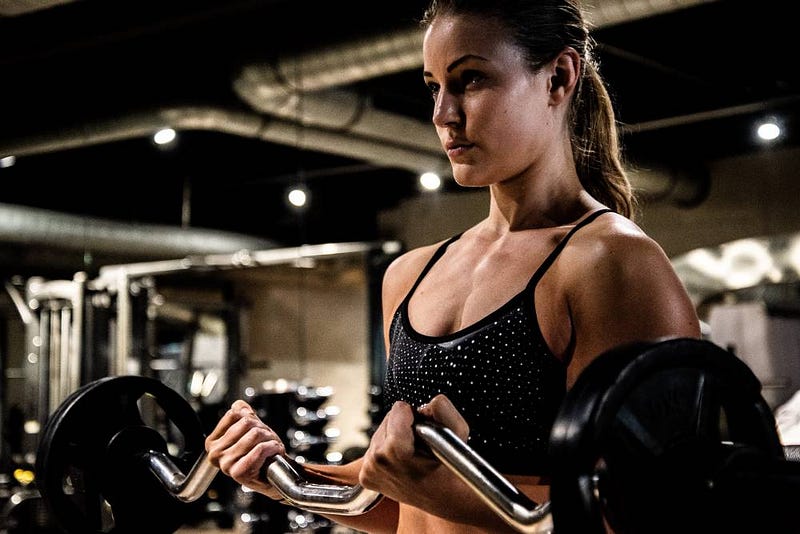
Exercises that target just one muscle group are called isolation exercises and they also have their place.
Once we’re fatiguing from the heavy compound lifts such as squatting, machines have their place to help us really isolate the muscle groups we’re targeting. These exercises take less energy overall; so even though we’re fatigued, these machines allow us to train at a high enough intensity level to damage the muscle, forcing it to adapt by growing back bigger/stronger (in basic terms).
Isolation exercises are trained closer to failure, using techniques such as forced reps or drop sets, repetitions are slower and more controlled, focusing on time under tension and mind-muscle connection.
Stick to the 8 to 15-rep range for most of your isolation exercises, as this will best stimulate hypertrophy and minimise the fatigue of heavier loads.
Exercises that you should be doing include: Bicep Curls, Lateral Raises, Face Pulls, Chest flies, Tricep pulldowns, Hanging Leg Raises, Calf Raises, Hamstring Curls, Leg Extensions, Lat pulldowns, and Barbell Shrug.
Save cardio until after your workout
Don’t make the mistake of doing your cardio before your workout.
Yes, you should do a low to medium-intensity warm-up for 5-10 minutes, to get your joints and muscles warmed up and help reduce injury risk. But if you’re planning a 30-minute run, do it after your workout. Otherwise, doing the cardio first means you’ll expend energy, and you’ll be highly fatigued for your weights workout.
If you’re fatigued, your workout will lack intensity and you’ll struggle to get the results you want.
2017 research from Küüsmaa-Schildt and colleagues reflects this, finding that if a person does strength training and cardio during the same session, they could lift more and/or do more sets if they did cardio after weights.
If cardiovascular endurance is your main goal, do the cardio first.
Ideally, if you want to do both on the same day, you’d schedule your cardio in the morning, let your body recover and then lift weights in the afternoon or evening. However, exercising twice a day isn’t practical for most people. Many people struggle with it just once a day!
Do the most important exercises first
If you do full-body workouts, what muscle groups would you most like to improve? What’s the best exercise to target those muscle groups? Do that exercise first.
If you’re doing a split, what are the most important compound exercises for the muscle group/s you’re targeting?
Do that exercise first.
Most of the time, a multi-joint exercise comes before a single-joint exercise. For example, squats before leg extensions. Overhead press before a lateral raise.
Focus your energy on these exercises to give yourself the best possible chance to build muscle and increase strength.
2010 research concluded that “if an exercise is important for specific training goals, it should be performed at the beginning of the training session, whether or not it is a large or a small muscle group exercise.”
Moreover, 2012 research found that exercise order affects a person’s performance throughout a workout. The results showed that person can do more total sets of the given exercise at the beginning of the workout.
“Greater strength increases were evident by untrained subjects for the first exercise of a given sequence, while strength increases were inhibited for the last exercise of a given sequence. Additionally… the research suggests that exercises be ordered based on priority of importance as dictated by the training goal of a programme, irrespective of whether the exercise involves a relatively large or small muscle group.” — Simão et al., 2012
For a rundown on exercises to avoid, check out the article below.
Vary your rep ranges
How many repetitions (reps) we do for each exercise depends on the exercise itself, how we structure our workout, and our goals.
In simple terms, the practical rep range is around 3–20 reps. If you stay in this zone, you can’t go wrong.
Why? There are three key factors here when it comes to rep ranges.
First, we want to lift close to our 1RM to “shock” our central nervous system by exposing it to weight it’s not typically used to. Strength athletes will periodically train in blocks in the lower rep ranges near their PR.
Second, we want to do enough reps to maximise muscle growth.
Thirdly, we want to reduce our injury risk and fatigue.
We need to recover for our body to adapt and build more muscle.
The accumulation of volume in heavy rep ranges (1–5) is difficult as far more sets are required to have the same hypertrophic effects. For example, a 2014 study from Schoenfeld and colleagues found that 3 sets of 10 reps will build a similar amount of muscle as 7 sets of 3 reps.
As we’re going to reduce our injury risk, but build the same amount of muscle, it makes sense to have most of our exercises in higher rep ranges as it requires fewer sets and accumulation of fatigue to be effective.
This is because strength training requires much heavier loads much closer to our 1RM (one rep maximum), which becomes taxing on our joints.
Higher rep ranges tend to improve endurance and build a higher work capacity more resistant to higher volumes.
“A common area of concern with powerlifting-type training is an increased potential for injury. The performance of high training volumes using very heavy loads places substantial stress on the joints and soft tissue structures. This may make an individual more susceptible to muscle and connective strains, as well as increasing the potential for long-term degenerative changes at the working joints.” — Schoenfeld et al., 2014
Training with fewer than 6 reps does have its place for strength training. But it is fatiguing and requires long rest periods between sets.
Moreover, because low-rep workouts require more total sets and rest periods, they end up taking far longer. Therefore, less than a quarter of our total workout volume should be within this rep range.
Start your workout with your strength-focused exercises in the lower-rep ranges.
Training with heavy loads is better for building strength, leading to more muscle growth in the long term. This is because can lift more weight overall with our isolation exercises in the higher rep ranges. Thus, we put more tension on the muscle, stimulating more hypertrophy.
“Both bodybuilding- and powerlifting-type training promote similar increases in muscular size, but powerlifting-type training is superior for enhancing maximal strength.” — Schoenfeld et al., 2014
For an in-depth discussion about rep ranges, check out the below article.
Minimise distractions to focus
This next tip is really two tips in one. But you don’t get one without the other, and focusing on the gym is crucial to achieving your fitness goals.
Get into the zone. Shut people out with music in your headphones!
Focus on your workout and what you want to achieve. You’ll create a much better mind-muscle connection and build more muscle.
You’re not there to keep up appearances. Think about your goals and how you’re going there to achieve them.
Be specific with your goals, as this is what will help hold you accountable to follow through and see results.
Results depend on training with high intensity and progressively overloading. You can do this by:
- doing one more rep at the same weight
- increasing the weight for the same reps
- an improved technique for the same weight and reps
- more total sets targeting a muscle group
Just as importantly, don’t let others distract you in the gym.
Don’t get stuck in the habit of using the gym to socialise. It’s a trap! Your workouts will end up taking much longer, and you’ll put less time into doing “hard” sets that get results.
If you train with somebody, ensure they have similar goals and are equally dedicated. The number of people I’ve seen over the years training in groups that have really shitty workouts that take 2–3 hours…
One big issue is both of you will have different strength levels; therefore, you need to use a different weight for the given sets. You either must keep changing the weight and cause extra fatigue, or the stronger person is training at a weight that isn’t sufficient for progressively overloading.
Don’t worry about what others think
If you’re too concerned with fitting in with other people, you won’t maximise your lifts. You won’t train hard enough because you think people are judging your facials as you squeeze everything out of your last set.
I don’t like too many people in my personal space when I work out. After a heavy set of squats or something when I’m gasping for air, I don’t want people to nearby. It feels uncomfortable.
I’ve learnt to shut out my surroundings because it does get busy. If I want to make progress, I need to work hard!
Moreover, if you’re new to the gym and don’t look a certain way, some people will dismiss you. People with better genetics or who have been in the gym much longer. Having better genetics for being leaner or building more muscle doesn’t make you a better person. So, f**ck them!
If you focus on why everyone else looks great and how you’re making shitty progress, you’ll only be discouraged.
People constantly comparing themselves to others can just end up using it as an excuse for their own lack of progress.
Focus on your own goals of fat loss and body recomposition goals.
Likewise, if you worry about how people perceive you or your appearance, or exercise choice, it’s not empowering you with the right mindset.
Final Thoughts
In conclusion, we’ve just discussed eleven gym rules that you should follow to get fit and build muscle.
Those rules are:
- Eat 1–2 hours before your workout
- Train at a high intensity
- Get your rest periods right
- Perfect your technique
- Do compound exercises
- Do isolation exercises
- Save cardio until after your workout
- Do the most important exercises first
- Vary your rep ranges
- Minimise distractions to focus
- Don’t worry about what others think
Don’t get caught up exerting time and effort into crazy things that you might have heard from some random gym bro, read in Men’s Health or watched once in a TikTok video. Chances are, you’ve only seen it once because it’s rubbish!
Thank you for reading.
If you enjoyed the content, you might be interested in this article about 7 common gym mistakes that you should avoid.
Read More Medium Articles
Non-Medium members can only read 3 articles a month — become a Medium Member for unlimited access.
If you would like to read more articles like this one, sign up to become a Medium member for only $5 a month.
Subscribe to be notified when I publish new content.


