
Medium Writing Tips
Medium Writing Tips — An Updated Guide to Writing on Medium
Medium Writing Tips for Amazing Stories (Updated Monthly)

I had previously written an article called 59 Medium Writing Tips. While I meant for this previous article to be a comprehensive list of Medium writing tips, I have since realized that the layout and length of the article have made it far less useful to writers than I had hoped.
I created Medium Blogging Guide with the hope of empowering Medium writers to reach a wider audience, increase their earnings, and address some of the questions that I researched throughout my own journey writing on the platform.
This new article is a completely revamped, comprehensive guide to the most important Medium writing tips. Some of these tips were briefly covered in the previous article. Many are entirely new tips or revised tips with a better and more concise explanation.
I also updated the Medium writing tips in this article to reflect the many recent changes that have occurred on the Medium platform. I will update this article monthly or whenever Medium makes any further major changes.
I hope you find this guide useful!
Note: This list is focused on general Medium writing tips for writer success. If you have additional questions about Medium Earnings, Medium Article Formatting, Medium Publications, Medium Tools, or just want to read all of Blogging Guide's Articles, please check out the links below.Earnings / Article Format / Tools / Publications / All Articles

Medium Writing Tip #1 ✏ Build Your Email List ASAP

In order to maximize your time spent creating content for Medium readers, you need to work on email list building. Email list building is the act of getting more people to subscribe to your emails.
Email lists are important because email marketing is the best way to connect with customers vs. social media. In fact, you are 6x more likely to get higher click-through rates through emails instead of tweets.
Building an email list is especially critical on Medium because you don’t have the ability to easily or directly contact your Medium profile followers.
So even if you are not ready to actively start an email campaign, I would highly recommend that you start collecting emails of your audience.
This is something that I got a late start on, but have recently been working on. It can take a lot of work and there is definitely a learning curve, but the sooner you start building an email list, the sooner you can promote relevant articles to your true Medium followers and the sooner you can begin building your own brand/business as a writer.
Now that I have an email list, I have the opportunity to connect directly with readers. For example, if someone wants to learn more about writing on Medium, they can easily subscribe to my Medium Blogging Guide email list. Once they do so they will receive exclusive updates on new content as I add it to Medium. Best of all this process is entirely automated.
Similarly, I have an email list for one of my other publications, Escaping The 9–5.
Subscribers to this email will receive access to exclusive articles covering new passive and active income streams, personal finance, and entrepreneurship.
The beauty of having an email lists is the ability to target segments of your audience.
I could send out one mass email for all my 7 publications, but they all contain articles on totally different topics.
Someone who is interested in learning about the content in Escaping The 9–5 may have no interest in Medium Blogging Guide.
By segmenting my readers, I am able to not only reach out to them directly, but to better help them get the content they actually care about from me.
Medium Writing Tip #2 ✏ Research The MPP

Medium’s partner program allows practically anyone to easily publish and monetize their writing. And as I’ve discussed, there are many people making supplemental income or even full time income through the program.
But checking the accept box when publishing a Medium article, does not guarantee that an article will be successful. It simply means it is eligible to make money.

As with any system or business, take the time to understand how Medium works before you spend hundreds of hours writing posts.
I see many writers posting comments on Facebook groups or in response to articles that suggest they do not understand how Medium compensates writers at all.
This is partially Medium’s fault for not making the earnings process more transparent. But if you take a few hours and search Medium, there are a number of very useful posts designed to help writers.
While I am by no means the sole authority on Medium, I have written dozens of posts which could save writers hours of research and vastly increase their earnings. Many of these articles answer pretty much any question you might have about the Medium Partner Program, including: historical earnings, tips to increase article profitability, guides explaining how payments are calculated for writers on Medium, and even surveys which contain author self reported earnings.
Writing for Medium is a fantastic way to express creativity and passion. But if you want to make money, you need to approach it systematically and take the time to understand the underlying compensation system.
Medium Writing Tip #3 ✏ Get Curated

While there is a constant debate among Medium writers about the exact extent to which curation matters, there is no question that curation does matter for most writers.
Curation on Medium means that your story has been distributed through one or more topics on the platform.
Curators have a lot of say in selecting “the best writing” on Medium. Curators are the gate keepers of Medium’s coveted homepage, topic pages/top writer lists, the Daily Digest newsletter, and other emails that millions receive.
Curated content also appears to fair better over longer periods of time as readers are sent old (but good) curated articles periodically.
Only select topics are eligible for Medium curation:
Medium also have a number of rules and guidelines which establish what content is eligible for curation:
While this may seem daunting at first, most curation guidelines are pretty easy to remember. And even if you do have trouble with one required element of curation, chances are there is already an article covering that.
For example, Medium cares about how you format your article titles. Standard headline styling, preferred by Medium, is title case for the headline and sentence case for the subtitle. This isn’t a firm requirement, but it can be a deciding factor for editors looking for articles to curate.
I wrote an article expanding on this point, and I even provide a link to a free tool that will format your titles automatically:
Bottom line — learn what is expected of writers, format your articles appropriately, get curated, and you will see at least some level of success on Medium.
Medium Writing Tip #4 ✏ Write Consistently
There is no substitute for hard work and consistency. No hacks. No shortcuts. If you want your new and old articles to gain views, you need to write and publish on a daily basis.
This is underscored by a recent article in which I examined the posting habits of top earning Medium writers.
While some authors do succeed with less frequent posting, these writers almost always have large audiences from outside of Medium, a lot of Medium followers, or are social media influences.
Try your best to publish daily. You do not need to necessarily write everyday as Medium has tools, such as the post scheduling tool, which allow you to write and schedule posts in advance. The important thing is keeping a steady stream of content flowing from your account.
Medium Writing Tip #5 ✏ Custom Article Format

A big appeal of Medium, to many readers, is the clean yet elegant layout of the text and images.
However, many of the best articles on Medium have subtle (yet effective) custom formatting which make them stand out.
There are many Medium article formatting tips, but a few of the top formatting tips are:
- Add drop caps to your article intro
- Add a “kicker” to your article title
- Use custom pull quotes and block quotes
- Adjust the focal point of your article’s featured image
- Customize your Medium article’s meta description
- Share your content with a Friend Link
Medium Writing Tip #6 ✏ Establish a Niche

Medium writer success does not happen overnight. But it also doesn’t happen to writers who erratically jump from topic to topic.
To succeed on Medium, you need to establish a voice that readers become familiar with. This allows you to build a following on the platform that is actively engaged.
Focusing on a few key topics allows you some freedom, but also allows you to build your credentials as a top writer in one or more Medium topics (which are eligible for top writer status).
Medium Writing Tip #7 ✏ Adapt to Change

Medium has pivoted several times as a platform. It is important to keep an eye on the monthly newsletter to remain current on the latest platform changes and trends. It’s also useful to regularly check publications that track change on Medium, since Medium does not always spell out these changes, clearly.
For example, I wrote the first article about Medium adding Alt-Text capabilities to article images, in my publication, Blogging Guide and in my Medium writing newsletter. This came nearly two months before this major update was formally announced by Medium.
Eagle-eyed readers who took note started tagging their images and editing old articles to ensure they got an easy but significant SEO boost.
The importance of being aware of and adapting to change on Medium was underscored this past month, as Medium transitioned to an entirely new method of calculating article earnings.
Medium Writing Tip #8 ✏ Medium Facebook Groups
There are a number of great Medium groups on Facebook. This can be great for new writers with limited followings. It can also be a great place to interact directly with fellow writers and editors of Medium publications.
Personally, I have met many other writers who have helped me achieve success, through Facebook groups. I found these groups so useful, that I even created my own, called Medium Writing. Feel free to join us!
Medium Writing Tip #9 ✏ Include Bio in Article

If a reader is taking the time to read your article, they usually want to know your background or a little bit about you, as an author. That is why they likely chose to read your writing over someone else’s.
This is why I would always suggest that authors include a brief bio at the end of their articles. This is also a great way to feature a call-to-action (CTA) or any lead generation/email list building links.
Medium Writing Tip #10 ✏ Select Unique Images

I see a lot of writers using the same top images from Unsplash for their Medium articles. This is OK — but regular readers notice this. Try to find less commonly used images. This can be hard when you write a lot, but in my experience it is worth the time. Google’s search engine also rewards you for this if the images are completely original.
If you are willing to look beyond free images, and you are writing a lot of articles, it may be worth looking into buying a cost effective package of high quality stock images. I have tried this with great success.
Medium Writing Tip #11 ✏ Respond to Comments
Some of the benefits of responding to all comments are improved search engine optimization (SEO), the gratitude you cultivate as a content creator, and the unexpected advice/tips you may receive from readers.
Maybe I will reconsider my stance on responding to Medium comments when I receive huge amounts of them. However, I’ve had stories do well in terms of claps and views, and I am still rarely inundated by comments. And after examining some of the most popular stories on Medium, there are rarely so many comments that you cannot take the time to issue a simple response.
Medium Writing Tip #12 ✏ Learn Medium SEO
SEO stands for Search Engine Optimization, which is the practice of increasing the quantity and quality of traffic to your website through organic search engine results.
A major component to successful writing on Medium is making your content easily accessible to search engines. If readers do not see your writing, internally, on Medium within 72 hours, there is little chance they will see it again. That is, unless you optimize the HTML elements of your Medium post, which helps with both rank within Medium’s internal search algorithm and in major search engines, such as Google.
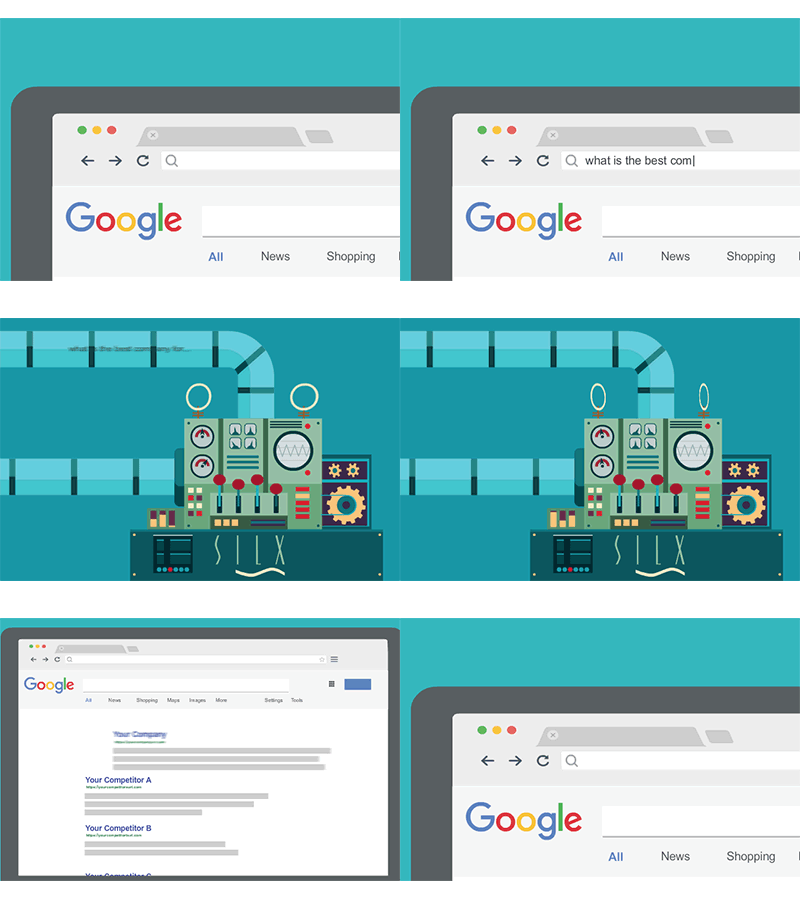
Google’s algorithm evaluates a number of “on-page” factors to determine what a page is about. These on-page ranking factors include the following:
- Title
- Subheadings
- Meta Description
- URL
- Article Content
- Image Tags
Medium provides writers with the ability to include a target keyword in each of these fields. If you want to generate huge amounts of external views, it is essential to optimize each of these fields.
Title

A title tag is an HTML element that specifies the title of a web page. Title tags are displayed on search engine results pages (SERPs) as the clickable headline for a given result, and are important for usability, SEO, and social sharing. The title tag of a web page is meant to be an accurate and concise description of a page’s content.
- Google typically displays the first 50–60 characters of a title tag. If you keep your titles under 60 characters, our research suggests that you can expect about 90% of your titles to display properly. There’s no exact character limit, because characters can vary in width and Google’s display titles max out (currently) at 600 pixels.
- Avoid titles that are just a list of keywords or repeat variations of the same keyword over and over. These titles are bad for search users and could get you into trouble with search engines. Search engines understand variations of keywords, and it’s unnecessary and counterproductive to stuff every version of your keyword into a title.
- According to Moz’s testing and experience, keywords closer to the beginning of your title tag may have more impact on search rankings. In addition, user experience research shows that people may scan as few as the first two words of a headline. This is why they recommend titles where the most unique aspect of the page (e.g. the product name) appears first. Avoid titles like:
Brand Name | Major Product Category — Minor Product Category — Name of Product
- Titles like this example front-load repetitive information and provide very little unique value at first glance. In addition, if search engines cut off a title like this, the most unique portion is the most likely to disappear.
Subheadings
A subheading, or subhead, are mini-headlines and play a huge role in capturing and holding the scanners attention. It also keeps them moving down the page from one subhead to the next.
The subheading would ideally be:
- Useful — it shows a promise and a benefit to the reader.
- Unique — it contains a fact or opinion your reader may not be aware of.
- Ultra-specific — this makes a subheading stand out and demand attention.
- Urgent — urgency gets your reader to take notice and action.
Meta Description
The meta description is an HTML attribute that provides a brief summary of a web page. Search engines such as Google often display the meta description in search results where they can highly influence user click-through rates.
- Meta descriptions can be any length, but Google generally truncates snippets to ~155–160 characters. It’s best to keep meta descriptions long enough that they’re sufficiently descriptive, so we recommend descriptions between 50–160 characters.
- A page’s meta description should intelligently (read: in a natural, active, non-spammy way) employ the keywords that page is targeting, but also create a compelling description that a searcher will want to click. It should be directly relevant to the page it describes, and unique from the descriptions for other pages.
URL

A URL (Uniform Resource Locator), more commonly known as a “web address”, specifies the location of a resource (such as a web page) on the internet. The URL also specifies how to retrieve that resource, also known as the “protocol”, such as HTTP, HTTPS, FTP, etc.
- A well-crafted URL provides both humans and search engines an easy-to-understand indication of what the destination page will be about.
- URLs are a minor ranking factor search engines use when determining a particular page or resource’s relevance to a search query. While they do give weight to the authority of the overall domain itself, keyword use in a URL can also act as a ranking factor.
- Well-written URLs can serve as their own anchor text when copied and pasted as links in forums, blogs, social media networks, or other online venues.
Article Content
On the Internet, content sends signals to visitors and search engines about the quality and purpose of a site. Good writing, images, and other forms of content help visitors engage with a site and can build trust. Meanwhile, duplicate content and keyword-stuffed copywriting can indicate that a site is low-quality or even spammy. Content, especially when created according to a defined content strategy, is a cornerstone of effective digital marketing.
- Keyword Research: If you want to generate traffic through search, it’s best to do keyword research before you start writing. This way, you can focus on keywords for which a certain amount of search volume already exists — in other words, write toward topics (or find keyword niches!) that people are already searching for information about.
- Keyword Optimization: Know where and how to use keywords in your content for maximum searchability.
- Content Organization: The content on your site should be organized in a logical way. This is not only good for SEO, it also helps visitors on your site find other related content easily. (The longer they stay on your site, the better.)
- Content Promotion: Increase visibility to new content you create by sharing it on social networks and building links to your content (both internally and from external sites). As I’ve written about before, I love to use Signal. Signal auto-tweets your articles on repeat to help you share your articles and grow your audience on your schedule.
Image Tags
Up until recently, Medium did not allow proper image tagging. However, a few weeks ago, Medium added alt-text functionality, which allows writers to properly tag their images.
If you’re creating content on a topic that requires the support of visuals, consider how your audience might prefer to find answers to their questions on that topic. In many cases, Google searchers don’t want the classic blue, hyperlinked search result — they want the image itself, embedded inside your webpage.
One of the most important things image alt text can do for you is turn your images into hyperlinked search results — giving your website yet another way to receive organic visitors.


Medium Writing Tip #13 ✏ Become a Top Writer

Not to be confused with the list of possible Medium curation topics described earlier, there are currently only 73 topics eligible for top writer status.
As an example, the fictitious article The Impact of Internet Marketing on X Industry, can include the tags: internet, internet marketing, technology, future, business, and it is still eligible for curation in Marketing (one of the possible curation topics).
However, the views a writer receives through this article will only count toward top writer status in technology, future, and business, because out of the 5 sample tags, these are the only 3 on the list of 73 eligible topics for top writer status.
Medium Writing Tip #14 ✏ External Promotion

I had a post go viral on Medium that was primarily driven through traffic from a simple repost on LinkedIn. It took me less than a minute and the article ended up receiving over 30,000 views from LinkedIn alone!
Another great platform to submit your Medium stories to is ManyStories. ManyStories is not affiliated with Medium, but it does contain a large amount of Medium readers and writers. This is advantageous because it gives you a built in audience that already have Medium, while allowing you to promote your writing to readers not on the platform.
You can even use tools like Signal to automate the promotion of your content, on social media platforms, such as Twitter.
Signal can auto-tweet your Medium articles (or any article, for that matter), on Twitter, according to the schedule you set. This can be used to promote new content or revive old content that has faded out of view on Medium’s featured articles, tags, topics, or publications.
Medium Writing Tip #15 ✏ Submit to Publications

Smedian is the largest community of Medium editors and writers. Writers can request to contribute to top and fast growing publications, chat, and grow their audience through writing tools. While it does not contain every publication, it is by far the easiest way to submit content to multiple publications.

Thanks for reading this article! Leave a comment below if you have any questions. Be sure to sign up for the Blogging Guide newsletter, to get the latest tips, tricks, and news about writing on Medium and to join our Facebook group, Medium Writing, to share your latest Medium posts and connect with other writers.
If you liked this article, here are some other articles you may enjoy:

Casey Botticello is an internet entrepreneur and the founder of Blogging Guide, an online community of writers with an award-winning newsletter. He is also the creator of the popular Medium Writing Course and the Substack Newsletter Course.
Casey previously worked at several tech startups, a lobbying & strategic communications firm, and has created several businesses of his own. He is a graduate of The University of Pennsylvania, where he received his B.A. in Urban Studies.
You can connect with him on LinkedIn, Twitter, Facebook, follow his Medium publications, Digital Marketing Lab and Medium Blogging Guide, or reach out to him directly on his personal website.


