
Life Discovery: The Unfoldness of Activity
Unfolding, Modeling, and Storytelling

This article aims to introduce the concept of “Unfoldness” and the related term “Unfolding” for the Anticipatory Activity System (AAS) framework and the AAS for Life Transitions (AAS4LT) framework.
The Unfoldness of Relevance
On April 14, 2022, I sent an email to a theoretical sociologist after I received a recommendation from Academia. We had an email conversion in the following ten days.
I started re-reading his books, papers, and articles. He developed a meta-theory of theoretical sociology and wrote three books and many academic papers in over 10 years.
On May 7, 2022, I had a wonderful afternoon in a beautiful park with my family. I read books and articles and wrote notes. Then, I had an insight into the theoretical sociologist’s work. I should consider his work as a case for the Slow Cognition project.
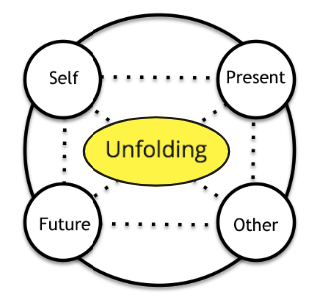
The “Self, Other, Present, Future” schema is the core of the (Anticipatory Activity System) AAS framework. The “Self — Other” Relevance is related to the “Present — Future” Complexity. Both are not static, but dynamic. I’d like to use the concept of “Unfoldness” and the related term “Unfolding” to describe this idea.
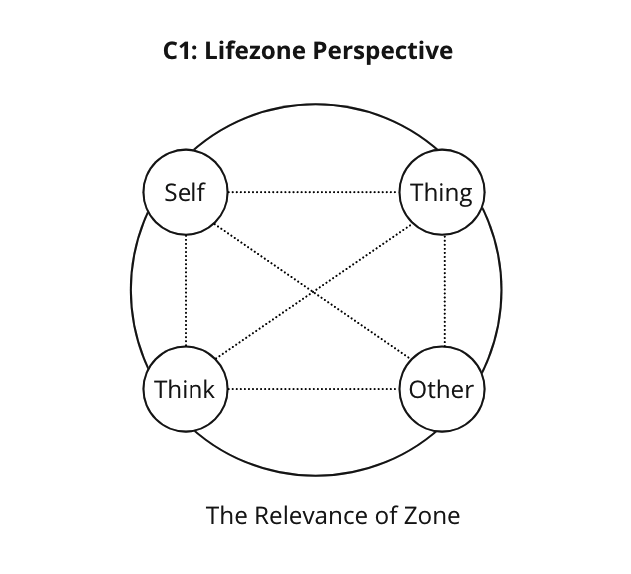
I also used the “Self, Other, Thing, Think” schema to discuss the “Self — Other” Relevance in general. See the diagram below. You can find more details here.
On April 27, 2022, I published an article titled Life Discovery: “Points of Observation” and “Significant Insights” and I used “Decision” for the AAS framework.
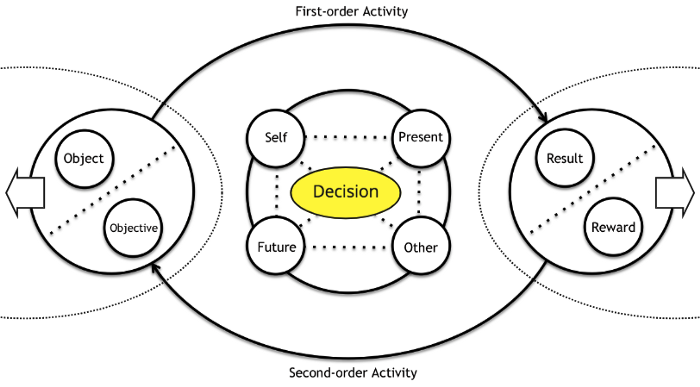
Today, I’d like to use “Unfolding” to replace “Decision” for the AAS framework. I am not going to say “Decision” is not important for Life Activity. I want to use “Unfolding” to highlight the dynamics of the activity of making decisions.
While the term “Decision” is about “mental operation” or “cognitive operation”, the term “Unfolding” is more about “the change of context”.
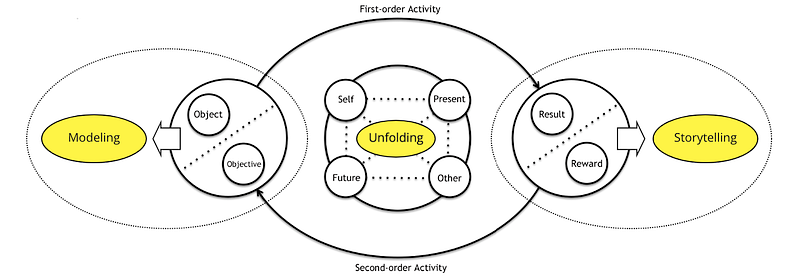
Originally, I consider “Decision, Modeling, Storytelling” as a group of actions for the AAS4LT framework. Now, I want to use “Unfolding, Modeling, Storytelling”.
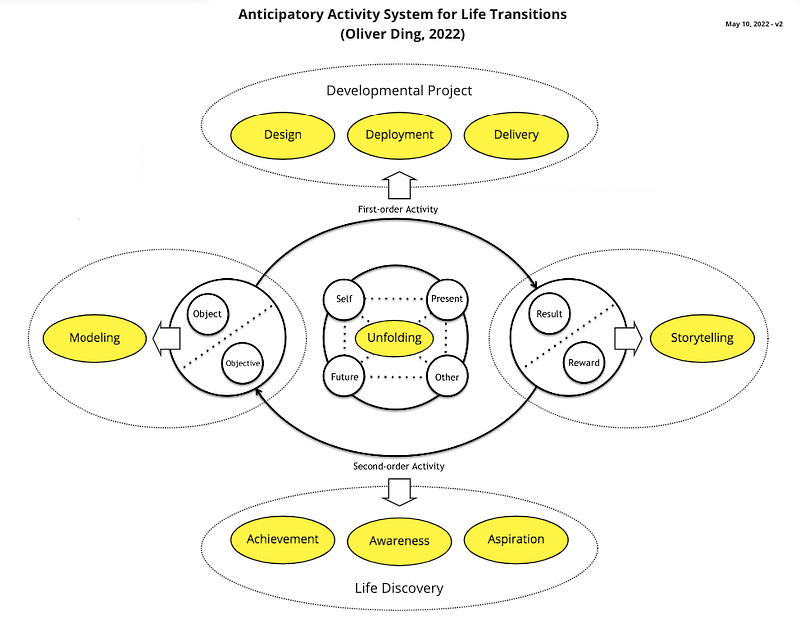
The original version of the AAS4LT framework considers eight steps. The new version of the AAS4LT framework has nine steps or nine movements.
The Unfoldness of Projects
I am recently working on two projects:
On Oct 22, 2021, I published an article and shared the Creative Work Canvas. Two weeks ago, I made a new diagram for Creative Work.
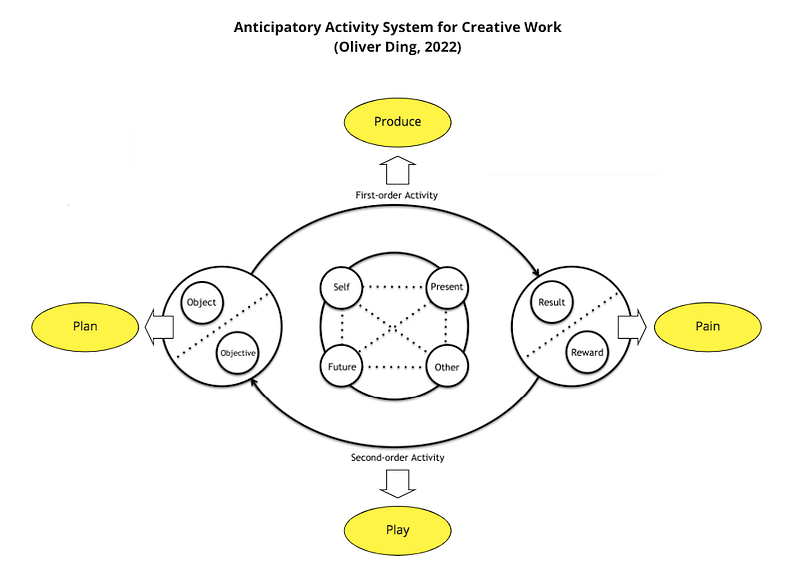
While the Creative Work Canvas is based on the Ecological Practice approach, the new diagram is based on the Anticipatory Activity System (AAS) framework. I just add four words to the AAS diagram:
- Play: Second-order Activity
- Plan: Defining Objective and Object
- Produce: First-order Activity
- Pain: Making ideal Results and Earning Rewards
Now we can use the AAS framework to understand this three-month creative work.
- Creative work starts from Play, then the creator finds an opportunity from the Creative Discovery activity which is a Second-order Activity.
- Thus, he or she made a Plan and switch from Play to Produce. This decision leads to the Creative Production activity which is a First-order Activity.
- Finally, the creator will face Pain which refers to the challenge of closing the work with ideal results and rewards.
To be honest, I am playing “4P” words which is a metaphorical game.
I’d like to share more insights from my reflections. For example, the notion of “Unfoldness” and the “Unfolding” movement.
The Slow Cognition Project (Phase 1) is a great example of the notion of “Unfoldness”.
On April 26, 2021, I sent an email to a friend of mine and introduced my book The ECHO Way which reflects on my journey of writing three books in six months. I coined a new term called Slow Cognition to describe my favorite methods such as Howard E. Gruber’s evolving systems approach to creative work.
Four months ago, I designed the following picture and wrote a short post on Linkedin.
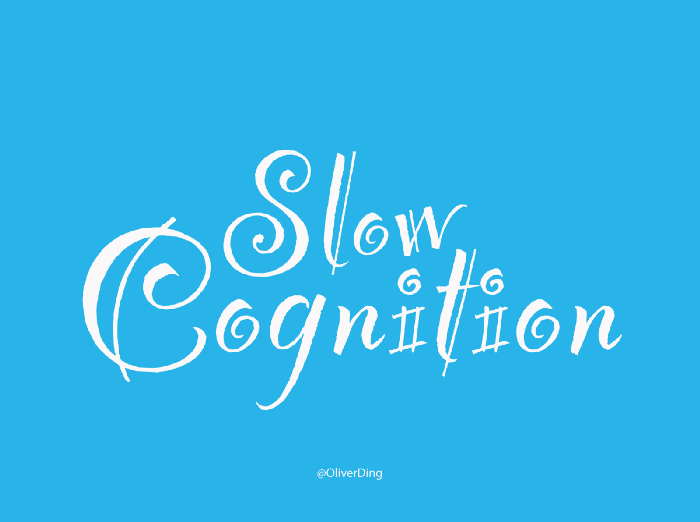
I used “A Theme for Creative Work Study in 2022” as the title of the short post. I spent 30 minutes designing a logo for Slow Cognition. This technique is called Objectification from the perspective of Project-oriented Activity Theory. Cognitive psychologists called it Cognitive Offloading. If an idea is very important to you, you could make a logo for it, design a picture for it, write a slogan for it, and print out these things.
It’s clear that I wanted to apply Howard E. Gruber’s evolving systems approach to conduct a study project. On Jan 5, 2022, I published two posts that defined the Slow Cognition project on Medium:
- The Slow Cognition Project (I just republished the Linkedin post)
- The Notion of Thematic Spaces
The notion of Thematic Spaces is part of a large knowledge enterprise that contains the following ideas:
- Curativity Theory > Cognitive Container > Knowledge Curation
- Curativity Theory > Themes of Practice
- Life as Activity > Creative Life > Slow Cognition
- Mind as Play > Diagramming as Practice
- Mind as Play > Developing Tacit Knowledge
- Mind as Play > Themes of Practice
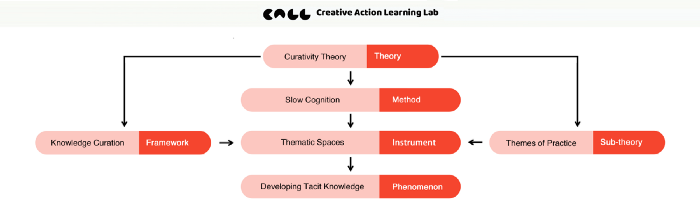
For Curativity Theory, the notion of Thematic Spaces is a new theoretical concept that is part of the Knowledge Curation framework. Also, Themes of Practice is a sub-theory of Curativity Theory, the notion of Thematic Spaces is also part of the Themes of Practice framework.
The notion of Slow Cognition refers to the long-term development of thoughts and the historical-cognitive method. The notion of Thematic Spaces is a great tool for turning the notion of Slow Cognition from a concept into a project.
I also mentioned the notion of “Developing Tacit Knowledge” which was published on Dec 25, 2021. On Dec 31, 2021, I published an article titled The Dynamics of Tacit Knowledge.
Moreover, I also designed a concrete thing for the concept of “Thematic Space”: a canvas. Thus, I had a “plan” for the Slow Cognition project on Jan 5, 2022.
- Objective: I want to develop a new method for researching Developing Tacit Knowledge.
- Object: I developed the Thematic Space Canvas which is the core of the Slow Cognition project (phase I).
From Jan to March, I worked on the Thematic Space project and it produced six canvases.
- The Thematic Space Canvas
- The Spark Space Canvas
- The Statue Space Canvas
- The Life Discovery Canvas
- The Optimal Context Canvas
- The Lifesystem Development Canvas
The Life Discovery Canvas led to the Life Discovery Project which led to the Significant Insights Analysis.
Now we see types of Unfoldness:
- The Unfoldness of Second-order Activity
- The Unfoldness of First-order Activity
From Dec 25, 2021, to Jan 5, 2022, while I was closing the D as Diagramming Project (phase 1) which is a First-order Activity, I worked on unfolding a Creative Discovery Activity that is a Secord-order Activity.
I played with some meta-canvas and meta-diagrams from Dec 25, 2021, to Jan 5, 2022. I designed a series of Mandala diagrams. The Thematic Space Canvas was born from this Creative Discovery Activity.
From Jan 5, 2022, to April 29, 2022, The Slow Cognition Project unfolded and led to the following projects:
- Knowledge Discovery Project
- Life Discovery Project
- Concept Discovery Project
- Design Wisdom Project
- Significant Insights Analysis
- Anticipatory Activity System for Life Transitions (AAS4LT)
- Modeling A Development Project
- The Curated Mind Project
- The Thematic Spirit Project
- The Ecosystem-for-Development Project
Some projects are sub-projects of other projects. They also echo each other. What a project network!
Unfolding is about Detecting Opportunities
As mentioned above, while the term “Decision” is about “mental operation” or “cognitive operation”, the term “Unfolding” is more about “the change of context”.
From the perspective of the Ecological Practice approach, Unfolding is about Detecting Opportunities for Growth.
On Jan 4, 2022, I published an article titled The Sailor’s Mandala: A Life Discovery Framework and used the diagram follow to model a life development program.
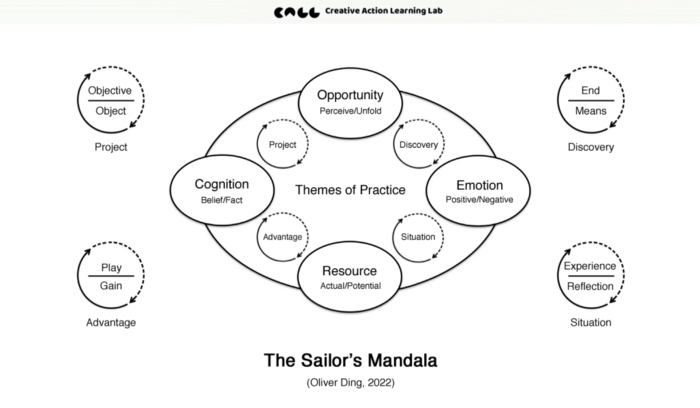
In the article, I mentioned the pair of concepts of “Perceive — Unfold” for the “Opportunity” theme.
Opportunity: Perceive/Unfold
As mentioned above, the program adopted the OKRs method as a core to develop the process of Social Practice Acceleration. I have observed the process and reviewed some documents during the past several months. There is a big issue for participants to define an objective for their life change. Though the clarifying of life meaning and life vision is very helpful for orientation, it is so hard for many people to transform abstract life meaning into a short term project. Thus, I suggested that the program could consider Opportunity as an important issue for Social Practice Acceleration.
Opportunity is about clues from environments. The change of contexts will bring new opportunities to us.
Unfolding is also about “changes in Points of Observation” from our perspectives. While the Context is changing, our Point of Observation is changing too.
Unfolding, Modeling, and Storytelling
The “Unfolding, Modeling, Storytelling” are three critical movements of Anticipatory Activity Systems.
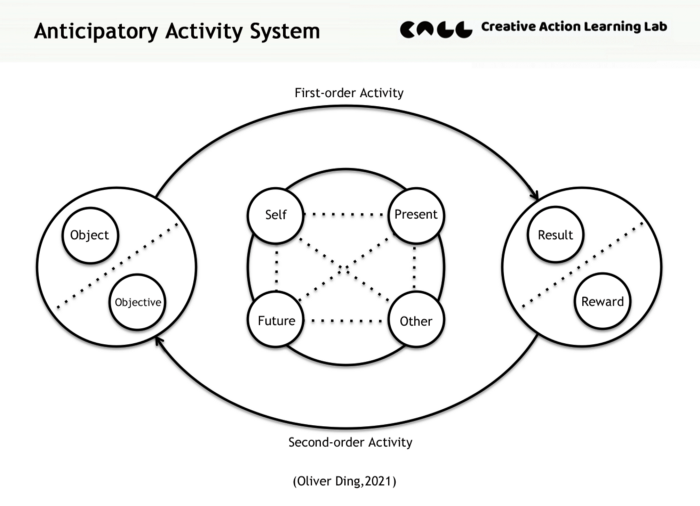
As a basic model, the above diagram presents the structure of Anticipatory Activity Systems.
The new version of the AAS4LT offers nine movements of Anticipatory Activity Systems. These movements present the dynamics of Anticipatory Activity Systems.
The AAS4LT is developed for dealing with Life Transitions. If we return to the AAS framework, we can roughly consider “Discovering” for Second-order Activity and “Producing” for First-order Activity. Together, we have the following five movements:
- Unfolding
- Discovering
- Modeling
- Producing
- Storytelling
This is not a step-by-step guide for designing a coaching program, but a general description for understanding the dynamics of Anticipatory Activity Systems.
Related Articles
- Knowledge Discovery: The “Perspectives — Views” Mapping
- The Project Engagement Toolkit (2022)
- Life Discovery: The Life-as-Project Approach
- The Life Discovery Toolkit (v1)
- The Life Discovery Canvas (v1.0) — Part 1: Theoretical Background
- The Life Discovery Canvas (v1.0) — Part 2: Spatial Structure
- The Life Discovery Canvas (v1.0) — Part 3A: Concepts (THINK and LEARN)
- The Life Discovery Canvas (v1.0) — Part 3B: Concepts (SAY and DO)
- The Life Discovery Canvas (v1.0) — Part 4: Inspirations
- Life Discovery: The “Being by Doing” Principle
- Life Discovery: The “Performance as Experiment” Principle
- Life Discovery: The “Engagement as Projection” Principle
- Life Discovery: The “Discovery as Development” Principle
- CALL for LIFE: Anticipatory Activity System for Life Transitions
- CALL for LIFE: Modeling A Developmental Project
- CALL for LIFE: Oliver Ding @ 2021 and Second-order Activity
- Life Discovery: Twelve Significant Insights from Four Months
- Life Discovery: “Points of Observation” and “Significant Insights”
- Life Discovery: Significant Insights Analysis
- Life Discovery: The “Tacit” Type of Second-order Activity
I am also working on building a new website for the Platform Ecology project. You can save the following links:
- PlatformEcology.org
- Twitter: @PlatformEcology
- Linkedin: @PlatformEcology
You are most welcome to connect via the following social platforms:
Linkedin: https://www.linkedin.com/in/oliverding Twitter: https://twitter.com/oliverding Polywork: https://www.polywork.com/oliverding Boardle: https://www.boardle.io/users/oliver-ding


