avatarJillian Enright

Free AI web copilot to create summaries, insights and extended knowledge, download it at here

5096

Abstract

on>Calvin & Hobbes created by Bill Watterson — (image created by author)</figcaption></figure><p id="3350">Notice, however, the person must be calm and relaxed — or feeling some other emotion they experience as pleasant — in order to create a new association.</p><p id="7404">In fact, the pleasure must outweigh the initial fear or anxiety in order to counter the previously learned conditioned response.</p><p id="0803">When it comes to sensory sensitivities, there is <a href="#cc0f">evidence</a> that Autistic folks experience <a href="https://doi.org/10.1007/s10803-020-04780-1">reduced habituation</a>, meaning we may have significantly greater difficulty adjusting or getting used to a stimulus — especially one we find aversive.</p><p id="160d">It’s pretty hard to feel calm and relaxed when one’s nervous systems is signalling danger or distress.</p><h2 id="5693">One of these things is not like the other</h2><p id="71dd"><a href="https://readmedium.com/exposure-therapy-does-not-work-for-most-autistics-da45556a33dc">Systematic desensitization</a> may work well for some people, and under some circumstances, but the evidence shows this is certainly not the case for:</p><ul><li><a href="https://doi.org/10.1007/s10803-020-04636-8">Most Autistics</a>, especially for <a href="https://doi.org/10.1007/s10803-020-04780-1">sensory-related sensitivities</a> and aversions.</li><li><a href="https://readmedium.com/why-adhd-and-autism-can-look-like-trauma-4d1428d82e4d">Trauma</a>-related fears and <a href="https://readmedium.com/anxiety-its-not-what-it-looks-like-c9df6d583c2d">anxieties</a>.</li></ul><p id="6a3b">When an Autistic person has sensory sensitivities which cause them considerable distress or interfere with their day-to-day living, some approaches which may help:</p><ul><li>Providing the person opportunity to learn about their own <a href="https://readmedium.com/sensory-processing-disorder-explained-e34efe5afb82">sensory processing</a> and sensory needs.</li><li>Providing the person strategies and tools for managing those sensitivities, and for self-advocating when needed.</li><li><a href="https://readmedium.com/finding-neurodiversity-affirming-support-b57bae9b5b20">Neuro-affirming</a> occupational therapy (OT) with a practitioner who is knowledgeable about autism may help improve various sensory systems in ways that work for the individual.</li></ul><p id="3007">When an Autistic person has <a href="https://readmedium.com/sensory-processing-disorder-explained-e34efe5afb82">sensory sensitivities</a> which are perceived by <i>others</i> as problematic, but not experienced as such by the individual, the best approaches are:</p><ul><li>Educating the folks who are struggling to accept that others perceive and process sensory stimuli differently from themselves.</li><li>Learning how to accept and accommodate one another’s differences and preferences.</li></ul><p id="6618">© Jillian Enright, Neurodiversity MB</p><h1 id="2e8e">Related Articles</h1><div id="3504" class="link-block"> <a href="https://readmedium.com/exposure-therapy-does-not-work-for-most-autistics-da45556a33dc"> <div> <div> <h2>Exposure Therapy Is Ineffective For Most Autistics</h2> <div><h3>Especially with regards to sensory sensitivities and trauma</h3></div> <div><p>medium.com</p></div> </div> <div> <div style="background-image: url(https://miro.readmedium.com/v2/resize:fit:320/1*e2cPE_9c5YjhTDB5FXZr6Q.png)"></div> </div> </div> </a> </div><div id="6a97" class="link-block"> <a href="https://readmedium.com/how-dog-training-is-like-parenting-a8e29c783de4"> <div> <div> <h2>How Parenting Is Like Dog Training</h2> <div><h3>(also teaching, or working with children in any capacity)</h3></div> <div><p>medium.com</p></div> </div> <div> <div style="background-image: url(https://miro.readmedium.com/v2/resize:fit:320/1*rxLONq5GLelXbzGJD9YR8g.png)"></div> </div> </div> </a> </div><div id="4832" class="link-block"> <a href="https://readmedium.com/dont-ignore-that-false-alarm-ef717c002423"> <div> <div> <h2>Don’t Ignore That ‘False’ Alarm</h2> <div><h3>Canaries, popcorn, smoke detectors, and dog training all have something in common</h3></div> <div><p>medium.com</p></div> </div> <div> <div style="background-image: url(https://miro.readmedium.com/v2/resize:fit:320/1*vV2urZZpUJH0Vr6yTh-uFg.png)"></div> </div> </div> </a> </div><p id="0415"><i>When you join medium, as a member you’ll have access to unlimited reads for only $5 per month. If you use <a href="https://twoemb.medium.com/membership">my referral link</a>, I’ll earn a small commission, and you’ll earn

Options

my undying gratitude.</i></p><p id="56d7"><i>If you’d prefer give a one-time tip, you can <a href="https://ko-fi.com/neurodiversitymb">support my writing on Ko-Fi</a> — also, it’s free to <a href="https://facebook.com/NeurodiversityMB">follow me on Facebook</a> and <a href="https://linkedin.com/in/adhd2emb">LinkedIn</a>!</i></p><h2 id="f4d6">Learn more</h2><div id="7bae" class="link-block"> <a href="https://readmedium.com/all-behaviour-is-communication-but-42236d8e7ded"> <div> <div> <h2>All Behaviour Is Communication, BUT…</h2> <div><h3>It just might not be communicating what you think it is</h3></div> <div><p>medium.com</p></div> </div> <div> <div style="background-image: url(https://miro.readmedium.com/v2/resize:fit:320/1*aaiVJ_QCkwRN1xVAk93BcQ.png)"></div> </div> </div> </a> </div><div id="30f1" class="link-block"> <a href="https://readmedium.com/how-punishing-unwanted-behaviour-just-makes-it-worse-baf22793d07b"> <div> <div> <h2>Punishing Unwanted Behaviour Just Makes it Worse</h2> <div><h3>(Especially for neurodivergent children) — Based on neuroscience</h3></div> <div><p>medium.com</p></div> </div> <div> <div style="background-image: url(https://miro.readmedium.com/v2/resize:fit:320/1*e-FTvqKRuWvQ9vSvM1RDzw.png)"></div> </div> </div> </a> </div><div id="7afe" class="link-block"> <a href="https://readmedium.com/punishments-dont-teach-skills-c709873e3db0"> <div> <div> <h2>Punishments Don’t Teach Skills</h2> <div><h3>Okay, maybe one: They teach people how to be better at avoiding punishment.</h3></div> <div><p>medium.com</p></div> </div> <div> <div style="background-image: url(https://miro.readmedium.com/v2/resize:fit:320/1*k-YmTYDhgD11sofeB4Ozyg.png)"></div> </div> </div> </a> </div><div id="6aea" class="link-block"> <a href="https://readmedium.com/behaviour-management-programs-are-out-dated-and-ableist-3858b82b9154"> <div> <div> <h2>Behaviour Management Programs are Harmful & Ableist</h2> <div><h3>Charts, points, and other behaviour management programs touted as “positive” are actually harmful, and ableist AF.</h3></div> <div><p>medium.com</p></div> </div> <div> <div style="background-image: url(https://miro.readmedium.com/v2/resize:fit:320/1*McQMUHRf6gMvd2YHGITkGw.jpeg)"></div> </div> </div> </a> </div><h2 id="cc0f">References</h2><p id="2666">Gandhi, T. K., Tsourides, K., Singhal, N., Cardinaux, A., Jamal, W., Pantazis, D., Kjelgaard, M., & Sinha, P. (2021). Autonomic and Electrophysiological Evidence for Reduced Auditory Habituation in Autism. <i>Journal of Autism and Developmental Disorders</i>, <i>51</i>(7), 2218–2228. <a href="https://doi.org/10.1007/s10803-020-04636-8">https://doi.org/10.1007/s10803-020-04636-8</a></p><p id="0ff3">Green, S. A., Hernandez, L., Lawrence, K. E., Liu, J., Tsang, T., Yeargin, J., Cummings, K., Laugeson, E., Dapretto, M., & Bookheimer, S. Y. (2019). Distinct Patterns of Neural Habituation and Generalization in Children and Adolescents With Autism With Low and High Sensory Overresponsivity. <i>The American Journal of Psychiatry</i>, <i>176</i>(12), 1010–1020. <a href="https://doi.org/10.1176/appi.ajp.2019.18121333">https://doi.org/10.1176/appi.ajp.2019.18121333</a></p><p id="14d7">Jamal, W., Cardinaux, A., Haskins, A. J., Kjelgaard, M., & Sinha, P. (2021). Reduced Sensory Habituation in Autism and Its Correlation with Behavioral Measures. <i>Journal of Autism and Developmental Disorders</i>, <i>51</i>(9), 3153–3164. <a href="https://doi.org/10.1007/s10803-020-04780-1">https://doi.org/10.1007/s10803-020-04780-1</a></p><p id="2141">Keller, N. E., Hennings, A. C., & Dunsmoor, J. E. (2020). Behavioral and neural processes in counterconditioning: Past and future directions. <i>Behaviour research and therapy</i>, <i>125</i>, 103532. <a href="https://doi.org/10.1016/j.brat.2019.103532">https://doi.org/10.1016/j.brat.2019.103532</a></p><p id="920e">Maier, S. F., & Seligman, M. E. (2016). Learned helplessness at fifty: Insights from neuroscience. <i>Psychological review</i>, <i>123</i>(4), 349–367. <a href="https://doi.org/10.1037/rev0000033">https://doi.org/10.1037/rev0000033</a></p><p id="6a28">Maier, S. F., & Seligman, M. E. (1976). Learned helplessness: Theory and evidence. <i>Journal of Experimental Psychology: General, 105</i>(1), 3–46. <a href="https://psycnet.apa.org/doi/10.1037/0096-3445.105.1.3">https://doi.org/10.1037/0096-3445.105.1.3</a></p></article></body>

Emotions Are Not Behaviours

Exposure therapy “exposed”

Created by author

Feelings are neither rational nor logical

One can neither punish nor reward an emotion, and it is especially harmful to attempt to do so with sensory sensitivities and trauma.

The definition of a punishment is something which decreases or stops a behaviour.

The definition of a reinforcer is something which increases the likelihood of a behaviour recurring or continuing.

Emotions cannot be perpetuated, changed, nor stopped through the use of punishments or rewards.

When someone is sad and we comfort them, we are not rewarding their sadness, nor encouraging them to continue being sad. Instead, we are co-regulating by providing connection and a calm, caring presence.

If someone is afraid and we reassure them, we are helping them feel safe, not reinforcing their fear. If someone is dysregulated, we provide support and co-regulation.

There are still some clinicians out there who advise people to “ignore” any unwanted behaviour from people in our care, especially children —the theory being we do not want to reinforce the behaviour by paying attention to it.

One of the primary purposes of behaviour is to communicate to others.
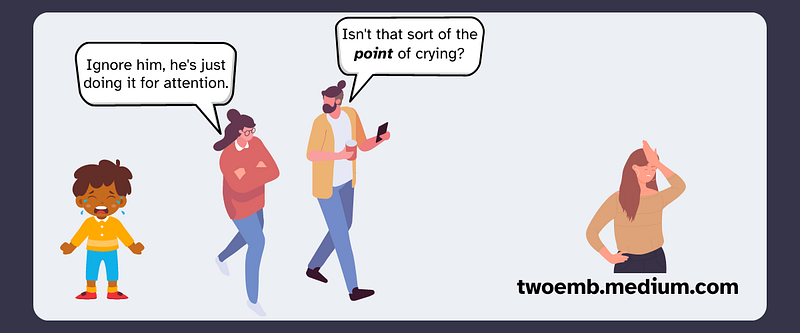
Created by author

One of the primary purposes of behaviour is to communicate to others.

It gets worse

In abusive scenarios, people are punished for having emotional reactions.

Punishing a behaviour based on emotion (which is essentially all of them), is essentially punishing someone for:

  • Having a nervous system which responded in a certain way to an event, environment, or stimuli.
  • Lacking the skills, knowledge, or capacity to handle the situation differently at that time.

What does all this have to do with exposure therapy and systematic desensitization?

Like the idea of punishing and rewarding emotions, systematic desensitization and exposure therapy are based on principles of behaviourism.

They build upon the idea we can elicit certain emotions through pairing fearful or unpleasant stimuli with something rewarding. (Yes, kind of like Pavlov’s dogs).

Just relax

In exposure therapy, psychologists create a safe environment in which to gradually “expose” individuals to the things they fear and avoid.

The idea is that a person is first taught relaxation techniques, then exposed to the fearful stimuli, starting at the lowest tolerable intensity and gradually increasing.

The exposure to the feared objects, activities or situations while feeling calm is presumed to reduce fear and decrease avoidance. This is a form of classical counter-conditioning, wherein a stimulus is paired with something the person experiences as pleasant, thereby creating a new association.

(Side note: If you do an Internet search of the term, the entire first two pages will be filled with dog training advice).
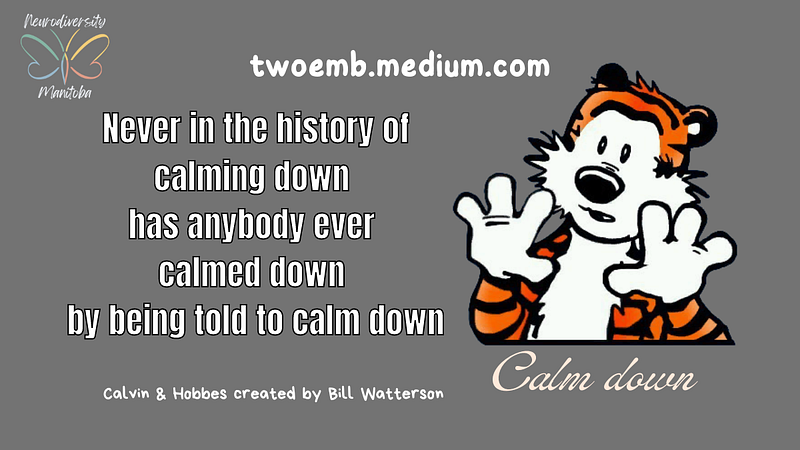
Calvin & Hobbes created by Bill Watterson — (image created by author)

Notice, however, the person must be calm and relaxed — or feeling some other emotion they experience as pleasant — in order to create a new association.

In fact, the pleasure must outweigh the initial fear or anxiety in order to counter the previously learned conditioned response.

When it comes to sensory sensitivities, there is evidence that Autistic folks experience reduced habituation, meaning we may have significantly greater difficulty adjusting or getting used to a stimulus — especially one we find aversive.

It’s pretty hard to feel calm and relaxed when one’s nervous systems is signalling danger or distress.

One of these things is not like the other

Systematic desensitization may work well for some people, and under some circumstances, but the evidence shows this is certainly not the case for:

When an Autistic person has sensory sensitivities which cause them considerable distress or interfere with their day-to-day living, some approaches which may help:

  • Providing the person opportunity to learn about their own sensory processing and sensory needs.
  • Providing the person strategies and tools for managing those sensitivities, and for self-advocating when needed.
  • Neuro-affirming occupational therapy (OT) with a practitioner who is knowledgeable about autism may help improve various sensory systems in ways that work for the individual.

When an Autistic person has sensory sensitivities which are perceived by others as problematic, but not experienced as such by the individual, the best approaches are:

  • Educating the folks who are struggling to accept that others perceive and process sensory stimuli differently from themselves.
  • Learning how to accept and accommodate one another’s differences and preferences.

© Jillian Enright, Neurodiversity MB

Related Articles

When you join medium, as a member you’ll have access to unlimited reads for only $5 per month. If you use my referral link, I’ll earn a small commission, and you’ll earn my undying gratitude.

If you’d prefer give a one-time tip, you can support my writing on Ko-Fi — also, it’s free to follow me on Facebook and LinkedIn!

Learn more

References

Gandhi, T. K., Tsourides, K., Singhal, N., Cardinaux, A., Jamal, W., Pantazis, D., Kjelgaard, M., & Sinha, P. (2021). Autonomic and Electrophysiological Evidence for Reduced Auditory Habituation in Autism. Journal of Autism and Developmental Disorders, 51(7), 2218–2228. https://doi.org/10.1007/s10803-020-04636-8

Green, S. A., Hernandez, L., Lawrence, K. E., Liu, J., Tsang, T., Yeargin, J., Cummings, K., Laugeson, E., Dapretto, M., & Bookheimer, S. Y. (2019). Distinct Patterns of Neural Habituation and Generalization in Children and Adolescents With Autism With Low and High Sensory Overresponsivity. The American Journal of Psychiatry, 176(12), 1010–1020. https://doi.org/10.1176/appi.ajp.2019.18121333

Jamal, W., Cardinaux, A., Haskins, A. J., Kjelgaard, M., & Sinha, P. (2021). Reduced Sensory Habituation in Autism and Its Correlation with Behavioral Measures. Journal of Autism and Developmental Disorders, 51(9), 3153–3164. https://doi.org/10.1007/s10803-020-04780-1

Keller, N. E., Hennings, A. C., & Dunsmoor, J. E. (2020). Behavioral and neural processes in counterconditioning: Past and future directions. Behaviour research and therapy, 125, 103532. https://doi.org/10.1016/j.brat.2019.103532

Maier, S. F., & Seligman, M. E. (2016). Learned helplessness at fifty: Insights from neuroscience. Psychological review, 123(4), 349–367. https://doi.org/10.1037/rev0000033

Maier, S. F., & Seligman, M. E. (1976). Learned helplessness: Theory and evidence. Journal of Experimental Psychology: General, 105(1), 3–46. https://doi.org/10.1037/0096-3445.105.1.3

Psychology
Mental Health
Autism
Neurodiversity
Emotions
Recommended from ReadMedium