
Changing The Association
Therefore changing the response
If your dog has an unwanted association with something, I’ll explain how you can change that in a way that is gentle and does not cause your dog unnecessary pain, fear, or discomfort.
A positive association
The association may be positive, but your dog loses his mind with excitement and you need him to be a little calmer — for example, he goes bonkers when you get the leash out to take him for a walk. By the time you’re trying to leave, your dog is practically flying out the door, taking you with him.
Perhaps you’d prefer a calmer, more dignified exit (or at least a safer one). What you need to do is remove the association of leash equals walk.
Step by step
- Get out leash.
- Dog loses mind.
- Put away leash.
- Sit down.
- Put in headphones while dog goes bonkers.
- As soon as your dog settles reward him with a frozen Kong, a delicious bone, or a game of fetch.
- Repeat.
This isn’t intended to “tease” the dog, it’s to change the association of leash with walk to leash with being calm. It’s important to reward your dog as soon as he does settle, and do something else enjoyable with him that also helps him get out that pent up excitement and energy.
Once you’ve done this a number of times over a number of days and your dog’s reaction to the leash has become less intense, you can introduce a new association.
The leash can signal the beginning of a training session where you reward your dog for a previously-learned behaviour such as go to your bed or lay down. The training session should only be a minute or two long, followed by play time for your dog to enjoy and expend some energy.
Changing negative associations
If your dog has a negative association with something, such as the vacuum cleaner or nail clippers, the process of counter-conditioning is a bit more complex.
Fear-based responses are evolutionarily important. If something is dangerous, your dog should be afraid of it and learn to avoid it in order to stay safe. For this reason, once a dog has developed a fear of something, it is more challenging to help him be more comfortable with it, but certainly not impossible.
Low and slow
Whatever the fear-inducing stimulus, it’s very important you never force your dog to interact. Don’t push your dog towards it, nor bring it to him without ensuring he has an escape if he needs it. These tactics will only serve to make the fear worse and harm your dog’s trust in you.
Start with the mildest or least intrusive version of the stimulus you can find. For example, if it’s the nail clippers, don’t go straight to using them. Start by just showing them to your dog.
Here’s how I do it:
- Have treats and the nail clippers behind your back, where your dog cannot see them.
- First, bring the clippers out so your dog sees them, then put them back behind your back.
- Then give your dog a treat.
The three most important things to remember are:
- Order of operations is paramount.
- Use classical, not operant conditioning.
- Keep your dog below threshold.
I’ll explain what each of these mean.
Order of operations
The fear-inducing stimulus must come first so that it predicts and signals something good is coming next. Remember how your dog learned to love his leash? This is the same process, but more intentional, because your dog has not yet developed a positive association with the nail clippers.
If you pair them at the same time, your dog may ignore the clippers and enjoy the treat. No harm done, but no association made.
If you show the treat first, then the clippers, the treat comes to predict the clippers. Your dog then may come to distrust treats, thinking you’re trying to lure him in to do something unpleasant, and we don’t want that either.
We’re using classical conditioning
This is classical conditioning, not operative conditioning.
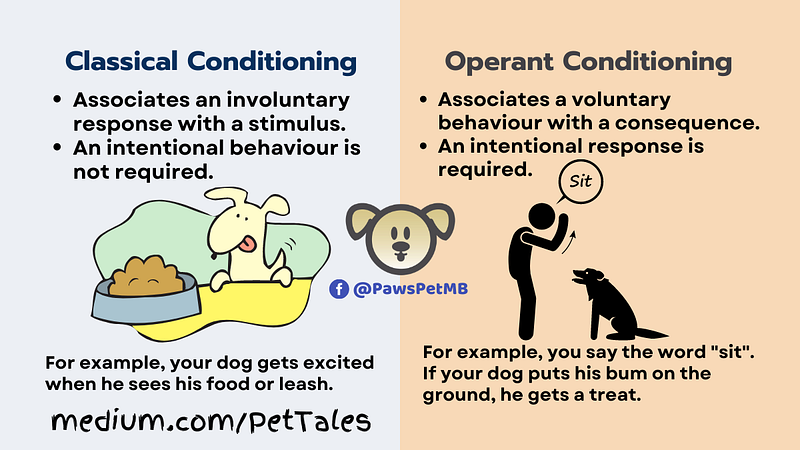
Your dog doesn’t need to do anything other than see the clippers (or another fear-inducing stimulus). Dogs are very good at pairing, making associations, and predictions. When one thing frequently follows another, they pick up on it quickly.
I have a funny example. In the evenings, my husband and I often read or watch TV together with the dogs, after our son is in bed. When we’re ready to head to bed ourselves, we turn out the lights and television.
Our dogs, who were moments earlier sleeping soundly, are suddenly up and heading up the stairs before we are. They learned to associate turning off the lights and T.V. with going up to bed.
Clever pups.
Keeping your dog below threshold
What I mean by this is we’re trying to keep the dog from getting stressed out. People tend to think “this isn’t working” if the dog is happily looking at the clippers and eating the treat without a care in the world.
That’s exactly what we want.
When people think this isn’t working, they’ll push a little further, starting to clip one nail. The dog gets stressed, starts to whine or pull his paw away, and won’t eat the treat.
This is what we don’t want.
If your dog is anxious and won’t eat, this means he is over threshold. We can’t learn when stressed. Our brain goes into survival mode and the part of our brain responsible for logic and learning powers down, allowing instincts to take over.
Once you’ve done this a number of times over a number of days, you should see your dog’s response to seeing the clippers change. He should be happily anticipating something yummy coming his way, rather than showing signs of stress or worry.
When your dog’s eyes light up at the sight of the clippers you can proceed to the next step: touching the clippers to his paw, following the same principles outlined above.
- Have treats and the nail clippers behind your back, where your dog cannot see them.
- Gently touch the clippers to your dog’s paw, then put them back behind your back.
- Then give your dog a treat.
Repeat these steps a number of times over a number of days.
The more intense your dog’s fear, and the more negative experiences he’s had, the longer it will take to help him feel comfortable with nail trims (or the vacuum, brushing, etc.).
Keep it short, sweet, and followed by fun
These sessions should only be about a minute long, sometimes shorter. Perhaps start with 5 repetitions, gradually increasing to 10 (i.e. show your dog the clippers, followed by a treat a maximum of 10 times in a session).
If you notice your dog starting to get anxious or losing interest, end on a positive. Follow your dog’s lead, it will not serve either of you to push him beyond his limits.
Be patient, as this is a long-term process, your dog’s fears aren’t likely to be overcome in a single day. Plan training sessions for when you won’t feel rushed or pressured, so that you aren’t tempted to hurry onto next step before your dog is ready.
Follow your training session with play time. Play helps us rid ourselves of any pent-up stresses, helps to solidify learning, and it’s just fun.
© Pawsitive Pet Care
Related stories
References
Affenzeller, N., Palme, R., Zulch, H. (2017). Playful activity post-learning improves training performance in Labrador Retriever dogs (Canis lupus familiaris). Physiology & Behavior, 168, 62–73. https://doi.org/10.1016/j.physbeh.2016.10.014