
Animal Behaviour | Dog Training
Do The Words “Pavlov’s Dogs” Ring A Bell?
(See what I did there?) — Practical applications of classical conditioning

Originally published on February 21, 2016
A couple of upsetting scenes got me thinking about classical conditioning and canine behaviour (again. It’s a never-ending train of thought in the back of my nerdy mind).
The first incident happened in the summer: I was walking two dogs through a park on a busy day and a man and woman were standing on a hill overlooking the pathway. Every time someone would walk by with a dog, their dog would react with barking, pulling on the leash, and whining.
The man was attempting to punish the behaviour out of the dog: He was setting him up to fail by having him so close to the path that he couldn’t control his reaction, ensuring he would react, and then hitting him every time he did react. It was heart- breaking to watch and I got out of there as quickly as possible.
The other two incidents happened in the last month: One was a lady walking her two large dogs on prong collars (ugh). Similarly, they got excited when they saw another dog and started to react with barking, whining, and pulling on leash. The lady very harshly corrected them, yanking on the leash to tighten the collar around their necks, and scolding them loudly to “STOP”.
The third one happened just last week: A lady was again walking two dogs and I was across the street walking a dog as well. Her dog got excited and was barking and whining, looking at the dog I was walking. The lady turned and yelled at her dog, kicking it, and kneeing it until it backed up and paid attention to her.
I. Can’t.
Please don’t suggest to me I should have said or done something in these scenarios either. I’ve found that speaking to someone when they’r upset, embarrassed, or frustrated only ends up making things worse. There are also no laws protecting dogs from this kind of treatment, only against intentional cruelty through neglect or outright abuse.
Abuse in Manitoba is defined as “suffering, seriously injured, or in extreme anxiety or distress”. Unfortunately, many people inadvertently abuse their dogs in the name of training, but our current animal protection laws do nothing to stop this.

Punishment Increases Fear and Anxiety
Even if these owners weren’t hurting their dogs (I’m sure they were, but let’s pretend the punishment wasn’t physically painful), the whole point was to stop the dogs from reacting this way and what they were doing was the complete opposite.
I am sure these people love their dogs very much, and that their intent was to improve their behaviour. Unfortunately dogs don’t know our intent, only what they experience.
If you are afraid of spiders and see one in your kitchen, what do you do? Scream, squeal, yell for someone to come squish it, run away? What if you were trapped in the room (like a dog on a leash unable to move away)?
What if someone scolded you or kicked you in the shin because you were afraid? How would you feel about the spider then? How about the person who scolded you or kicked your leg? What would you do the next time you saw a spider in your kitchen, would you feel more or less upset?
Dogs don’t know our intent, only what they experience.

Learning by Association
A conditioned emotional response (CER) is an emotional response or reaction to a stimuli (an event or object) that is brought about by associations (Chance, 2014).
When you bring your dog’s leash out, does he do a happy dance, wagging his tail and excitedly moving towards the door in anticipation of his walk? When he hears that familiar crinkling of the treat bag, does he come running, offering you his best sit in anticipation of a cookie?
Your dog doesn’t have a thing for nylon or plastic, those associations were learned by pairings, making them conditioned emotional responses. The difference is these are positive emotional responses: the leash is associated with enjoying a walk and the plastic bag is associated with eating a yummy treat.
“Negative” emotional responses come about when seeing another dog becomes associated with getting yelled at, smacked, kicked, or choked. How do you expect those dogs to react next time they see another dog?
If the punishment is severe enough, they may learn to suppress their response (Brush, 2014) and keep quiet on the outside, but that sure won’t change how they feel on the inside. In fact, I would wager that they feel more anxious because they’re not allowed to respond for fear of punishment.
I have a series on punishment, including one story entitled “Punishing Unwanted Behaviour Just Makes it Worse”.
It doesn’t have to be like that
A more effective, kinder way is possible. Create positive associations with the feared object and this will get you on the right path to helping your dog feel more comfortable.
Don’t worry about rewarding your dog’s unwanted behaviour (barking, pulling, lunging, whatever he may be doing). Counterconditioning means that you are trying to change how your dog feels first, which in turn will change how he behaves.
A fearful dog will act defensively. A comfortable dog will not. You cannot change your dog’s behaviour until you have helped him feel safe.
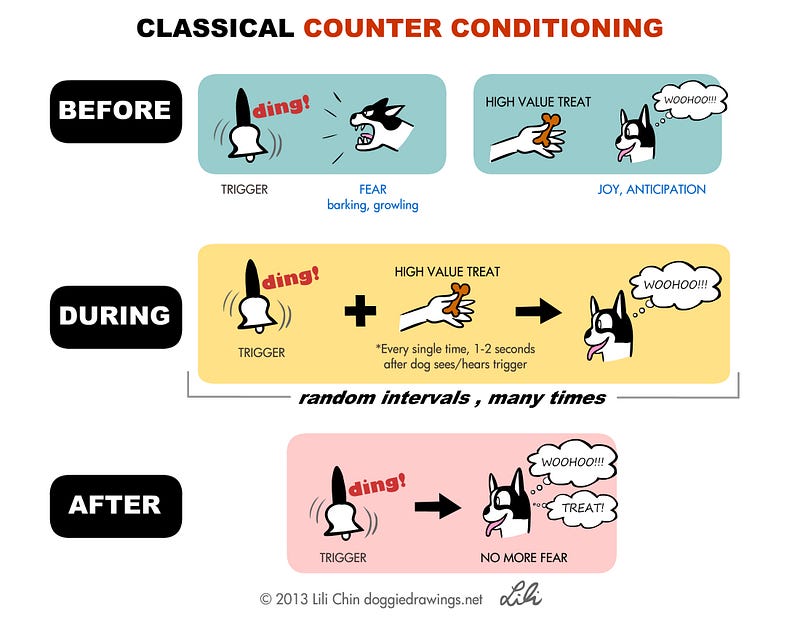
Classical Counterconditioning
Donna Hill has a great video on teaching the “look at that” game, based on Leslie McDevitt’s “Control Unleashed” program.
If you want to learn more, I have two blogs on Dog Reactivity: Understanding Dog Reactivity and Reactive Dog Myths, and Karen Pryor has a brief article further explaining the benefit of the “look at that” exercise.
Classical Conditioning is not just for reactivity, it’s part of everyday learning. You can use it to help your dog feel more comfortable with being in a kennel, with meeting new people, going to the vet, or just about anything that could potentially make them anxious.
Important: Please don’t wait until your pooch is anxious to start classical conditioning! Socialize your pup as early as possible in controlled, relaxed, positive situations and you can go a long way in preventing your pup from developing fears or reactive behaviours.
© Jillian Enright, CPDT-KA
For more great training tips, visit us on facebook, and read more training stories and articles at medium.com/PetTales.
References
Brush, R. F. (2014). Aversive conditioning and learning. Academic Press.
Chance, P. (2014). Learning & behavior. Brooks/Cole Pub. Co.