
Positive Parenting
Kinder, More Effective Alternatives to Punishment
Guide children and set appropriate boundaries without threats or punishment

This is a follow-up to our recent story, punishment makes behaviour worse.
First and foremost: deal with your own issues
We all have baggage, some of us more than others, but we all have some. We also have preconceived ideas about how children should or should not behave and about how adults should parent.
Let me tell you something: when you have a neurodivergent child, those shoulds tend to go right out the window.
What works for neurotypical kids does not always work for neurodivergent children. As any parent knows, what works for one child may not necessarily work for another, regardless of whether or not they have a disability.
Sometimes we correct, criticize, or punish our children for behaviours out of our own anxiety and discomfort, or because the behaviour triggers something in us.
“An emphasis on having a well behaved child prioritizes outward appearances and conformity with established rules of conduct over their inner state.” — Alfie Kohn
In other words, are we more concerned with what others might think of us, or focused on how our behaviour might impact our child?
As I’ve mentioned previously, before we begin to address any child’s behaviour, we must first check ourselves and honestly reflect on whether the behaviour is truly problematic.
Is the behaviour only a problem for me, or is it a problem for my child, and for other important people in my child’s life?
If the answer is the former, then it’s time for me to do some work with myself, and leave my child out of it. If the answer is the latter, then I can proceed.
Next, Get Curious
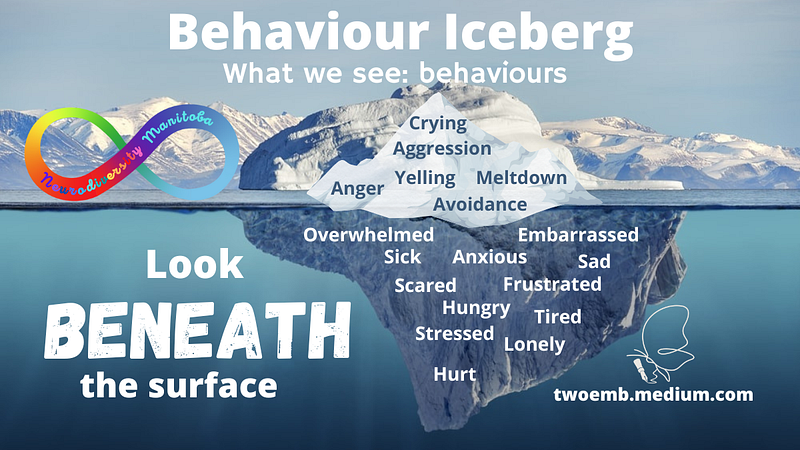
Ask yourself: what purpose does this behaviour serve for the child? What goal are they trying to achieve with this behaviour?
More importantly, what need are they trying to communicate and have met with their behaviour?
As Susan Stiffelman would say, ask yourself, why does this behaviour make sense for that child? (Stiffelman, 2013).
“Why does this behaviour make sense for that child?”
— Susan Stiffelman
As I mentioned in a previous story, my son hid under his desk at school in first grade because he struggles with the physical act of writing. He is twice exceptional, meaning he is gifted and has ADHD. The assumption was that because he is gifted the activity would be easy for him, but a lot of children with ADHD struggle with fine motor skills, and my son is one of them.
Had the teacher stopped to think about why my son’s behaviour made sense, and considered what he was trying to communicate, she may have slowed down and stopped pushing him to complete the assignment. Instead of assuming that he was being “defiant”, she might have approached him with some empathy and compassion.

Check Your Assumptions
Oftentimes we have assumptions or thoughts about someone’s behaviour that feed our emotions. Perhaps we believe they did something intentionally, or that they should know better, and as a result we feel angry.
Although it happened two years ago, there is a memory about assumptions that really sticks with me. At my son’s former school, because of his struggles, he had developed a reputation with the staff. He was no longer given the benefit of the doubt because he was considered a “difficult” child and his behaviour was always viewed through that lens.
One afternoon my son and another boy were playing a game. They took turns making their arms into a “hoop” behind their backs and would try to shoot a basketball into the hoop. (I don’t understand it either, but children come up with some interesting games).
My son was 6 years old, the boy he was playing with is autistic and also quite a bit older than my son — I think the other boy was around 10 years old at that time. Another student in the playground saw a 10 year old throwing a basketball at a 6 year old, assumed the behaviour was malicious. and accused the older boy of hurting my son.
The older boy became upset, but my son was completely oblivious as to what had happened. The older boy started walking away, but my son thought he was still playing, and threw the ball toward his back.
Well, an adult saw this occur from across the playground, and marched over and collected my son to take him to the principal’s office. I only know the full story because I happened to be volunteering at the school that day, as it was supposed to be a “fun in the sun” day near the end of the school year.
The adults assumed, wrongly, that because the older boy was crying and they saw my son throw a ball at him, my son was the culprit here and his behaviour was aggressive.
It wasn’t, and even when my son tried to explain what had happened, they assumed he was lying and making excuses to not take responsibility for his actions. He was 6, and no, my son no longer attends that school.
My point with this story is that we make assumptions and view children’s behaviour through an adult lens, with adult life experiences and adult-sized cynicism. Honestly, I have no clue what went through my mind when I was a kid. I barely remember what my thought processes were a week ago, let alone three decades ago.
What I do know is, the vast majority of the time, our children are spending more time plotting about how to get an extra serving of dessert or more video game time, and not plotting ways to make our lives more difficult.
Listen, Empathize, and Validate
When our children try to explain something to us, we need to actually listen. As adults, we can be very dismissive of children’s experiences and perspectives, and write their explanations off as “excuses”. I have certainly been guilty of this.
When I take the time to truly listen, though, I gain a new perspective, and insight into my son’s decision-making process. I may not always agree with him, nor with his behaviour, but taking the time to listen and try to understand strengthens our relationship. This also allows me to teach him new skills and guide him toward making better decisions for himself.
The for himself part is key. I don’t want him to make my decisions, nor do I want to force him to do what I want for fear of retribution. As L.R. Knost would say, thoughtful cooperation is much healthier than thoughtless obedience.
I want my son to make his own decisions, provided they are developmentally-appropriate decisions for him to be making. And when they’re not, I still seek his input and have conversations with him about it, so that he is developing the skills to do so independently in the future.
It is so important for us to listen to our children and validate their feelings and experiences. So important, in fact, that I wrote an entire article on that topic alone. I won’t go into detail in this story because you can read it here.
Dig Deep and Collaborate
If your child is engaging in behaviour that concerns you, it is an understandable reaction to want to threaten or lay down consequences in order to put a stop to it.
The thing is, our children aren’t always going have us there to draw those lines and set limits for them. They need to learn how to do this for themselves, and now is the time for us to teach them those skills.
Instead, when we have a concern, we need to dig down to the root of the problem. In conversation with our child, we need to find out what is contributing to this concerning behaviour: what need is it meeting for them, and how can they find a healthier or safer way to have that need met?
The most important priority is to strengthen the adult-child relationship first and foremost. When our children feel loved and cared for in a secure, unconditional way, it is much easier for them to engage in self-reflection, which enables them to learn and grow in a healthy direction.
A great place to start the problem-solving process is by using Dr. Ross Greene’s Collaborative & Proactive Solutions approach. Our website has a summary of this method, as well as links to the Lives in the Balance website, which offers extensive resources for both families and professionals.
In essence, the CPS method explains that kids do the best they can with the skills they have right now. When we encounter difficulties, it’s up to us — the adults — to dig down to the root of the problem, then identify and teach those skills which our children are lacking.
Our kids don’t need us to “beat some sense into them” — neither literally, nor metaphorically speaking. What children need is loving, caring guidance.
Yes, we need to set firm boundaries and expectations for our children. We also need to allow our children to be human and make mistakes, because will all make a lot of mistakes. We all need the skills to learn from our mistakes, rather than beating ourselves up over them or being paralyzed by them.
So instead of slapping your child’s hand, gently take them by the hand and show them the way.
Further Resources
Neurodiversity MB has an extensive booklist with recommended books (and a few podcasts) about child development, behaviour, parenting, neurodiversity, ADHD, and education. This list is updated frequently with new recommendations.
I have a number of related stories which I have compiled in a series called The Perils of Punishment:
The Perils of Punishment
Because I like alliteration… and science. I really like science.
medium.com
When you join medium, as a member you’ll have access to unlimited reads for only $5 per month. If you use my referral link, I’ll earn a small commission, and you’ll earn my undying gratitude.
If you’d prefer give a one-time tip, you can support my writing on Ko-Fi — also, it’s free to follow me on Facebook!

References
Barkley, R. A. (Ed.). (2015). Attention-deficit hyperactivity disorder: A handbook for diagnosis and treatment (4th ed.). The Guilford Press.
Knost, L.R. (2013). The Gentle Parent. Little Hearts Books, LLC.
Kohn, A. (2016). The Myth of the Spoiled Child: Coddled kids, helicopter parents, and other phony crises. Beacon Press.
Stiffelman, S. (2013). Parenting without power struggles: raising joyful, resilient kids while staying calm, cool, and connected. Tantor Media.