
All Behaviour Is Communication, BUT…
It just might not be communicating what you think it is

Assumptions are harmful
Most of you have likely heard the phrase “all behaviour is communication”. It’s true. Behaviour tells us something about a person’s inner experience.
We have to be careful, however, when we’re reading into people’s behaviour. Sometimes we get it wrong, and that can have negative consequences for everyone involved.
For example, some Autistic people use echolalic speech and scripted speech, especially when we are stressed or in an unfamiliar situation and aren’t sure what to say.
When asked a question or given a statement, an Autistic person might repeat back part of what they heard to help them process what was said. This may come across as agreeing, or it could even come across as argumentative, depending on the tone and context.
It might be either one of those, or it might be neither. Sometimes Autistics need time to process and formulate a response. If we repeat the question or make assumptions, we haven’t given them an opportunity to be properly heard.
Another common response when we don’t know what to say is to use scripted language. This can mean using lines we’ve read in books or seen on T.V., or it can be replaying older conversation that remind us of the present one.
“Don’t assign meaning to behaviour you don’t understand.”
I’ve noticed as well that some Autistics who have been subjected to behavioural “therapies” tend to script what they think someone wants to hear, what they’ve been taught is the correct response, rather than expressing their own views.
If we take that at face value, then we aren’t giving the person an opportunity to be properly heard either. It may take time to help the person feel more comfortable, to build up trust so they feel they can communicate honestly without repercussions.
An even more potentially dangerous side-effect of behaviourism is when “therapists” want to stop behaviours they view as atypical, but those behaviours are the only way that person has to communicate a specific need.
For example, some Autistics have difficulty with interoception and alexithymia. A person may be experiencing something upsetting, or even painful, but unable to explain it in the way neurotypicals would find easiest to understand.
An unexpected or sudden change in behaviour could signify a person is sick, injured, or is experiencing psychological distress. It could just mean they’re gassy, who knows?
We’ll never know if we try to “extinguish” (aka stop) the behaviour without figuring out what’s causing it in the first place.
“Trust that if your child is exhibiting troubling behaviours, they are trying to communicate something… but some approaches may force them to suppress their behaviour, thus depriving you of the information you need to keep your child healthy and safe.” — KBronJohn
Disinhibition
A lot of disabled and neurodivergent people experience disinhibition (impulsivity) to varying degrees. In this context, I’m not talking about impulsive behaviours like buying a chocolate bar in the check-out line, or throwing something in anger.
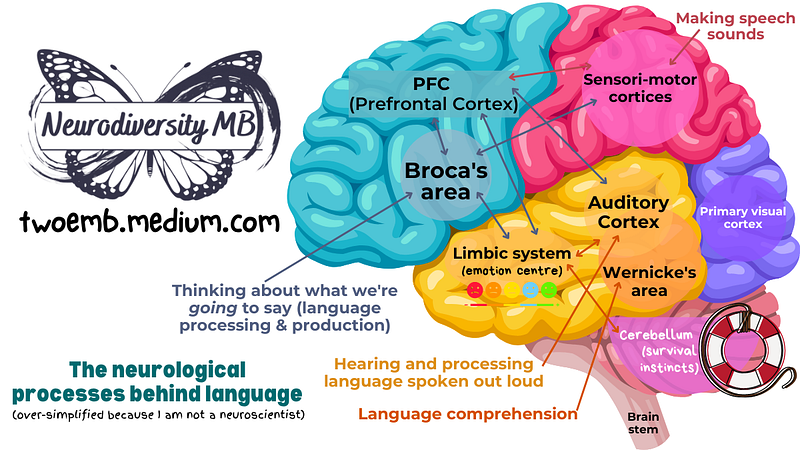
In this case, I’m talking specifically about disinhibition as it relates to communicating when under stress. If you’ve ever experienced a situation where you were very stressed, or even in distress, you may have found it very difficult to express verbally what you wanted to say.
This is, in part, because when we’re under duress, or experiencing intense emotions, our body dedicates more resources to the areas of the brain necessary for survival.
If we’re being chased by a dangerous animal, we’re not likely needing to stop for a chat, so our language centres aren’t much help. Instead, our brain tells the body to prepare for fight or flight, and lets our survival instincts have greater control of our behaviour.
Back off (please)
The difficulty is, everybody’s nervous system is different, and everyone responds differently to stressful situations. Further, what constistutes a stressful or dangerous situation is different for everyone too.
Autism, disability, anxiety, trauma, SPD, and many other factors can influence how easily a brain detects trouble and reverts to survival mode.
When this happens and a person is trying to communicate verbally, they may not be able to say what they want to — sometimes the complete opposite. If a person is stressed it’s very important to give them time to process, and avoid putting more pressure on them.
Our brain and body will not be able to cooperate until we feel safe again, so pushing or insisting on an answer will only increase our stress levels.
Not everything is about you
If a person is engaging in echolalia or scripting, they may be feeling stressed and need time. They may like the sound of a word or phrase they heard, or like how it feels to say it. Sometimes it’s a self-regulating behaviour, and sometimes it’s just kinda fun.
Neuroclastic, a non-profit advocacy organization, has two fantastic documents explaining disinhibition and disability:
A line I really like from their informative posts is, “not all behaviour is for you”. A person may be engaging in a wide variety of behaviours, and although they may have been interacting with you, their behaviours may not be directed at you.
A person may be pacing, stimming, or talking for their own needs. They may need to self-regulate, or process what they are experiencing. It’s important to give them time and not assign meaning to behaviour you don’t understand.
A little story
If a person is struggling to express themselves verbally, it’s important to offer alternative forms of communication.
I remember once in College I had a seizure outside of my classroom. Someone called an ambulance, and I became extremely distressed by two male paramedics trying to touch my body without permission (appropriately for their job, but not something I was able to handle at that moment).
In a postictal state (a state of confusion, disorientation, and fatigue which can occur following seizure activity in the brain), the only word I could utter was ‘no’. I tried communicating through sign language because I wasn’t able to speak.
Luckily the paramedics understood their physical closeness was causing me distress and backed off. One even knew a few signs and attempted to communicate with me using ASL.
Communication is communication
Not everyone knows sign language. Depending on the circumstances, it can be helpful to offer communication by writing, AAC device, or using another communication app or program.
Regardless, the three most important points I wish to convey are:
- People need time. Time to process, time to regulate, time to think.
- Don’t assume. If you don’t know the person well, you’re not likely to make a good guess about what they’re trying to tell you.
- Offer alternatives. After you’ve backed off and given time, if/when they’re ready, offer alternative forms of communication.
All behaviour is communication, but not all behaviour is for you, and behaviour doesn’t always mean what you think it means.
© Jillian Enright, Neurodiversity MB
Related Articles
When you join medium, as a member you’ll have access to unlimited reads for only $5 per month. If you use my referral link, I’ll earn a small commission, and you’ll earn my undying gratitude.
If you’d prefer give a one-time tip, you can support my writing on Ko-Fi — also, it’s free to follow me on Facebook and LinkedIn!
Learn more
References
Goodall, E., & Brownlow, C. (2022). Interoception and Regulation: Teaching skills of body awareness and supporting connection with others. Jessica Kingsley Publishers.
Johnson, K. B. (2021). How To Parent Like An Autistic. [Self-pub].


