
Speech Is Seriously Overrated
Assuming someone who does not speak is unintelligent is ableist b.s.

The hypocrisy and the irony are baffling
There is a harmful and uneducated faction of the population who wrongly believe those who don’t use speech to communicate are less intelligent than those who do.
Even more dangerous to the autonomy of non-speakers are those who believe that Augmentative and Alternative Communication (AAC), and other alternative forms of communication, are “pseudoscientific”. They believe the messages conveyed are somehow influenced and do not represent the individual’s thoughts or intended message.
Umm, hello?
First of all, did we forget that the significant majority of our communication is, in fact, not spoken? I’m referring, of course, to the old adage, “90% of communication is non-verbal”. Nonverbal involves messages sent via our tone, facial expressions, and body language.
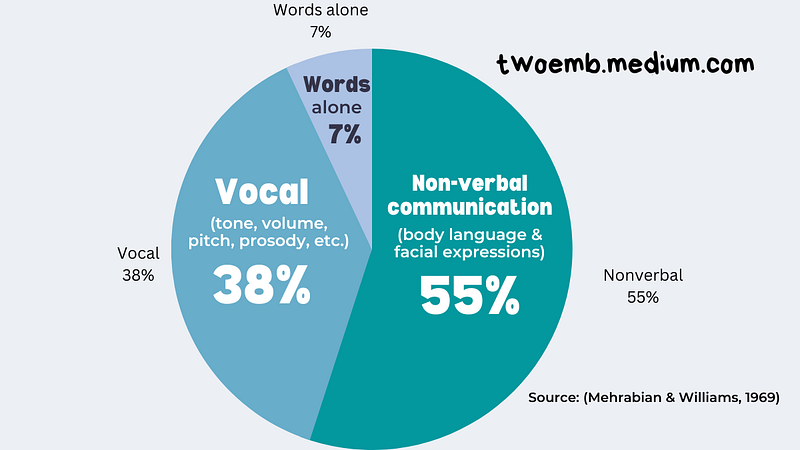
(There have been follow-up studies which question the accuracy of the percentages and conclusions reached by Mehrabian & Williams back in 1969, but none have ever challenged the idea that the majority of our communication does not involve spoken words).
Further, with the ever-increasing multitude of hours spent online, a significant portion of our communication doesn’t even involve body language or facial expressions, it’s purely written (rather, typed) word.
Wait — isn’t that the exact form of communication certain behaviourists are using to post comments in attempts to invalidate that very same form of communication?
Dizzy yet?
The ableism is strong with this one
I am not one known for a subtle style of communication, and I tend to miss subtleties from others. This message was as blatant, blunt, and unsubtle as they come. There was no missing this one, not even for me.
Neuroclastic, a non-profit advocacy organization run for and by Autistic and disabled people, has a section on their website dedicated to articles, blogs, and other works by non-speaking Autistics.
This is awesome and necessary because non-speakers are amongst the most ignored and discounted populations. It’s very important for more organizations to make space for non-speakers to be seen and heard.
A certain ableist behaviourist (not the first of his kind, but this one has been the loudest of late) had the audacity to straight-up accuse Neuroclastic of faking these articles. They said other people wrote the articles, then Neuroclastic falsely claimed they were written by non-speaking Autistics.
What in the ableist fuckery is this?
Let me get this straight. Their contention is allistic (non-Autistic) people can write articles. Speaking Autistic people (like myself) can write articles… but they claim there’s no way any non-speaking Autistic could have produced a well-written article?
I guess they haven’t heard of Amy Sequenzia, Tito Mukhopadhyay, Ido Kedar, or Naoki Higashida, among many others. Aside from published authors, there are thousands of non-speaking Autistic self-advocates and activists who post on social media, blogs, and online forums.
The reason there aren’t more is not due to lack of ability, it’s due to lack of accessibility.
This gives “use your voice” energy
For those who don’t know, I’m hard of hearing, fluent in American Sign Language (ASL), and have been involved in the Deaf community for much of my life.
I wrote a piece this past Spring about an experience I had at a Deaf camp as a teenage camp counsellor. To summarize briefly, I was immersed in the Deaf camp culture where everyone was using ASL to communicate, and it was wonderful.
Until the day the parents came to visit.
One mother kept insisting I “use my voice” when communicating with her Deaf son. She was clearly anxious about him learning to read lips and speak, along with using ASL, and expected me to facilitate her ableist approach to her son’s language development.
Nope.
I get this parent was thinking of her child’s future. She’s worried he won’t be able to “get a job and contribute to society” (society being capitalism) if he can’t communicate with hearies (hearing people).
Part of the reason these barriers still exist is because people keep playing into ableist beliefs about one form of communication being superior over others.
All forms of communication are valid, and communication is a basic human right.
Let’s get right down to it
The crux of the anti-communication argument (made mostly by ableist behaviourists) is that certain types of alternative communication are invalid because there is not yet strong scientific evidence that they are accurate and effective.
I’m typically a strong proponent of “evidence-based” services and information — up to a point. I’m an even stronger proponent of critical thinking, which includes being critical of scientific research when necessary.
Much (most) research on Autism and alternative communication is done by allistic, speaking academics with little to no lived experience. Much of that research is unabashedly ableist, assuming Autistic and non-speaking participants are not competent.
Many alternative methods of communication presume competence of the individuals using them. This means we acknowledge and understand that, given the proper tools and resources, people are able to communicate in ways other than speaking.
Plenty of Deaf and non-speaking people communicate directly using signed languages, writing, typing, and specialized apps or computer programs.
Ever heard of Dr. Stephen Hawking, my guy? Yeah, the Dr. Stephen Hawking uses text-to-speech software, which is a form of AAC. I wonder if our ableist behaviourists would have liked to question the great Dr. Hawking about his capacity and competency?
© Jillian Enright, Neurodiversity MB
Update
After watching a livestream conversation with Neuroclastic representatives and the ableist behaviourist, I had a lot more to say, so this article now has a part two:
When you join medium, as a member you’ll have access to unlimited reads for only $5 per month. If you use my referral link, I’ll earn a small commission, and you’ll earn my undying gratitude.
If you’d prefer give a one-time tip, you can support my writing on Ko-Fi — also, it’s free to follow me on Facebook!
Related Stories
References
Ballou, E. P., daVanport, S., Onaiwu, M. G. (2021). Sincerely, your autistic child: what people on the autism spectrum wish their parents knew about growing up, acceptance, and identity. Beacon Press.
Mehrabian, A., & Williams, M. (1969). Nonverbal concomitants of perceived and intended persuasiveness. Journal of Personality and Social Psychology, 13(1), 37–58. https://doi.org/10.1037/h0027993
Sequenzia, A., & Grace, E. J. (eds). (2015). Typed Words, Loud Voices. Autonomous Press.
Travers, J. C., Tincani, M. J., Lang, R. (2014). Facilitated Communication Denies People With Disabilities Their Voice. Research and Practice for Persons with Severe Disabilities, 39(3), 195–202. https://doi.org/10.1177/1540796914556778


