
Driven to Abstraction
Discussing and defining abstract art, from the Stone Age to the Modern Era…
Abstract is a word often misused when talking about art. Some critics doubt that truly abstract art can ever be produced through human agency and is therefore impossible! Basically, abstract art needs to be purely formal without any figurative reference. More precisely, abstract work should contain nothing that remains representational.
Russian painter Wassily Kandinsky was, arguably, the first to successfully achieve abstraction as an art form. Though he was not the first to use abstraction in art. So, before we consider his innovative improvisations and compositions, let’s take a look at some precursors and, briefly, discuss what makes them abstract… or not.
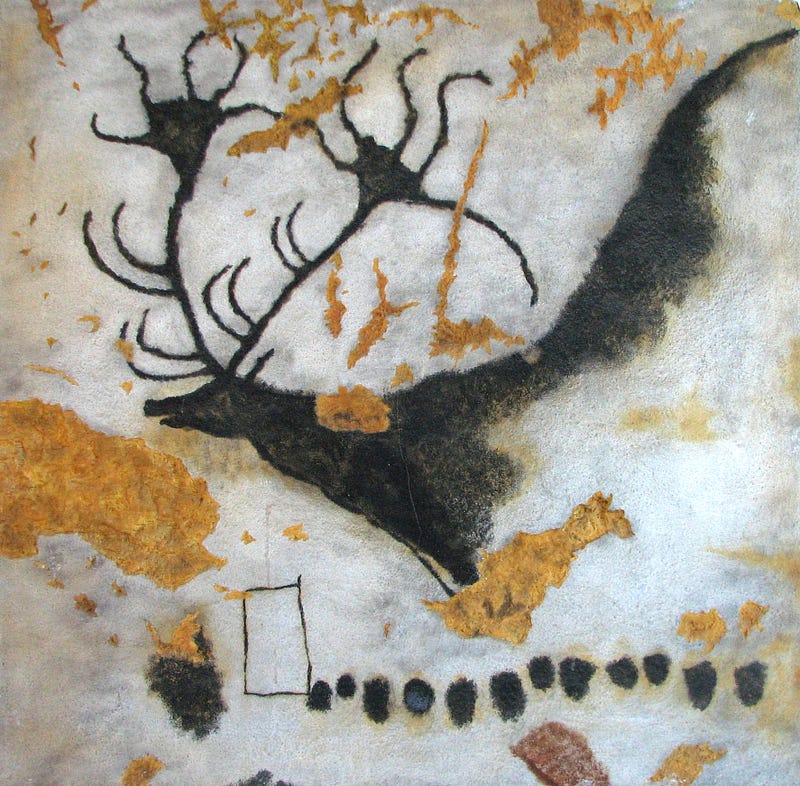
Perhaps the earliest painting we have yet discovered was, indeed, the first piece of abstract art? Among the famous animal paintings found in the caves of Chauvet and Lascaux France, there are numerous squares, grids, and rows of dots. In many ways they resemble the abstract art of the mid-Twentieth Century, a Miro maybe…
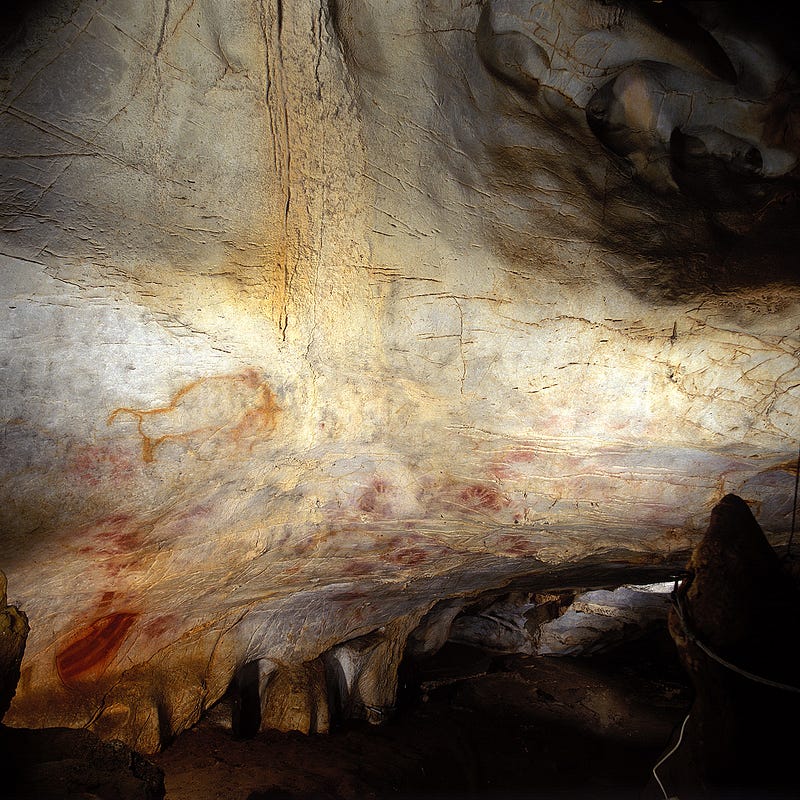
In the older Cantabrian cave complex of El Castillo, among simple outlines of macro-fauna and numerous hand-prints, are patterns of dots and discs. One single dot of red ochre has been dated as 40,800 years old. That’s much earlier than all the other marks made on the stone walls there, several millennia before the art of Chauvet or Lascaux, and may have been the work of Neanderthals.
But are these examples of abstract art?
It’s widely thought that most of the dots are forms of notation, either a number system or, more likely, star charts. This means they are certainly representing something — we will probably never know for sure — and perhaps not really art as we understand it. Well, no more so than any form of written notation or the dates in a calendar.
It has been argued that writing is an abstract form of visual art. The shapes are not directly representational of the concepts they carry, but have meaning associated with them as a linguistic structure. So, writing in a language the reader cannot comprehend, would appear abstract, though not intended to be so.
Another prehistoric contender would be the decorated jaw bone of a horse, found in Kendrick’s Cave, Llandudno. It’s the oldest known piece of portable art from Wales and is thought to have originated in the Ice Age. This presents the same problem of interpretation as the Stone Age dots and grids on cave walls. We can only guess at the meanings, if indeed there are any. This could simply be reverential adornment.
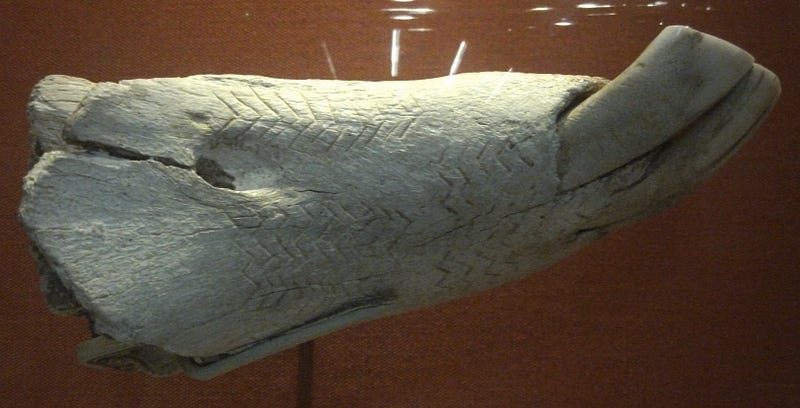
Abstract motifs can be found in many decorative traditions. Zigzags and spirals are very widespread ancient designs. This brings us to the debate of what the differences are between design, decoration and art. Not wishing to digress too far at this point, I can summarise…
Design is a process carried out in order to solve a problem. Decoration is a form of patterning or accessorising intended to make a thing pleasing to the eye. What elevates a thing to be considered art has been discussed previously in Signifier. Here we can differentiate with the phrase, “art without concept is merely decoration.”
Leonardo Da Vinci used abstract shapes he found in his surroundings to suggest forms— like imagining dragons in wine stains and cats in damp patches on the walls, or seeing castles in the clouds.
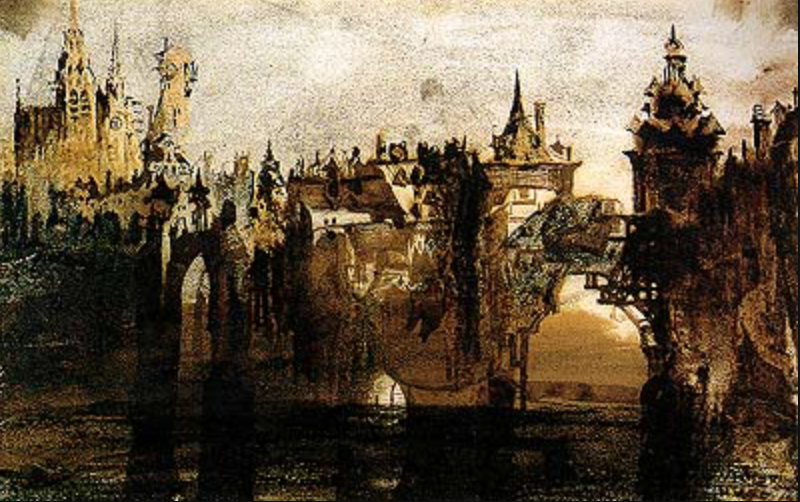
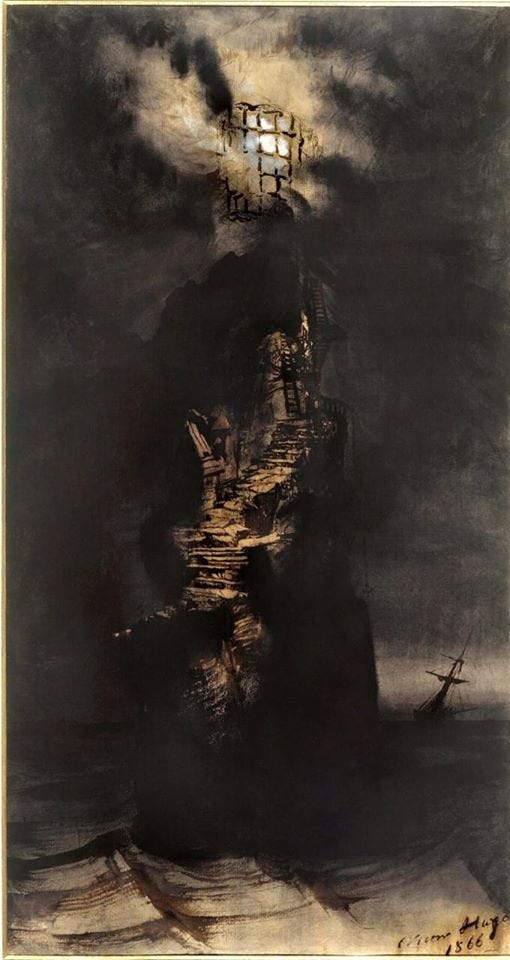
Centuries later, author-artist Victor Hugo employed a similar approach, though he intentionally created his random patterns through the pouring, spilling, and splashing of inks, paints, and coffee…
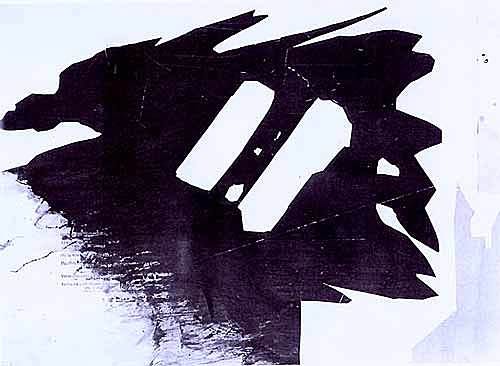
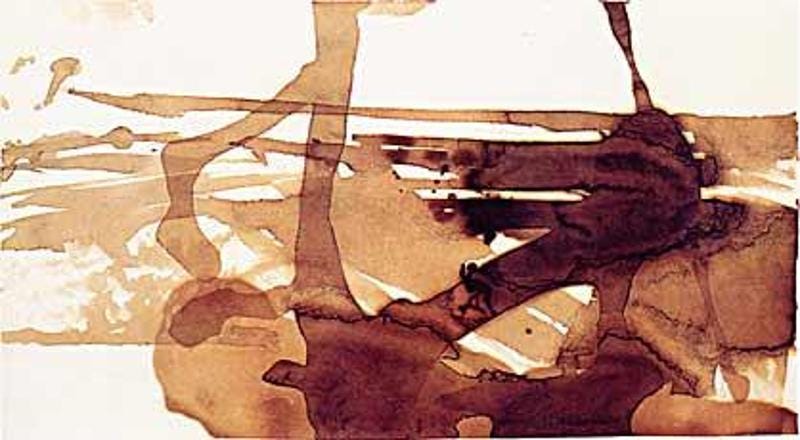
He was also known to draw energetically onto blotting pads using a pen with a twisted nib that unpredictably scratched and flicked the ink. He would empty coffee grounds onto paper and smear them with fabric or fingers. Generally, he did this to suggest landscapes that he would then work into illustrations, a technique prefiguring Automatist Surrealism. Some of his compositions, such as those shown above, he thought were successful compositions in their own right and considered them finished works of art…
Victor Hugo’s fame as an author overshadowed his output as a visual artist and this is perhaps why he’s not so prominent in histories of abstract art when he clearly was an important contributor. He remains better known for his epic works of Romantic fiction including The Hunchback of Notre-Dame (1831), Les Misérables (1862), and The Man Who Laughs (1869).
As the Nineteenth turned into the Twentieth-Century, there was a vogue for trying to represent the abstract, such as music and emotions, in visual form. This was an idea more associated with Victorian mysticism than art and is represented in the book Thought-Forms compiled in 1901 by Annie Besant and Charles Leadbeater, in which they attempt to depict both music and the listener’s emotional response using line and colour...
So, in the early decades of the Twentieth Century, there were a few artists experimenting with different approaches that would drive them down the road to abstraction. There’s also the vast body of world Folk Art which included abstract motifs, often given some significance as protective talismans — such as ‘witch marks’, ‘hex marks’, and ‘barn stars’. There’s still debate as to who really did ‘invent’ abstract art. That’s if it wasn’t Neanderthals or Victor Hugo…
At the vanguard, were several artists associated with Der Blaue Reiter (The Blue Rider), a pre-war art group who shared artistic vision and exhibited together, based around an occasional journal also titled Der Blaue Reiter. Most notable among these for exploring aspects of abstraction were Gabriele Münter, August Macke, Franz Marc, Paul Klee, Kazimir Malevich and Wassily Kandinsky — who is usually credited with producing the first truly abstract paintings, although it really was a result of discussions and exchanges of ideas with his fellow Blue Riders…
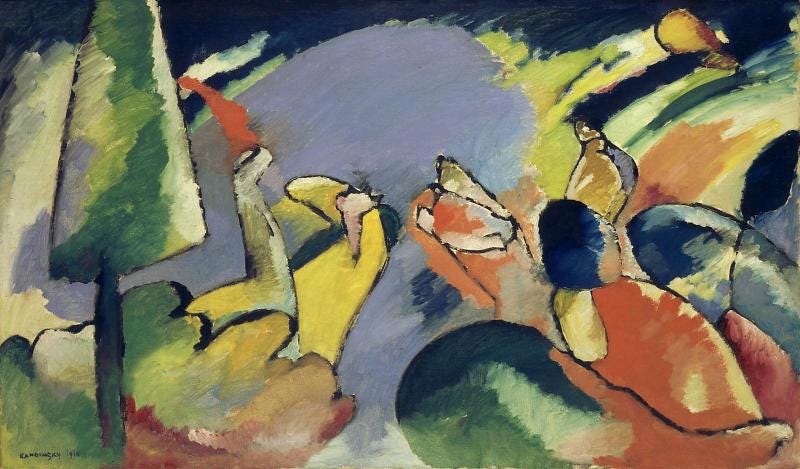
Wassily Kandinsky began to experiment with abstracting from landscape and by painting expressive, narrative pictures that were symbolic, though not taken from real scenes. His series of ‘improvisations’, exemplified here with his 1910 painting, Improvisation XIV, may imply that they were constructed rather than painted from observation, yet there is clearly a landscape within the balanced, rhythm of Fauve-like colours. The simplified tree, and treatment of forms across the canvas, is reminiscent of the landscape paintings of Paul Cézanne, so much so that it could be a study of Bibemus Quarry painted by Cézanne in 1895.
Around 1911, Kandinsky painted Cossacks, a deceptively simple and almost childish picture that is at once: narrative, expressionistic, romantic, fauvist, symbolic, allegorical…
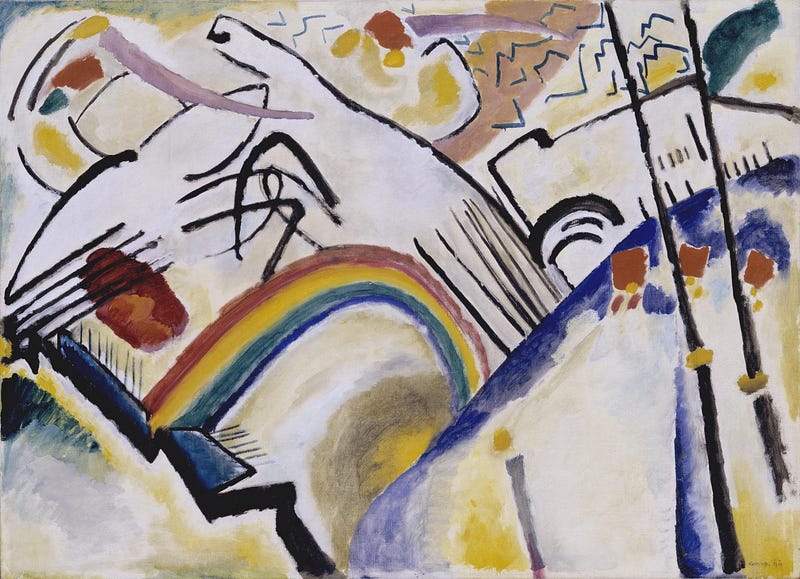
At first glance, it may appear to be abstract, but it remains representational. The Cossacks of the title were a militarised, though independent, community within Russia. Here, they have been reduced to cartoon-like blobs of colour with bold use of negative space on the right of the picture. The cloud of smoke rising from the barrage of long rifles on the left is a fiery blood-red blob. The guns of either side bristle from the landscape that seems to be sliding into the valley… and is that the golden glow of a distant, burning city or the light of a new dawn?
At the top, the dynamic forms of two more sabre-wielding Cossacks seem to be carving up the land itself, a confusion of calligraphic lines perhaps represents their slicing or the cross-fire of battle over the rainbow that holds the picture together and forms a bridge between the two sides, both hopeful of a brighter future and an end to hostilities…
It’s not a painting of a battle, but a painting of some of the emotions and meanings of a battle. It depicts the violence and confusion, but is also romanticised. In this image, both sides are heroic in their fight for a better future and should instead be united by these hopes and not in conflict. Kandinsky is championing the bravery of the soldiers, whilst condemning war. At the same time it operates as a representational scene and as an abstract composition of colour and line.
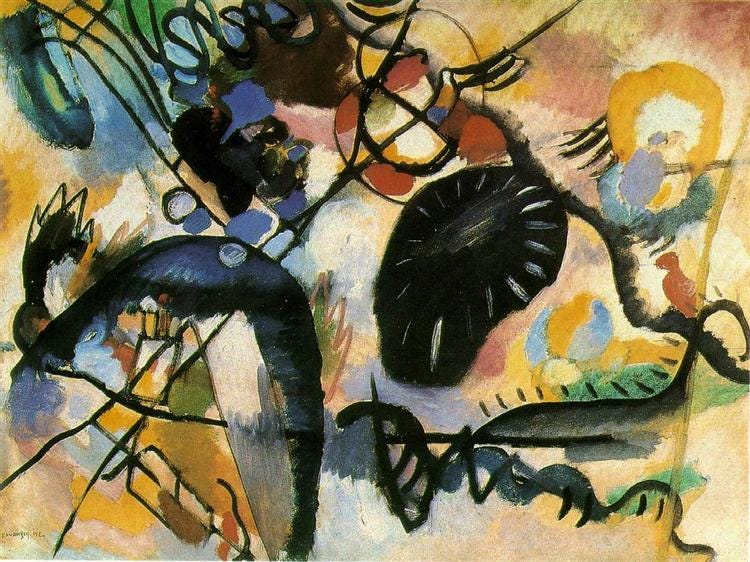
By 1912, Kandinsky was painting compositions that are considered to be abstract, though there still seems to be elements of landscape here, in Black Spot I. The title refers to a formal element within the painting and not what the painting may represent, indicating the prime importance of form and structure here. The use of line is bold and, in some ways, is reminiscent of some earlier Fauvist painters, but here the colour is not strictly contained by line and, in some areas, is set free entirely from line.
The relationship between line and colour becomes one of balance and interplay. The result is a dynamic composition that bypasses rational meaning, becoming directly expressive in a similar way to music. Some of his paintings so resemble the art of the spiritualist movement, particularly the ‘thought-forms’ of Annie Besant and Charles Leadbeater that it’s difficult to believe he had not seen their visual representations of music:
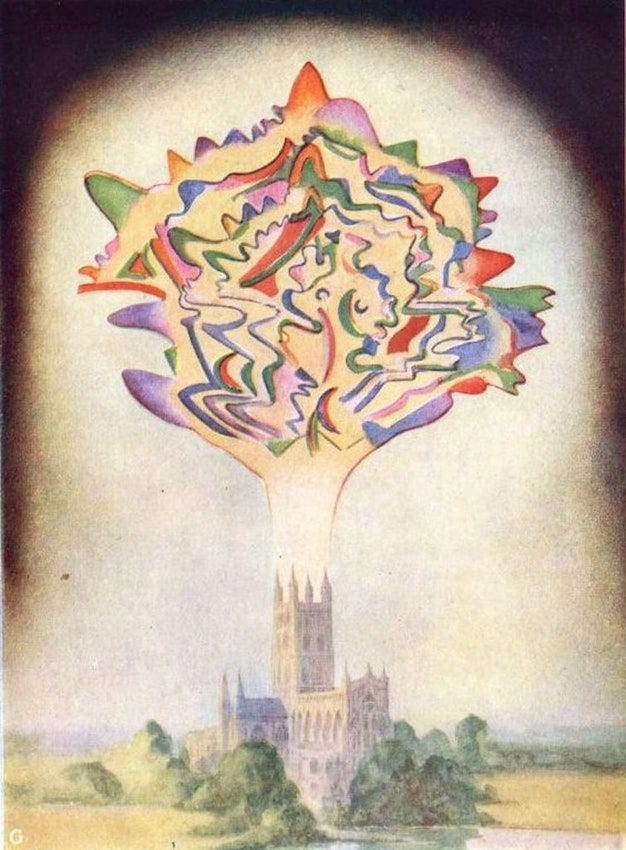
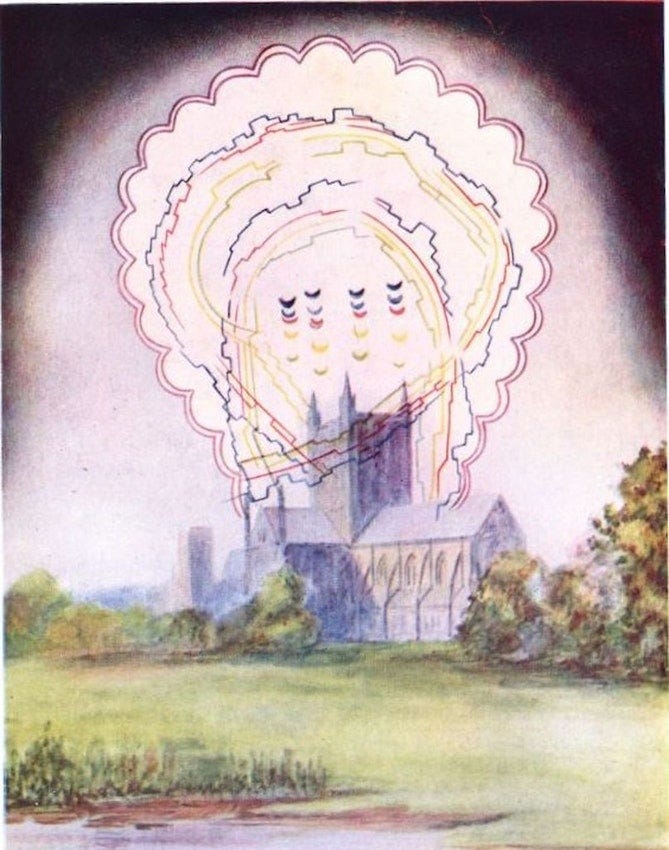
Kandinsky often avoided using titles that gave a clue to the meaning of a picture in order to ‘side-step’ the rational mind that is eager to categorise and dismiss. If the intellectual faculty was momentarily confounded, then this allowed the spiritual, or subconscious, faculty to engage with the work…
By the time he painted Composition 6, in 1913, he was working directly with the canvas — each colour and line is governed by its relationship with those around it. This series of early ‘Compositions’ are generally cited as the first abstract paintings. Most critics and historians would agree that, here, we finally have an abstract with no explicit iconography, ideographs or representational forms:
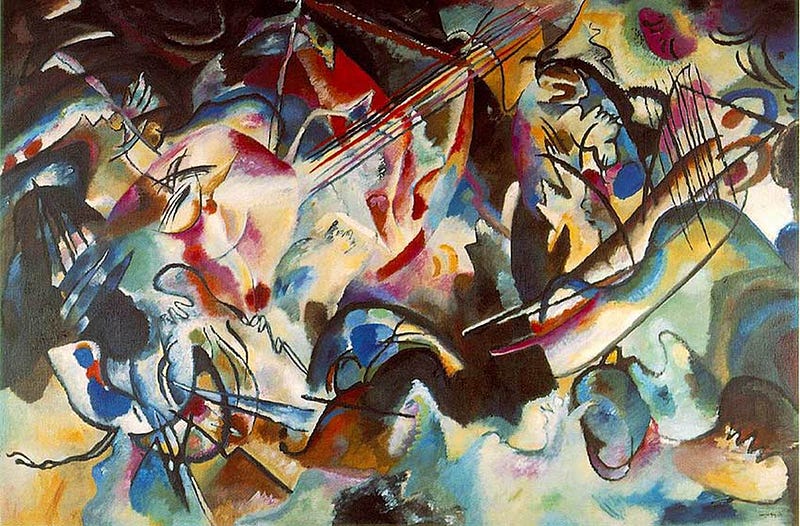
The rounded, organic shapes are balanced by slashing lines. The soft tones are counter-pointed by bold, fiery colours, the dark in harmony with the light. The composition has flowing movement and, in many ways, has been created by applying a similar approach to a composer creating a concerto.
The starting point, the first ‘note’, may be one of the several red dots, but the eye cannot easily take in the whole image at a glance. Instead, we are invited to wander through the complex patterns. There are several routes our gaze may explore before coming to rest in the quiet conclusion of the composition at the patch of white near the mid-point of the right margin. This structural use of colour introduces an element of time to the work and, coupled with its complexity, keeps it just as interesting with every subsequent viewing.
Kandinsky produced hundreds of preliminary sketches for his abstract compositions, exploring how the purely formal elements of line, form and colour worked with each other to create harmony or discord. He hoped his paintings would achieve the same direct expressiveness of great music and dealt with similar elements of rhythm, tempo, tone, volume…
Like his friend and colleague, Franz Marc, Kandinsky believed that art should strive to be a synthesis of both the intellectual faculty and the emotions. He thought that art can express the “inner grace” of the artist and reveal that quality in the viewer.
His work, along with others of Der Blaue Reiter, would be a notable influence on all abstract art to follow including Suprematism, Constructivism, Synchromism, Orphism, Activism, De Stijl as well as the Dadaists and Surrealists — particularly Juan Miró. Kandinsky survived the First World War and was hugely influential between the wars. He was a teacher at the Bauhaus and an important conduit of ideas between Russia and the West.
* all images used with license or sourced in the public domain and presented here under fair usage for educational purposes
Originally published at https://remydean.blogspot.com.


