
Do You Know What’s Really Surreal?
…and do you know your Veristic Surrealism from your Automatist or Organic? A brief introduction to the first major movement in Postmodern art.
Surrealism grew directly out of the ideas and attitudes of Dada. The earlier movement had formed in 1916 and many artists associated with Dada went on to become major figures within the Surrealist movement, including Max Ernst, Man Ray, Jean Arp, Francis Picabia…
The main features of Dada that fed into Surrealism were:
- the re-assigning of new meaning to everyday objects,
- a disregard for accepted aesthetic,
- the rejection of rationalism,
- the use of confrontation,
- shock tactics and humour.
The Surrealists also thought of themselves as revolutionary, and later went on to demand that art be ‘magical’ and should transcend both religion and politics, thus echoing views first popularised by Der Blaue Reiter.
The main features of Surrealism that differentiated it from Dada were a conscious intellectualism, a fascination with Marxism, Freudian psychology, Occult philosophies and with cutting-edge physics. The Surrealists were also driven by the desire to make our private realities public… and to make art that was more than it seemed, art that in some way could question and ultimately transcend ‘reality’.
The term ‘surrealism’ was coined by the hugely influential art critic Guillaume Apollinaire, as early as 1917, to describe something in art that exceeded reality. He was referring to works by Der Blaue Reiter group and the ‘Grand-daddy of Dada’, Marcel Duchamp. Apollinaire also used the term ‘surrealistic’ in program notes for a ballet that included work from Jean Cocteau.
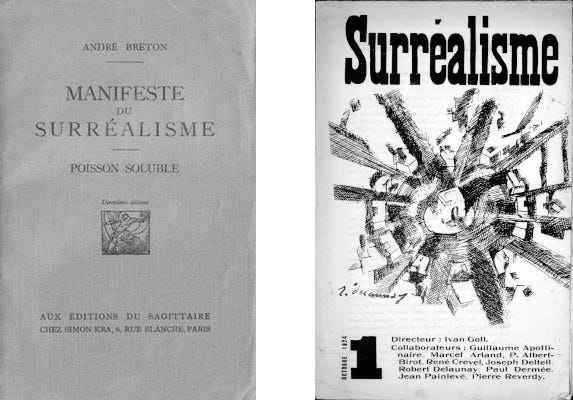
Surrealism (with a capital ‘S’) was launched as an art movement by the French poet, André Breton in October 1924, when he wrote and published his Manifeste du Surréalisme / Manifesto of Surrealism. That same October, another poet, Yvan Goll, published a rival manifesto in the the first and only issue of his journal, Surréalisme. Apparently, their rivalry led to a brawl, at a the Théâtre de la Comédie des Champs-Elysées, between the two contenders.
It seems that the general consensus supported Andre Breton’s claim as the founder of the movement. In his manifesto, Breton demanded that works of Surrealism should be, “As beautiful as the chance meeting on a dissecting table of a sewing machine and an umbrella,” quoting Comte de Lautréamont, aka Isidore Lucien Ducasse.
The closest he came to a definition of Surrealism was:
“Psychic automatism in its pure state, by which one proposes to express — verbally, by means of the written word, or in any other manner — the actual functioning of thought. Dictated by thought, in the absence of any control exercised by reason, exempt from any aesthetic or moral concern.”
Breton acknowledged a debt to Dada, but also clearly differentiated Surrealism with a very structured doctrine and elaborate theoretical basis. Surrealism was certainly avant-garde, though it marks the end of Modernism…
How’s that?
Andre Breton, and other major Surrealist artists, looked to the art of the past for inspiration and example. They championed the ‘underdogs’, naming artists who they felt had been overlooked, misunderstood or not given the credit they deserved. They cited ‘artists’ — including poets, philosophers and scientists — that exemplified some of the theories and values that Surrealism was concerned with. By deliberately looking to the past they set themselves aside from Modernism, which had avoided overt references to art history, and this is why Surrealism is considered the first Post-Modern movement.
Of course, by looking to history, they also embraced many of the new ideas, materials and techniques that had been innovated and explored by the Modernists who preceded them in their recent past. They ‘mixed-and-matched’ old and new.
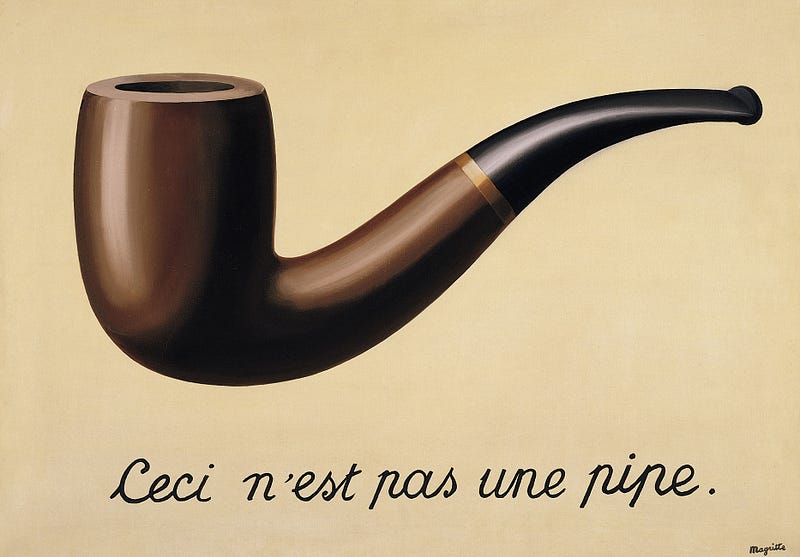
René Magritte’s La Trahison des Images / The Treachery of Images is a key work in understanding Surrealism that offers what is almost a definition in itself. It’s also commonly known as Ceci N’est pas une Pipe / This is Not a Pipe, for obvious reasons, because that’s what’s written on the canvas!
The initial response is, “Yes, it is a pipe.”
…OK, then, try and smoke it.
It is not a pipe, it is the image of a pipe. Not even that, it’s an arrangement of formal elements painted onto a surface that, given our cultural background, we recognise as representing a, larger-than-life, pipe. But then, what does a pipe represent?
To readers of Sherlock Holmes stories, it probably suggests contemplative problem-solving. Whereas a Freudian psychoanalyst would see its curves as erotically suggestive and consider the psycho-sexual connotations arising form the act of packing-in tobacco, and sucking its smoke as a pacifier.
If a relatively simple image can represent so much more than it actually is and deal with multiple layers of meaning, then it follows that everyday objects must also share this ability, especially when presented in a way that removes them from their everyday context, or renders them ‘non-functional’.
The main thing that Surrealism took from Dada was the reassigning of new meaning to ordinary objects. By presenting an object in the arena of art, removed from its normal context, the mind opens up to new relationships with that object and we question the nature of its reality. This had been exemplified by Duchamp’s Dada-defining objet of 1917, Fountain.
This falls in with the Romantic notion of a poetic reality that overlays our shared experience. When we engage with the idea of a thing in this way, our responses are guided by our cultural identity and reveal more about our individual subconscious than about the material ‘realness’ of that thing. These responses reveal more about ourselves than about the thing that causes them.
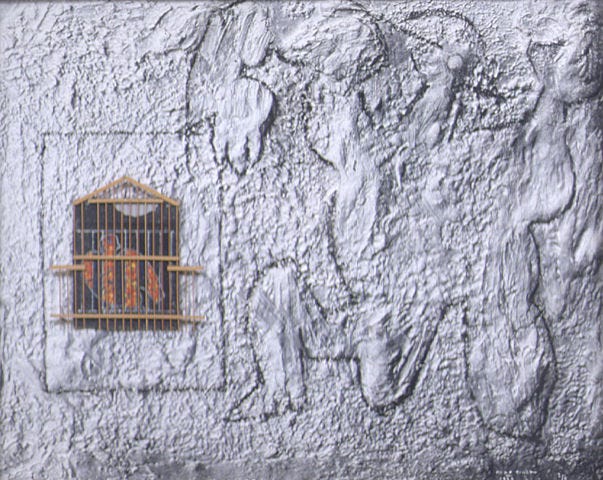
Max Ernst was instrumental in defining Surrealism and innovating its central concepts and techniques. Loplop Introducing a Bird is, at least in part, a result of his approach to Automatist Surrealism.
This work is part painting, part sculptural relief, and part assemblage. We are presented with a biomorphic figure that resembles the character ‘Loplop’ — a birdman character that Ernst uses to represent himself within the mythology of his own art. Loplop is loosely drawn in response to patterns suggested by the random texture of a roughly plastered surface, black line on off-white. Fixed to this surface, that appears to be a piece of wall, is the front of a wooden bird cage. Within the cage is painted the colourful bird that Loplop presents to us.
Automatists created work that is derived from automatic mark-making or responding to random stimulus, such as seeing shapes and forms in the surroundings, the grain of wood, a cloud, or the shape of a stone. They would allow the subconscious to create with minimum intervention from the conscious intellect. Action Painting and some Abstract Expressionism also falls into this category.
Often, the Surrealists would use this technique up to a point, then ‘step back’ and ponder any symbolism and meaning that seemed to have been revealed. Then they would engage their intellect and add more considered elements to their initially Automatist composition.
Here, the Picasso-esque figure seems to be the result of a random pattern suggesting an outline, whereas the addition of the cage detail and the more ‘finished’ bird must have been added after some further thinking. The subconsciously derived bird-man is presenting an artistic rendering of a similar concept, though this other bird is in a cage that is not a rendering, but the front off a real cage.
Perhaps Ernst considers the tyranny of reality something that can set a limit to artistic expression, though the figure that represents himself is shown outside of this system. Reality, or at least representational art, is a prison that prevents ideas from flying free… Sur-reality offers the potential for greater freedom.
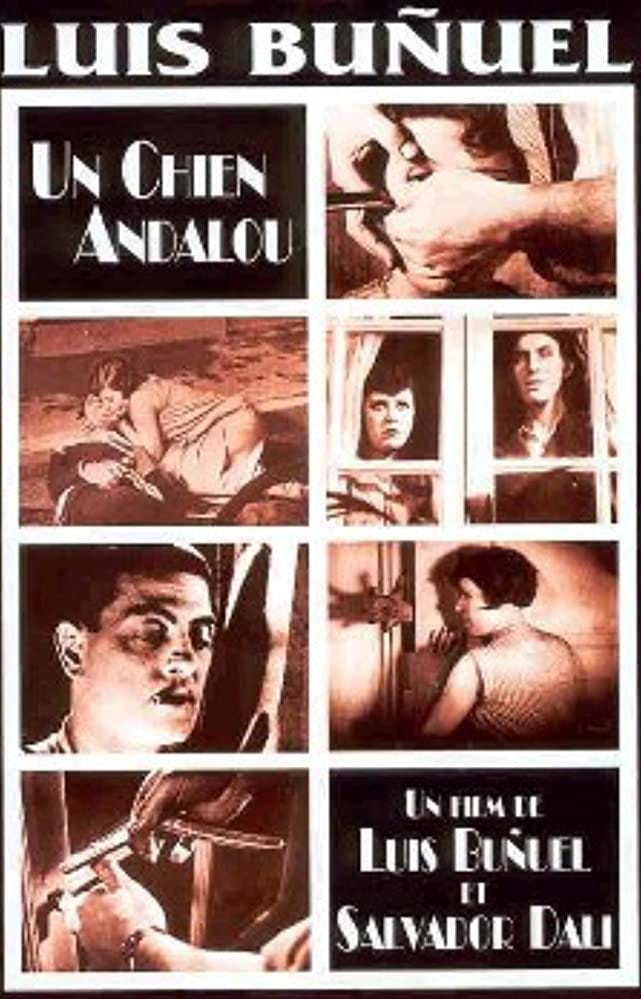
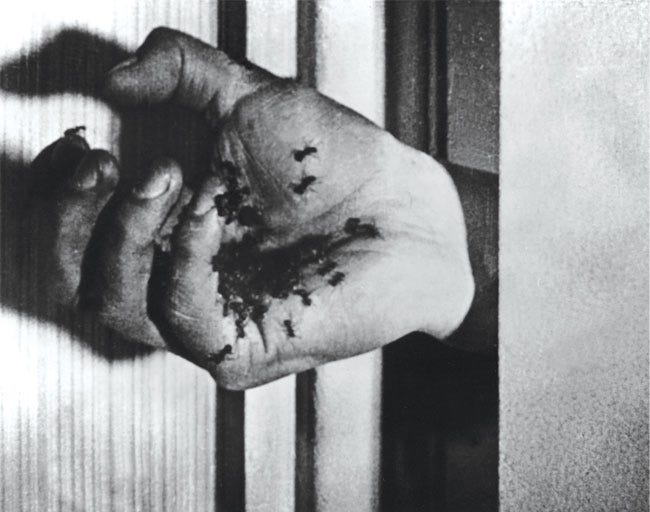
With Un Chien Andalou, Luis Buñuel and Salvador Dali explored and exploited the similarities between cinema and dreams. This silent film of 1929 deliberately avoids presenting a plot, though does remain within narrative conventions. There is a logic to how the scenes follow on from one to another, though that is the logic of dreams.
It’s not simply a film of a dream, though, it’s more of a film representing the psychoanalysis of dreams. The juxtaposition of the various symbols and actions, though sometimes seemingly random, is actually very contrived. This venture would fall into the category of Dream Surrealism, typified by the compilation of images that are usually fantastic and ‘dream-like’ and themes tending toward the subconscious realms of fear, desire, obsession and the erotic. Meanings often seem obvious, but on closer inspection confound expectations, or contain contradictory elements…
The Surrealists were the first major movement to take up the gauntlet of the ‘art-film’ thrown down by the Futurists. They saw the obvious parallels between film and dreaming: both can compress and extend time, one scene does not necessarily follow on from another in either temporal or corporeal terms.
Even though special effects were limited by today’s standards, the use of time-lapse, double exposure and clever trick photography could make impossible things appear real, and a powerful emotional effect could be achieved by what was nothing more than an insubstantial pattern of light projected onto a screen.
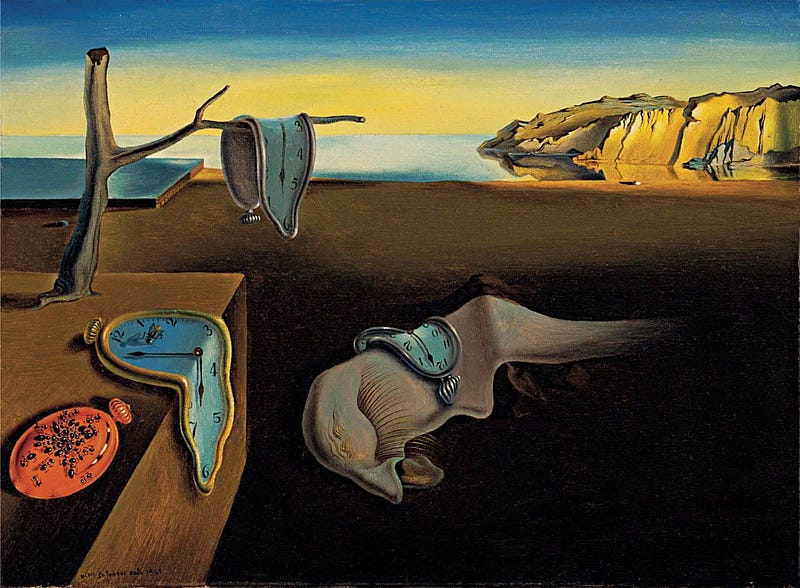
Salvador Dali’s painting, The Persistence of Memory, is probably the first image that springs into many minds as representative of Surrealism. A coastline and a dark beach upon which lies what appears to be a discarded mask along with four pocket watches, three of which are ‘floppy’, the fourth covered with ants.
Dali was perhaps the most widely known proponent of Surrealism and one of the few artists who was a great success during his own lifetime, achieving the status of international celebrity. His career was long and varied and he produced works in different media, both two- and three- dimensional as well as some time-based performances, installations and more film works, including a dream sequence he designed for Alfred Hitchcock’s Spellbound in 1945.
He claimed that this painting was inspired by watching a disc of soft cheese, such as Camembert, slowly melting off the edge of a plate on a hot day. It struck him that this made the passage of time visible and illustrated how other factors affect our varying perceptions of the pace of time. In this case the heat of the sun caused the cheese to soften and the process of change, as it melted, accelerated. He transferred this observation to watches, much clearer symbols of time.
Apparently, the inclusion of ants here, and in many of his works such as Un Chien Andalou, stems from his irrational fear of the them. In order to understand his phobia, and perhaps the workings of his own subconscious, Dali studied the insects. He saw their ordered hierarchy and regimented organisation as some sort of metaphor for civilization. He weighed their stark lack of individuality against the merits of their selfless toil. He was intrigued by the mathematics that governed their behaviour. Instead of them giving him the creeps, he found them to be fascinating...
Like most of the Surrealists, Dali was far more interested in personal, internal reality than in consensus reality. To each individual, their own imaginings and particular viewpoint is much more real than anything that exists in the shared world. One person’s experience of a table might be very different to another’s experience of the same table. Not just in terms of visual point of view, but memories and experiences associated with that or similar tables.
For example the word “shoe” probably conjures up an image in the mind of some sort of footwear… A hiker might think of a sturdy walking boot, a Dutch person may think of a wooden clog, a fetishist might imagine shiny leather and a nine inch chrome heel, a dancer might think of their ballet slippers, a new mother may see woollen baby booties.
All these images are also symbols with associated emotional value and the true response happens within the private world of the individual’s mind. Yet in our interactions we generally attempt to reinforce consensus reality and may not even allow our own true responses full reign, especially if they are not considered ‘socially appropriate’.
With Veristic Surrealism, Dali and many others were attempting to make visible the subconscious. Giving those fleeting thoughts and dreams the illusion of solid reality that can be shared with others. Making dreams and impossible fantasies appear as real as possible, or using the symbolism of dreams to depict a concept or scenario. They attempted to express our private realities and make them tangible and shareable.
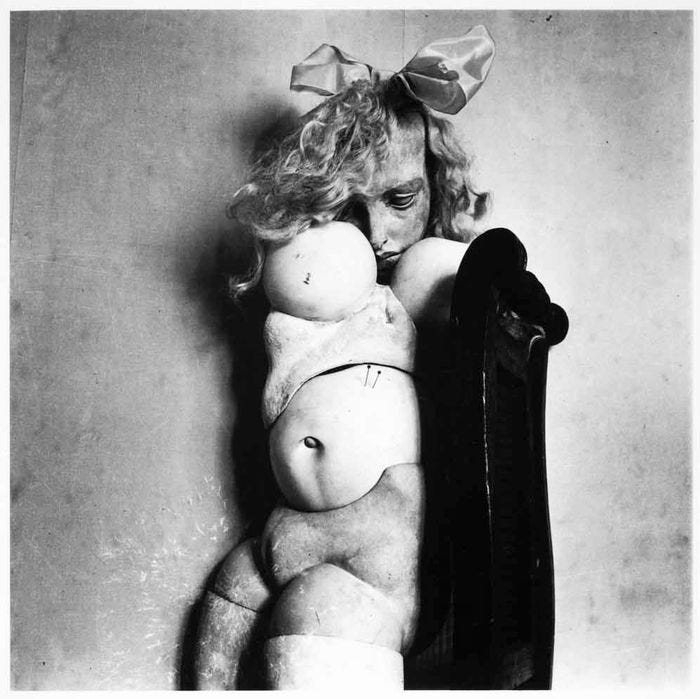
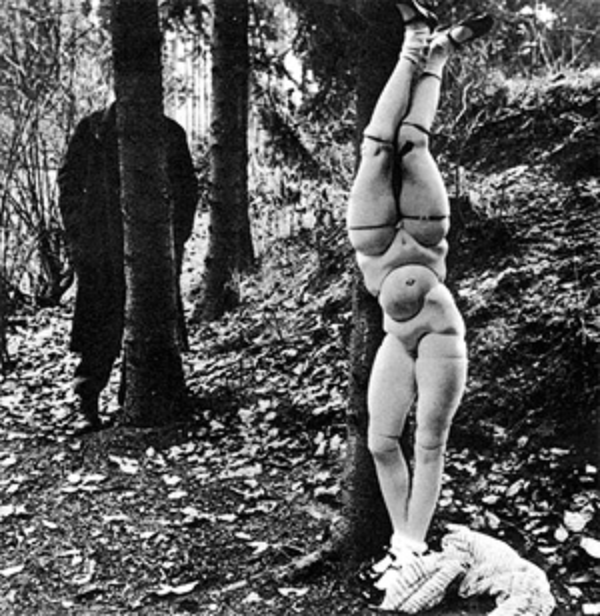
Surrealist photographer, Hans Bellmer, created dolls that were distorted assemblages of recognisable human parts. Though mainly sourced from mannequins they were also sculpted with emphasised features that suggested breasts and genitalia, in many ways resembling the pre-historic Venuses. This primitive approach to figurative sculpture was often counter-pointed by very realistic faces and wigs. He positioned these dolls in recognisable surroundings, but in such a way that suggested, often psychologically disturbing, narratives:
A jumble of body and limbs with the face of a young girl sits on a chair facing the blank wall in the corner of a room. A blue ribbon adorns the dishevelled blonde wig…
In a woodland scene, stands a strange figure. It’s made up of the lower-half of a female which is echoed by the top-half, with legs sprouting from where the shoulders should be. A gown has fallen to the floor at this doll’s feet, and it now wears nothing but shiny shoes and ankle socks — on all four of its feet. Partially concealed behind a tree we see the looming shape of another figure dressed in military boots and a heavy greatcoat…
Bellmer created these dolls as characters and then cast them in tableaux which he photographed. The photographs were exhibited and published in a book titled La Poupée / The Doll, later some of the dolls were reconstructed as sculptures. These works have influenced many artists that followed, most notably Jake and Dinos Chapman in their easy-shock installation Tragic Anatomies (1996) which features a menagerie of sexually deformed dolls that were intentionally childlike.
This kind of work falls into the ‘broad camp’ of Organic Surrealism, which tends to use obviously biomorphic forms or to blur the boundaries between the animate and the inanimate. Dolls, mannequins and automatons are treated in a visually similar way to living humans and vice versa… Flesh and landscape merge. Objects are juxtaposed with living flesh or seem to have a life of their own. René Magritte painted figures that usually appear as artificial and rigid as showroom dummies. Salvador Dali also produced many important works of Organic Surrealism, perhaps the most famous being Autumn Cannibalism (1936).
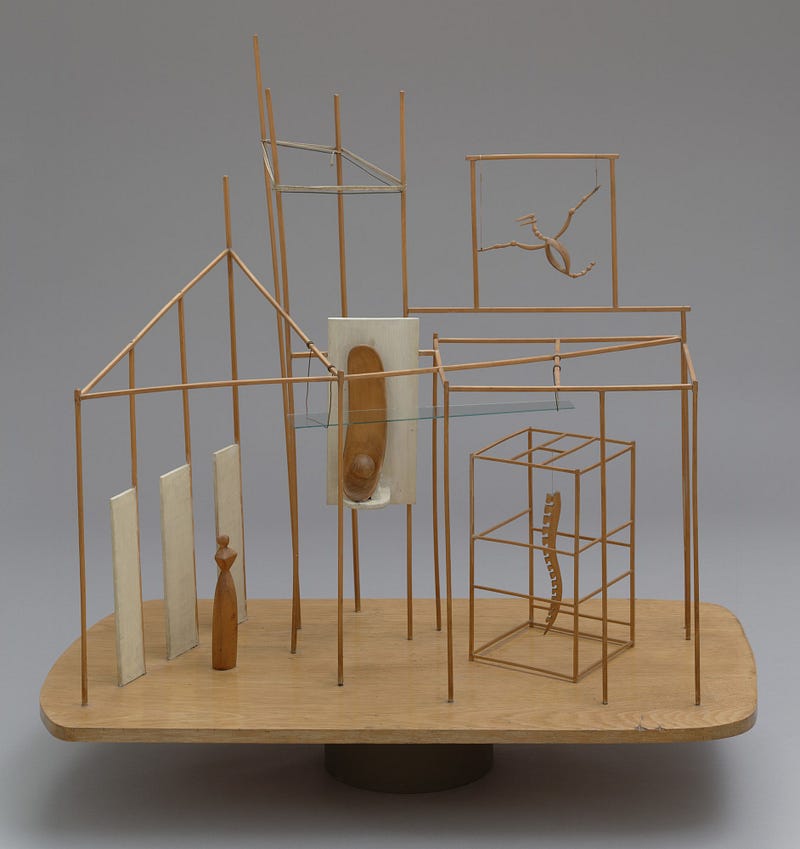
Alberto Giacometti’s The Palace at 4 a.m. is a small seemingly fragile construction of wood, glass, wire and string. This is from Giacometti’s earlier period when he was experimenting with the surreal. The rooms of a house are suggested by a framework of slender wooden dowels and these rooms are populated by small carvings: a simple feminine figure, a detailed human backbone, an organic seed-like form and a skeletal bird.
For me it’s one of the most truly dream-like pieces of Surrealism in its subconscious logic and implied narrative. It’s insubstantial and delicate enough to evoke that sense of fleeting memory as a dream, though it seemed so real to the dreamer, loses its substance and is revealed to the awakening memory only as a vague sequence… and then drifts away.
* all images used under license or sourced for educational purposes and presented here under fair usage policy
A version of this article was first published in my book Evolution of Western Art (questing beast books, 2012)


