
Franz Marc’s ‘Tiger’
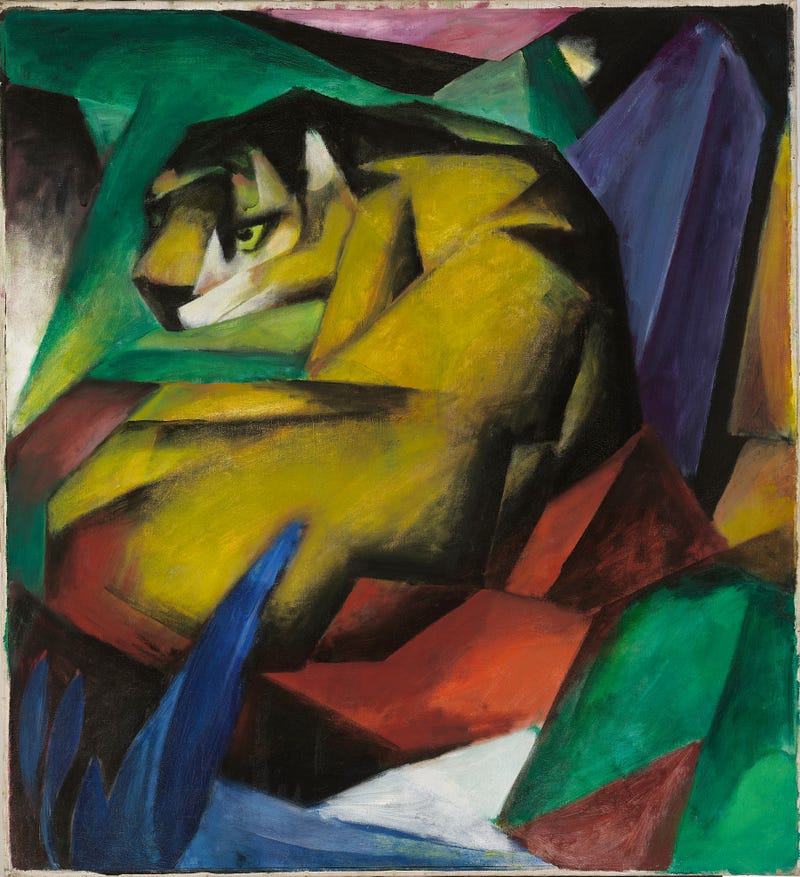
This 1912 painting of a tiger is typical of Marc’s style and would influence Expressionism, Abstract Expressionism, Cubism, and much of European Modernism that would follow ‘between the wars’.
Along with his friend Wassily Kandisnky, Franz Marc was a founder member of the hugely important and influential group of artists collectively known as Der Blaue Reiter (The Blue Rider) — a fairly loose association of several pioneering international artists who were united by the importance they placed upon colour and a belief that visual art could transcend cultural and political boundaries.
They also represent a return to the sensibilities of the Romantic Movement in thinking that art could directly address and affect our emotional and spiritual faculties. Marc’s Tiger is quite possibly a nod to William Blake’s illuminated poem, The Tyger (1794), recognising that Romantic lineage.
Franz Marc saw colours not only as an expressive element in painting, but as representing various universal principals that were either in conflict or in harmony. He believed that painting was a spiritual act and a form of transcendence and, as a student of theology, saw art as a combination of human, animal, nature, the spiritual and the scientific. In Aphorisms (1914), written at the eve of the First World War, he wrote:
“The art to come will be giving form to our scientific convictions. This art is our religion, our centre of gravity, our truth.”
Although Franz Marc depicted mainly recognisable natural forms, his art heralded the development of Abstract Expressionism. This is clear in this work. Imagine the painting with the detail of the tiger’s eye omitted (block it out with a thumb if you like) and it effectively becomes a powerful abstract.
Tiger is typical of Marc’s strong yet well-balanced style, even though complementary colours of intense reds and greens are placed right next to each other. The theory that colour had both psychological and spiritual effects was shared by most Blue Rider artists, but Marc also used colours as narrative and metaphorical elements.
This is a very dynamic composition with typically dazzling treatment of colour and light. In Marc’s many animal paintings, he shows animals in such a state of harmony with their natural surroundings, that they become interwoven, creating a metaphor for the ideal harmony between humans and nature. This painting shows many characteristics that would later identify the style of the German Expressionist movement: strong dark shading mixed with rich colour and a dynamic, almost jewel-like faceting of the image.
By creating a harmonious composition using contrasting colours, he poetically points out that society should be able to achieve harmony by the strength of its differences and not be fractured by them. Just because someone has different political or religious views, it does not mean they cannot contribute to a stable and progressive culture and, just like the whole of nature, human society should thrive on its variety and not strive for conformity. Sadly, that message still needs to be heard and is just as relevant now as it was then!
Wassily Kandinsky and the development of abstract art is also discussed by Remy Dean in Signifier


