
The Wisdom of William Blake
Being Romantic may not mean what you think it means! Reading the Songs of Innocence and of Experience…
Some people would look to The Bible, The Koran, or similar religious texts at those times when they need to contemplate serious matters… for me William Blake’s Songs of Innocence and of Experience (1794) is that book. It’s also a book you can turn to for light reading and entertainment — a five-year-old can appreciate the beauty and majesty of the words as well as the illustrations. It is accessible and contains The Tyger, one of the Nation’s best known and well-loved poems. It has no pretensions, yet works on many levels so that repeated readings yield increasing rewards.
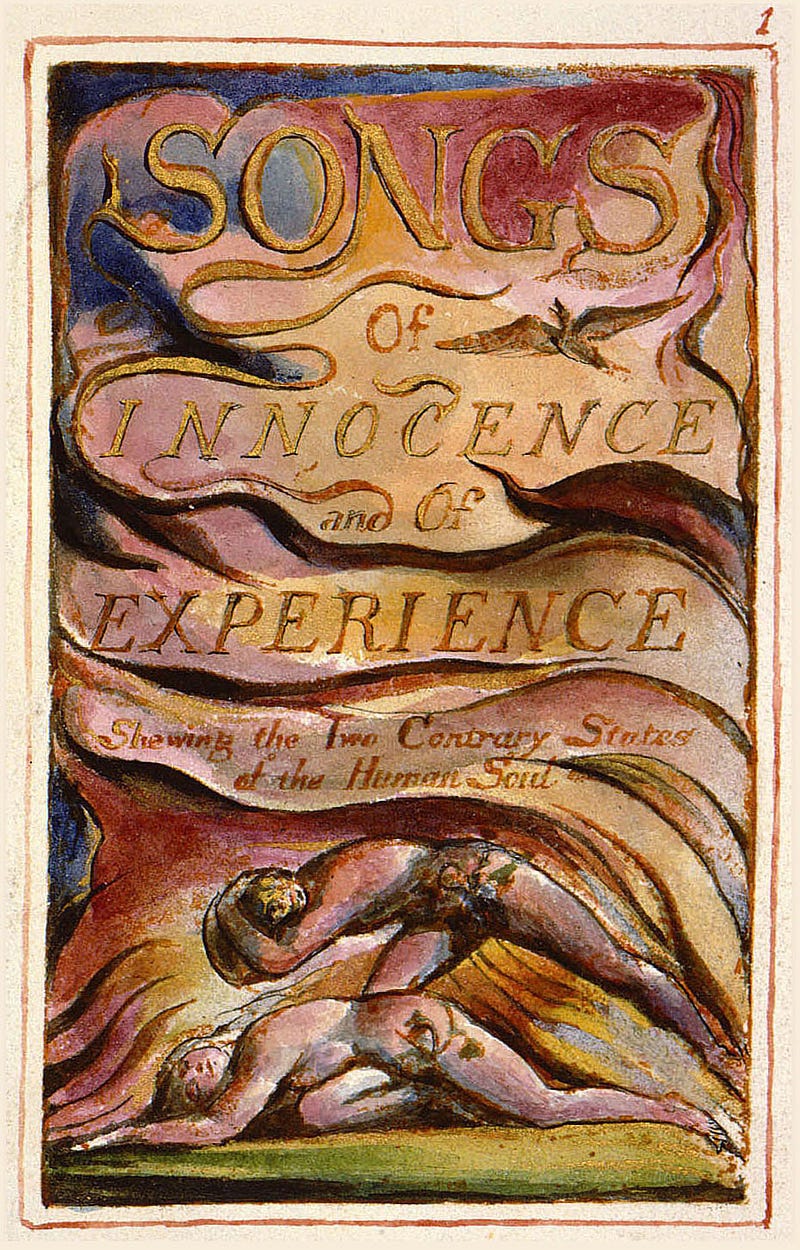
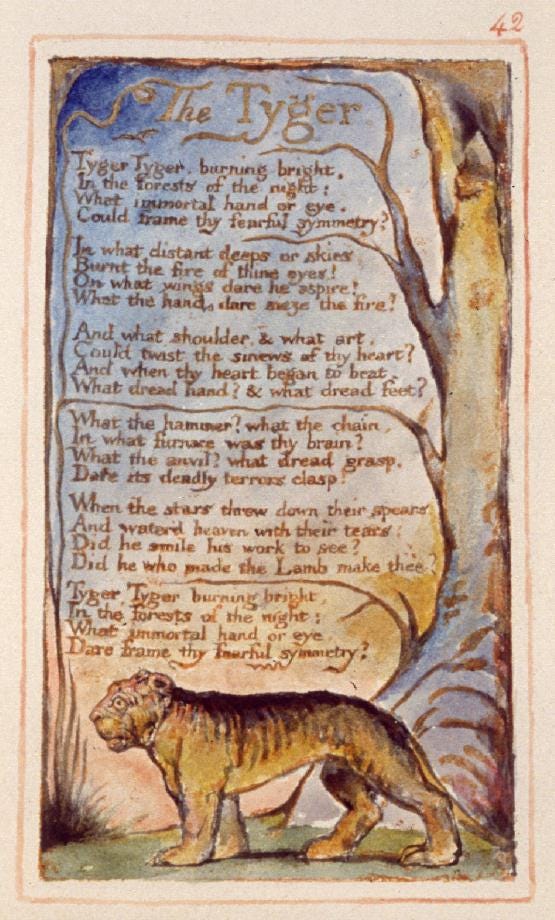
Songs Of Innocence was originally published in 1789, with Songs Of Experience following in 1793. These two books were then brought together in a single edition as intended in 1794, and expressed many of Blake’s important themes and concepts. It is also difficult to categorise because it is is a visual piece, a series, narrative imagery, as well as being a collection of fine poetry…
William Blake was one of Britain’s most innovative and important creatives, he was a pre-Romantic visionary whose ideas were a primary influence upon the emergent movement that grew out of the Industrial Revolution. He put forward the fact that rational reasoning is flawed and a balance between intellect and imagination, with the bias leaning toward imagination, is the key to becoming a fulfilled human being and this was at the core of later Romantic ideology.
He pointed out that the scientific facts of a generation are generally disproved by the following generation. For example, during one period everyone knows the world is flat because they can see that it is! The people of the next era work out that it is actually a ball that the sun and the moon and the stars move around, the stars being set in a series of crystal spheres. Then someone works out that it’s not the earth, but the sun that’s actually the centre of the universe… and so on. Then we turn from the macrocosm to the microcosm and we eventually discover the atom, which is thought to be the smallest possible particle of material, until Einstein and Oppenheimer work out that it can be split… now we know that every particle appears to be made up of smaller particles, until we reach the foam of quantum fluctuations!
So, now imagine going back in time and explaining quantum physics to a medieval person who believes the world is flat — they would not have a clue what you were talking about and would probably try to burn you at the stake — but go back to any time in human history and talk about dreams, love and emotions, and they would know exactly what you were talking about. Blake thought that it is these components of the human make-up that define us, set us aside and give us clues as to our place and purpose in the universe.
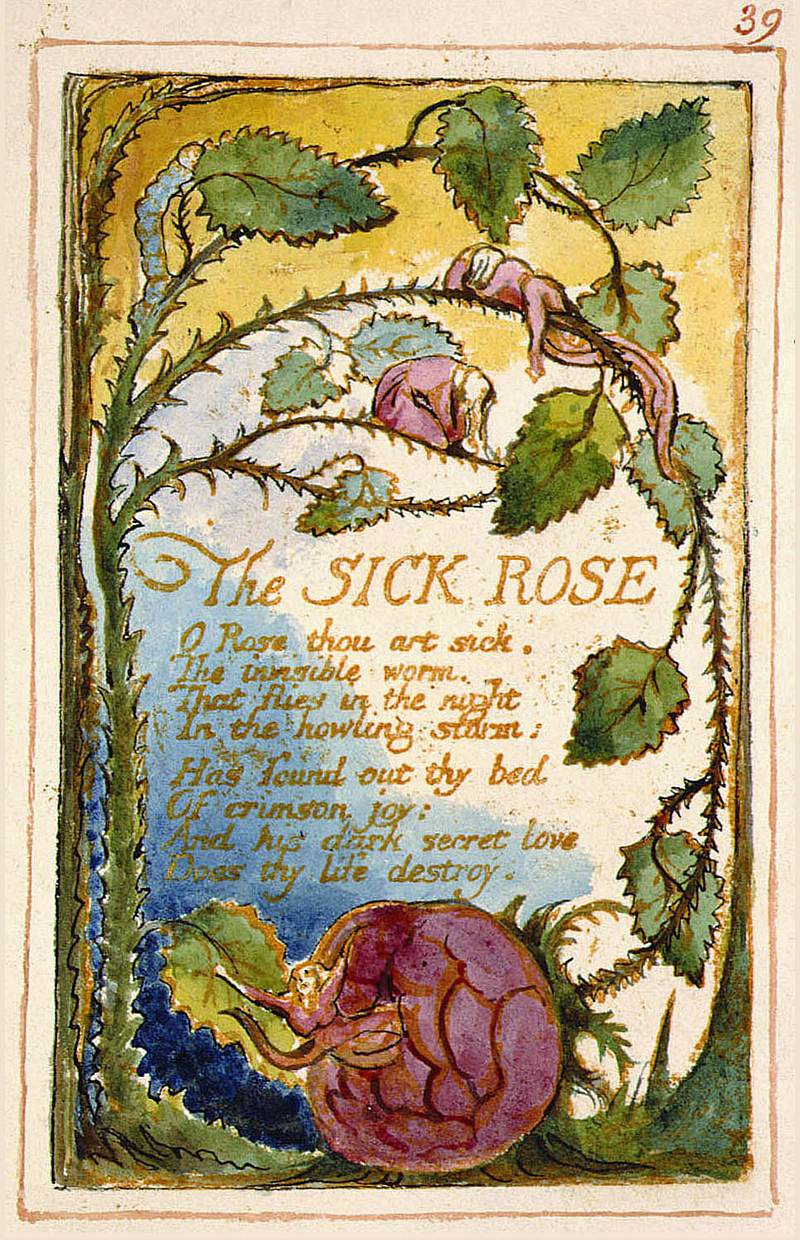
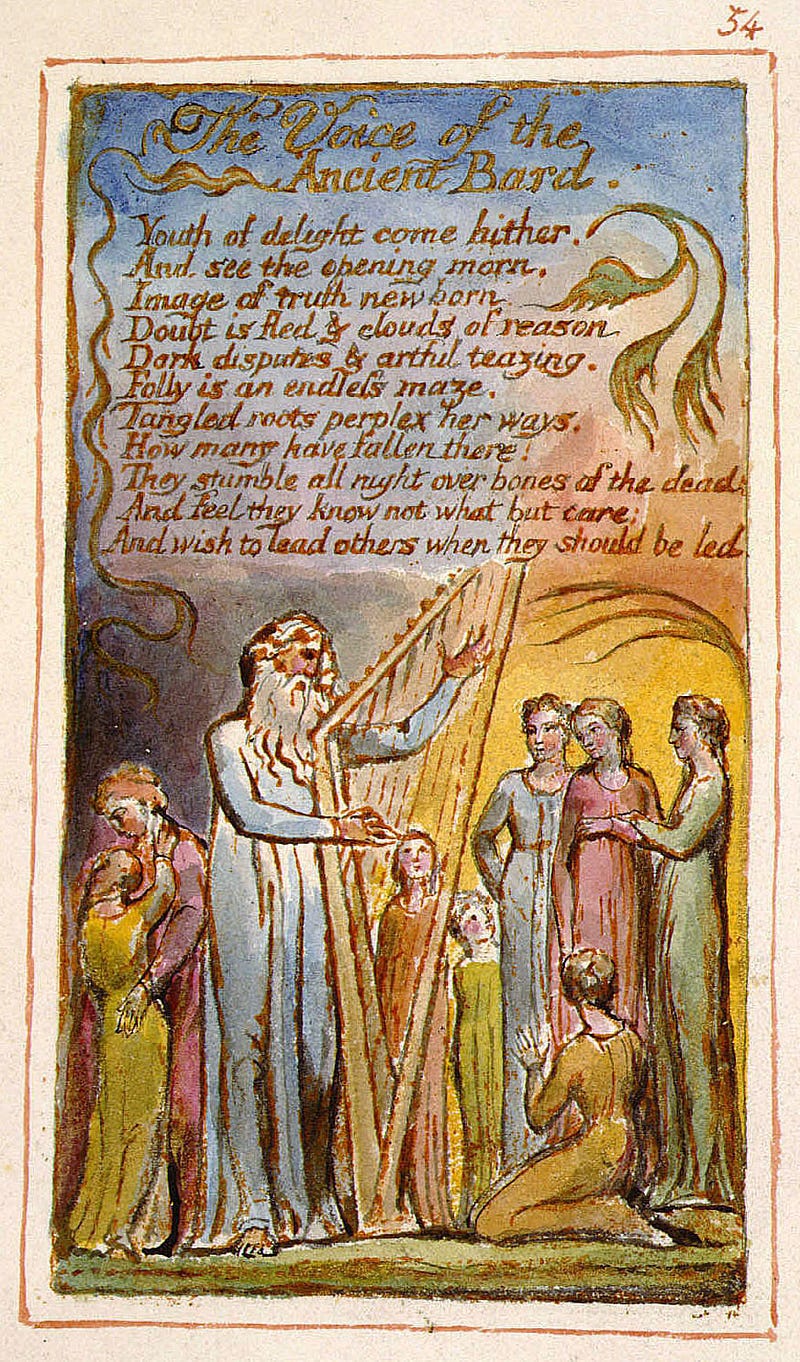
Songs of Innocence and of Experience is a beautiful little book that was intended to be read and re-read and the meanings considered. In this respect it is a Modern work. We are expected to consider each poem in conjunction with its imagery and in relation to the other poems in the twinned volumes. Each poem from Innocence is ‘answered’ and counterpointed by a poem from Experience and somewhere between the two lays (or lies) a truth. Most of the poems are written in simple language that has a similar feel to nursery rhymes, yet the meanings are complex and changeable, depending on the reader’s experiences and at what point they are at in their personal journey of life.
Visually, the book is a feast with Blake’s distinctive style that foreshadows Expressionism and graphic novels. He was one of the first to successfully combine word and image as a cohesive design, in fact he devised his own method of acid etching to achieve this. Blake claimed that his dead brother, Robert, visited him in a dream and explained the innovative process by which writing and drawing can be done on copper engraving sheets using a ‘gum’ that resists the acid, so that the acid eats away the blank areas, creating what we now know as ‘relief etching’.
Blake produced the book on a small ‘pocket edition’ scale, intending the reader to carry it about and re-read in different situations and surroundings. He also purposefully made some of the tiny writing difficult to discern, due to its colour or background. This was to enable the meaning to be revealed in a designed sequence, and so that some of the information needed some effort to unlock its reward. I think of it in much the same way as modern song-writing, where the chorus may be clear and obvious, but there are often lyrics that take a few listens to decipher and interpret, lending the song a more lasting appeal and revealing parts of the ‘story’ in a sequence. Indeed, these poems are ‘Songs’ and have that ability to accrue meanings, memories, moods… and to become mental anchors for psychological states than can then be recalled…
Central to Blake’s philosophy was the idea of seeking a balance between imagination and intellect, somewhere between innocence and experience. Between wide-eyed wonder and jaded cynicism. He was to reiterate these ideas in a series of hand-coloured prints over the following years. Good examples being his images of Newton and Nebuchadnezzar, currently widely used on the internet to publicise this year’s major exhibition of Blake’s art at Tate Britain.
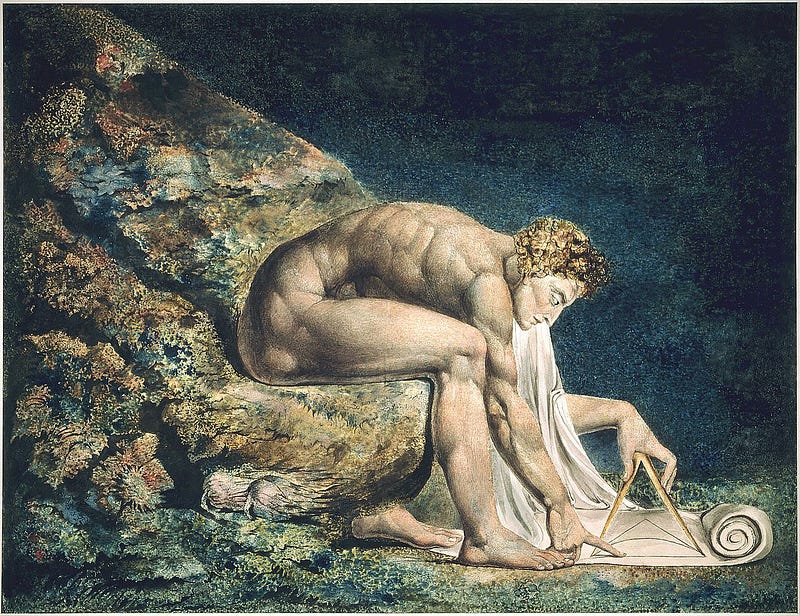
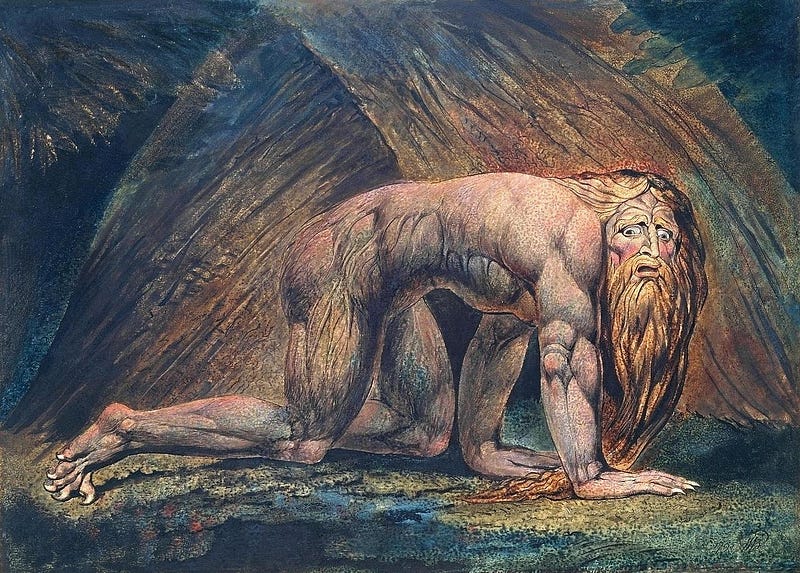
Here we see two extremes. In Newton, we see an ‘ideal man’ of the Enlightenment, completely obsessed with placing order onto the natural world, so much that he sees only his calculations on paper and not the real world around him, his scientific model of the world obscures the natural world in which he resides. The natural form on which he sits forces him into what appears to be an uncomfortable position, yet this discomfort does not distract him. In Nebuchadnezzar, we see the biblical version of a man who has lost his rational faculties and becomes nothing more that an animal, following his desires wherever they may lead.
Blake’s message is clear: neither approach is the exclusive solution. The purpose of Songs of Innocence and of Experience was to show “the two contrary states of the human soul”… A balanced human must recognise both their faculties of reason and emotion. Blake thought that the persistent truths were emotional, but also recognised that this should be balanced by at least some rationalism… and I feel that still makes perfect sense.
Originally published at https://hotgoat.blogspot.com.


