
Readymade Art: Marcel Duchamp’s ‘Fountain’ (1917 & 1964)
This is the most influential artwork of the 20th Century! Top artists, curators, critics, and dealers said so…
Currently displayed in the Tate Modern, adjacent to one of Andy Worhol’s Brillo Boxes (1964), Marcel Duchamp’s Fountain is probably the most famous piece of art to come out of the Dada group. Duchamp was the grand-daddy of Dada and here he presents us with a manufactured object — what he called a ‘readymade’, that when divorced from its intended function, can be viewed as a highly successful piece of sculpture: it has a balance of form, suggests movement, and creates tension with a dynamic relationship between positive and negative space.
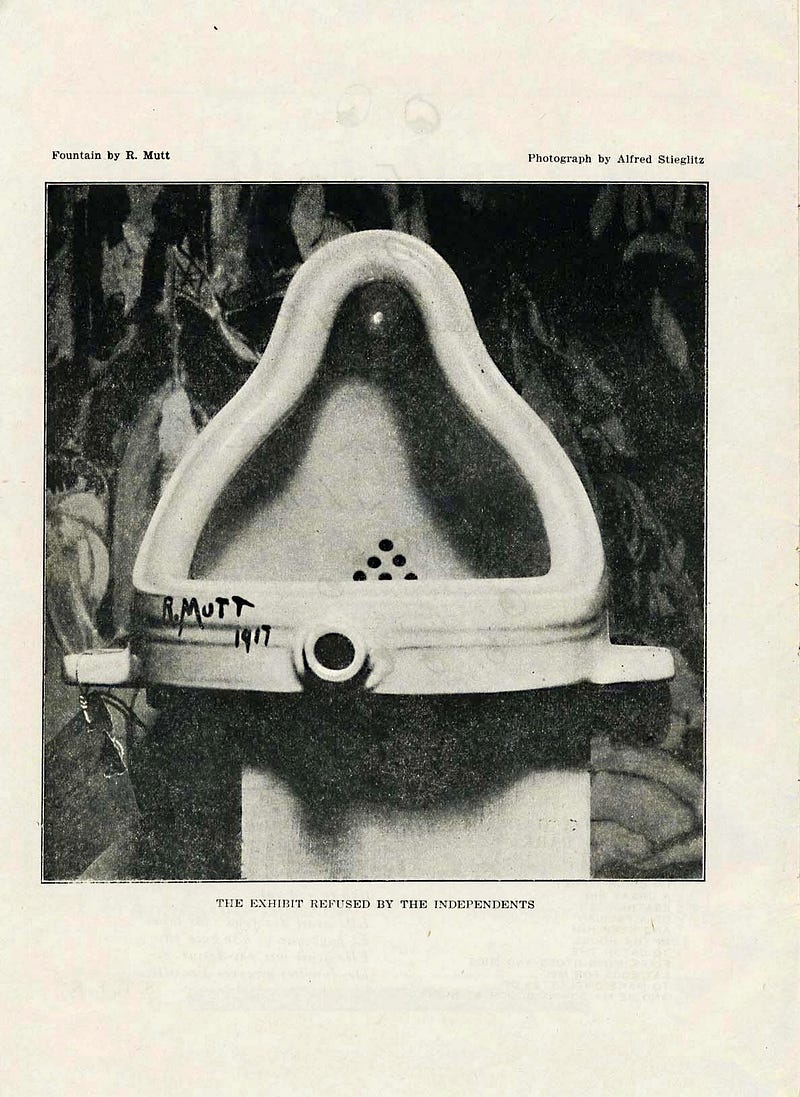
It also references the human form and introduces an element of the magical by transforming an everyday biological function into a poetic act. The title, ‘Fountain’, associates a basic bodily function with a concept of beauty and grandeur… whilst at the same time, ‘pissing on art’.
Duchamp’s work often addressed the divisions in society, be those due to class, race or gender. The issue of social division is also implied with this being a gender-specific object. This pre-dates Worhol’s similar use of everyday objects in art by nearly a half-century and Duchamp also enjoyed playing with the ideas of art and celebrity, signing the piece using the pseudonym ‘R Mutt’.
Understandably, this piece caused much controversy when it was almost exhibited in New York. Apparently, the gallery, at the last minute, decided that it was not suitable for public display and hid it behind a screen. The object (or ‘objet’) was much talked about by critics and fellow exhibitors, though not shown to the general public. As a response to this, Duchamp took Fountain to the studio of his associate Alfred Stieglitz, where it was visually recorded by the influential photographer before being ‘lost’, thought to have been disposed of in a builder’s skip.
In May of 1918, Duchamp transmediated the work when he published the photograph along with a short but exceptionally profound piece of text in an arts magazine titled The Blind Man in which he stated:
“Whether Mr Mutt made the fountain with his own hands or not has no importance. He Chose it. He took an article of life, placed it so that its useful significance disappeared under the new title and point of view — created a new thought for that object.”
This was the ‘monolith moment’ of Modernism and prefigures Surrealism as well as most of what we consider ‘Postmodern’.
From this point on, the whole idea of what art is and who it belongs to, was in turmoil. Duchamp had proven that it was the concept that mattered, not the technical skill of the artist, not even the artefact that constituted the piece of ‘art’ itself. Here was a radical piece of art that no longer existed, being reproduced in another form as a two-dimensional photograph, yet it retained its meaning and if anything had gathered more power and had indeed extended its meanings by its own absence.
In 2004, a major survey of 500 top artists, curators, critics and dealers was undertaken by UK’s Turner Prize sponsors, Gordon’s Gin. The survey asked these art world luminaries what they considered to be the top three most influential pieces of art of the twentieth century, rated in order. Overwhelmingly voted as the chart-topper was… Duchamp’s Fountain.
[Filling the remainder of the chart were Pablo Picasso’s Demoiselles d’Avignon (1907) in second place; Andy Warhol’s Marilyn Diptych (1962) was third; Pablo Picasso in again at fourth with Guernica (1937); Henri Matisse’s The Red Studio (1911) was fifth; Joseph Beuys with I Like America and America Likes Me aka Coyote (1974–1976) at sixth; Constantin Brancusi’s Endless Column (1918+) at seventh; Jackson Pollock’s One: Number 31 (1950) was eighth; Donald Judd’s 100 untitled works in mill aluminium (1982–1986) was ninth; with Reclining Figure 192 by Henry Moore (1938+), in tenth place.]
By the time that Fountain had gained iconic status, the original piece was long gone and the same model was no longer available from the original suppliers. So, several replicas were then hand-crafted from the photographic evidence of Stieglitz, under personal direction from Duchamp, who then signed and dated them, this time using his own name. It is these multiple replicas of a lost ‘readymade’ that now reside in some of the most prestigious galleries in the world. It has been suggested by some art historians that the ‘original’ version was actually a hand-sculpted replica in the first place, but we’ll probably never know that for sure.
Duchamp often expressed the opinion that Modern art was taken far too seriously, and that humour could often be an effective way of addressing the most serious issues.
He had the last laugh here.


