
How Long is a Piece of String?
Marcel Duchamp’s ‘Stoppages’ is a set of related artworks that tell the conceptual narrative of a radical creative process…
In 1913, the French artist Marcel Duchamp measured and cut a piece of string into three sections, each one metre long. He took these strings and held them horizontally one metre above a primed canvas, painted a deep dark blue, onto which he dropped each piece of string. He then preserved the curves formed by the strings as they fell by fixing them to the canvas which was mounted as three separate pieces. This was the beginning of a conceptual narrative, developing through several stages and introducing profound new ideas that changed what art was.
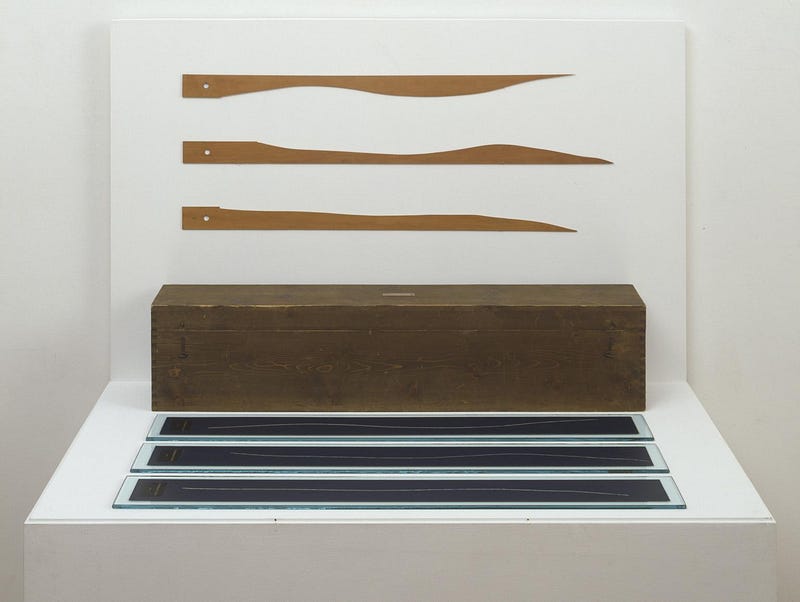
Each canvas was now an elegantly simple drawing consisting of a single, embossed line. Although the strings were all cut to a standard length, each had now expressed individual characteristics as the result of just one, minimal action governed by the ‘laws of chance’. Already, Duchamp is calling the concept of standardisation into question, demonstrating that even similar, simple things have subtle differences in the real world.
Even something as ‘sterile’ as a unit of measurement is, indeed, conceptual. As with a common language, the given quantitative unit is necessary as a baseline for transactions, placing order and meaning onto chaotic and natural events. Yet this arbitrary standard measurement is a physical expression of a concept that has profound and far-reaching social and cultural implications — scientific, commercial, and philosophical. Why a metre anyhow?
It was during the French Revolution of 1789–99 that the metre was introduced to replace the old unit of measurement with one that represented a totally new paradigm for a new regime. Prior to this, the standard unit had been measured as the distance of arc described by a pendulum with a swing — or ‘half-period’ — of one second. The metre was a new unit designed to replace this and was defined as: one ten-millionth of the meridian from the North Pole to the equator passing through the ‘centre’ of Paris, with an Earth flattening compensation of 1/334. An iron bar held in the Paris archives originally set the length for calibration but, of course, iron expands and contracts due to changes in temperature so later, in 1875, the bar was replaced with one made from less variable platinum-iridium alloy.
After preserving his 3 Stoppages Étalon / 3 Standard Stoppages in 1913, Duchamp continued to extend the work into an expression of time-based Process Art that grew toward a sense of completion never reached… Instead of a manufactured metal bar, he used wood to record the length and gentle curves of each piece of string. This choice introduced another time-scale as wood is a natural material that grows at a rate of one tree ring per season and that amount varies to reflect climatic conditions. So, these lengths of wood were already a measure of sorts that recorded a time-span of natural growth that had been stopped.
By drawing the curves described by the strings onto these three lengths of wood, and then cutting them to shape, Duchamp produced a set of metre-long templates that enabled him to accurately reproduce the now standardised forms of his three Stoppages. This could be viewed as an attempt to assert order and meaning onto chance events, along with making the point that art too has a definite function within society.
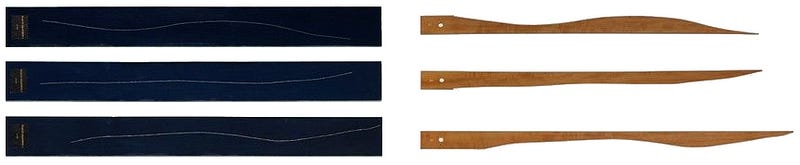
The resulting ‘batons’ resembled a stretched-out set of French Curves — drawing-aids used by designers to smoothly reproduce sections of Euler spirals. This was the second direct reference made by Stoppages to a mode of standardisation originated by the French.
Each of the curves now existed separately, detached from their original context. In a way, the curves were no longer material things. Although they were expressed physically in wooden shapes, the curves themselves existed at the edge, the line between positive and negative forms.
The curves were now transferrable and could proliferate, independently of any single fixed expression. Duchamp experimented with using them this way and in 1914 he took an abandoned second version of his 1911 figurative painting, Young Man and Girl in Spring, rotating the canvas from portrait to landscape orientation. With its first layers of paint in earthy tones and the layout grid still visible, the canvas suggested terrain as if viewed from above, like a kind of map.
According to some arbitrary rules, Duchamp used his wooden ‘templates of chance’ to draw each of the three curves three times, in a recursive branching pattern. He titled this painting Network of Stoppages. The lines fanned out from a point of origin and resembled a railway network with symbols that could represent stations and end-of-the line buffer-stops — perhaps a play on the term ‘stoppages’.
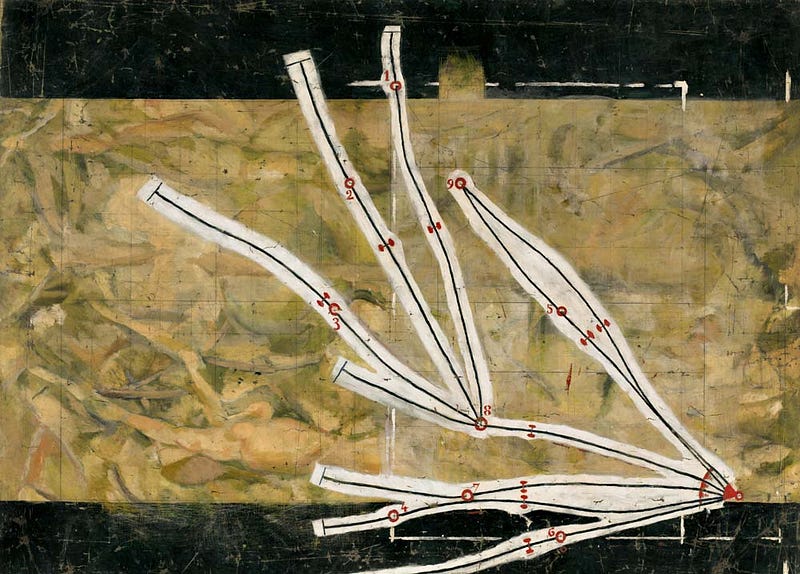
He added numbers to the ‘stations’ of the network indicating its diagrammatic nature whilst serving a compositional purpose — moving the eyes of the viewer around the canvas. It seems that the concept of numerical progression is too hard for our intellectual faculties to resist. Whilst the rational mind is occupied ‘by the numbers’, perhaps our emotions may slip by to engage with the work. It also suggests a train-of-thought, a sort of mind-map.
With the connotations of a map comes the concept of borders — examples of other lines that do not physically exist but are expressed where one thing meets another. In the case of national boundaries, those may be differences in religious, political, and economic ideologies. Although nearly all borders began rather randomly — often due to a natural feature such as a river or ridge, or as a result of conflict — they have been maintained through ‘arbitrary beliefs that influence repeated behaviours or habitual responses’. Though they may be demarked by fences and physical barriers, borders do not exist in the material sense and neither do their effects. It’s possible to straddle a border line but that doesn’t mean the right hemisphere of the brain adopts one nationality and instantly develops a separate cultural identity in conflict with the left hemisphere. Does it?
As the branching lines of the Stoppages don’t all enclose areas, they are more readily read as paths rather than boundaries. This lends more positive connotations of forging new routes into unknown territories, creating paths that become increasingly established as they are trodden by others. Which could be interpreted as a kind of democratic process, or as a metaphor of social structures and behaviours that become normalised through repetition, for better or worse.
The semantic mantra, “the word is not the object, the map is not the territory,” comes readily to mind here and we must also take into account the signifiers of the original painting that Duchamp extended with the Network of Stoppages. If presented in its original portrait orientation, the image of two figures reaching upward become more apparent as does the central motif of a tree, which the spreading branches of Stoppages seem to reference. There’s a ‘Garden of Eden’ vibe and the tree, along with the nod to spring in the painting’s discarded title, suggest growth and new beginnings springing forth from the seeds of what went before. The rotation of the composition through 90 degrees also indicates a paradigm shift in Duchamp’s artistic practice.
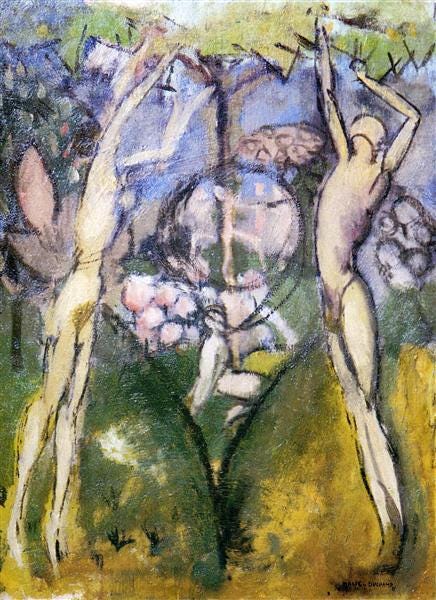
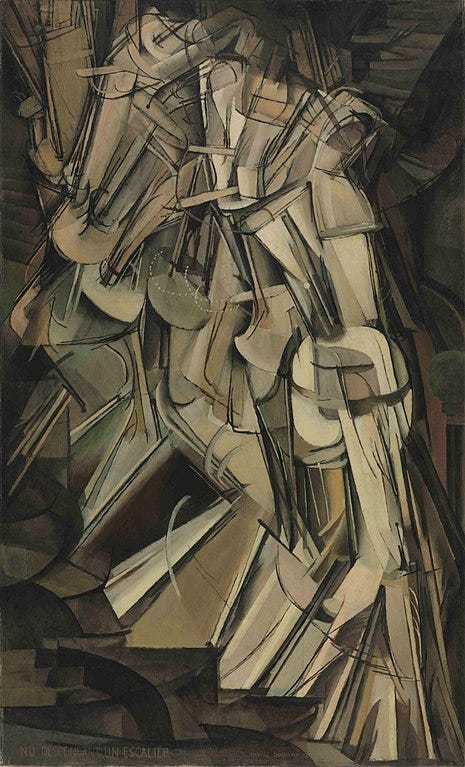
Indeed, this set of works marks an important transition in the work of the artist and in the general development of art. Duchamp had become disillusioned with painting and was actively considering what future there could be for art. This brave shift away from traditional formats to seek new forms of art may well have been catalysed by the Société des Artistes Indépendants refusing to include Nude Descending a Staircase, №2 in their 1912 Salon. This groundbreaking work of Cubist dynamism was widely ridiculed. To the modern eye, the fragmented figure repeated to imply motion is quite obvious but at the time, mainstream art audiences just weren’t visually literate enough to understand what they were looking at.
With his Network of Stoppages, Duchamp quite literally turned painting around. He would later claim that the Stoppages were the first of his Readymades, because they developed from a ready-made concept, of the metre, and used ready-made material as the starting point, a piece of string, and when used in future works of art the stencils were, indeed, ready-made.
He had a wooden box made to store the Stoppages — the strings on canvasses along with their cut wooden templates — reinforcing their reading as a standardised set of equipment to be used, ‘in the field’, rather than finished sculptures. Even in its final fixed form, the set of objet presents plenty of potential for further usage and can be arranged in different ways that completely alter its formal appearance. These were usually displayed with the box open and either all or just one or two of the items it contained mounted for gallery exhibition. The large Network of Stoppages canvas would be hung so that all the pieces were in dialogue with each other as an installation.
Over the next few years, Duchamp did use his Stoppages as equipment and they, or at least their ‘viral’ pattern, appear in several other works including 1918’s self-referential exploration of perception, Tu m’, in which the Stoppages curves appear, at the bottom left. They share the elongated canvas with representations of other works including Roue de Bicyclette — generally accepted as the first Readymade in 1913 — and Hat Rack from 1917. The Stoppages were also the pattern for the ‘capillaries’ in the ‘Bachelor Apparatus’ section of The Bride Stripped Bare by Her Bachelors, Even or The Large Glass which was in production from 1915 to 1923.
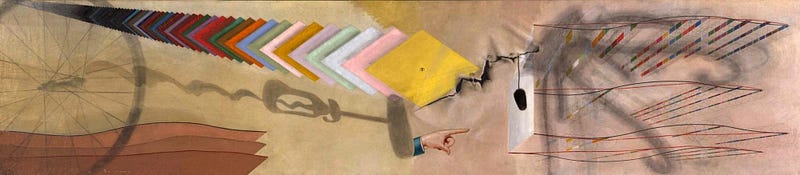
With Stoppages, Duchamp demonstrates that concept can be divorced from object. This is the beginning of what we now call Conceptual Art. With his Readymades, he also showed that any thing can be removed from its original context and assigned a new concept, transforming its function into art. This idea was most boldly expressed in 1917 when he presented a urinal, turned through 90 degrees and placed on a plinth. He called this ready-made sculpture, Fountain. It has since been recognised as the most important single work of art produced in the twentieth-century.
The concept of the metre has remained constant, though how it’s expressed has changed several times. In 1960, its measurement was standardised more accurately as 1,650,763.73 wavelengths of orange light from a krypton-86 lamp passing through vacuum. This method of international standardisation stuck until 1983 when the metre was re-defined as the distance travelled by light through vacuum during a time interval of 1/299,792,458 of a second — with the second measured by caesium-133 frequency (ΔνCs).
* All images are used with license, or presented here for educational purposes under fair usage policy.


