
Duchamp’s New Spin on Art
Readymades circumvented the artist’s rational aesthetics by using objects that already existed and were partly adopted as a protest against the elitist art market.
Marcel Duchamp became the ‘prime mover’ of Dada and pioneered the ‘readymade’ in art. These ‘objets d’art’ were made from everyday objects and therefore could easily be replicated by anyone. The value of a readymade should, in theory, be no more than the items it’s made from, despite what artists or critics may say…
Readymades become art through selection and presentation. This indicated that the art is not in the object, but exists as an idea, or concept, which can then be conveyed by an object. So, why create a new thing, such as a painting or a sculpture, if an existing object can be re-appropriated to communicate the same intentions?
Duchamp’s 1913 sculpture of a bicycle wheel mounted on a wooden stool was the first readymade and now generally recognised as the first manifestation of Dada ideology, a few years before it would be called ‘Dada’. The original is now lost, but Duchamp argued that the items already existed before he presented them and so none of his readymades could be considered ‘originals’.
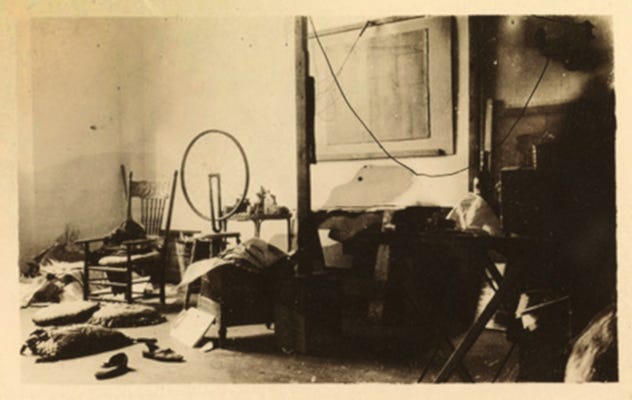
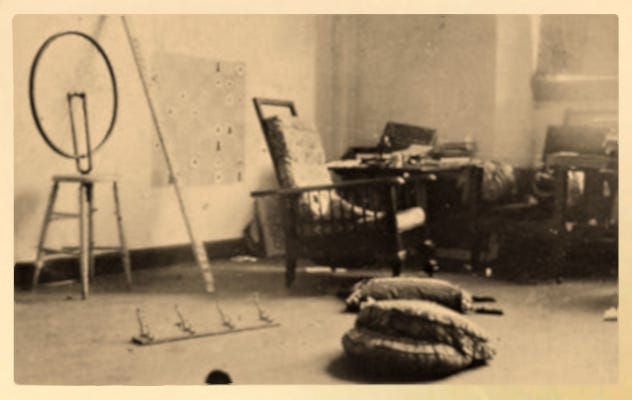
He went onto produced several editions of Roue de Bicyclette / Bicycle Wheel, including the final version in 1964, now displayed in the Centre Pompidou, Paris. Duchamp also explained that he did not, initially, consider readymades to be art:
“I had the happy idea to fasten a bicycle wheel to a kitchen stool and watch it turn. To see that wheel turning was very soothing, very comforting… I enjoyed looking at it, just as I enjoy looking at the flames dancing in a fireplace.”
This simple, pleasurable pastime led Duchamp to introduce several game-changing ideas that would irrevocably alter the art scene forever and remain palpable at the forefront of our contemporary art.
He was aware that he hadn’t chosen the items for their aesthetic qualities, though he would come to appreciate those aspects too. What interested him was the rotary motion. He was fascinated by the way the spokes became blurred or invisible when the wheel spun. The way they disappeared and then gradually reasserted themselves to the viewer was a pleasing process that merged a duration of time with the act of observing. This aspect also necessitated physical interaction with the viewer who was encouraged to set it in motion.
Here, he’s already dealing with ideas that he’d later explore and progress. As he shared the work and considered its appeal, he realised that it also resonated with the landscape he had grown up in. He recalled being fascinated by colliery wheels, to which there’s an undeniable resemblance.
This meant that a subconscious memory may have guided the construction of the readymade. The acceptance that art can express the subconscious and only become apparent, even to its creator, after it’s made would become one of the key principles of Surrealism, an art movement that grew directly out of Dada ideologies.
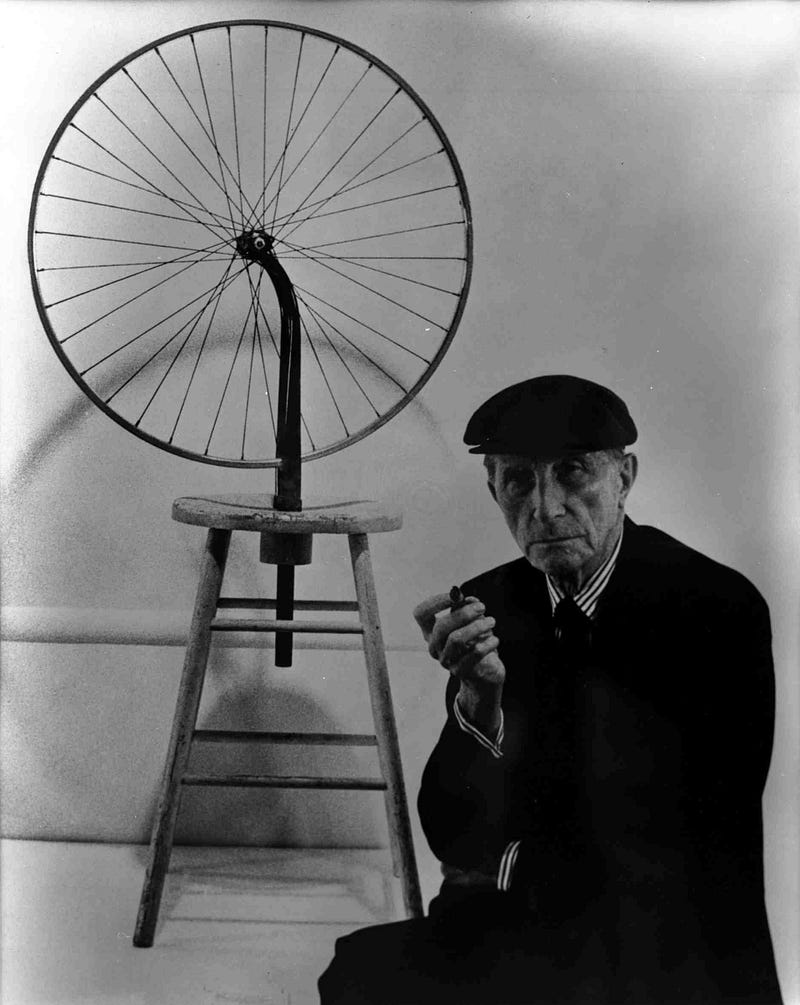
Duchamp also realised that Roue de Bicyclette fulfilled the traditional critical requirements of a successful sculpture. There was a formal balance: the circular wheel moved around its hub in a mode of perfect balance and the vertical circle of the rim echoed the horizontal disc of the stool’s seat. The curves of these circles were in dialogue with the straight lines of the stool’s legs.
A sculpture should suggest movement: here the movement is expressed as a potential that can also be realised as rotation. There should be tension with a dynamic relationship between positive and negative space: there is an interplay between the negative cubic space beneath the stool, contained within its four legs, that provides a counterbalance to the flattened space circumscribed within the wheel. Additional dynamic tension is contributed, quite literally, by the spokes that maintain the relationship between the circle and its centre.
Another tenet of traditional sculpture was that it should reference landscape or the human form. Roue de Bicyclette does both: the stool had been designed in direct response to human form and the dimension of the wheel also responded to ergonomic factors. The resulting combination suggested the aforementioned colliery wheels and provided a poetic link to landscape, as well as memory.
Duchamp did not class it as a straightforward readymade, but referred to it as an ‘assisted readymade’ because it required some assembly, making it a simple assemblage, or an early manifestation of what Robert Rauschenberg would develop into what he called Combines, four decades later.
By combining the two objects, Duchamp also divorced the stool and wheel from their intended functions. This removing of familiar objects from their usual context and then reassigning a new function or meaning to everyday things, would be one of the main threads to connect Dada with Surrealism.
The word ‘dada’ means several things in several languages. It is French for ‘hobbyhorse’, Slavic for ‘yes-yes’, Cymraeg for a ‘treat’ and in some languages might be the first words spoken by a baby…
Dada was not an art movement. Dada was anti-art, anti-aesthetic, anti-elitist, anti-tradition, anti-academic, anti-rationalism, anti-war, anti-complacency…
Rebellion, protest, cynicism, disgust, humour, shock and surprise in multiple manifestations: the Dadaists were the first Punks!
Other artists associated with early Dada include Francis Picabia, Kurt Schwitters, Jean Arp, Sophie Taeuber, Hans Richter, Raoul Hausmann, Hannah Hoch, John Heartfield, and the poet Tristan Tzara, originating from the rich refugee culture associated with Hugo Ball’s club, Cabaret Voltaire, in Zurich during and following the First World War.
Throughout his life, Marcel Duchamp would repeatedly return to ideas that grew from Roue de Bicyclette, most evident in his 1920 piece of kinetic sculpture, Rotary Glass Plates (Precision Optics).
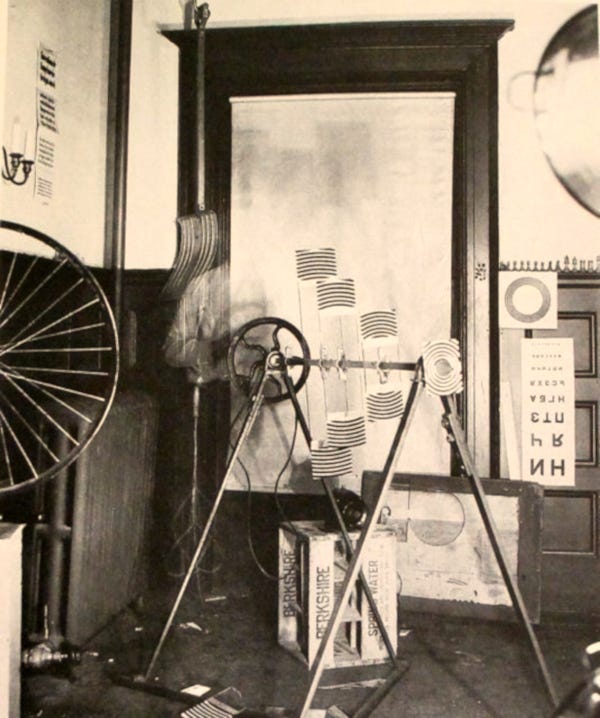
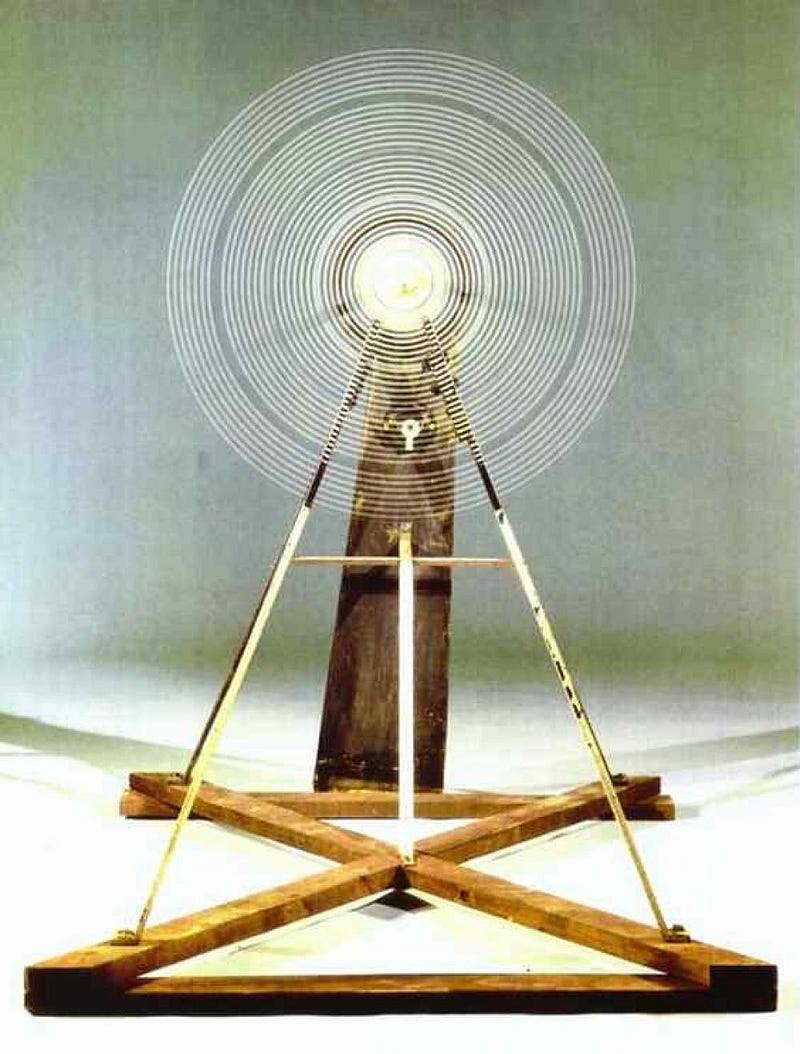
Sections of arcs from concentric circles are painted onto the series of five glass plates in black and white and when this motorised sculpture machine is activated, the plates spin and create the illusion of full circles, when viewed from a precise distance of one metre.
The first version of this sculpture was photographed by Man Ray as this visual effect was achieved, moments before it flew to pieces and shattered. Duchamp rebuilt it, now knowing that the machine could only be activated for a short time otherwise the centrifugal energy threatens to destroy it, making its action rare and dangerous, even.
Most of the time, it stands as a sculpture with the potential of dynamic movement, creating tension, anticipation and either a preconception or a memory of the visual effect. It also influences the behaviour of its audience, for they must wait for the ‘show’ to start and then be in a specific position at a particular time to fully experience its intended effect.
Duchamp saw this more as an optical experiment than as a finished piece and made several variations, which he resisted displaying in galleries as art. He later developed set of six Rotoreliefs, describing them as “Optical Toys”. These coloured designs on card discs, printed in editions of 500, were designed to be rotated on gramophone turntables to create changing patterns or three dimensional illusions. They featured in a short seven-minute film he made in 1926, Anemic Cinema. He later took a booth at the 1935 Paris Inventors Convention where he sold some sets of Rotoreliefs directly to the visitors.
Whether he intended these moving optical experiments to be art or not, he managed to contribute two more hugely important innovations that were to be taken up by notable artists in the following years: kinetic sculpture, and a form of art which directly exploits the mechanics and biology of seeing, later to become known as Op Art.
Here’s a video from MoMA, The Museum of Modern Art in New York, in which curator Ann Temkin talks about Roue de Bicyclette and other works by Marcel Duchamp:
* All images used here for educational purposes under fair usage policy.
Originally published at https://dean-evolution.blogspot.com.


