
Revealing Evil: The Visual Zygosis of John Heartfield
With his scathing photomontages, John Heartfield subverted the propaganda of the Nazi Reich…
The political potential of photomontage was pioneered by three prominent members of the Berlin Dada group. During the First World War, Helmut Herzfeld, George Grosz, and Hannah Höch were experimenting with arranging photographic elements sourced from advertising, newspapers, journals, and pamphlets, thus synthesising selected images to create new meanings. This was also the first melding of art and activism using the method and, when Helmut Herzfeld anglicised his name to John Heartfield, he became synonymous with the technique he termed zygosis.
In 1899, when Helmut was 8 years of age, he and his three siblings were abandoned by their parents and raised by an uncle. He’d just turned 23 at the outbreak of the First World War but was deemed mentally unfit for military training, which suited his pacifist sensibilities. Instead, he was assigned to the army’s film unit, and it was around this time that he changed his name to John Heartfield in protest against the hatred that was being stoked against the British.
He lost his job in the film unit due to his outspoken support for a workers’ strike that protested against the politically motivated torture and executions of Karl Liebknecht and Rosa Luxemburg, both members of the Social Democratic Party and founding members of the German Communist Party. This spurred him on to become yet more vociferous and critical of the rising tide of fascism that followed the First World War and together with his younger brother, Wieland, he began publishing the political periodical Die Pleite / The Broke, illustrated with the satirical drawings of fellow Dada practitioner, George Grosz.
It’s not the first time revolutionary pamphlets included politically charged ‘cartoons’ and harked back to similar publications put out by activists, artists, and poets, during the eighteenth-century. This aligned Heartfield with the Romantics of the French revolutionary period.
As well as editing and contributing to Die Pleite, Heartfield was providing editorial illustrations and cover designs for Die Rote Fahne / The Red Flag, journal of the Socialist Workers Party, and Arbeiter-Illustrierte-Zeitung / The Workers Pictorial Newspaper known simply as A-I-Z, a staunchly anti-fascist publication with an international profile, originally sold in support of workers’ wellbeing and rights in times of hardship.
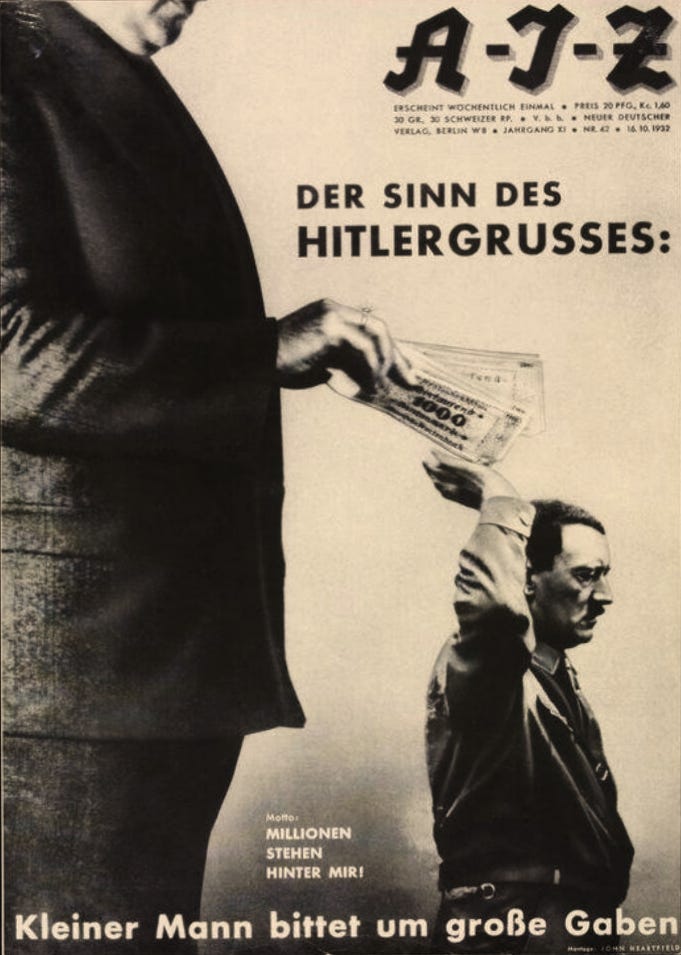
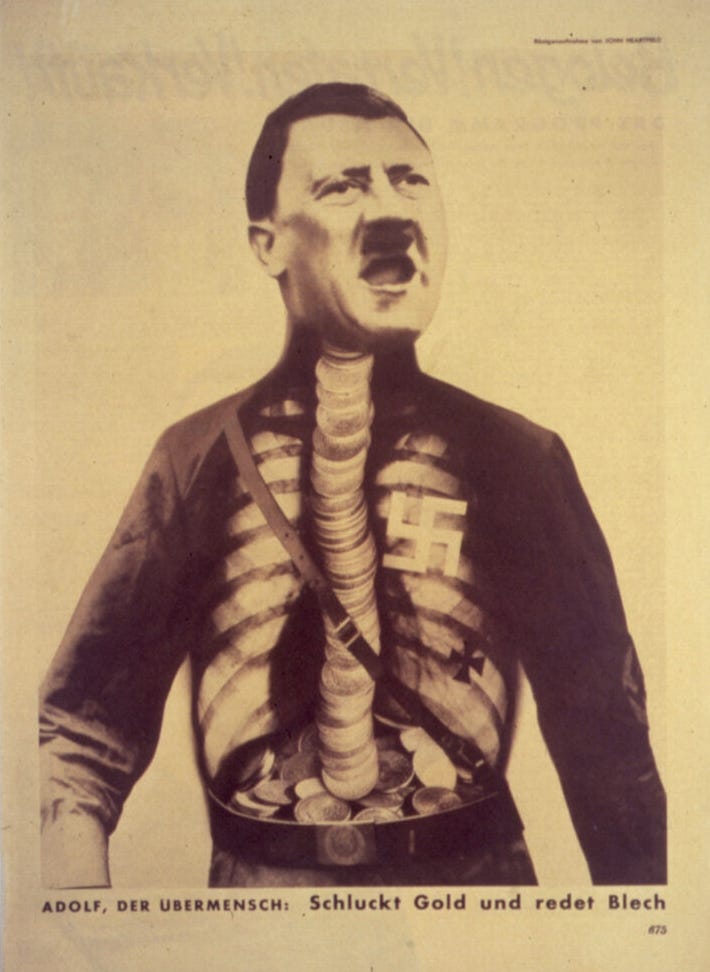
Heartfield’s groundbreaking and, at the time, strikingly unique photomontages became central to the identity of A-I-Z and regularly featured on the covers and as full page ‘pull-out’ posters within. They were a fierce rebuttal to the increasing use of photography by the mainstream newspapers owned by rich industrialists who benefitted by reinforcing government propaganda that was increasingly right-leaning. The journal also included photojournalism and encouraged contributions from its readers, being one of the earliest outlets for both amateur photography and independent citizen journalism.
This was at a time when photography was still a new media and, with the launch of the first compact cameras, only hinting at its massive potential to mediate and manipulate what the public is shown. As Heartfield’s friend, Bertolt Brecht put it, “Photography has become a terrible weapon against the truth used to obscure the facts.” Sentiments that are, sadly, still relevant today as we sift through fake facts and false news.
John Heartfield was designing stage sets and promotional posters for the Modernist and Marxist playwright, who would become internationally renowned as the controversial founder of ‘Brechtian Theatre’ which sought to break down barriers between audience and performers whilst employing archetypal gestures and expressions — an approach borrowed from the traditional theatre of China and Japan.
With significant funding from rich businessmen who stood to benefit from the suppression of workers’ rights, the nascent National Socialist Party took control of much of the media and used powerful imagery to reinforce their political agenda. At first, the party mimicked popular socialist policies portraying themselves as champions of the people. They began their manipulation of mass media to stir national pride which they would soon direct toward capitalist ideologies before spouting fascist propaganda to polarise the populace and exploit the fear and uncertainty caused by the nation’s economic collapse.
Disseminating their Nazi message, unchallenged, via mass media was essential to their goal. So, any media not under their control was a threat to their dominance of the public. John Heartfield knew this and cleverly used their own propaganda against them by appropriating its iconography. His photomontages took familiar, well-known images from mainstream journals and advertising, collaging them into visual collisions to highlight underlying meanings. By doing this, he preempted what would become known as Pop Art decades later.
As a Dadaist, he didn’t consider himself an ‘artist’, denouncing artists in general and abstract artists in particular. He accused them of avoiding a clear stance. Ironically, abstract art was to irritate and confound the Nazis just as much as his work. Many artists were labelled as ‘degenerate’, and those who had their works lampooned in the Entartete Kunst exhibitions were also put in genuine danger and forced to flee or die. You see, the Nazi’s didn’t like people to be encouraged to think for themselves, which is exactly what abstract art did, providing another effective antithesis to the state propaganda.
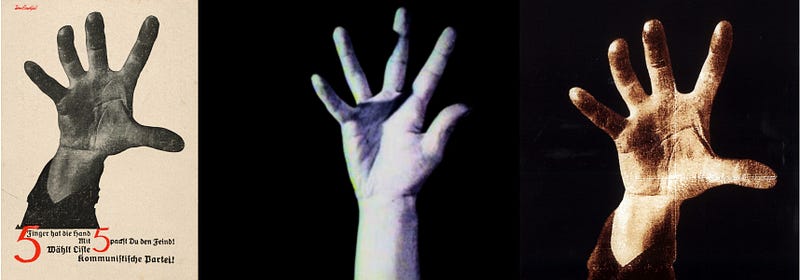
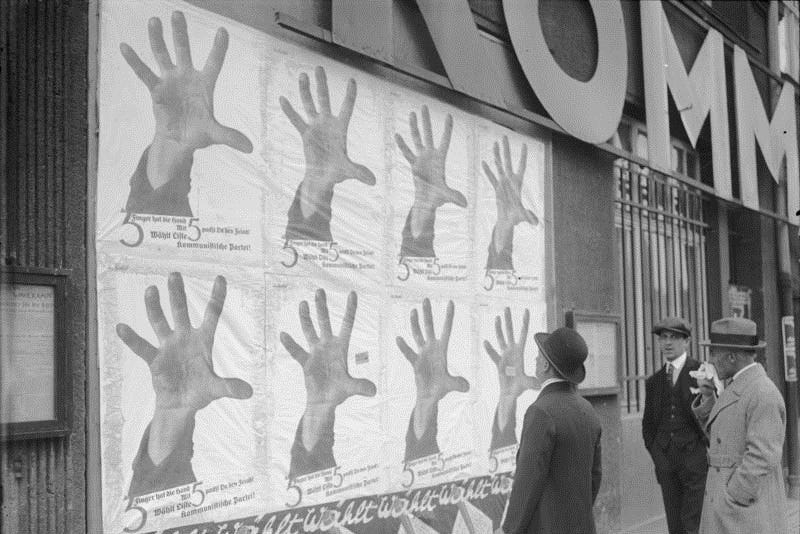
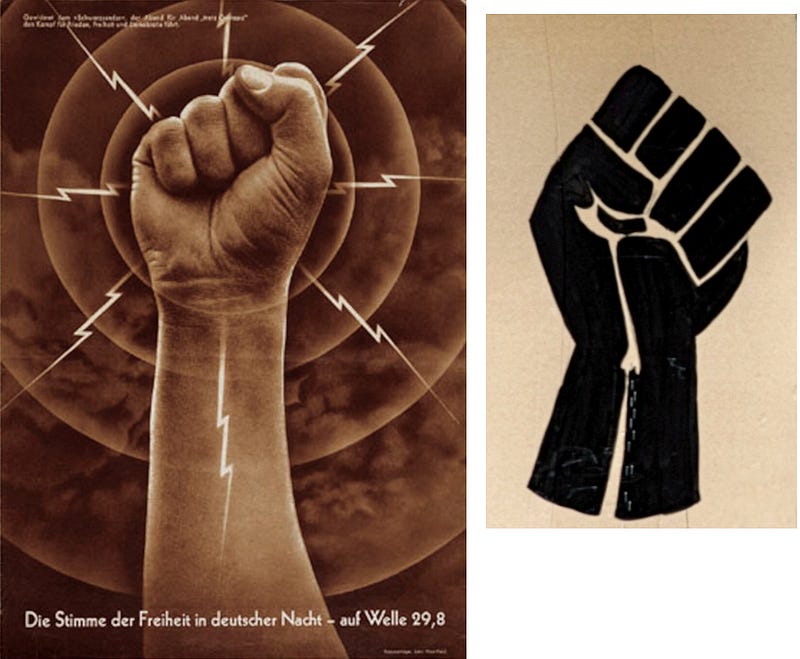
John Heartfield designed the now iconic poster that the German Communist Party used during their 1928 election campaign in which they gained significant support leading to a coalition government led by the Social Democratic Party. The poster was striking in its simplicity depicting a worker’s hand reaching up to grasp power, with the slogan, 5 Finger hat die Hand / The Hand has 5 Fingers, implying the necessity to work together at a human, and humane, level. The hand would become a recurring motif in Heartfield’s work, either grasping for power, clenched in a defiant fist, sometimes raised to attack or defend.
At this point, the Nazi party weren’t thought to be politically significant and their new leader, Adolf Hitler was still disgraced by his involvement in the failed 1923 coup d’état which saw him convicted of treason with a five years prison sentence of which he served only nine months. That was enough time for him to dictate his polemic Mein Kampf to fellow prisoners Emil Maurice, a founder of the Nazi SS, and Rudolf Hess, the future deputy Führer. One of Hitler’s first political actions as party leader was to call the democratic process into question and contest the election result, even though they had only a dozen of the 491 seats.
Just four years later, through a concerted, well-funded media campaign and promotional tour that catered to and reinforced populist opinions, the Nazi Party won 230 seats and led a coalition government. Within a year, under relentless pressure from industrialists and the business sector, Hitler was made Chancellor of Germany early in 1933.
The German Communist Party planned a general strike to protest this appointment but Hitler swiftly declared demonstrations illegal, banned the Communist Party and ordered all its members to be arrested. The SS were armed and ordered to enforce bans on trades unions and associated literature. The burning of books began and political opponents were methodically intimidated or outlawed, including the Social Democrats, whose 133 seats in the Reichstag government reverted to the Nazis, making them a majority.
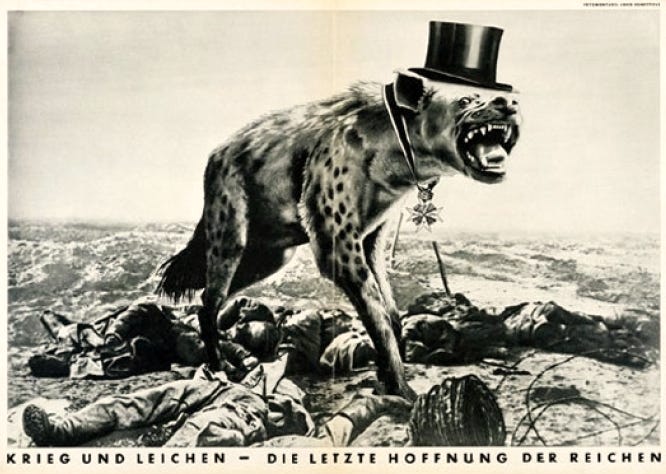
Adolf Hitler founded the Gestapo, a para-military police division that were automatically absolved from any legal accountability. Democracy was officially abolished and the Nazi Party withdrew from the League of Nations, declaring themselves the sole representatives of the German State. All ‘non-Germans’ were denied work permits and the Aryan Ideal became their guiding paradigm. (I may’ve said this before, but it bears repeating: In the midst of our current political turmoils, it would serve us to remember and recognise this pattern!)
During this orchestrated seizure of power, John Heartfield had bravely continued to produce his anti-Nazi photomontages despite regular abuse and beatings in the streets. On Good Friday, 1933, the Gestapo broke down the door of his Berlin apartment but he managed to escape by leaping off his balcony and hiding in a bin. Despite being listed in fifth position on the Nazi’s most wanted list, he managed to flee to Prague where he continued contributing to A-I-Z. The newspaper was now banned in Germany where distribution continued covertly, even though possession of a copy could result in death.
Prior to the German occupation of Czechoslovakia in 1938, Heartfield left Prague for London. After a period of internment as an enemy alien, he began working for Picture Post Magazine and joined the Free League of German Culture made up of fellow refugees. He was instrumental in bringing their exhibition Allies Inside Germany to a Regent Street gallery which attempted to reframe the enemy as Nazi Fascists, who did not represent the German people and their culture.
After the Second World War, John Hartfield returned to Berlin where he resumed working with Bertolt Brecht, who had waited out the war as a refugee in the USA, staging some of his plays on Broadway and writing scripts for Hollywood with Fritz Lang’s Hangmen Also Die! the only one to make it to screen, in 1943. The authorities in East Berlin were suspicious of John Heartfield because of his time spent in England and barred him from taking a post at the East German Academy of Arts until 1956 when, after active lobbying from Brecht, he was accepted as a Professor there.
John Heartfield was a courageous pioneer of the politically charged photomontage — a precursor of both Pop Art and Punk. His influence may be detected in the ongoing scathing satire of Scarfolk Council, created by Richard Littler, and in the photomontages of Christopher Spencer under his moniker of Cold War Steve. The power of Heartfield’s imagery remains evident and his legacy still resounds throughout graphic design, fine art, and political counterculture.
The Bauhaus and the Politics of Design are also discussed by Remy Dean in Signifier
The war reporting of Feliks Topolski is also discussed by Remy Dean in Signifier
* All images are used with license, or presented here for educational purposes under fair usage policy.


