
Figures in the Romantic Landscape: Two Early Paintings by Turner
Joseph Mallord William Turner was at the forefront of a new approach to life that gave us radical new art:
The Romantics were seeking various ways of attaining the ‘peak experience’. This peak experience was something that would be different for everyone: for some it may be writing a verse of stirring poetry, for others it might be found in excess of alcohol and other substances, for many it may be found through challenging experiences and travel.
The Romantics that could afford to, travelled to far off exotic destinations in the East. Many remained in the British Isles but journeyed into the wilder and more desolate places where they could become aware of the awesome beauty of nature, what they termed ‘the sublime’.
The sublime was something that had a terrible beauty, stirred the senses to a level of ecstasy, yet retained an ‘edge’ of danger and unpredictability. The sublime, whilst making us aware of our insignificance in the whole of creation, also stimulates the senses and causes us to revel in the wonders of the world around and, most importantly, within us.
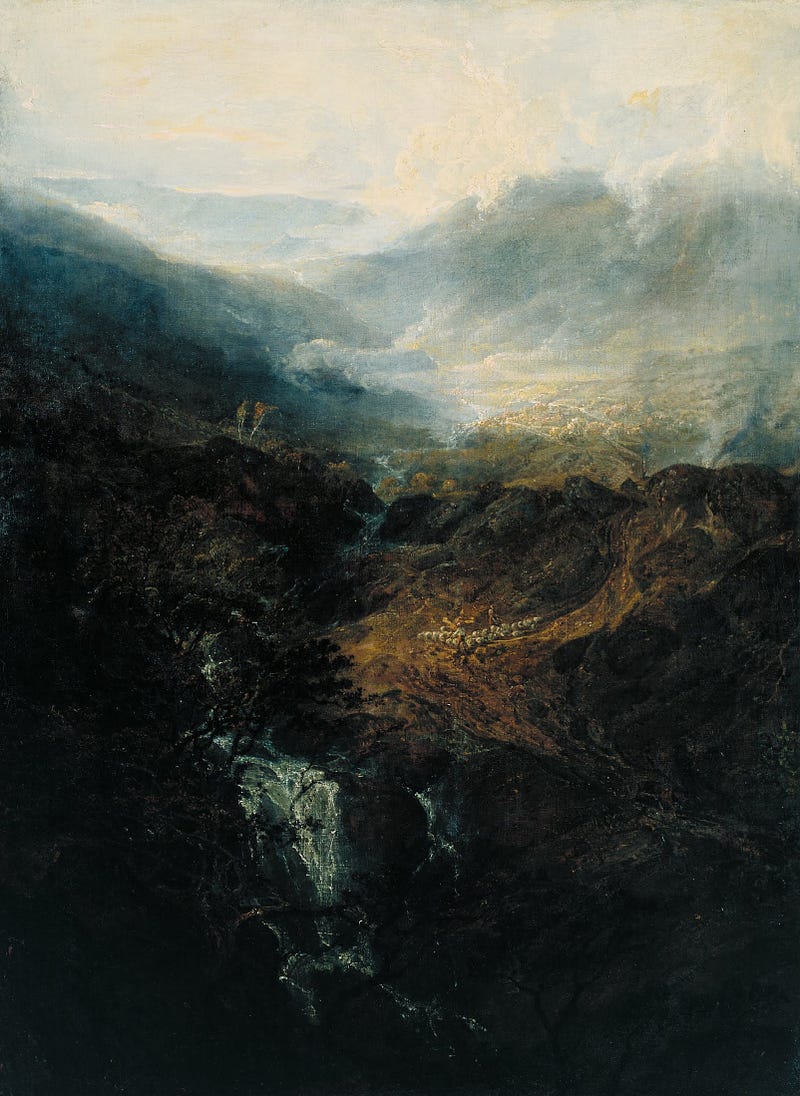
This is an example of a landscape painter attempting to express ‘the sublime’. Until the Romantics, the countryside was seen as an uncivilised, dangerous and dirty place full of peasants and sheep farmers: not somewhere anyone would venture for fun. Even hunting was undertaken on managed estates that were an artificial ‘model’ of the countryside.
Romantic poets had begun to sing the praises of the wilderness and speak of the rugged beauty of windswept mountains and moors. For the first time, truly wild places were seen to be beautiful. Shelley had extolled the mountains of Snowdonia and William Wordsworth had written about the Lake District of Cumbria, the setting for this painting.
The figures Turner includes in many of his landscape paintings are dwarfed by the immensity of the wilderness that surrounds them. They are included to show us ‘the way in’. The two tiny ‘adventurers’ tending their flock of sheep, to the right of the mountain cataract, encourage us to enter the scene. They seem to have paused in the patch of sunlight that sweeps across the rugged valley as the morning mist lifts from the distant slopes.
They have ventured into a place without paths, and seem fine with that. We observe form an elevated, detached point of view. At the same time, we’re drawn-in to share their sense of challenge, discovery and personal achievement in communing directly with untamed nature.
The painting is allowing us, the viewers, to partake of this feeling by proxy, from a position of safety. Yet we are encouraged to share the experience of these humble shepherds. Perhaps feel admiration or aspiration. Maybe glimpse a portion of the sublime and be inspired to seek it out ourselves for a primary experience.
It isn’t safe, it isn’t pretty, but it sure looks exhilarating…
Turner was the most innovative and notable of the Romantic landscape painters and his style was an important precursor for the Impressionists. He believed in the rugged beauty of desolate places and also set heroic historical scenes against sympathetic backdrops…
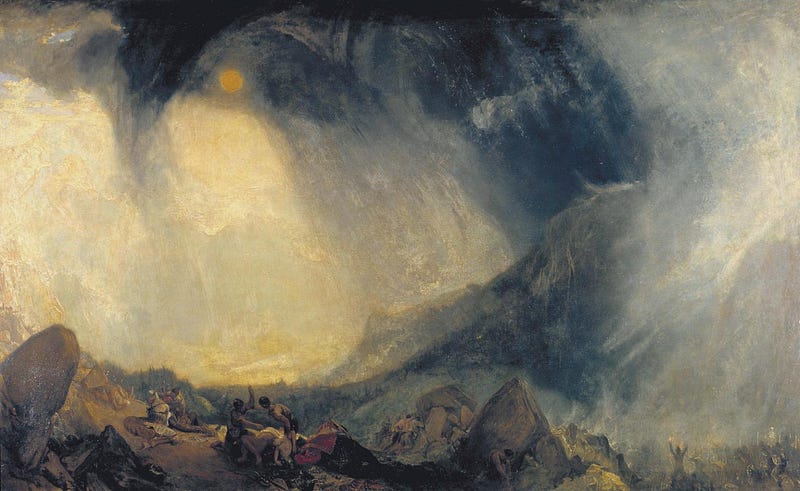
Though this is a historical painting, it does not follow the traditional composition of such. The historical action occupies a relatively small proportion of the canvas. Hannibal and his army are pushed down toward the bottom edge by the swirling snowstorm that rears across the sun like the maw of some great beast threatening to swallow them up. The overwhelming vortex was to become emblematic in the structure of Turner’s later works.
This is one of the clearest examples of both the ‘pathetic fallacy’ and the Romantic theme of persistence in the face of inevitable defeat. To understand the ‘pathetic fallacy’ think of it meaning ‘a sympathetic falseness’. The approach is central to much Romantic art and is still widely used in the media of today: if the characters in a film are happy, then the setting is all summer flowers and meadows, if they are sad then the backdrop will be dark and gloomy. Whenever the travellers arrive at Castle Dracula, it’s on a thundery night and perhaps there’s even a flash and ominous rumble as the heavy door creaks open...
Hannibal was the Carthaginian general who famously took on the might of Rome in an audacious advance across the Pyrenees, through Gaul, over the Alps and into Italy with a large army consisting of infantry, cavalry and his war elephants. Just getting to Italy in order to engage the Romans in battle was an achievement, though the arduous campaign had already impacted his army numbers. Hannibal is believed to have started out with about sixty thousand soldiers and around forty elephants.
During the Alpine crossing a combination of hostile factors including mountain tribes, perilous terrain and severe weather reduced his army to an estimated forty-five thousand and only twelve elephants. He was still able to put up a good fight, though Rome was ultimately victorious.
This kind of heroic gesture against insurmountable odds appealed very much to the Romantic sensibilities. Better to risk everything, to die trying, rather than take the safe option and do nothing. Brave failures on an epic scale were thought of as even more poetic and worthy of attention than grand successes. Turner also attempted to express this concept in his epic poem, Fallacies of Hope, which, appropriately, he never managed to finish…
It was this aspect of Romanticism that had led the French peasants into revolution. Arguably, the revolutionary tide that swept across Europe from the late Eighteenth Century, and on into the early Twentieth, grew from the Romantic movements in art and literature...


