
Bauhaus & the Politics of Design
If you understand the Bauhaus, you will, pretty much, understand twentieth century art and design… and much of what followed.
The artists, designers, teachers and students who worked at the Bauhaus have a more direct and encompassing influence on the culture of the current western world than any other school or movement. A bold and sweeping claim, perhaps, and one not made lightly…
Walter Gropius wrote the Bauhaus Manifesto a century ago, setting out a mission statement for a new, more holistic, way of teaching and practicing Design. Operating ‘between the wars’, from 1919 to 1933, the Bauhaus was a German school of art and design based first in Weimar, then Dessau, and finally in Berlin.
In terms of design and manufacture, they were the culmination of what had begun in the Industrial Revolution and their core ideology upheld the principles set down by the British Victorian visionary designer, Christopher Dresser, who outlined an approach to design and making in which, “Form Follows Function,” and emphasised that things should be, “Fit for Purpose”. One of his most quoted mottoes was, “Knowledge is Power”.
Dresser is often said to be the ‘first designer’ because he was the first to set-down design principles that could be taught and applied across different disciplines. To these basic tenets, the Bauhaus added some of their own such as a rejection of all superfluous decoration and a remit to maintain a, “Truth to Materials”. Their approach and output was to define ‘The Modern’.
1919
After the First World War, the German economy was in tatters and culture was in crisis. The Bauhaus Manifesto pushed mass manufacture as the intended outcome in a vision to rebuild Germany with a new visual culture, style and inclusive identity. Gropius aimed to abolish any division between the artist and artisan, pointing out that so called ‘artists’ were simply artisans that had been elevated by elitist structures within a society.
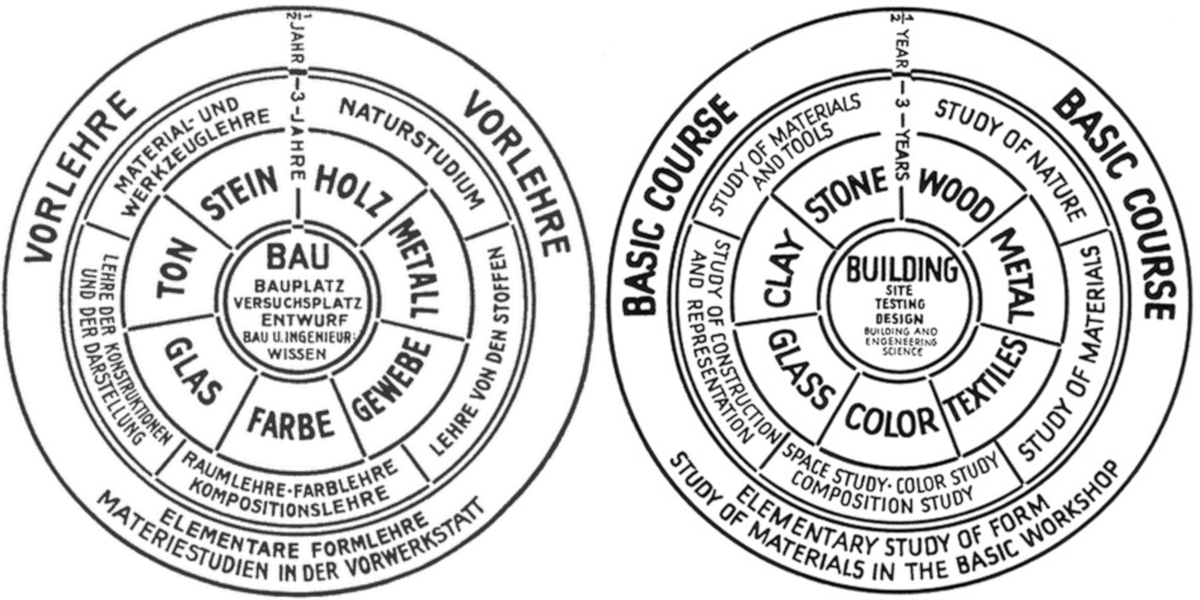
Any artisan has the potential to be an artist and according to Gropius, any builder or practical artisan was of greater value that any ‘second-rate’ painter. He also acknowledged that, whilst there are techniques and methods associated with creativity, art in itself could not be taught. So the Bauhaus approach would be preoccupied with technical instruction and all lectures would be hands-on and workshop-based.
Having said this, Gropius goes on to say that there are artists who have technical prowess, in their chosen media, and who have great spiritual and philosophical value, and in order to inject innovation both in thought and in ways of doing, these people are invaluable as teachers and would instruct alongside those expert ‘technical’ practitioners:
“…a school of design should have on its faculty the purely creative and disinterested artist, such as the easel painter, as a spiritual counterpoint to the practical technician in order that they may work and teach side by side for the benefit of the student.”
…and:
“The Bauhaus strives to bring together all creative effort into one whole, to reunify all the disciplines of practical art — sculpture, painting, handicrafts, and the crafts — as inseparable components of a new architecture. The ultimate, if distant, aim of the Bauhaus is the unified work of art — the great structure — in which there is no distinction between monumental and decorative art.”
1925
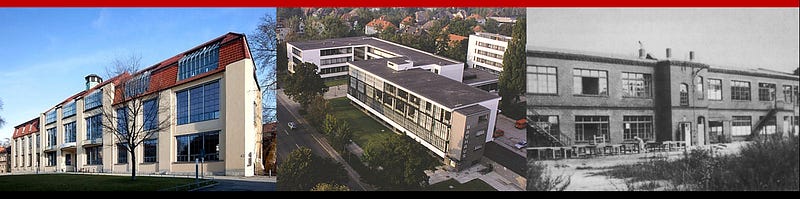
After establishing itself in Weimar, the Bauhaus moved to a purpose-built site of their own design — the now iconic Bauhaus building in Dessau — and were recognised by the government as a Design Academy along with an approved Diploma qualification. In a very short period, the school managed to exert an indelible influence upon nearly all aspects of art and design that remains ubiquitous in teaching and manufacture… But the political climate in Germany was also rapidly changing with the rise of the extreme right.
In the face of mass redundancies, the disbanded National Socialist German Workers’ Party found favour once more and was re-established with 270,000 members. Adolf Hitler was its new leader. They re-branded as the National Socialist Party and openly declared their opposition to Bauhaus ideology, campaigning to close the design school and demolish its campus…
1932
Under the directorship of Ludwig Mies van der Rohe, the Bauhaus moved to a disused factory in Berlin. It was now an independent design school after having its official approval revoked due to political pressure.
The socio-political upheaval around them swiftly intensified: The Reichstag Government collapsed and Adolf Hitler was instrumental in forming a new government. In response, the German Communist Party planned a general strike and public demonstrations, but too late as the the ruling Nazi Party declared demonstrations illegal and arrested all members of the Communist Party for planning to break the new laws. The SS were formed, an armed police division to enforce bans on trades unions and unapproved literature. Many union leaders were arrested and many books were burned in the streets.
Next, the opposition party of Social Democrats was outlawed and all other political parties were dissolved. The Gestapo were formed, another armed police division that reported directly to Adolf Hitler and were absolved from any legal accountability.
New statutes were then passed to abolish democracy and make the Nazi Party the sole representatives of the German State as they withdrew from the League of Nations. The Aryan ideal was made central to the new German cultural identity, and ‘non-Germans’ were denied work permits. (In the midst of our current political turmoils, it would serve us to remember and recognise this pattern.)
Important artists who taught at the Bauhaus include, Joseph Albers, Lionel Feininger, Wassily Kandinsky, Paul Klee, Lazlo Moholy-Nagy and Piet Mondrian. You may note from the names that these contributors were from a widely varied cultural background, Hungarian, Swiss, Soviet, Netherlands… and some were Jewish.
This multiculturalism, plus their support of new and challenging styles of art along with their promotion of creative free-thinking, placed the Bauhaus at odds with all the dominant Nazi ideologies. After the police raided the Berlin Bauhaus building and arrested many of the students, Ludwig Mies van der Rohe was finally forced to shut down the Bauhaus in the summer of 1933.
Although the Bauhaus ceased to exist as a single school of design, the principles of its Manifesto lived on… Many of the influential teachers and students became refugees, taking their talents and ideals with them to other countries, mainly Britain and the USA, thus spreading the big Bauhaus influence far and wide where it thrives to this day.


