
Piet Mondrian’s Tree Paintings
Exploring the essential balance and beauty of nature in search of a simple truth in the human experience…
With his many studies of trees, Piet Mondrian demonstrated his process of distilling the essence of beauty from naturally harmonious forms. He was attracted to trees because of their complex and often chaotic structure. Yet, at the same time they are balanced compositions that also respond to, and reflect, their environment along with the action of time. In order to better understand the underlying forms, Mondrian, repeatedly painted the same tree reducing the visual language he used with each treatment…
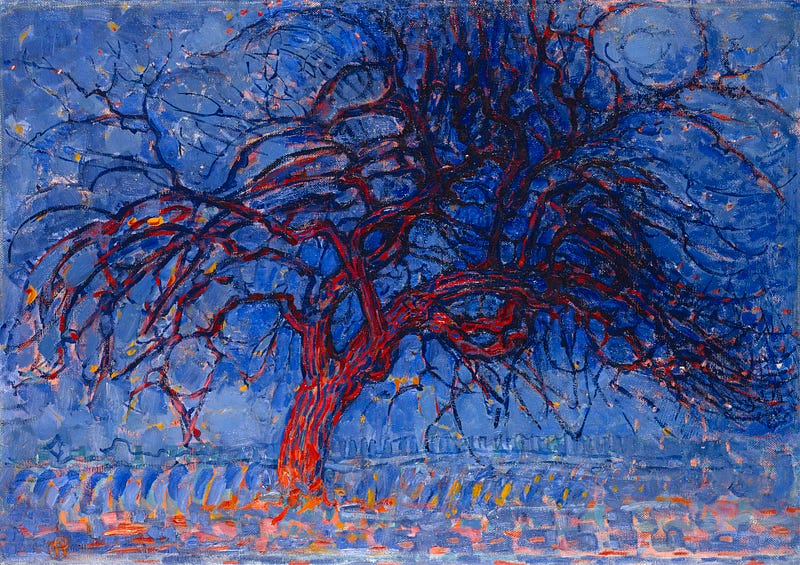
The Dutch painter produced an extensive series of tree paintings over a period of five years between 1908 and 1913. To begin with, he simply reduced the information he chose to represent. In much the same way as the Impressionists selected details to better reflect the experience of perceiving rather than evenly capturing the details across a canvas without any ‘editing’, Mondrian selected only the major boughs and left out the thinner branches and twigs. He still managed to paint a tree, with a clear tree shape, yet he was now closer to ‘essence of tree’ than ‘diagram of tree’.
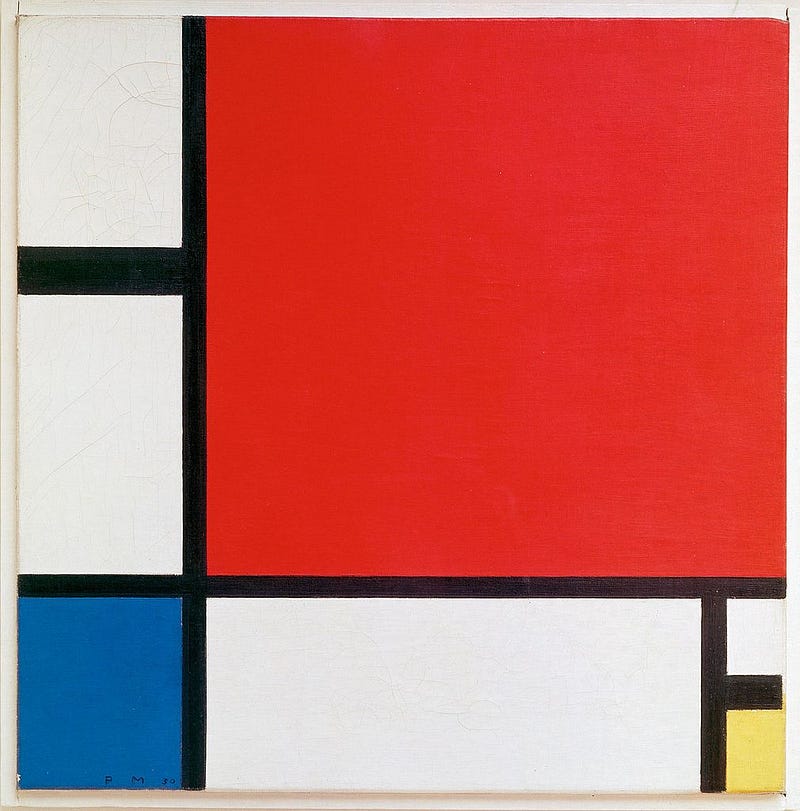
He continued to paint variations on this theme, limiting the colours he used, eventually to grey monochrome, and then limiting the painted angles either to a vertical or horizontal. So, a branch angled at less than 45 degrees would become horizontal, a branch angled greater than 45 degrees would become vertical. He also went through a similar reductionist approach to that of Malevich, first working in greyscales, then re-introducing a limited colour palette. Later, he concentrated on using black, white and primary colours only. This also echoes the development of early Cubism.
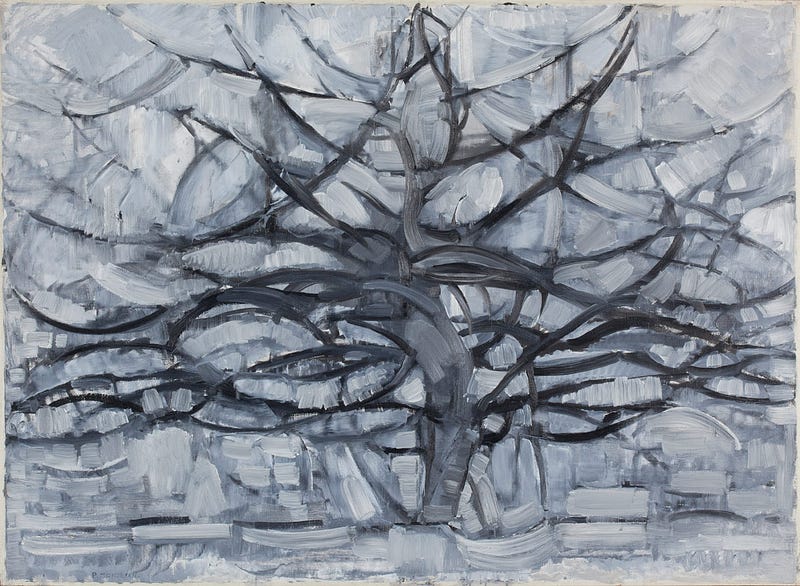
These early studies of trees are lovely renderings of their natural form, the later ones are grid patterns that are weighted in a similar way, the density of squares and number of lines transmuted from the distribution and visual density of branches, but are only clearly recognisable as trees when seen in their developmental sequence.
In this process Mondrian deconstructs natural form in an attempt to understand the underlying rules of harmony that cause the satisfying emotion we feel when appreciating natural scenes. He believed that this is the same emotion we recognise as ‘beauty’ and devoted most of his career to exploring the cause and effects of it.
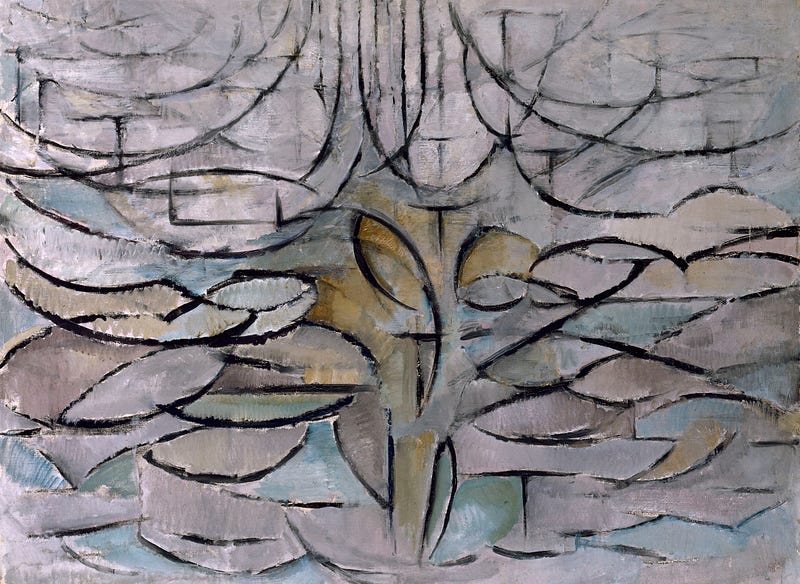
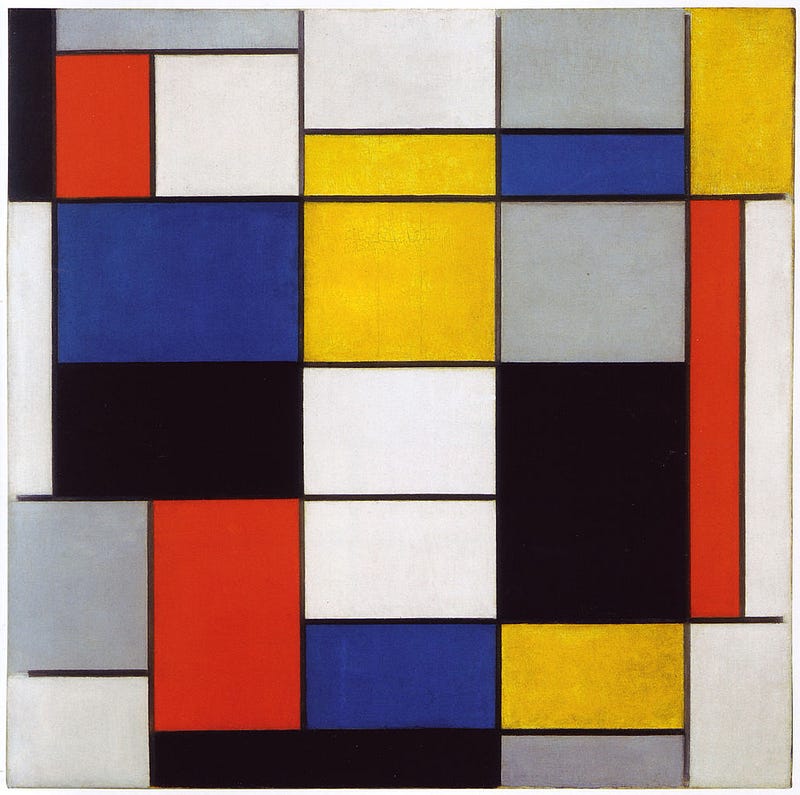
Soon after painting the trees series, and other features of landscape, he turned away from representational pictures and worked directly with the elements of his reduced language: the horizontal and vertical, with the limited palette, and their relationships on the canvas. He realised that the emotion of beauty is caused by interactions of more than one factor and was therefore the result of relationships. He also observed that the beauty of nature relies on balance and harmony, though not necessarily symmetry.
This exploration eventually resulted in his famous ‘Squares and Lozenges’ paintings of the 1930s and 1940s — the culmination of decades of visual research and development. Mondrian began by producing simplified representations of natural environments and then took what he learned about balance and relationship into total abstraction. He systematically reduced and simplified in search of an essential truth that underlies beauty. Or, perhaps, a simple beauty that underlies truth...
Gustav Klimt’s Tree Paintings and the use of Trees as Art have also been discussed by Remy Dean in Signifier.


,_oil_on_canvas,_70_x_99_cm,_Gemeentemuseum_Den_Haag.jpg)
,_oil_on_canvas,_79.7_x_109.1_cm,_Gemeentemuseum_Den_Haag,_Netherlands.jpg)


