
Klimt’s Tree Paintings
Though best known as a Symbolist for his portraits with burnished gold, Gustav Klimt’s landscapes were a big step toward ‘the Modern’.
For many, the name Gustav Klimt conjures imagery of figures engulfed by symbol-crammed patterns and loads of gold leaf that lends them the vibe of religious icons. Or sprawling architectural friezes packed with mythological narratives and allegorical motifs. Yet he was also an accomplished, and innovative, landscape painter...
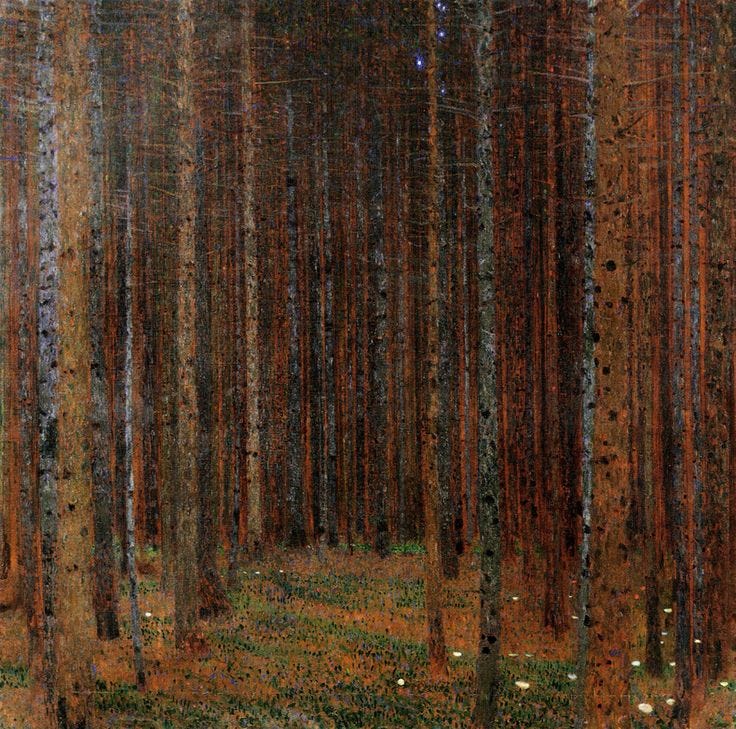
Around the same time as Dutch painter, Piet Mondrian was exploring similar notions in his early tree paintings, Klimt was studying the rhythms and balances in nature that appealed to the human eye… and soul. Something about being in nature, surrounded by the sculpturally complex yet calming forms of trees, seemed good for everyone.
The silent stillness of a deep pine forest, its cool shade pierced by pin-points of sunlight, could stir the spirit as much as any great cathedral. Even in his faithful renderings of views within forests of tall, straight fir trees, Klimt manages to include some symbolism. The repeated trunks take the eye upward toward the unseen canopy and above that, the imagined heavens, the spiritual, the overwhelming brightness of the encompassing sky. Here, he seems to share the spiritual view of nature with Vincent van Gogh, for whom trees also represented transcendence and, perhaps, a slice of the Romantic ‘sublime’.
Klimt was also interested in understanding why certain natural harmonies and arrangements stimulate strong positive emotions when we recognise them as ‘beautiful’, whether found in the face and form of a fellow human, in the wild hills of his native Austria, or in managed gardens and parklands. He saw the artist’s task — at least a significant part of it — as finding, analysing, and capturing whatever that essence may be.
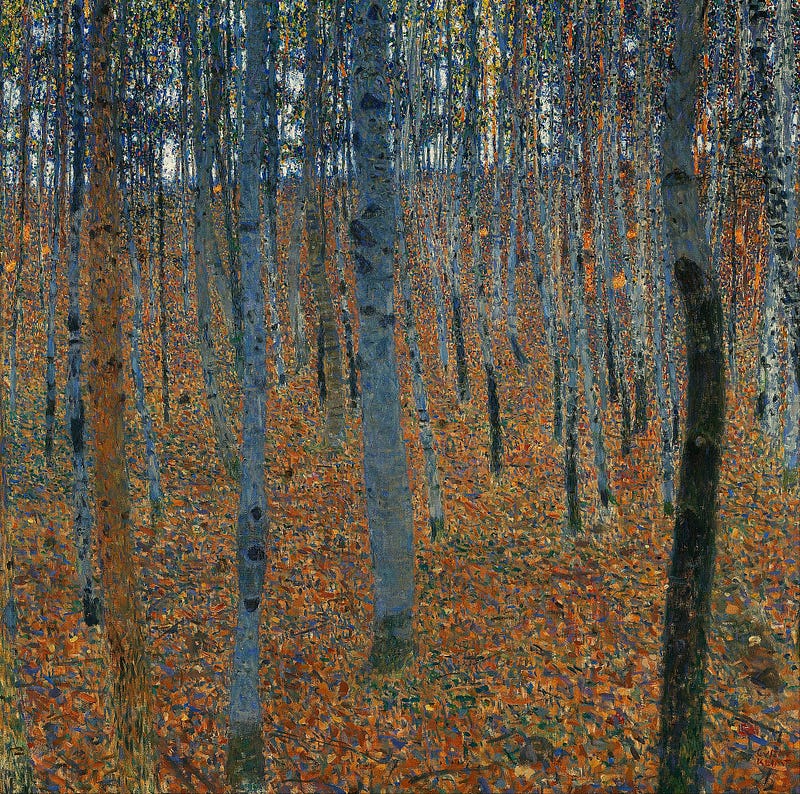
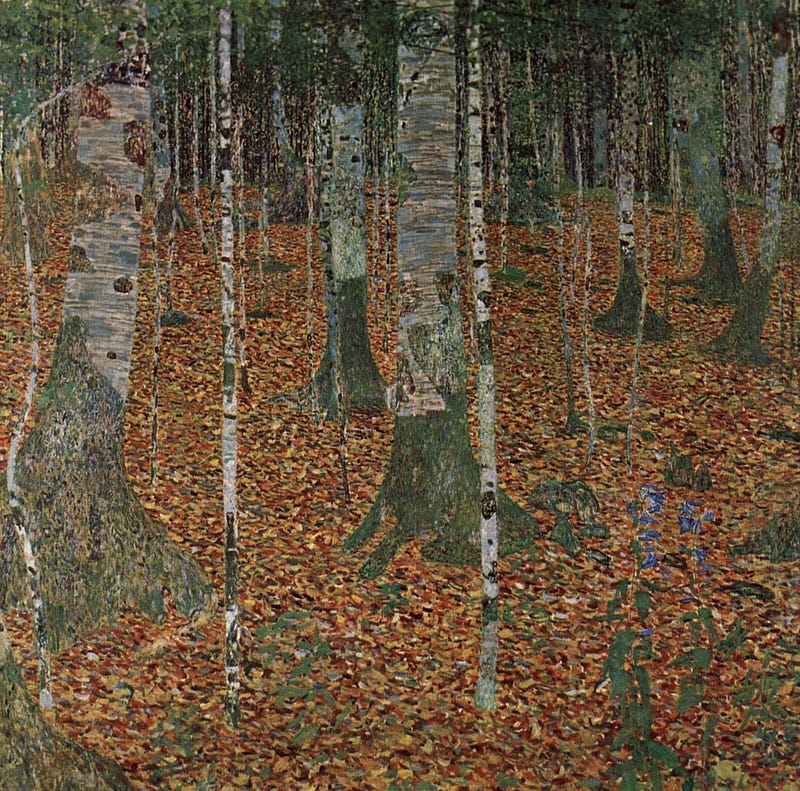
As a painter, he was always interested in arranging patterns on the flat surface of a canvas and deciding how the frame would crop and interact with them. This focus had come via the influence of Japanese woodblock prints, watercolours, and other oriental objects. His inclination toward this decorative approach led him to transcribe the three-dimensional environment into repeating surface pattern, cropped in a way that emphasised strong rhythms and structure. Many of his best known landscapes are well-observed and unquestionably realist in their treatment, yet they begin to look like abstracts.
In his studies of a beech grove, he became increasingly fascinated with the energy of so many scattered, separate brush marks contained within the ‘divisionist’ order imposed by the bold bars of the tree trunks. These strong uprights are challenged by the tight horizontal banding often seen in the distinctive birch bark and Klimt also seems to have enjoyed balancing the lurid greens of mosses with the reds and bronzes of the fallen leaves — achieving harmonious compositions with potentially conflicting components.
His use of contrasting colours laid right next to each other — warm reds and oranges against cool greens and blues — is also reminiscent of Paul Cezanne’s first experiments with Pointillism. The pure colours ‘mix in the eye’ and their contrasts make them seem even more vibrant, an effect we enjoy in the real world of reflected light that can be easily lost among the dull pigments of oils on canvas.
It wouldn’t take much simplification for some of Klimt’s renderings to be reduced to grids and blocks of colour that may look something like the later abstracts of Mondrian. The way that Klimt dabs colour to represent blossom and leaf is approaching the pure Pointillism of Georges-Pierre Seurat, and there’s certainly a influence, in both treatment and composition, from Vincent van Gogh’s late nineteenth-century paintings of orchards in bloom.
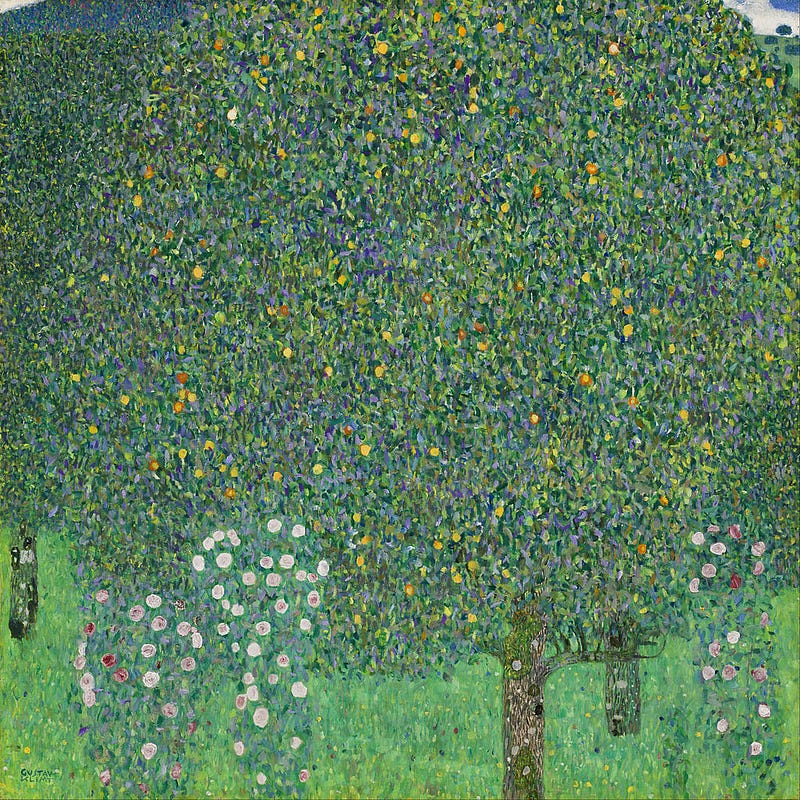
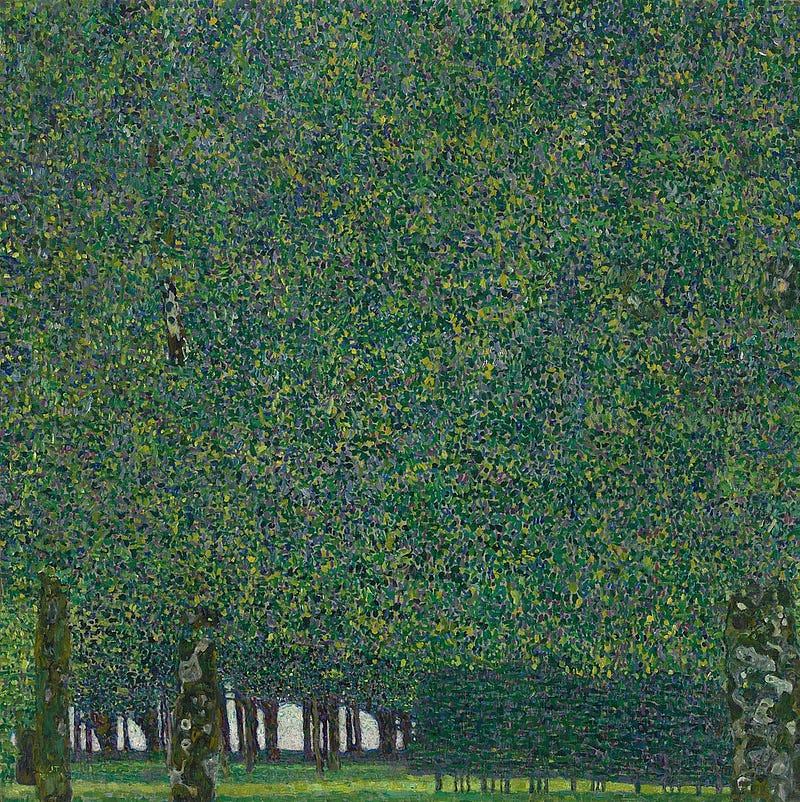
Klimt’s later landscape works became celebratory affirmations of life represented by nature in full bloom. The wealth of vibrant flowers and verdant leaves sang of abundance and fertility. There were less paintings of the wild places and his landscapes more often contained signifiers of a direct relationship between human and natural agencies. He favoured orchards, gardens, parklands, and tree-lined avenues, and perhaps there is what we would now call an ‘eco’ message about the symbiosis of nature and human wellbeing.
The patterns we see emerging in his blocks of blossom-scattered foliage, along with the symbolist grammar of plants, is something he repeatedly exploits, providing densely patterned backgrounds for his figures and portraits. Such patterns also comment upon the subjects and drive narrative elements in many of his best known works, not least his most famous ‘Gold Period’ painting, The Kiss...


