
The Great Wave
Quintessentially Japanese, yet influenced by Western art and printed with European blue, Hokusai’s print fascinated and inspired many Modern painters.
Hokusai’s The Wave is an iconic image and one of the most reproduced. It could be described as ‘viral’ — it’s even an emoji. Probably, the most well-known image from Japanese art. Yet, it was influenced by European art, and its prevalent blue colour, commonly called Prussian Blue, was a synthetic pigment discovered in Europe.
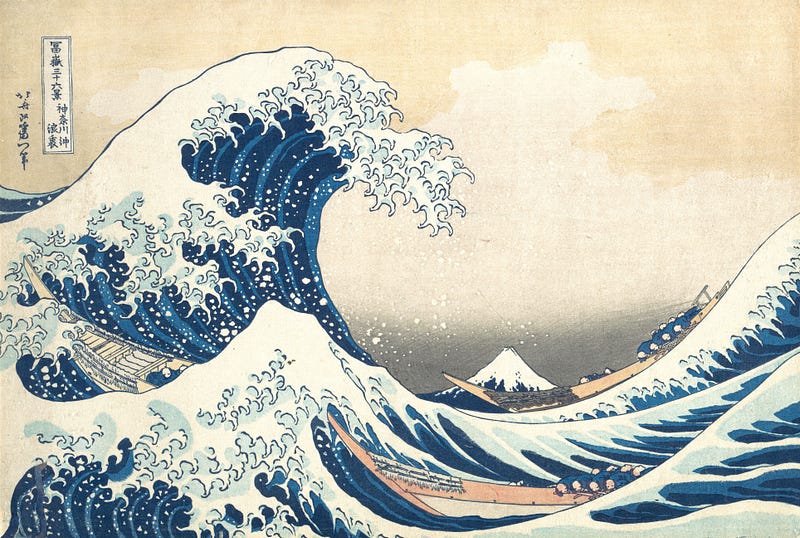
Hokusai literally translates as ‘Studio of the North Star’, and was the ‘moniker’ of the very famous ukiyo-e (‘floating world’) artist during the Edo period of Japan (1603 -1868). It was an era of greater access to affordable enjoyments for the common people, including various forms of theatre, books and decorative prints. Hokusai was just one of around 30 pseudonyms used by the master print-maker who, as a boy, had been named Tokitarō.
It was published sometime between 1829 and 1833 when Hokusai was in his seventies and already very famous in Japan. He was living in the capital Edo, now Tokyo, with his daughter Eijo who was also a talented painter.
Hokusai had the opportunity to study some examples of Western art that arrived in Japan and used the Western-style perspective in a playful way when composing this image. Mount Fuji is the tallest mountain in Japan yet from this angle The Great Wave seems ready to engulf the mountain, and flecks of foam seem like snow about to settle on its peak! It’s estimated the standing wave is cresting at about 30 feet. Impressive, though not a tsunami as it’s often described.
The graceful curves and limited palate viewed at a distance are almost abstract and only upon closer inspection do we see three fishing boats and fishermen using all their skill not to sink beneath the great wave. It’s an eloquent depiction of man’s heroic struggle for survival against the daunting and often destructive forces of nature. Japan, after all, suffers the vagaries of typhoon seasons, earthquakes, and tsunamis.
It’s taken from a series entitled Thirty-Six Views of Mount Fuji although the final collection contained many more images! Such views were immensely popular for the pilgrim and tourist trade as Mount Fuji has long been considered holy in Buddhist and Shinto traditions. Hokusai himself became fascinated with it as a symbol of longevity.
The views show various activities and seasons around the great Mount Fuji, but The Great Wave is by far the most popular print. It shows the mountain from Sagami Bay, Kanagawa Prefecture, where the great Tsunami of 1498 had destroyed the Koko Tin Temple of the Great Buddha and thousands of lives had been lost.
The traditional woodblock techniques used to produce the Great Wave required much skill. First, the image is painted then pasted onto the wooden block. Often, the wood used is mountain cherry. Sharp knives and chisels are used to carve the lines into the wood and different blocks are made for each colour to be used. The original drawings are necessarily destroyed in the process. Then the pigment, mixed with a little rice paste, is painted onto the relief image on the block.
‘Kozo’ paper, traditionally made from the mulberry tree which allows for elasticity when moistened and dried, is laid on top of the inked block. Then it’s carefully smoothed with a ‘baren’, a flat, cushion-like tool made from coiled and woven bamboo fabrics. This transfers the pigments to the paper and the process is precisely repeated for each colour to produce the final print.
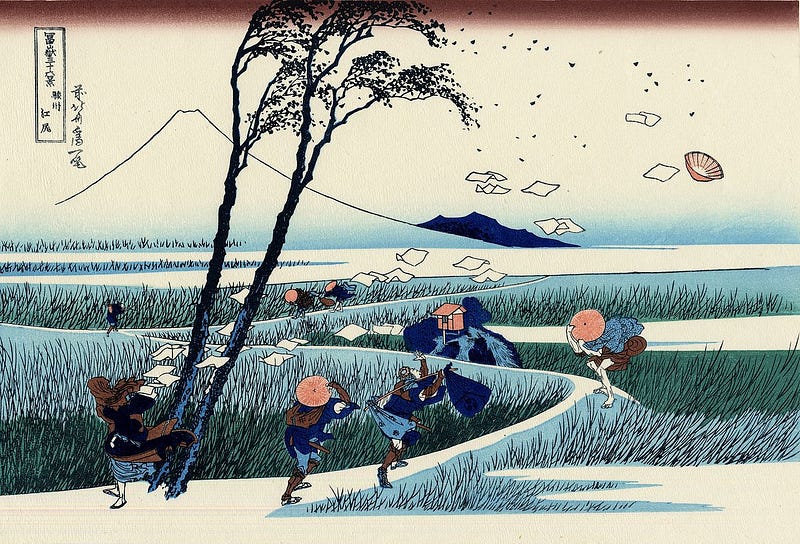
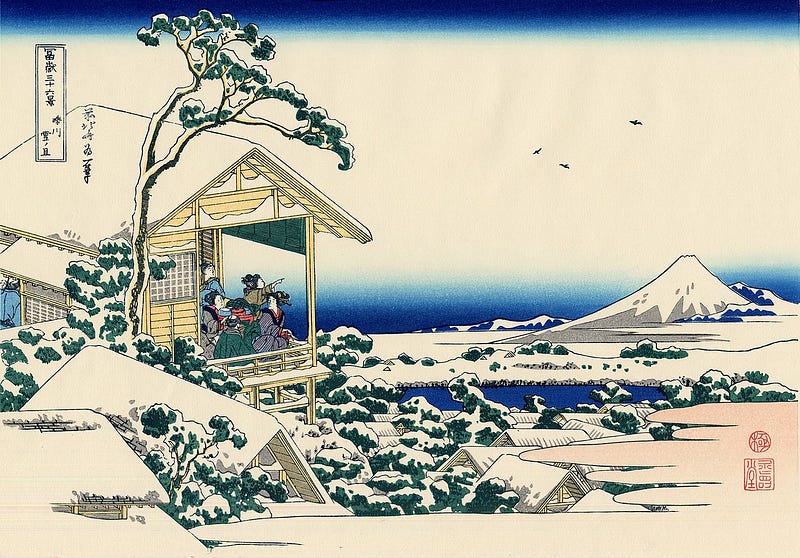
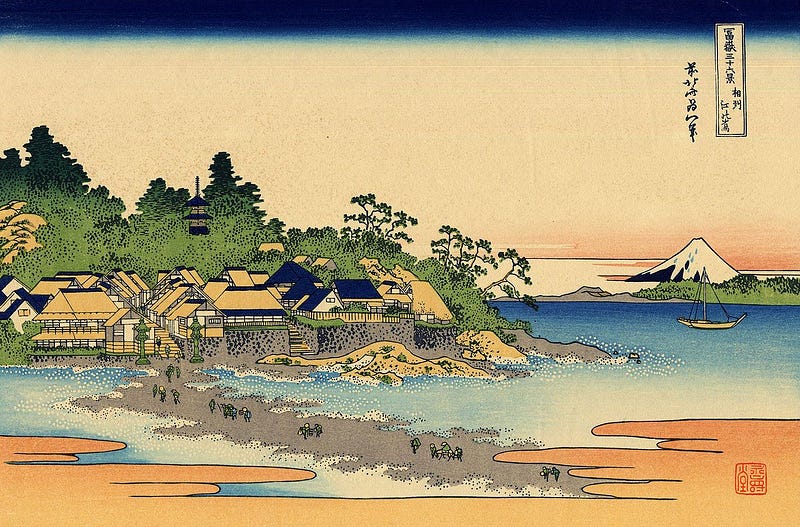
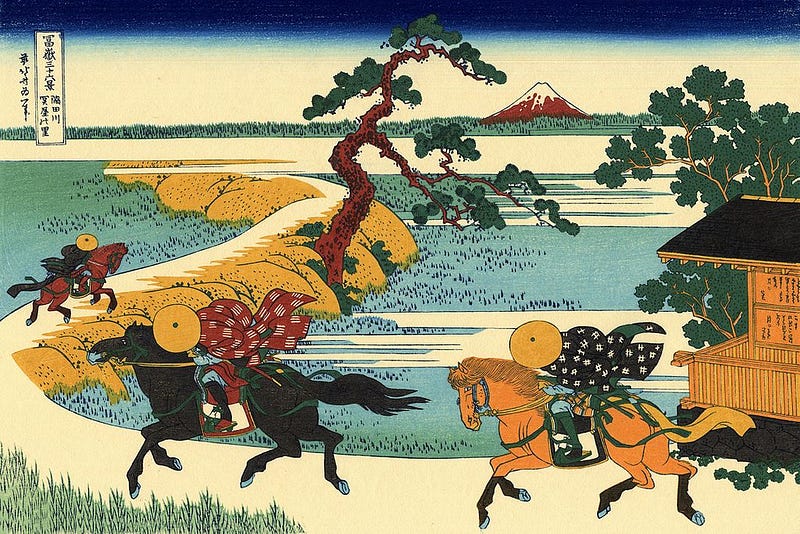
These images were presented as books or individual prints and were literally ‘cheap as chips’, or maybe ‘cheap as ramen’… The Great Wave was thus produced as a woodblock print in great numbers of 8,000 or more. To own a copy at the time would cost about the same as a double helping of noodles, the affordable staple food of the people. It seems fitting that it’s still so ubiquitous today — anyone can access the image as a download, poster, postcard, mug, or a tea towel…
Hokusai’s original images of Mount Fuji were promoted as ‘printed in shades of blue’, which was unusual and distinctive at the time. They used the natural pigment indigo, traditionally used in Japan, combined with the pigment ‘Prussian Blue’, invented in Europe and imported via China. It was prized for its durable qualities and Hokusai uses the blue tones to great effect to conjure the liminal tones of very early morning, just as colour seeps into the world again with sunrise.
As Japan ‘opened up’ to the West, a few decades later, such woodblock prints reached Europe where they greatly influenced the French Impressionist painters in Paris. They were literally the ‘packing paper’ used to protect Japanese vases and other craft artefacts exported to the West.
Vincent Van Gogh and his brother Theo, who was an art dealer, were probably among the first Europeans to appreciate these images. Van Gogh was known for pinning a great many Japanese prints on his walls as inspiration and reference. He recognised The Great Wave as an important work, and Vincent’s style — prominently showcased in his Starry Night composition — is reminiscent of Hokusai’s swirling blues. It’s hard to think of a parallel secular decorative art in the Western world, until the arrival of Toulouse Lautrec’s posters, which were also influenced by these Japanese woodblock prints.
Hokusai continued to create many more wonderful images — mythical creatures such as dragons are depicted as vividly as his landscapes and natural scenes. As he grew older, he devoted himself entirely to painting. When he was 80, he wrote:
“My eyesight and the strength of my brush are no different to when I was young. Let me live to be a hundred and I will be without equal.”
His Great Wave continues to fascinate us for many reasons — Hokusai’s skill to balance East and West, Man and Nature, Time and Tide, Line and Colour… all the while seeking meaning through art during his long life. Hokusai’s expertise seems to culminate in this visual poem, which we return to again and again.


