
‘Starry Night’ (1889), Vincent Van Gogh’s Key-work?
Reading this poetic rendering of the relationship between the inner soul and the vast heavens.
This well-known and well-loved image was painted from memory whilst Vincent was a voluntary patient at the asylum of Saint-Remy, and features an idealised version of a small town. It is a strikingly vivacious painting that goes much further than being a mere impression of a starlit night. It evokes the simple wonder and awe of a bright, clear night sky and conveys the euphoric feeling that can accompany such a moment. The emotional response of the artist is in every brush stroke and choice of colour. It’s not simply a landscape, it’s a poetic rendering of the relationship between the inner and outer ‘landscapes’ of the human mind and the universe! This goes beyond Impressionism and is truly a work of Expressionism — an attempt to externalise the internal and contain the eternal in a moment.
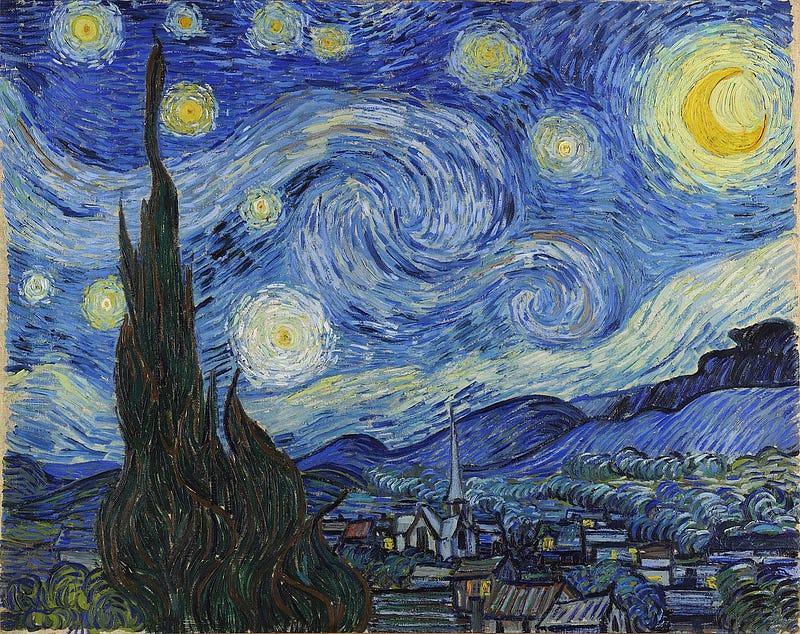
The scene is also a ‘potted biography’ containing a montage of scenes from Vincent’s own life and also a visual treatise on his changing values and beliefs. In the scene we notice several things, first and foremost the swirling starry sky with its Milky Way and golden moon. The vibrancy is achieved by clever use of his favourite colour combination — blue and yellow.
After we have been drawn into the painting by the wondrous sky, we notice the strange looming shape of a cypress tree that reaches from the bottom of the composition almost to the very top. It is so bold that we must consider it to have some significance. Its shape and proportioning are so very similar to the shape of the much smaller church at the lower centre of the image. This church is evidently recognisable, from his own earlier drawings, as the church in the Borinage region of Belgium, where he was assigned as a missionary to the local community of coal miners.
His calling as a priest had been all-consuming for three years up until 1879 when he left the church. He then began his artistic career in earnest, recording the locals, their impoverished way of life and the landscape in which they worked. It seems that he became disillusioned with the church and its judgmental stance, feeling that it did little to console or uplift the morale of these hard-working honest-living peasants. He later found the ecstatic elation he had hoped for, not through his devotion to the church, but through art inspired by nature. We can read all this in Starry Night …
The only non-celestial light in the painting comes from the homes in the valley. It is the warm light of lamps and hearths, hinting at the emotional warmth of simple family life. The church is empty, its windows in darkness. Its spire points to the heavens and indeed its tip passes above the mountains and pierces the sky, but only just. This tells us that formal religion can show us the way, but might not be there when you need it, and only takes us part way.
The cypress tree is not man made, it is a natural structure and its steeple-like shape takes us right up into the heavens, among the stars. To Van Gogh, the feeling of wonder he experienced when considering the grandeur of creation, the power of nature, the vastness of the night sky came closer to the religious experience than anything offered by the church.
In this painting, he evokes the notion of the sublime, placing him in the Romantic tradition, his ‘religious experience’ equating with the their ‘peak experience’. Also, by creating an improvised landscape rather than a literal representation, he has produced a Post-Impressionist painting that could be considered as both Expressionist and Surrealist, as well as giving us an important precursor to the Improvisations of Wassily Kandinsky.
Starry Night remains one of Vincent Van Gogh’s best known and most well-loved paintings. It’s certainly one of my favourite paintings of all and always brings to mind the Oscar Wilde quote from his 1892 play, Lady Windermere’s Fan, “We are all in the gutter, but some of us are looking at the stars.”
Other paintings from the latter days of Vincent have been discussed by Remy Dean in Signifier.


