
The Latter Days of Vincent
In the final two years of his life, Van Gogh painted a series of autobiographical paintings that reveal his joy and despair…
Vincent Van Gogh painted many of his best known works during the last two years of his life. They range from delicate nature studies to euphoric celebrations of the landscape, from brutally honest self-portraits to penetrating portraits of others that manage to mirror the artist’s moods, from intimate illustrations of his private spaces to paintings of the world he saw around him. Through considering a small selection of his works in chronological order, a narrative can be read of Vincent’s personal history…
The Yellow House
This remarkable painting is of the house on Place Lamartine in Arles where Vincent lived during his most revolutionary and prolific period from May 1888 until his demise. He rented the right half as we look at it in the painting, with the distinctive green door and shutters.
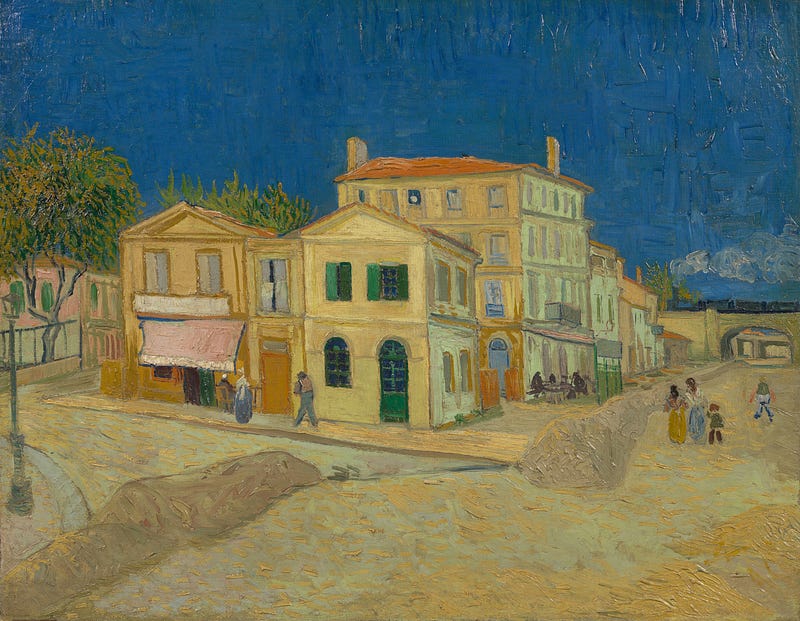
After several preparatory sketches, Vincent painted this view in September 1888, later titling it The Street, though it is more commonly refereed to as The Yellow House. It’s a cheery, autobiographical work. The house seems to glow with its own light against the deep blue of the sky, and careful observation reveals both blues and oranges in the roofing tiles, giving the vibrancy and optimistic atmosphere. This brightness captures a comparative positivity that Vincent felt when he took up residence, marking the beginning of a fresh chapter in his life, not realising it would also be the finale.
Reading the picture from left to right, we see a tree that stands in the corner of the local public park, then the pink canopy of the restaurant owned by Vincent’s landlady, where he would often eat his meals, when he could afford to.
To the right we find a typical small café terrace on the side of the Avenue Montmajour that Vincent often passed when walking to visit his friend, Joseph Roulin — a postman that Vincent produced several paintings of, easily recognisable by his very fine beard. The railway bridges that take us off the canvas are seen as representing both the wider world beyond this scene and the ‘unpainted future’ to follow the moment captured here.
“I can very well do without God both in my life and in my painting, but I cannot, ill as I am, do without something which is greater that I, which is my life — the power to create. And if, frustrated in the physical power, a man tries to create thoughts instead of children, is he still part of humanity?”
- Vincent in a letter to his brother, Theo, August 1888.
Vincent’s Room
The beginnings of both Expressionism and Fauvism can be seen here in this study of his bedroom, painted in October 1888. This is what lies behind the green shutters of the upper floor in the Yellow House.
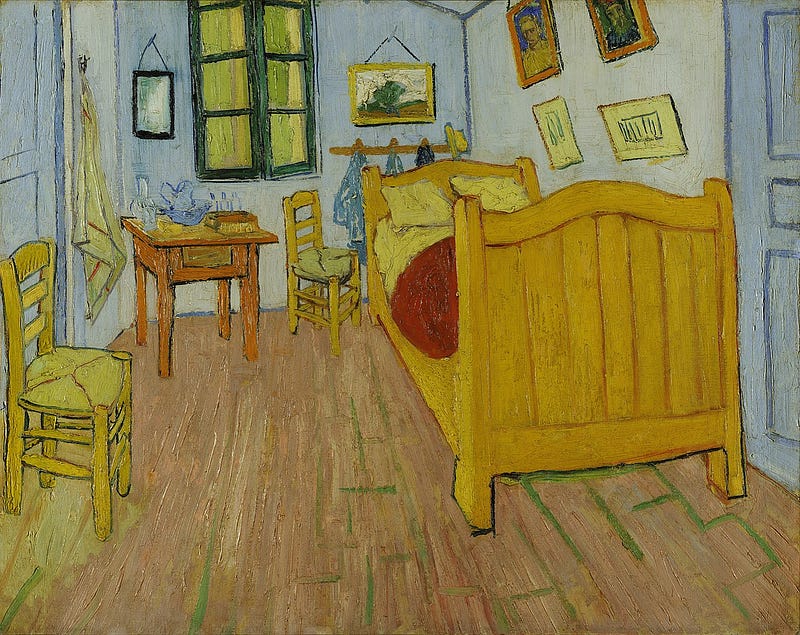
He was directly influenced by Japanese prints in this composition, which often depicted interiors from an elevated point of view. Though this scene is painted from eye-level, the perspective is skewed and forced. He did this to emphasise the character of the interior as the walls really were ‘wonky’. The framed pictures are hung at a slant and he also left the windows slightly ajar to create more interesting angles that challenge the perpendicular.
Although it’s an interior, there is a brightness about the scene and an absence of shadows, implying a sort of ‘time-lapse’ intimacy with the place. The items of furniture are not sharing a common perspective. So, it’s as if the viewer may enter the room and familiarise themselves with the furniture and other things that occupy the space. As if we can look at them from more than a single point of view. We become Vincent’s ghost in his absence.
The colour and prominence of each object reflects not only how the room looked, but also an emotional relationship with each thing and its surroundings. In this work, we can also appreciate the simplicity of his life and although he is not figuratively represented, this is also very much a self portrait.
“I wish you could spend sometime here, you would feel it after a while, one’s sight changes: you see things with an eye more Japanese, you feel colour differently … I am convinced that I shall set my individuality free simply by staying on here.”
- Vincent in a letter to his brother, Theo, May 1888
Sunflowers
Vincent painted two notable series of sunflower studies. The first in 1887 that featured mainly cut flower heads. the second set were painted in 1888 to decorate the room at ‘the yellow house’ in which Paul Gauguin would stay during his extended visit to Arles.
Vincent had hoped that he could establish a sort of artists’ quarter in Arles where like-minded creatives could form a community of mutual support producing adventurous paintings, poems and sculptures. Gauguin was the first to, perhaps reluctantly, ‘sign-up’ to this idea, after much encouragement from Vincent’s brother, Theo. The friendship that developed between Vincent and Paul became tumultuous and fraught, to say the least.
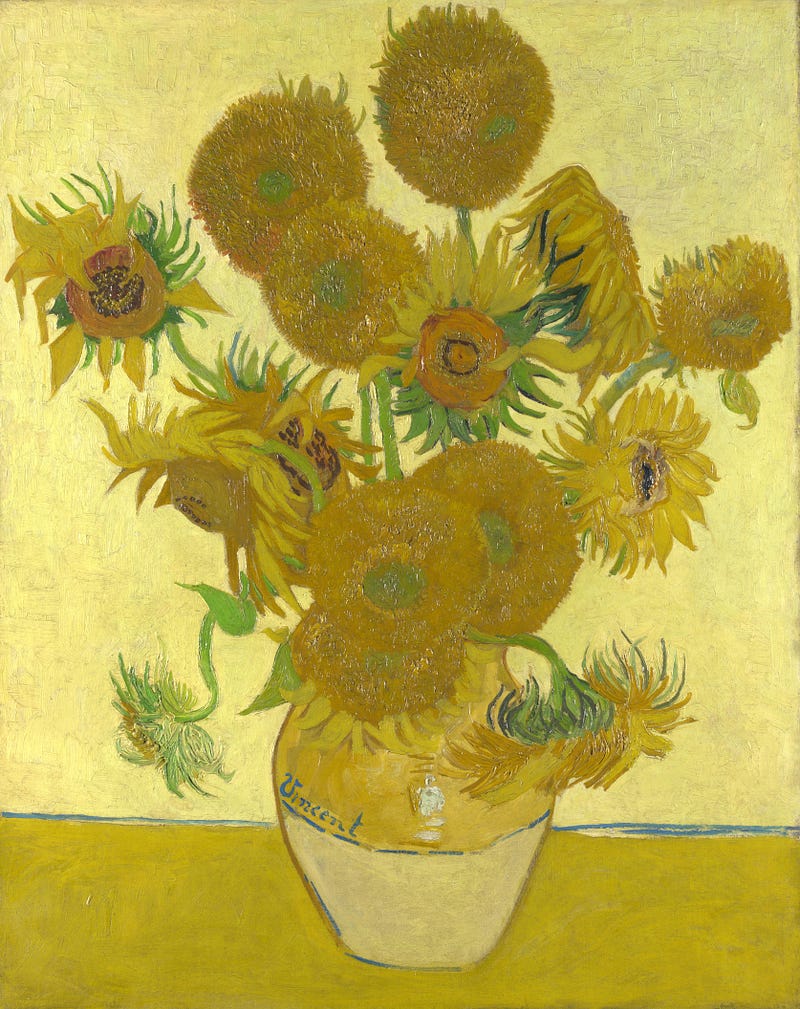
This is one of the most famous and popular images of all time, often reprinted and sold as cards and prints. An obvious oriental influence can be detected. The yellow and cream of the background is reversed in the vase, almost a ‘yin-yang’ balance. Here he is using strong lines to contain fairly flat blocks of each colour.
The cream of the wall is graduated to include subtle blue which increases the vibrancy of the sunflower yellow. There is no traditional perspective and little shading, and there is no use of chiaroscuro. Yet the arrangement of flower heads still seems to have some depth. The form of the flowers is suggested by their finely observed treatment and subtle differences in colour.
“Old Gauguin and I understand each other basically, and if we are a bit mad, what of it? Aren’t we also thoroughly artists enough to contradict suspicions on that score by what we say with the brush?”
- Vincent in a letter to his brother, Theo, January 1889.
Irises
This vibrant painting of 1889 depicts a well chosen arrangement of flowers, each well observed from life and painted with great care and attention to detail. The use of yellow in the background effectively makes the blue of the irises ‘pop’, with the single white flower eventually attracting the eye to settle and giving the composition focus and an almost narrative movement. The use of dark outline and bright colours gives the impression of a stained glass window.
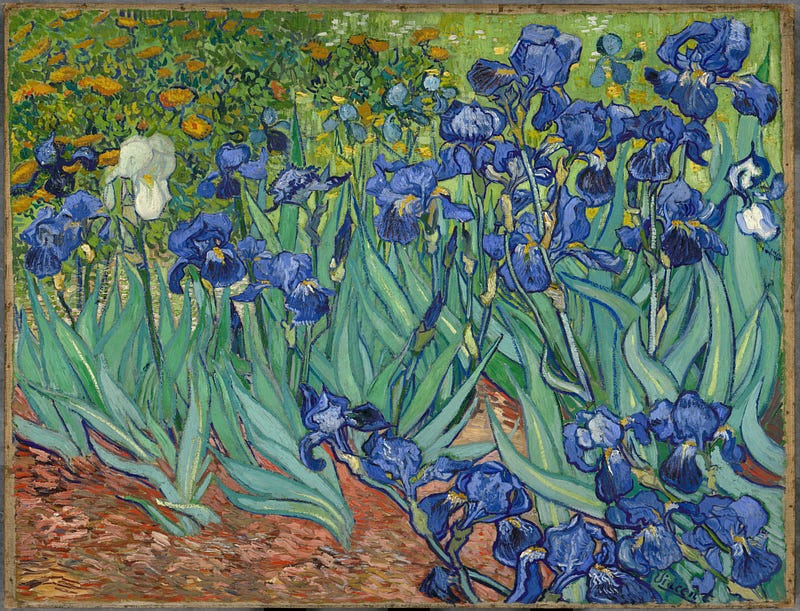
This is a good example of Van Gogh’s ongoing process of liberating colour from its duty of form by using strong outlines. Although the brush work is controlled and relatively smooth, the Van Gogh energy remains very evident. It has been said that this is one of his few painting that bears no trace of tragedy. He always seems at his happiest when painting subjects from nature and I feel this canvas transmits that to the viewer. This painting sold at auction in 1987 for £25.5 million, the bidding started at £15 million and lasted less than 2 minutes. At the time, this was the most ever paid for a painting…
“I have a terrible lucidity at moments, these days when nature is so beautiful, I am not conscious of myself any more, and the picture comes to me as if in a dream. I am rather afraid that this will mean a reaction and depression when the bad weather comes…”
- Vincent in a letter to his brother, Theo, September, 1888
Self-Portrait with Bandaged Ear
Vincent is known for his ongoing series of self-portraits. From his writings, we can gather that he painted himself so often as a method of scrutiny, to build an awareness of his own human condition, but also because he could not afford to pay models to sit for him. As in his other self-portraits from around this time, we can see Fauvist influences in the bold use of colour, which are vibrant and not entirely naturalistic.
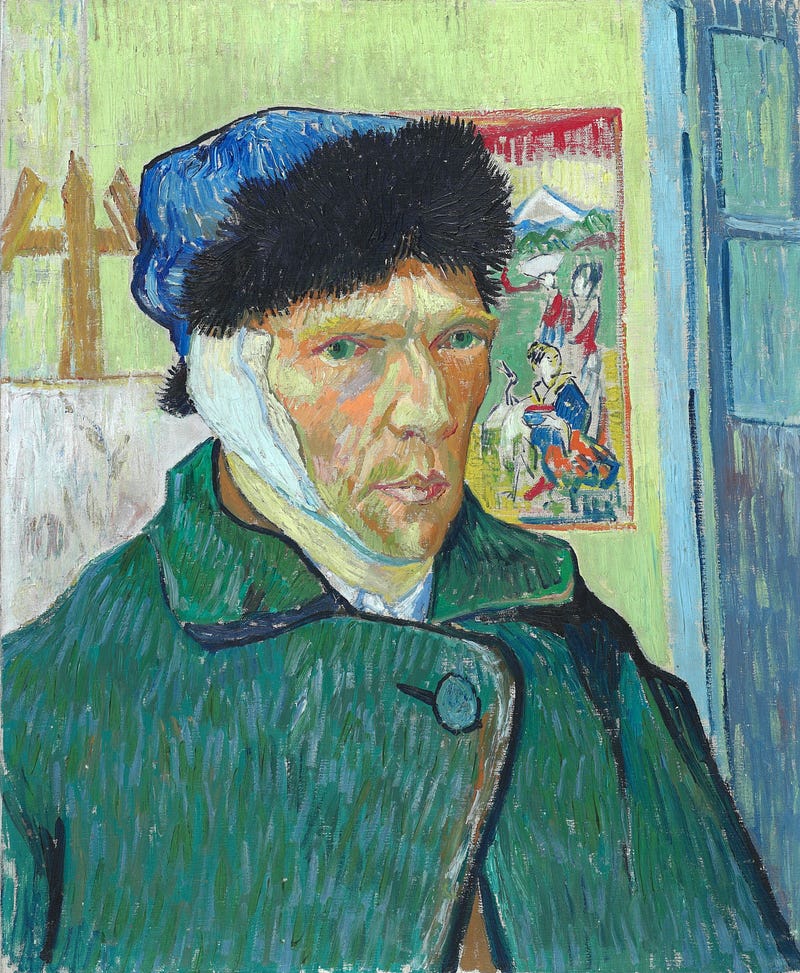
Interestingly, we can see one of the major influences on his style, in particular, and indeed on Modernism in general. He’s included a partial copy of a known Japanese print in the background. Vincent revered the art of Japan which was just becoming popular in Europe at the time. The coloured woodblock print on his studio wall is of traditional Geishas probably printed in the 1870s.
Unlike Matisse or Gauguin, who were also heavily influenced by oriental art, he doesn’t rely on flat blocks of colour here. The brushwork, consisting predominantly of short vertical upstrokes, is less exuberant and more uniform than in many of his similar self-portraits. Unusually, he’s not meeting the gaze of the viewer and instead looks off-canvas. This is a contemplative pose and no doubt he’s considering the preceding events, which are well-known, though still not wholly corroborated.
What we know is that, on the evening of 23 December 1888, Vincent seriously mutilated his own ear after a falling-out with Pal Gauguin who had been staying in the Yellow House. It seems it happened whilst in a state of fugue, now thought to be related to a form of epilepsy. Afterwards, Vincent could not remember anything of the episode.
One version of the story, and the most retold, if that he cut off his ear and sent it to his girlfriend. We know from medical testimony that he didn’t cut off his entire ear, but he did manage to nick an artery in his neck and lost enough blood to be life-threatening.
Another story has him walking to the nearby brothel to deliver a package, containing a chunk of ear, to his favourite prostitute. This seems unlikely given the severity of the injury and loss of blood that was said to be copious enough that it “stained the walls in every room of the Yellow House.”
In another version, Rachel, his bordello girlfriend discovers him unconscious, and alerts the police. It’s certain enough that he would’ve died had the police not found him as he required urgent hospital treatment. This seems to be the beginning of his mental health’s final decline.
Painfully aware of his mental and emotional problems, Vincent voluntarily signed himself into the care of doctors at Saint-Paul Asylum, Saint-Rémy de Provence, in May 1889…
“I have painted three more big canvasses since. They are vast fields of wheat under troubled skies, and I did not go out of my way to express sadness and extreme loneliness … I almost think that these canvasses will tell you what I cannot say in words, the health and restorative forces that I see in the country.”
- Vincent in a letter to his brother Theo, and sister-in-law Johanna, July 1890.
A Wheatfield under Threatening Skies
Painted in July of 1890 and often cited as Vincent’s last completed work. It was certainly among the last few, although the Van Gogh Museum list a study of Tree Roots as his final painting. This is a strongly narrative picture that is an externalisation of the internal. It can be interpreted as an Expressionistic representation of Vincent’s own inner landscape. Horizontally divided in two, between the bright sunny fertile field and ominous darkly threatening storm clouds, the painting is vigorous and impassioned, with Vincent using his fingers and both ends of the brush to hack and work into the paint.
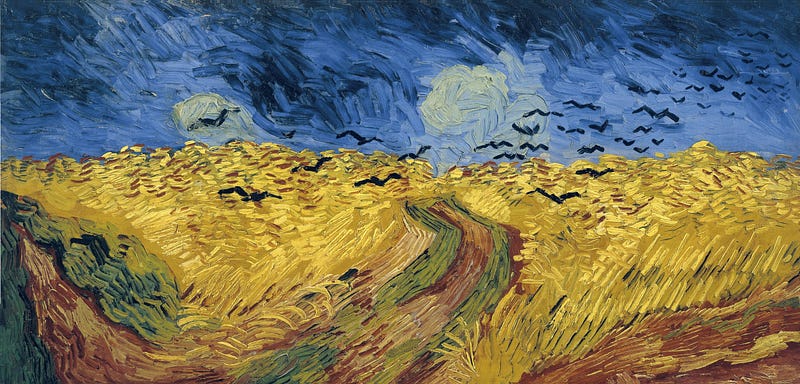
Vincent swung from extreme passion and euphoria, when he was painting, to deep despair and depression, linked with his undiagnosed condition. Perhaps a bipolar disorder, or a form of epilepsy.
Here we see the bright, fruitful wheat that represents creativity thrashed about in the strong winds with the inevitable rains about to beat down the harvest, under the bleak impending clouds of doom. The canvas is almost half-and-half, bright versus dark as Vincent’s life had been, but in this painting, the crows have been added, bringing the black down into the brighter lower half, corrupting the vibrant yellow of the wheat. A path swings into the painting and takes the viewer into the middle of the canvas where it seems to end, indicating no clear direction. Uncertainty.
This is a painting of the path that Vincent walked along, into the middle of the field where he was shot in the stomach, before walking back and returning to his room, where he died two days later. No one knows for sure the details of these events, but the generally accepted explanation of suicide has been brought into question and one credible theory is that Vincent was accidentally shot by a teenager whom he knew, and rather than implicate the boy, allowed people to believe he had shot himself.
“I am myself quite absorbed in the immense plain with wheatfields against the hills, boundless as a sea, delicate yellow, delicate soft green, the delicate violet of a dug-up and weeded piece of soil, chequered at regular intervals with the green of flowering potato plants, everything under a sky of delicate blue, white, pink, violet tone. I am in a mood of almost too much calmness…”
- Vincent in a letter to his Mother and Wilhelmina, his sister, July 1890.


.jpg)


.jpg)
