
Gazing Across the Centuries
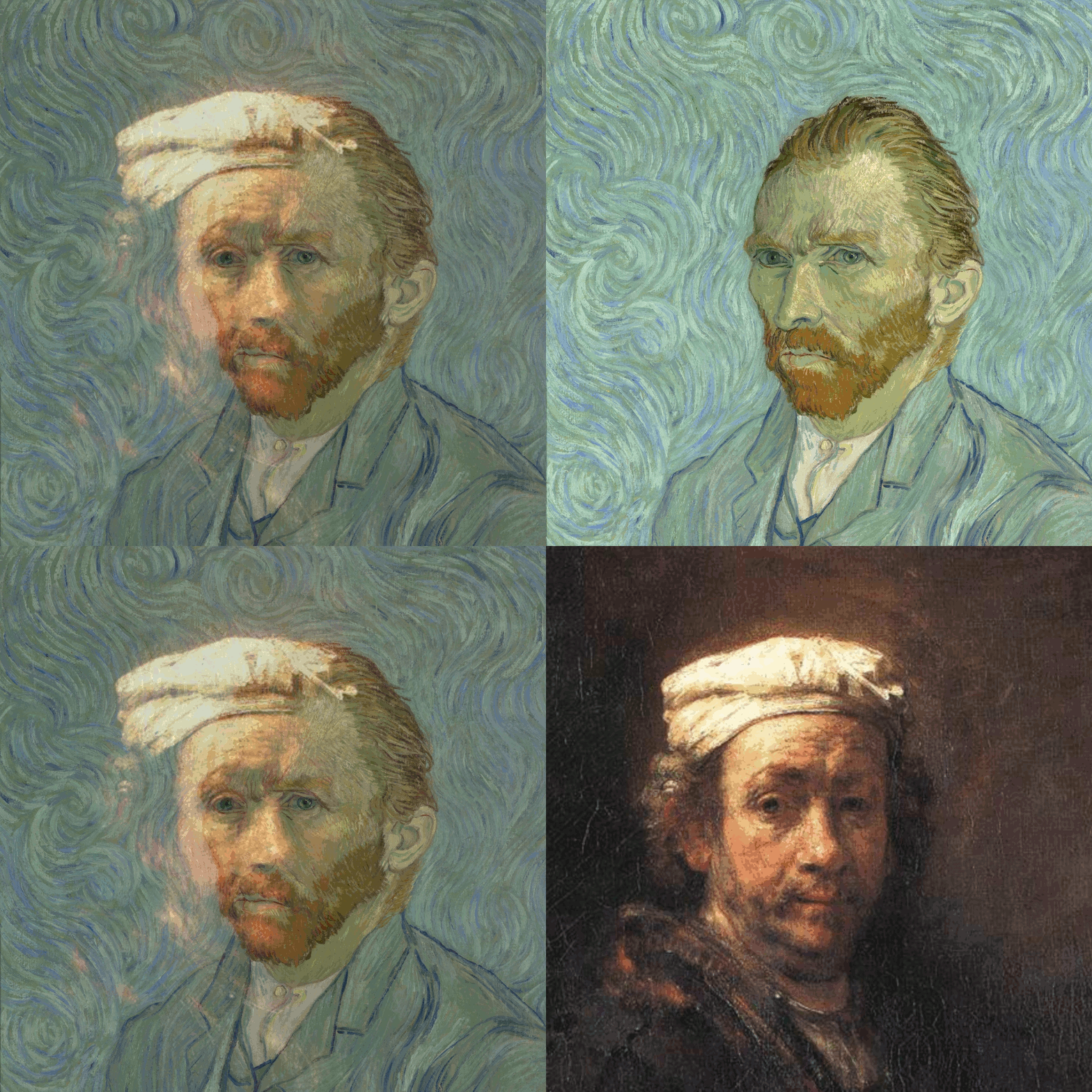
Vincent van Gogh made eye-contact with Rembrandt, a Dutch Master 200 years his senior. It changed him, just as it changes us…
Vincent van Gogh said, “Rembrandt is so deeply mysterious that he says things for which there are no words in any language,” and he learnt to, “exaggerate the essential, leave the obvious vague...”
When one thinks of the self-portrait as an art-form, in itself, there are two names that most readily spring to mind. Albrecht Dürer (1471-1528) may be credited with introducing it as a discipline, but chances are that the two painters most famous for their serial self-portraits are Rembrandt (Harmenszoon van Rijn, 1606-1669) and Vincent (van Gogh, 1853-1890).
Rembrandt and Vincent both developed daring styles that were out-of-pace with their times, and both managed to delve below the surface, allowing a glimpse of something deeper. Call it the ‘self’ or, perhaps, the ‘soul’? There’s something about their painted eyes. They seem to stare back at us, seeing our similarities and differences. By doing so, they make us consider ourselves more deeply, too.
Most Baroque paintings convey a fascination with how light reveals the details of a scene, lifting form out of its surrounding darkness. This tended to be approached academically, using accepted techniques already developed during the Renaissance. The results were often cerebral and solemn, with the look of a posed tableau, or something from a mythological setting.
Though his dramatic use of light and darkness definitely places his work in the Baroque style, Rembrandt wasn’t afraid to flout these rules and experiment. He developed his own methods which were, in contrast, often filled with compassion — very ‘human’ and sensitive. This is exemplified by his later self-portraits, particularly one showing the artist at his easel when he was in his mid-fifties.
Here, his use of loose brushwork, becoming more precise around the main features of the face, was a technical innovation that would influence many important artists to follow, though was misunderstood at the time. This was dismissed by many as unfinished, or showing the signs of senility.
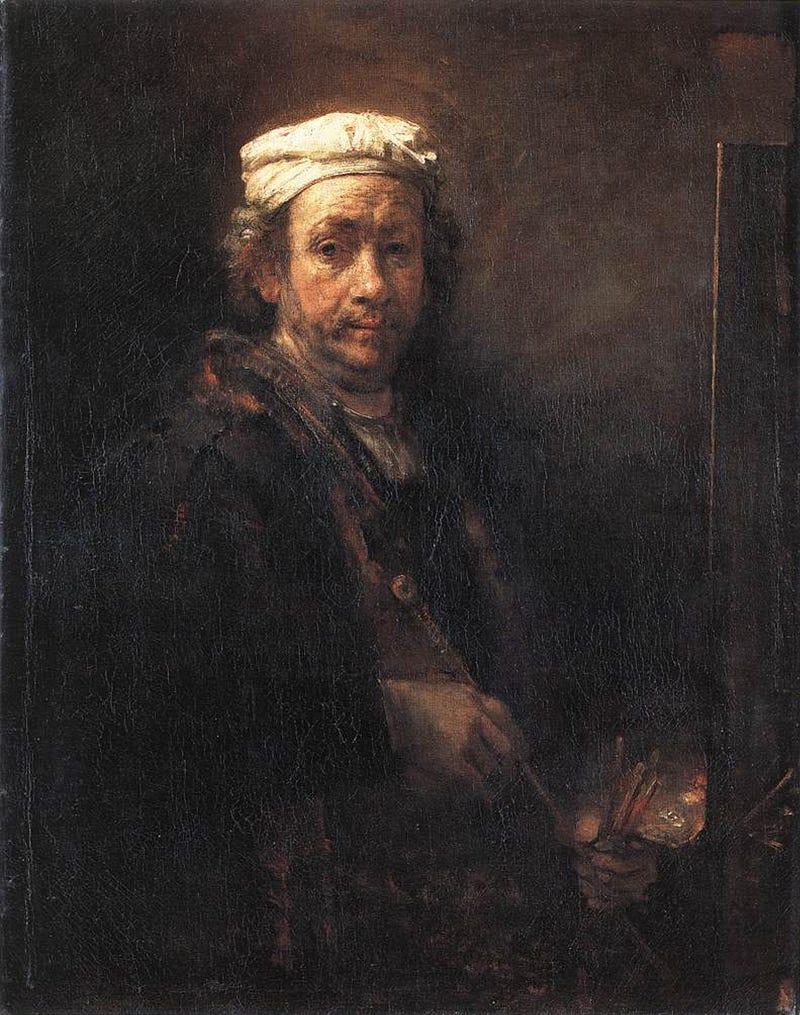

Rembrandt left rough brushwork and blocks of colour visible around the edges of the canvas. The hand holding the palette and quiver of brushes is little more than a cartoon. It could be a glove. The other hand is more finished, but still sketchy.
The details of his clothes are painted in a way that foreshadows the Impressionists, with simple brush strokes picking out highlights where stitching or folds catch the light. He’s exaggerating the essential, whilst leaving other aspects rather vague.
Only when we reach the face, does Rembrandt include fine detail with the eyes being the only areas that would have been considered ‘fully-finished’. This makes his eyes into the focal point of the composition and engages the gaze of the viewer, just as the face of a real person would. It brings the painting to life.
Rembrandt was fascinated by faces, “Life etches itself onto our faces as we grow older,” he said, “showing our violence, excesses or kindnesses.”
Now, we can more fully appreciate what Rembrandt was doing. He was grappling with the perennial problem of the portrait, and painted many in his career, including around 90 self-portraits. The primary problem of a portrait is: How can an artist show any truth about a person, when they are only dealing with an image of that person’s outer surface, painted on another surface?
As any person reading this will know, we are more than we appear to be. A portrait is expected to be a commemorative record of who a person was and what they were like. How can a simple representation of a face convey anywhere near enough information? Traditionally, artists have used symbolism, introducing details that give hints about the life of the subject. They may include particular plants or animals that in some way represent attributes the subject had, or wished to be seen as having.
In this self-portrait, Rembrandt not only shows us what he looks like, in a very characterful and humane way, he also tells us what he did by way of trade. He was a painter. Beyond this, he shows us how he painted. His unique technique is also very clearly displayed, his sketching, under-painting, colour-blocking and style of brushwork. This demonstrates the ability that he’d spent his life developing, and also his mood as he painted. The length and vigour of the brush stroke is an important part of the new visual vocabulary he introduces here in a more obvious and deliberate way than was hinted at by his contemporary, Diego Velázquez, in Las Meninas (1656).
It was another two centuries until others appreciated what had been achieved, when artists like Vincent van Gogh saw such works by Rembrandt and thought, Now, there’s an idea! and even then, it was still considered radical.
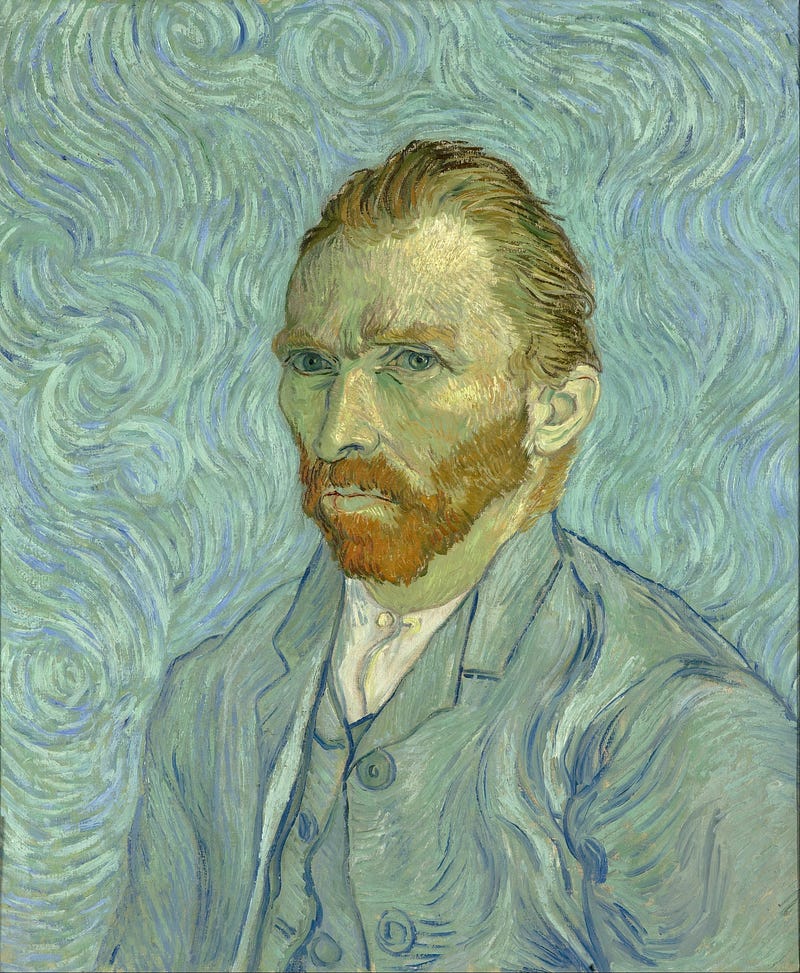

Vincent painted himself many times, partly because he could not afford to pay models to sit for him. Here, in one of his best known self-portraits, we can see Fauvist influences in what appears immediately to be a fine portrait. When we take note, though, we realise that the flesh tones are mainly non-naturalistic greens and yellows, which make his red hair even more fiery!
He sets himself apart from the Fauvists, such as Matisse or Gauguin, by not relying on flattened colour. Instead, he fills the canvas with his distinctive energetic swirls and short strokes. The brushwork is flowing and lively around the outer areas, almost suggesting smoke — perhaps another way to exaggerate his fiery nature. The details nearest the edge of the canvas are left sketchy, just a few lines suggesting a button. The brushwork is more contained toward the centre, and only when we reach the face do we begin to see merged marks and blended colours. The detail is most controlled around the highly expressive eyes which fix and return the viewer’s gaze, his left eye almost photo-real.
This technique is a deliberate visual reference to self-portraits by Rembrandt. Vincent not only shows us what he looks like, in a very characterful and humane way, he also tells us what he did with his life. He was a painter. Beyond this, he shows us how he painted. His unique technique is also very clearly displayed, his sketching style, his experimental use of colour, and his distinctive brushwork demonstrating an expressive approach to gestural mark-making. This shows a refreshing approach to art that he’d spent his life developing, and also suggests his mood as he painted.
Vincent embraced the brush stoke as an important part of his visual vocabulary like no other! He would use both ends of the brush, daubing quick, fluid swirls and then turn the brush around, using the tip of its handle to hack back, drag and work into the paint. This is another technique he picked-up from Rembrandt, who sometimes painted hair using the same approach.
Vincent pushed the idea of painting as self-expression. One of the reasons that his paintings can be so readily authenticated is because he often dispensed with the brush entirely, using his fingers to push the paint around, leaving his fingerprints as ‘forensic evidence’! Literally making his mark.
Of course, Vincent made all these techniques his own, taking them in new and exciting directions. He went on to influence a whole generation of Modern painters that are too many to list here! He’s often labelled as a Neo-Impressionist, but his legacy is clearly apparent throughout Expressionism in general, and Abstract Expressionism in particular — a genre of painting that relies almost entirely on the visual language of mark-making.
Adapted from articles first published in my book, Evolution of Western Art (questing beast books, 2012)