Looking at ‘Las Meninas’ Looking at Us
Diego Velázquez is often given credit for being the painter who elevated the status of the artist above the ‘mere’ artisan — this artificial distinction has caused controversy and debate ever since…
Las Meninas aka La Familia, painted by Velázquez in 1656, is one of the ‘great paintings’ and is respected as such by many later artists such as Pablo Picasso and Salvador Dali, who both paid homage to this work by painting their own versions. Picasso went on to produce more than 50 reinterpretations! The work itself continues to be the subject of much ongoing speculation and analysis by scholars.
It stands as one of the earliest works of art to question the nature and purpose of art itself. It’s literally self-referential as the painter who paints the picture is in the picture whilst in the act of painting the picture… If not the first, this is an early example of ‘art-about-art’, a thematic approach that becomes a defining feature for much of Modernism, four centuries later.
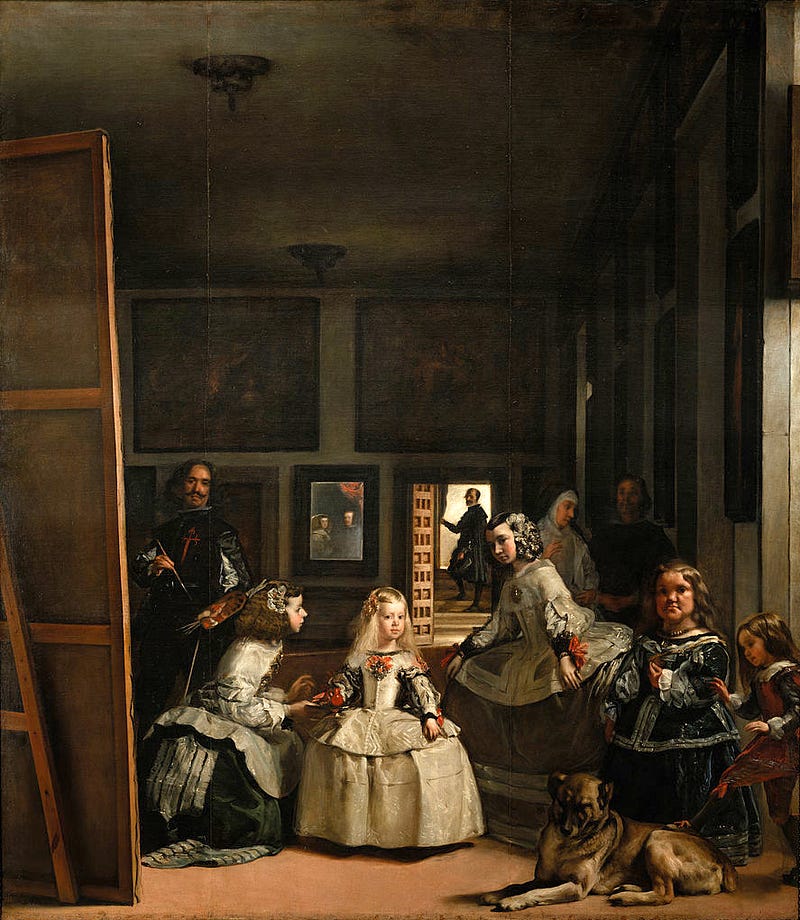

There can be no doubt that this painting is something more than the group portrait it initially seems to be. Here, Velázquez, who was the official painter to the court of King Philip IV of Spain, presents us with a portrait of the royal infant Margarita Theresa. She is indicated clearly as the main subject by the lighting and her (slightly-left-of-)central placement, though the title refers to the Maids of Honour who are also shown getting her ready to pose, probably, for her portrait.
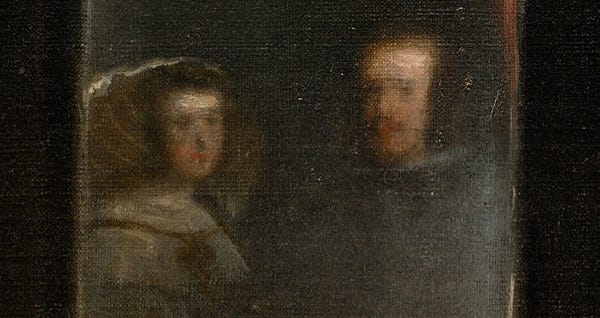
Margarita’s parents, the King and Queen, also appear in the scene. They’re reflected in a large mirror hung on the wall at the back of the hall. This clever portrait-within-a-portrait uses the brighter light that would exist off canvas, in the place occupied by the viewer, and clearly presents a reflection lit by the large window, just outside of frame. That same unseen window also lends a sheen to the hair of the maids and gives Margarita her almost angelic golden glow.
The viewer is put in the place of the royal couple and sees what they would see. Velázquez also placed himself in the picture, taking a step back from the huge canvas he is working on to acknowledge the arrival of his patrons. Interpretations vary about this aspect, some commentators believe he is painting the King and Queen and the man in the doorway at the back, identified as Don José Nieto Velázquez, the queen’s chamberlain, has just interrupted the session with some news. The artist is shown to be working on a very large canvas, which supports this reading and implies the work in progress may be a family portrait, pending the addition of Margarita Theresa.
Obviously there is a narrative here, though it remains unclear. What is clear, though, is that the surface of the canvas exists between two spatial realities: the viewer experiences the space in front of the canvas by actually occupying it and also seeing, via the mirror, the virtual reality of what occupied that space when the painting was made. Thus the past and present meet at the surface of the canvas.
Mirrors are also surfaces, though create the illusion of depth through reflection, so here the space off-canvas to the front creates an impression of depth that, visually, recedes behind the canvas. This depth beyond the canvas is also shown through the open doorway in which the queen’s chamberlain stands. This is a very conscious exploration of, and challenge to, the ‘tyranny’ of the picture plane.
We have to acknowledge here that Jan van Eyck first explored this idea in his famous Portrait of Giovanni Arnolfini and his Wife (1434) and Velázquez himself had been toying with extending depth through, windows, doors mirrors, and reflections for decades before its meaningful inclusion in his masterpiece.
A strong rhythm of rectangles made up by the paintings, doorway, mirror and walls, counterpoints the rather informal group of figures and also draws our attention to the largest rectangle of the composition, the borders of the whole painting itself, and our own informal relation to the entire composition. The viewer becomes involved in the picture, if only by implication, and is part of that overall composition.
With Las Meninas, Velázquez has shown the power of art and also its subjectivity. Technically, it’s a very accomplished painting, though when scrutinised, there’s a notable amount of free brushwork which was not characteristic of the style at the time. Visible brushwork was thought to be sloppy and to indicate either an unfinished work or a poorly trained artist.
This is a painting about painting and reveals some of the techniques he has used. The brush mark itself is presented as a new addition to the visual vocabulary of the artist. It makes it clear that a painting is not a frozen moment in time, but is the result of a compilation of moments, brush stroke by brush stroke.
It implies that the artist is a conduit and translator of ‘reality’, which will always remain subjective and unavoidably affected by the individual vision of each artist — and by placing himself in a group portrait alongside the royal family, he is also elevating the status of the artist. The way we now remember many such people is often through how the artists of their time chose to represent them.
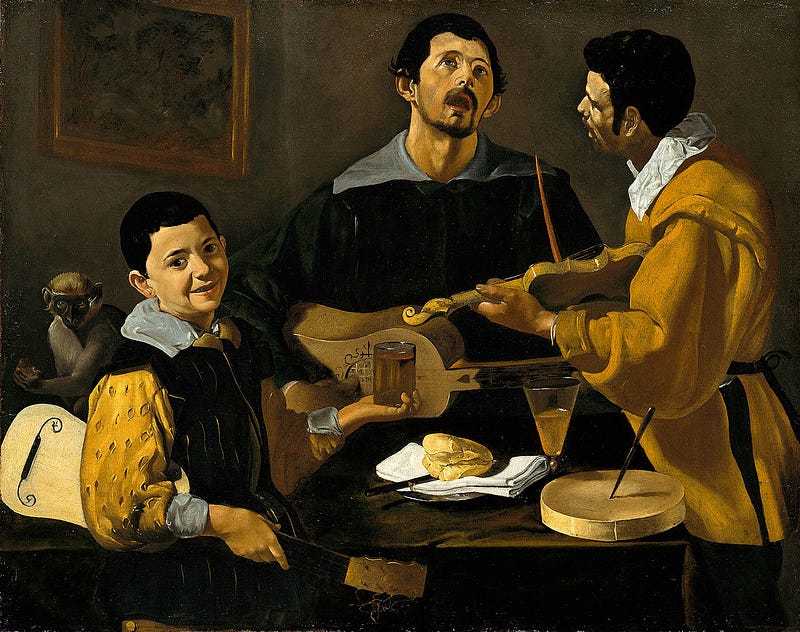
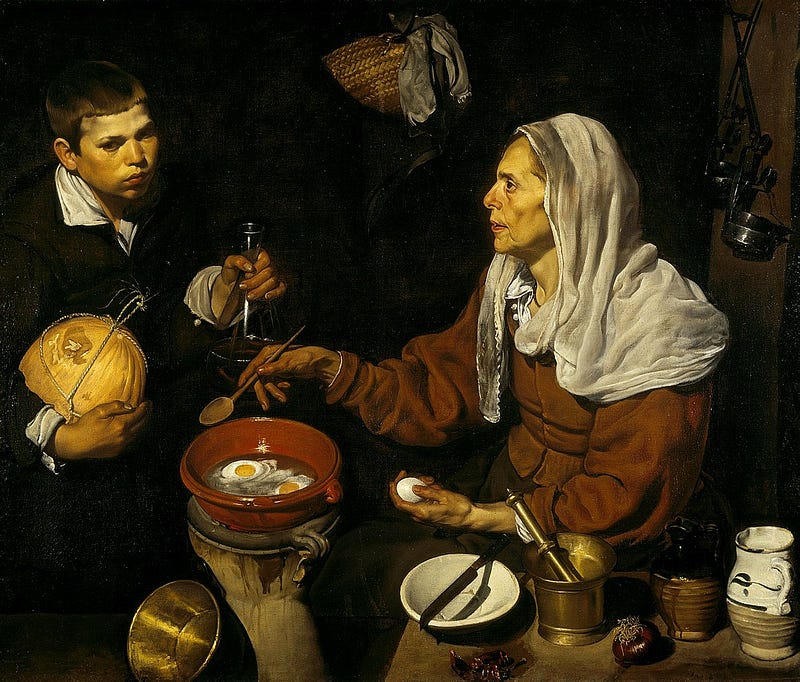
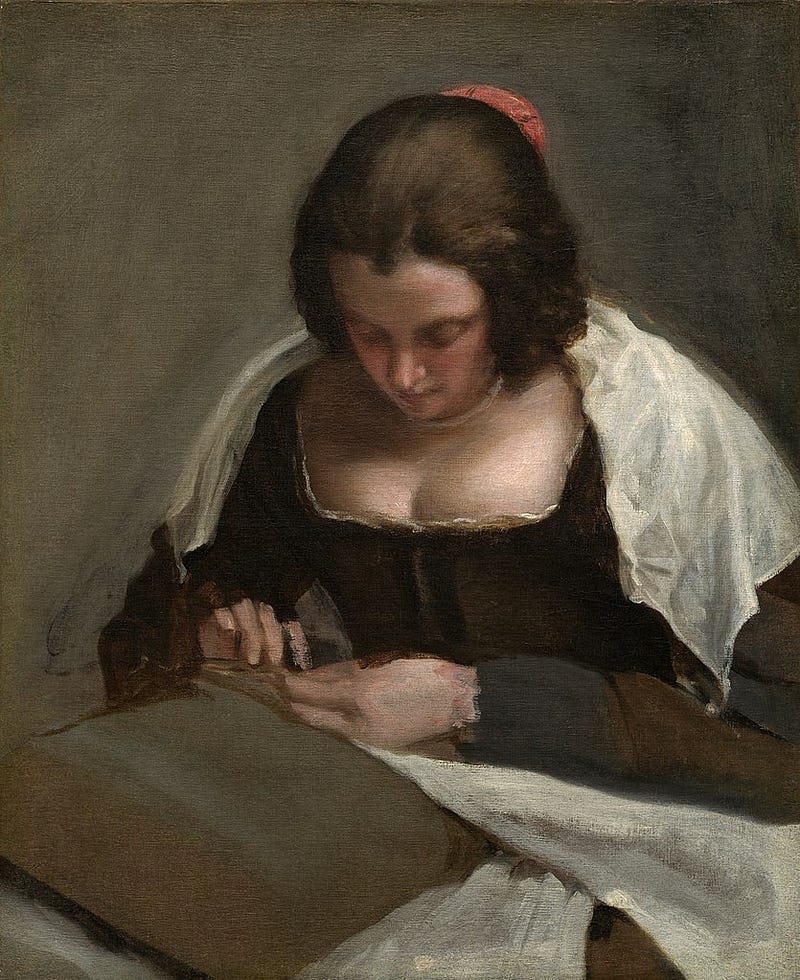
In many other works, Velázquez also chose to portray normal people in everyday situations, such as tavern musicians playing for their own amusement, an old woman cooking eggs, a seamstress at work….

.jpg)

Such subject matter was exceptional for the period as pictures of non-noble persons and pursuits were not attractive to rich patrons. He could only afford to spend time and pigment creating those images because he was appointed as an official painter of the royal court and paid a retainer beyond the hopes of his contemporaries. He was granted freedom to experiment and study a variety of subjects without worrying about selling the finished pieces.
His paintings of normal people in domestic situations, along with the inclusion of the maids and court entertainers in such an important painting as Las Meninas, shows a rare social awareness and the dawning of a belief that art could have social, documentary and ethical functions — a way of thinking born of renaissance-style Humanism. This tendency, in addition to his notable technical innovations, was to influence his contemporaries Rembrandt Van Rijn and Johannes Vermeer as well as many great painters to follow, particularly the early Impressionists.
It’s also noteworthy that he chose to place the viewer in the same virtual space as the King and Queen, by implication acknowledging that the viewer is an essential component and as important as anyone — and will be there long after the ‘important’ subjects have gone.
Are they looking at you looking at them?