
Mad as Munch!
Norwegian artist, Edvard Munch, painter of ‘The Scream’, was a self-proclaimed madman but, maybe, he was actually saner than most…
Edvard Munch is one of the earliest, and most influential, of the pioneering Expressionist painters. He’s widely known for his recurring themes of alienation, anxiety, grief, and despair. Munch had a traumatic childhood during which many of his friends and family died and this deeply affected his outlook. Although his paintings are often sombre and disturbing, the overall message proclaimed by his oeuvre is ultimately a positive one.
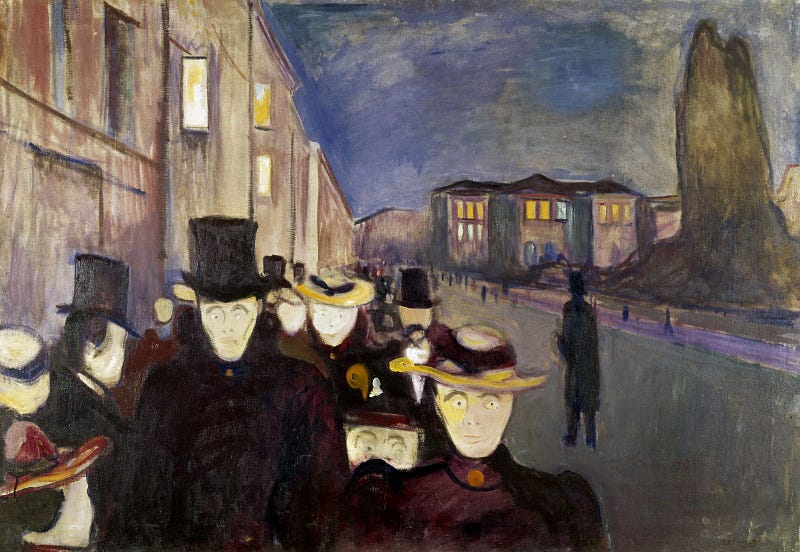

In his 1892 painting of an Evening on Karl Johan Street, the wealthy and fashionable people crowd along the street toward the viewer like a relentless column of zombies from a cheap horror film. The strong diagonals of the vanishing-point perspective emphasise the weight of numbers that threaten to overwhelm us. These are the privileged people, out to show off their fine clothes and best hats, on the way to or from a trendy theatre venue, to partake of ‘polite’ society. This is their idea of ‘fun’, yet their tense, mask-like faces are staring and ghostly. Pale, bland, almost death-masks. The pleasures they seek seem to have eluded them.
Apart from one or two, these people are all approaching the viewer, which implies that the lone walker in the street — separated from the throng and moving in the opposite direction — is significant. Some interpret this as representing the artist himself, who was known to disdain crowds and often found an abundance of strangers overwhelming.
Whoever the anonymous individual is, they have chosen to do something opposed to the mass accord. They elect to follow their own path in life and not be swept away with the societal expectations of the majority. Life should be enjoyed and savoured and if you walk about like a ‘zombie’ doing the things that are expected rather than what you enjoy, then you are not fully alive! The only hint of optimism in this picture comes from the warm light of interiors where people may be enjoying themselves, perhaps spending time with their families and friends or at their chosen pastimes.
The canvas is structured so that the people are crammed down to the left and the composition is dominated by the huge ‘monolithic’ shape that looms over all in the upper right. This dark amorphous mass is reminiscent of the poplars in several paintings by Vincent van Gogh, where such trees represent ways of escape, their upthrust taking the eye from the land to the sky, from the physical into the spiritual, from the earth to the heavens. It also implies a relationship between the transience of the flesh, the longer lifespan of trees, and the eternity of the cosmos that looms above with its profound lack of interest in our mundane human affairs…
The death-mask face is a motif that Munch recycled throughout his career, most famously in his iconic painting, The Scream, which has become one of the most reproduced and recognisable images. When I was at college and would visited the digs of fellow art students, it was a toss-up as to which poster would be hanging in their rooms — it always seemed to be either The Scream or Gustav Klimt’s The Kiss. It was fun trying to guess from the personalty of the person which it would turn out be.
The ubiquity of The Scream continues to this day. A tiny rendering of the image has been digitally distributed in the form of an emoji 😱 It’s also become a social media meme, with users adding their own humorous captions. A recent discovery has found this to be rather fitting as Munch himself had started the trend when he wrote his own caption on his original work:
“Kan kun være malet af en gal Mand!” Can only have been painted by a madman!
On close inspection, the phrase has always been visible, written in pencil in the top left portion of the painting, almost lost in the swirls of colour. It’s long been dismissed as ‘vandalism’ added sometime in the work’s history. Under scientific scrutiny, experts at the National Museum of Norway have conclusively matched the writing with notes and journals in the hand of the artist. It can therefore be considered an integral element of the work.
It’s a confession and a proclamation. Munch felt that his madness had enabled him to uniquely express… well, whatever the image expresses. To him, madness was not necessarily a hindrance. It might even be a badge of honour, something that sets the artist aside from those zombified masses on Johan Street, sleepwalking through their living deaths… Being ‘mad’, by definition, means standing aside from what is considered ‘normal’.
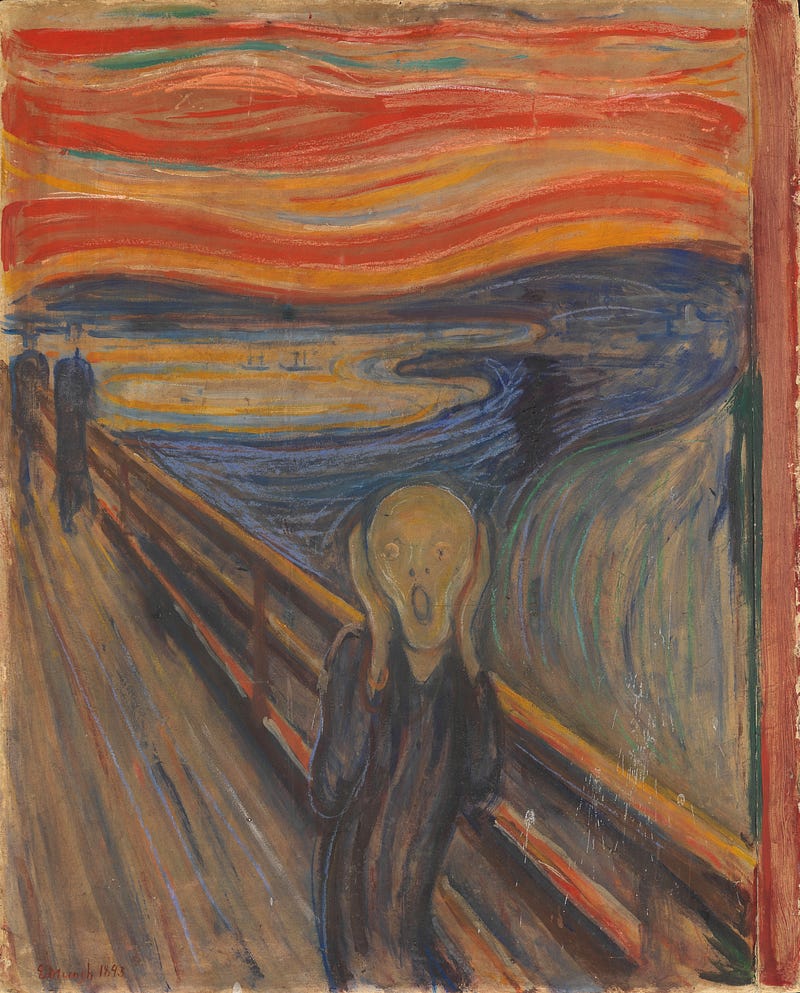

If you want a definition of Expressionism, all you need to do is look at this painting. Created with an unusual mix of oil and crayon, this strong design has become a pervasive signifier of paranoia and despair. The figure in the foreground is screaming and at the same time covering their ears in a futile attempt to block the sound out. The face is again mask-like, the skin stretched so tightly that it becomes skeletal, the staring eyes wild and wide. This person is on the brink of madness.
The structure of the painting is very bold and energetic with a diagonal down-thrust so strong that it threatens to propel the eye of the viewer off the canvas if not stopped by the strident vertical of the bridge strut acting as a barrier. This pillar of brown is also a distraction for us, drawing our gaze away from the anguish of the subject. Involuntarily, we look away from the madness, only to be repeatedly drawn back to it. The dynamic, forced perspective of the boardwalk pulls our eye away again, to the two approaching figures. They are dark and weirdly attenuated, ominous yet seemingly oblivious to the implied scream.
Again, there appears to be an influence from Vincent van Gogh, a fellow self-proclaimed ‘madman’ who’d painted his last picture just a couple of years earlier. The bright, lively swathes of warm colour across the top seem at odds with the cold and dull lower portions. It’s a visual narrative of descent into darkness. The coastline behind is suggested by the darkest tones of all that seem to be about to engulf the screamer entirely.
There are many different ways to read this painting. Some scholars suggest it is biographical, quoting the artist’s (possibly poetic) account of walking across a bridge with some friends when he was inexplicably assaulted by intense anxiety. He described the notion of a terrible outcry that seemed to pervade everything at once. His companions walked on, blissfully unaware of the terrifying scream which he felt was coming from deep in his soul, whilst at the same time emanating from every living thing throughout all of nature. Perhaps it felt like a great disturbance in the Force, as if millions of voices suddenly cried out in terror and were suddenly silenced?
The choice of mixed media is deliberate and interesting. Crayons used in this way were not in the accepted repertoire of the ‘serious’ artist. The brighter colours are highlighted with strokes of opaque pastels and chalk-like textures, unhesitatingly applied. They have the immediacy of a child’s drawing and evoke those brighter times of childhood, before the loss of innocence.
On the most famous version of the painting, there is a spattering of wax from when Munch forcefully blew out a candle. This can be seen in the bottom right quarter of the image above. Does this indicate a surrender to the darkness? Or was the candle no longer required because the dawn had brightened the room sufficiently?
The bold reds and oranges also force the viewer to make a choice that will be influenced by their own mood and philosophy of life. It divides optimist from pessimist by suggesting either a sunset or sunrise. If the day be ending and the sun is sinking, then the screaming figure is about to descend further into darkness, literally and metaphorically. Things are going to worsen. If this is sunrise, then things are bound to get brighter. A new day brings new beginnings and perhaps a glimmer of hope for the future…
This notion is, of course complicated when the geographical context is considered. Day length in Norway, varies greatly and, in winter months, the sun may never fully rise above the horizon to bring only hours of dusk that colour the sky with sunset all day short. This is known to have an effect on well-being, we even have a name for it now — S.A.D (Seasonal Affective Disorder).
Edvard Munch was known to have mental-health issues and contemplated suicide in his youth. Beset with paranoia and obtrusive compulsions, he would seek professional help when he felt things were too much to cope with. As Vincent van Gogh had done, Munch voluntarily signed himself into the care of an asylum but despite his recurring bouts of depression, he learnt to value and cherish life with a rare tenacity, constantly creating and living until his 80s.
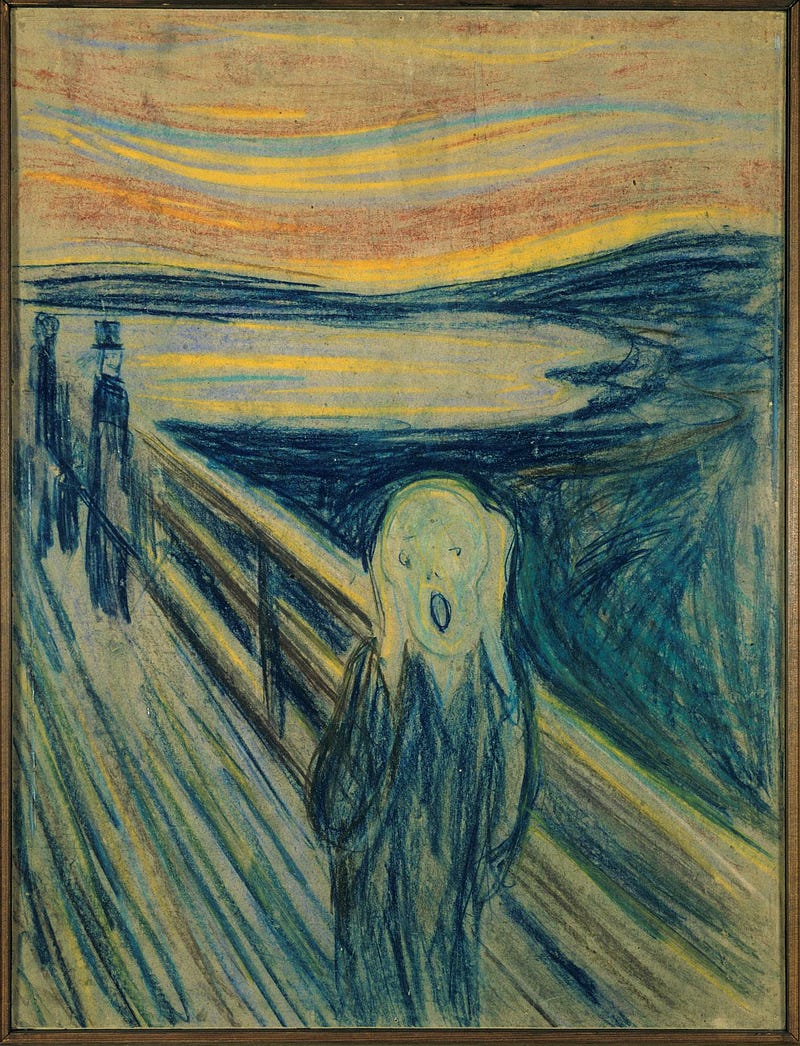
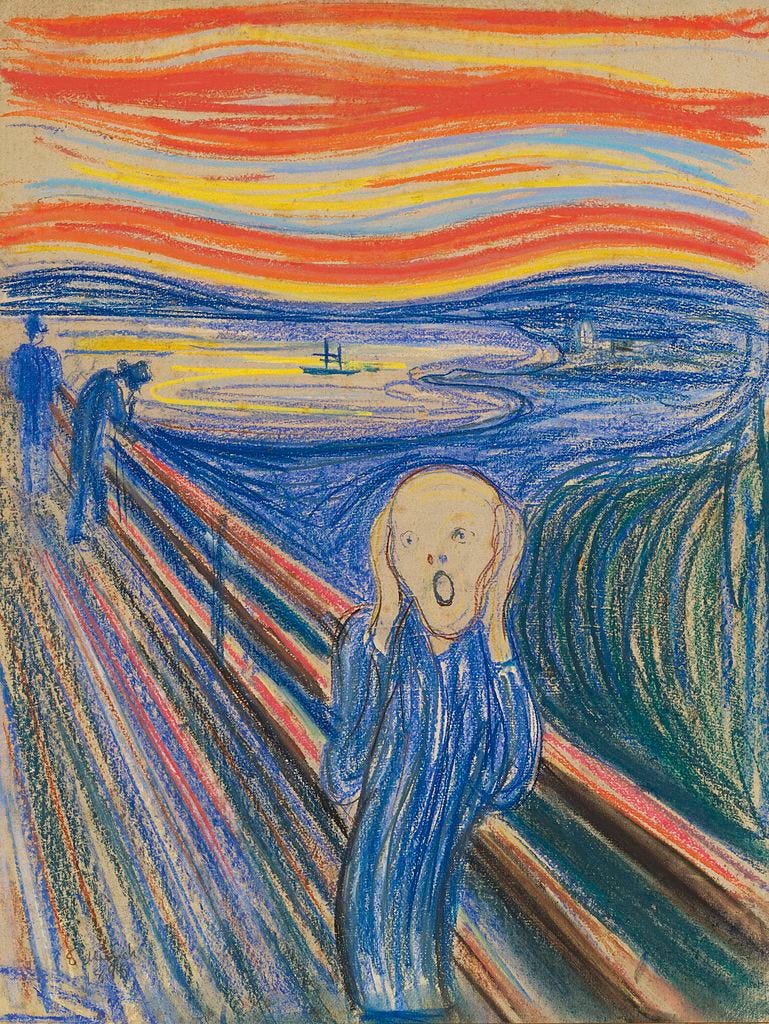
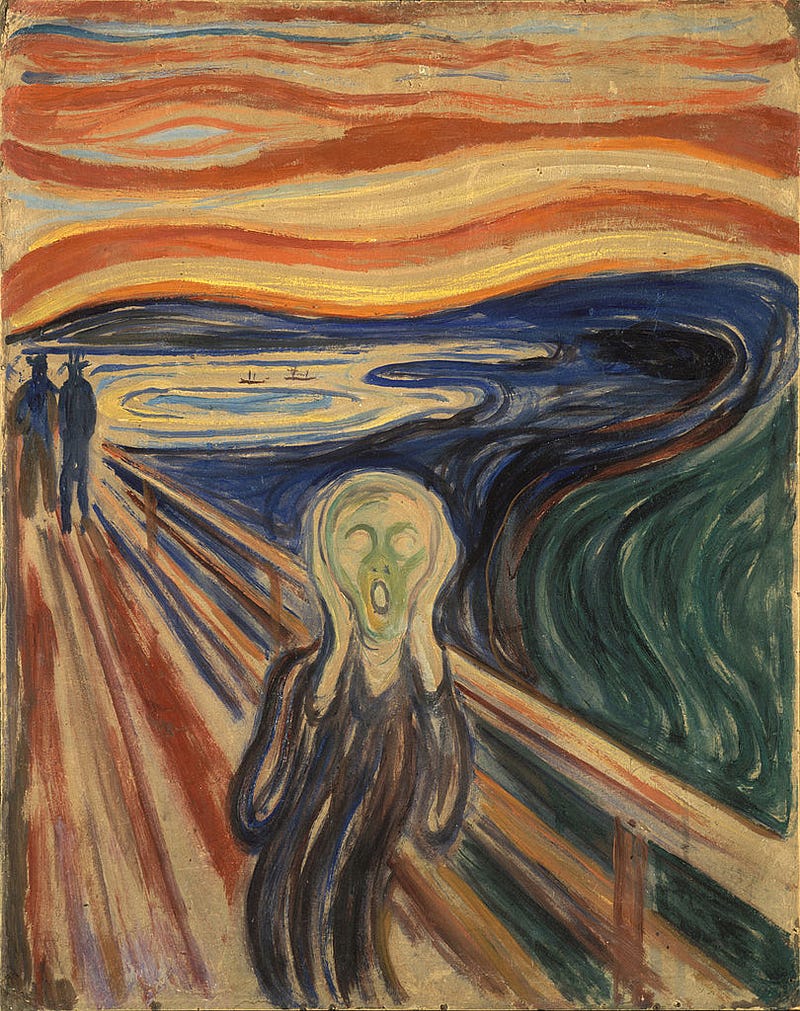


Munch returned to this design several times and painted a few variations. The most famous version was stolen in an armed robbery in 2004 along with another Munch painting, Madonna (1894). The story was told across the international news, increasing the enigmatic fame of the works. Both paintings were recovered by police, two years later in August 2006…
The motif of the pained individual, set apart from others, and vainly attempting to block out their internal scream of anguish recurs throughout several other works.
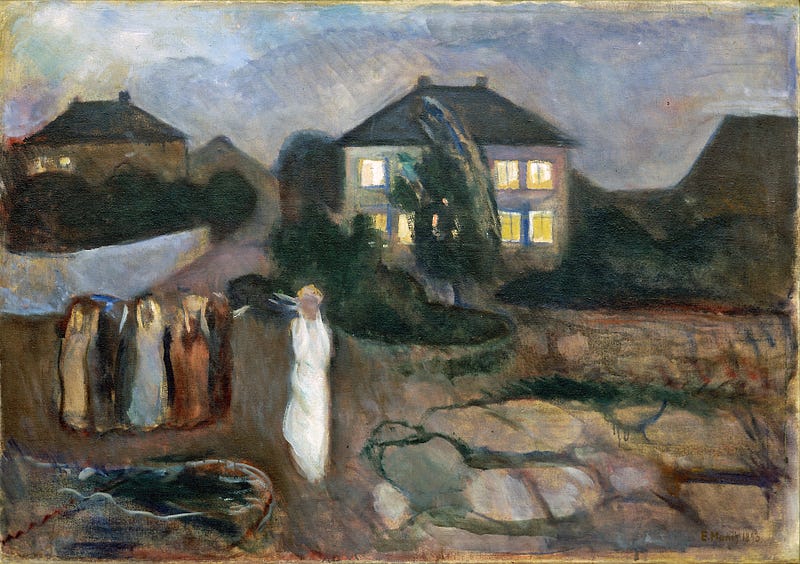
In his 1893 painting of a storm, he employs the ‘pathetic fallacy’ and gives voice to the torment of nature. The dramatic landscape, the trees whipped by the gale externalises and renders visible the internal turmoil of the human condition. The woman in white tries to block out the howl, as do a group of half-a-dozen onlookers. This time it’s a shared experience, perhaps a metaphor for some kind of emotional empathy with others, for all things?
.jpg)
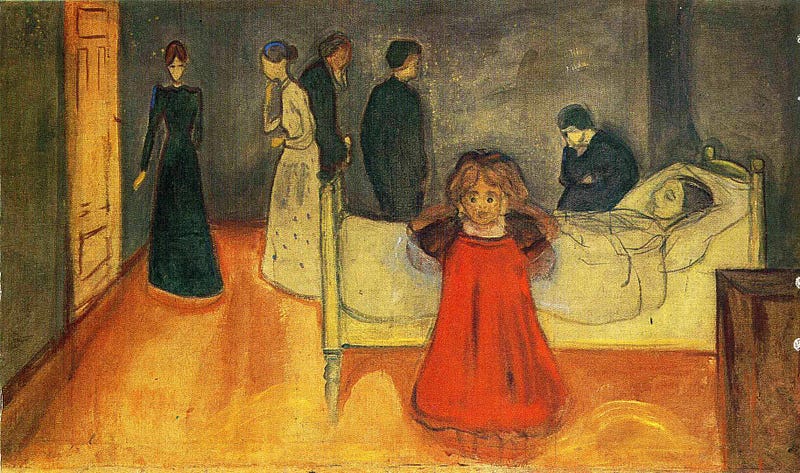
In his highly emotive series of paintings, The Dead Mother and the Child, the child fixes the viewer with a direct stare and the hands covering ears is seen again. The vivid colour of the living child contrasts with the ghostly paleness of the mother behind.
Symbolically, the child has been positioned to emphasise the connection between birth and death — the cycle of life. Yet at the same time, her figure seems to be translucent as if she too is a ghost, already fading… The lines of the bed pass through her form, perhaps implying a ‘loss of self’, that she feels insubstantial, still connected to her mother and not yet fully rendered as her own person in life.
Again, this is a subject that Munch returns to several times, and the translucence of the child is a constant in all the versions. Sometimes the child is alone in the room with the fading mother. Occasionally, there are other, faceless attendants in the background. Always, though, the child is set apart. They cover their ears and stare out of the canvas, appealing directly to the viewer… but we can do nothing to assuage the overwhelming panic of grief. Although Munch is famous for his bold Expressionism, this painting shows the heart-rending sensitivity that he was capable of and the brushwork is delicate and considered.

In the days before widespread vaccination effectively reduced childhood mortality, and medicine further extended adult health-span, death was ever present in life. Munch lost many loved ones during his own childhood and teen years. His mother died of tuberculosis when he was five years old and, when he was 14, one of his sisters also succumbed to the disease. This was not unusual and many of those he grew up with were no longer alive when he reached adulthood.
He felt these losses profoundly and mourned all their lost opportunities to find their dreams and spend their lives striving to fulfill them. Seeing so many others live on to be stifled by what society expects and going through life like zombies, enraged him. As an artist, he found the strength to shun such non-life.
So, Munch’s macabre images are far from depressing, being instead a life-affirming wake-up call. His paintings grab us and shake us by the lapels. “Live!” he screams to us across the years. If your passion lies elsewhere, don’t waste your precious time doing only what is expected of you.
Find your joy! Embrace your madness! Live. Your. Life.