
Out of Darkness, into Light
Looking at Paul Cézanne’s early paintings in the hope of glimpsing the first glimmers of his hugely influential later style.
French painter Paul Cézanne has often been called “the father of modern painting”. It’s his mid-career landscapes of Aix-en-Provence, and late-career still life paintings, that are most noteworthy and have the clearest influence in terms of broader art history. Though, we can gain insight into the development of his ideas by looking at some of his earlier, lesser known works. Before moving toward landscape and still life, he produced illustrative pictures often with heavy figures painted with an almost sculptural approach to the laying-on of paint.
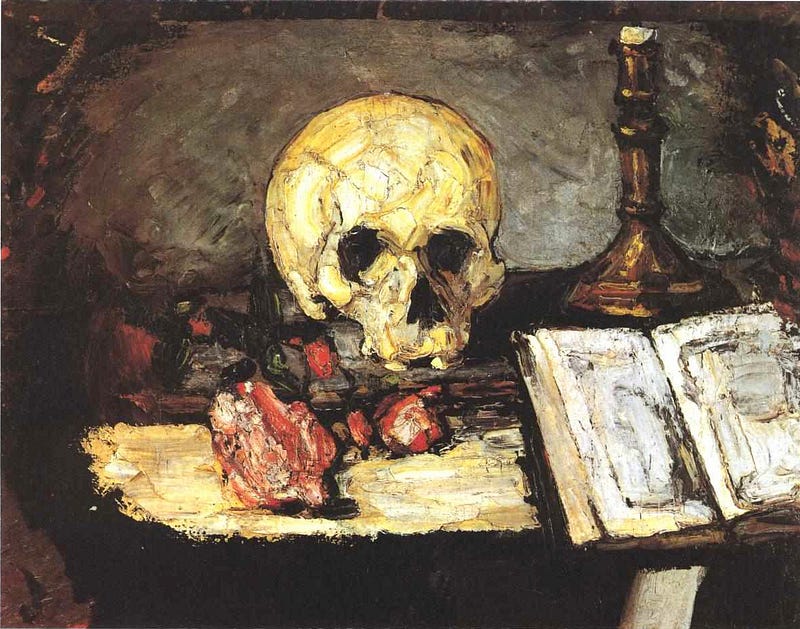
Skull and Candlestick (1866) has a dark, Gothic-Romantic feel created by a very sombre palette and ‘heavy’ strokes of paint applied with a palette knife… and, of course, the choice of subject!
The decaying flesh of the fruit and drying flowers, in juxtaposition to the book, evoke the dark, decadent poems of Charles Baudelaire and Gerard Nerval. Once in this frame of mind, the viewer notices the candle stub atop the holder that almost reaches the top of the canvas. It is the last inch of an unlighted candle, and when it is ever re-lit, it would have but a short time before it finally burns out… and as we look at this painting, we seem to be looking over the shoulder of the reader (is that a deathly pale wrist supporting the book?) as if we have been cast in the role of the grim reaper, patiently awaiting the moment…
The painting was almost certainly an exercise, and he chose to paint skulls many times. Skulls have long been a popular subject with painters, mainly because they offer good practice in depicting curved forms using chiaroscuro. Also, it’s important for an artist to understand the structure beneath the form if they intend to accurately represent living creatures.
Inevitably, the contemplation of skulls will lead to thoughts about mortality. After all, we all have one, but seeing one outside of its flesh implies a life lived and ended. This seems to be the narrative Cézanne has introduced into his painting.
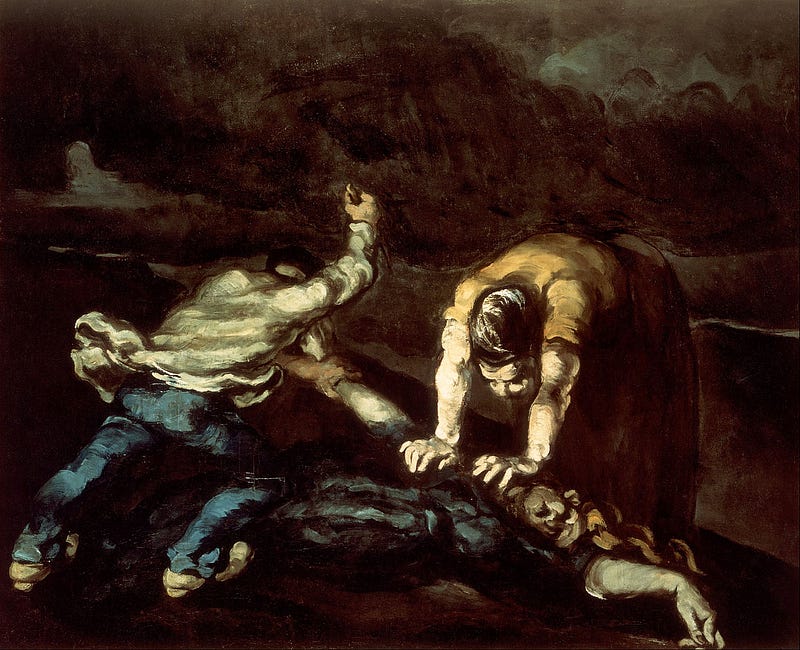
Another early Cézanne painting, The Murder (1870), is an even darker painting in both tone and subject matter. An influence from Eugène Delacroix can be seen in the structural use of the colours and the bold, almost sculptural application of paint. Unlike the work of Delacroix, the figures here are awkward and cartoonish. They are clumsy in their proportioning to the point of becoming grotesque, aligning this illustrative approach with Expressionism. The design of the image also quotes from many Romantic paintings, most obviously the works of Henry Fuseli and Francesco Goya.
Cézanne admitted that he had great difficulty with figures, which is demonstrated here. He later played to his strengths and approached his still life and landscape work with a more formal approach and figures are conspicuously absent from most of his more important work.
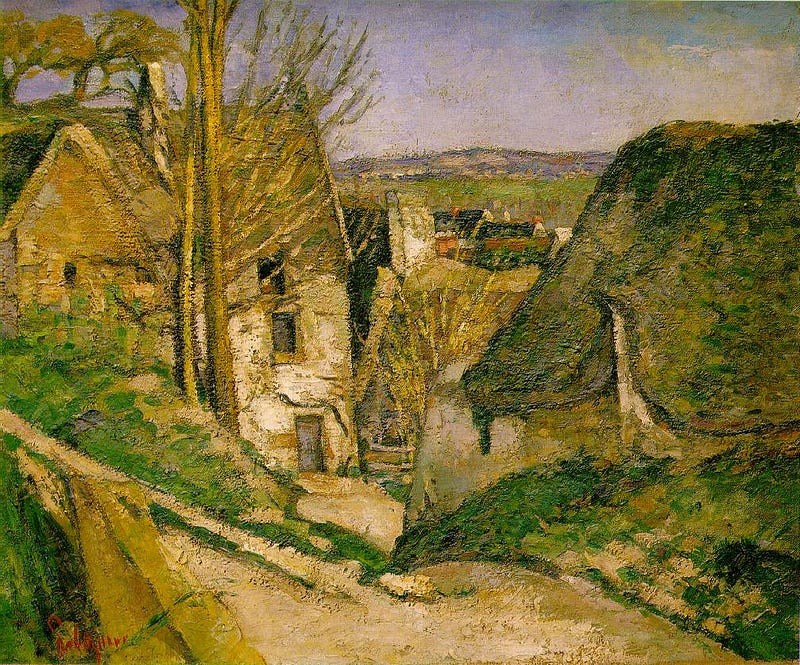
Thematically, The House of the Hanged Man (1874) follows on from The Murder, though with a strikingly different approach. The palette is bright, almost luminous, and the brushwork is much more delicate. If it wasn’t for the title’s implied narrative, there would be no morbidity here at all.
The composition of this rural landscape creates a convincing depth whilst avoiding the use of traditional vanishing point perspective. Instead, it’s the rhythm of forms and colours that give the sense of distance, with bold large shapes at the fore that almost surround the diminishing shapes that are painted with softer technique in cool blues and mauves towards the centre.
He was part-taught by the Impressionist painter Camille Pissarro, and on occasion worked alongside him on landscape painting trips. It seems that this friendship led Cézanne to dispense with the clumsy figurative work and focus on landscape. In The House of the Hanged Man, some commentators see many similarities to the work of Pissarro, though it is also an obvious step away from his influence.
This is the first really significant work from Cézanne and in it we can see the beginning of the Neo-Impressionist techniques of Pointillism, and Divisionism which were developed further by his colleague, Georges-Pierre Seurat…
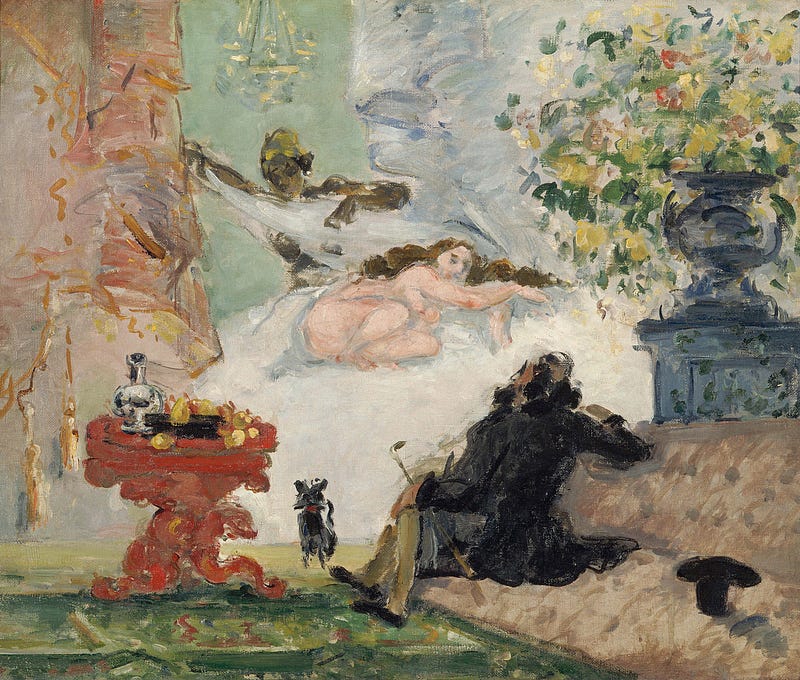
In Paul Cézanne’s A Modern Olympia (1874), painted brightly with very loose brushwork but strong structural form and colour, it seems that a man is watching a special theatre show that is performed for him alone. It’s obviously a titillating sequence when this modern Olympia is unveiled, but we are the voyeurs, also seeing what he sees.
His little dog has noticed us looking on — this response from a character within the work breaks down the boundary of the canvas, and though the scene is by no means photo-real and there is no true perspective, we are nonetheless drawn into the scene as if the picture itself was a stage.
Possibly a Romantic reference from Classical Greece given a modern twist but, at the time, an ‘Olympia’ was polite slang for a prostitute. The inside of a brothel was a very unusual and brave choice of subject for the time — which would later inspire fellow French artist Henri de Toulouse Lautrec — and aligns Cézanne with the Decadents…
The most striking thing about the painting, though, is the rhythm of shapes and a balance created by colour and form that holds this unconventional and loosely-painted composition together. The rusty-red wedge of the curtains echoes the same colour and shape in the sofa. The green on the foreground floor balances against the green at the top of the canvas. The ‘shrubbery’ and its urn is an almost exact copy of the shape of the table to the bottom left, only flipped the other way up. If you look carefully at the shading in the urn, the shape of the man’s top hat is quoted.
So, Cézanne has struggled with this loose composition that should not really hold together due to its lack of perspective and the absence of traditional structure. He’s used strong rhythms of form and colour to give the image an integrity of its own.
This shows the first clear evidence of his innovative and distinct approach to formal composition. He was beginning to develop his own theories of form that would have a huge influence on other painters and art movements, eventually earning him the reputation as “the father of modern painting”.
The later breakthrough paintings of Paul Cézanne are also discussed by Remy Dean in The Signifier
A version of this article was first published in my book Evolution of Western Art (questing beast books, 2012)


