
The Fine Line Between Decoration and Decadence
Aubrey Beardsley innovated illustration with an approach that was to influence great painters, graphic designers and comic artists
Aubrey Beardsley was a fine draughtsman, an innovative artist and his most famous works are prints devised for book illustration. Although his career was short, due to his early death of tuberculosis at the age of 25, and marred by controversy, his distinctive style and simplicity of line was a huge influence that can be seen in many illustrators and artists since, including comic artists and graphic designers.
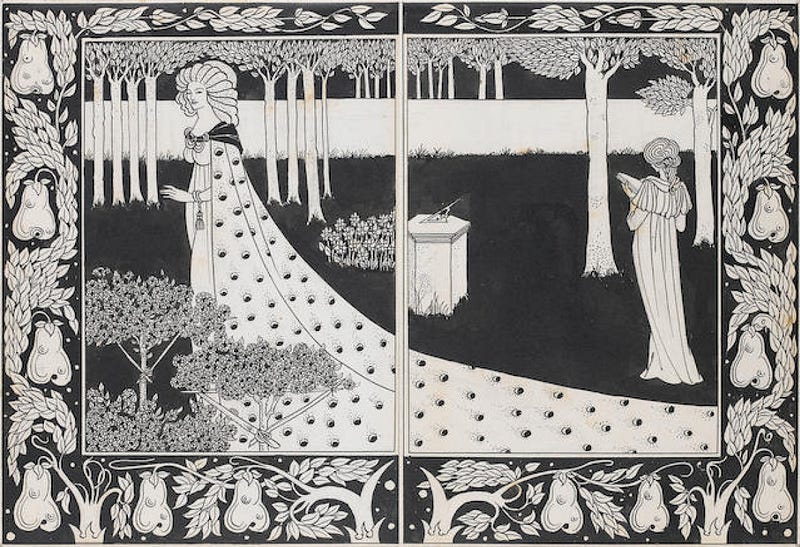
He was an editor of the art-literary journal The Yellow Book and quickly became a prominent figure of the Decadent movement, a pioneer of Art Nouveau and a major proponent of Aestheticism. He intentionally confronted the moral double-standards of Victorian culture and used ‘obscenity’ to question and provoke, particularly in his priapic pastiches.
The art and literature of the Decadents was born of the Romantic belief that passion was closer to the essence of the human experience than rational thought. They generally saw the modern progress around them as a victory of machine over man, of social control systems over individual freedom. The Decadent movement is complex as there was no published manifesto, but by definition must have grown out of the individual responses of those aligned with its core ideologies.
One of the first blatant and self-declared Decadents was the French poet Charles Baudelaire who redefined the meaning of the term in his infamous 1857 poetry collection, Les Fleurs du Mal, for which he was prosecuted for “insulting public decency,” due to its dark eroticism and for ‘championing’ the darker desires. Of course, the repressive regime of nineteenth century France failed to appreciate any irony or understand its use of deliberate provocation.
This approach became a central feature of Decadent art. They sought to outrage and annoy the sections of society that outraged and annoyed them. They were a kind of early ‘punk’ movement, intent on using shock and disgust as tools to call-out the double standards of the oppressive and highly conservative establishment, thus challenging what was promoted as societal norm.
The tools at their disposal were vicious satire and obscenity. If their art and literature could provoke outrage, then it must be doing something radical and moving things in what they saw as the ‘right direction’ for positive change.
Probably the most important Decadent on the British scene was Oscar Wilde who believed that art should be the ultimate freedom and should be driven by the pursuit of all desires, with the desire for personal liberty being the greatest. The Decadents rejected the accepted ideals of beauty and challenged aspects of society that perpetuated the outmoded moral beliefs that they saw as a mechanism for the elite to exert control over the masses.
Beardsley shared this interest in using personal freedoms to effect social change in the pursuit of greater equality. He saw the power that imagery could have over the rational intellect of the viewer and how it could be used to challenge attitudes.
Like all Decadents, he wanted to challenge the double-standards of Victorian morals where a gentleman may visit a brothel on the way home from church while his pure and chaste wife prepared Sunday dinner for him. Or the politician who condoned child-labour because it increased profits…
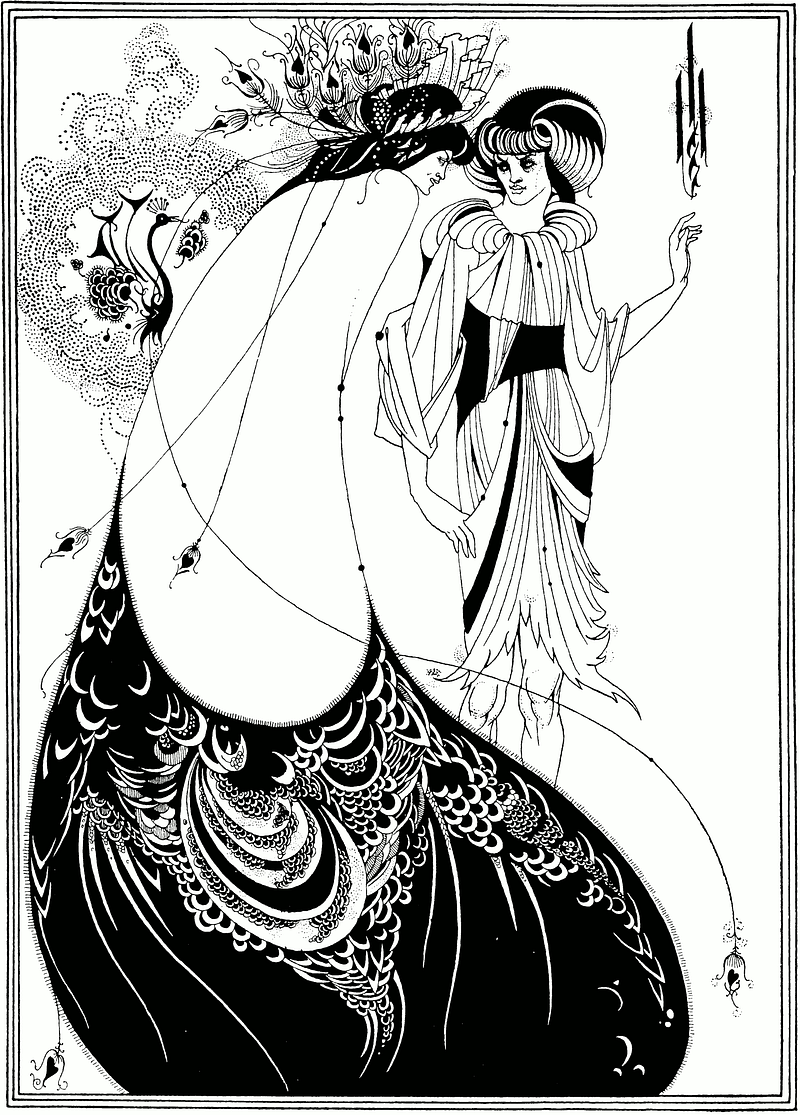
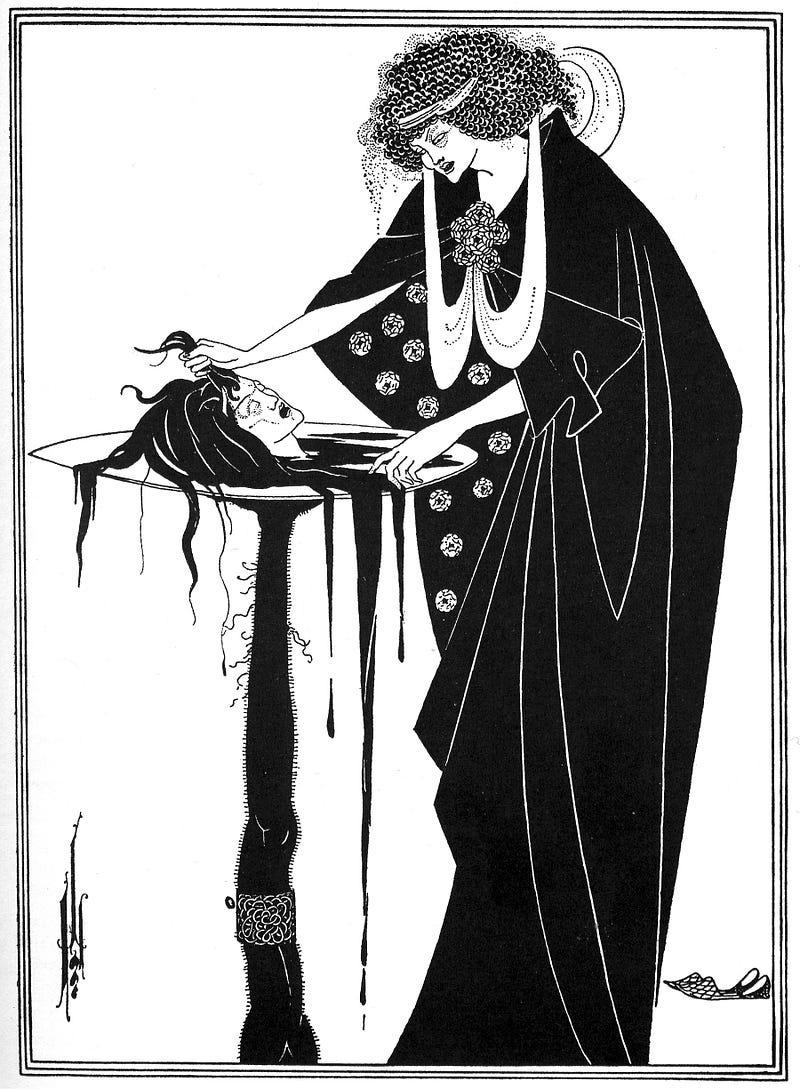
A pinnacle of Decadent art was when the words of Oscar Wilde collided with the illustrations of Aubrey Beardsley in Salomé (1893). The performance of Wilde’s play, loosely based on the Biblical tale of the temptress who demanded the head of John the Baptist, had already been banned in Britain on grounds of blasphemy. So, instead Wilde’s publisher decided to make it available in text form. A newspaper commissioned the young Beardsley to provide an illustration to print alongside a review of the book. The editor of the Pall Mall Budget journal was shocked at what he saw and rejected the image as obscene!
A year later, The Studio, a new magazine focussing on the emerging styles of Art Nouveau and the British Arts and Crafts movement published the illustration. When Oscar Wilde finally saw what all the fuss was about, he asked that his publisher hire Beardsley to produce an illustrated edition of Salomé…
Even though one of Beardsley’s illustrations was rejected for going too far in its perversity, the edition still stirred-up much outcry on publication. The Times criticised the cover design alone for its, “repulsiveness and insolence.”
In a negative review that dwelt on the book’s visual content, The Art Journal described it as, “terrible in its weirdness and suggestions of horror and wickedness.” Of course, this piqued public interest all-the-more and the book became a best-seller, initially selling at a rate of a thousand copies per day. Job done, in terms of Decadence!
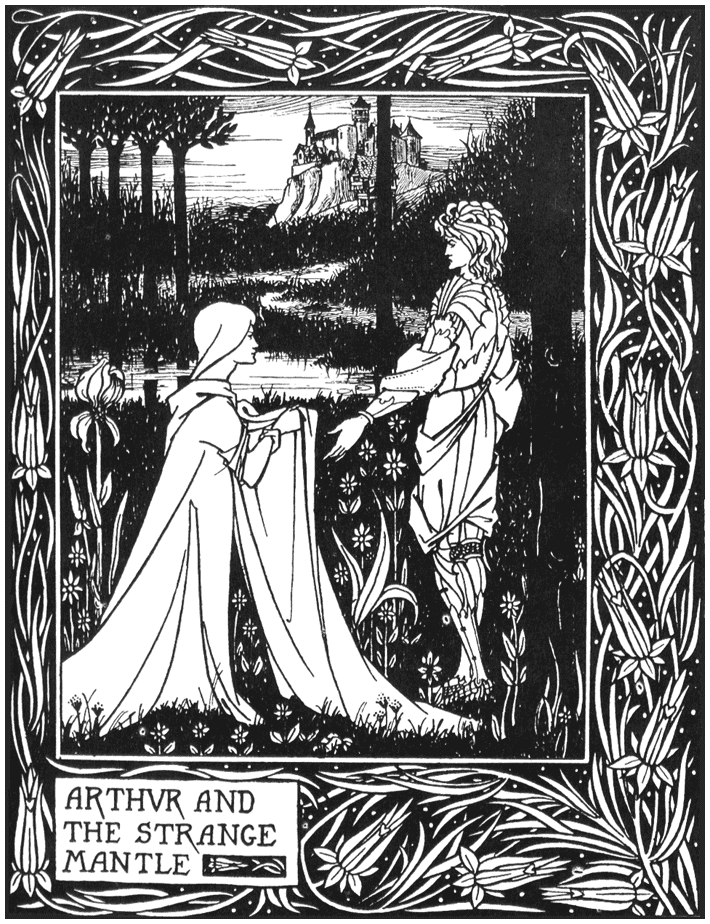
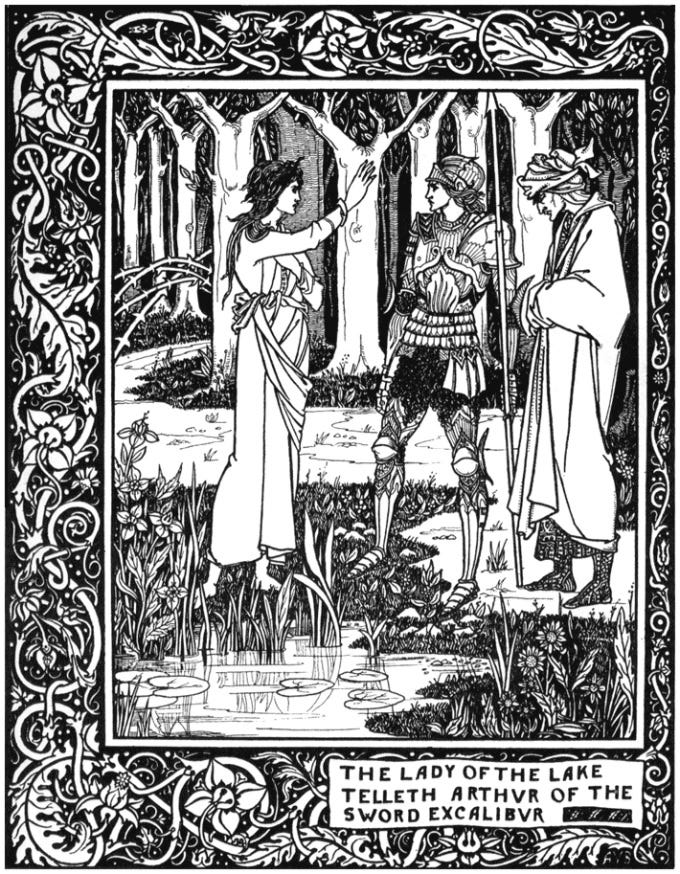
Probably the most respected of Beardley’s works is the 1893 illustrated edition of Thomas Malory’s epic poem Morte d’Arthur. In his work for this project, Beardsley merged illustration and illumination, remaining modern whilst ticking the Pre-Raphaelite box of harking back to a Romanticised version of the chivalrous past. Of course it also tackled Decadent themes of lust, infidelity, betrayal and beauty in death.
It’s a beautiful body of work and noteworthy for making elements such as frames, borders and lettering into integral parts of the overall illustrative compositions. The interwoven motifs that run through his plates for Morte d’Arthur are taken from the natural world and echo Viking and Celtic knot-work. This decorative approach was to became a definitive characteristic of Art Nouveau. Like many artists of the time, Beardsley had also been influenced by the influx of oriental objects and the ‘Japonais’ style promoted by Christopher Dresser — particularly in the treatment of figures and surface pattern.
Nearly all of Beardsley’s art can also be read as Symbolist. A flower in the background is not simply there for decoration. It will be contributing something more about the narrative within the image. Perhaps, vulnerability, transience, the fleeting beauty of youth, renewal, fertility, sex or gender. Perhaps it’s the ‘evil lily’ of the Aesthetes? Or is it the revered blue lotus of the ancient Egyptian cult of Ra?
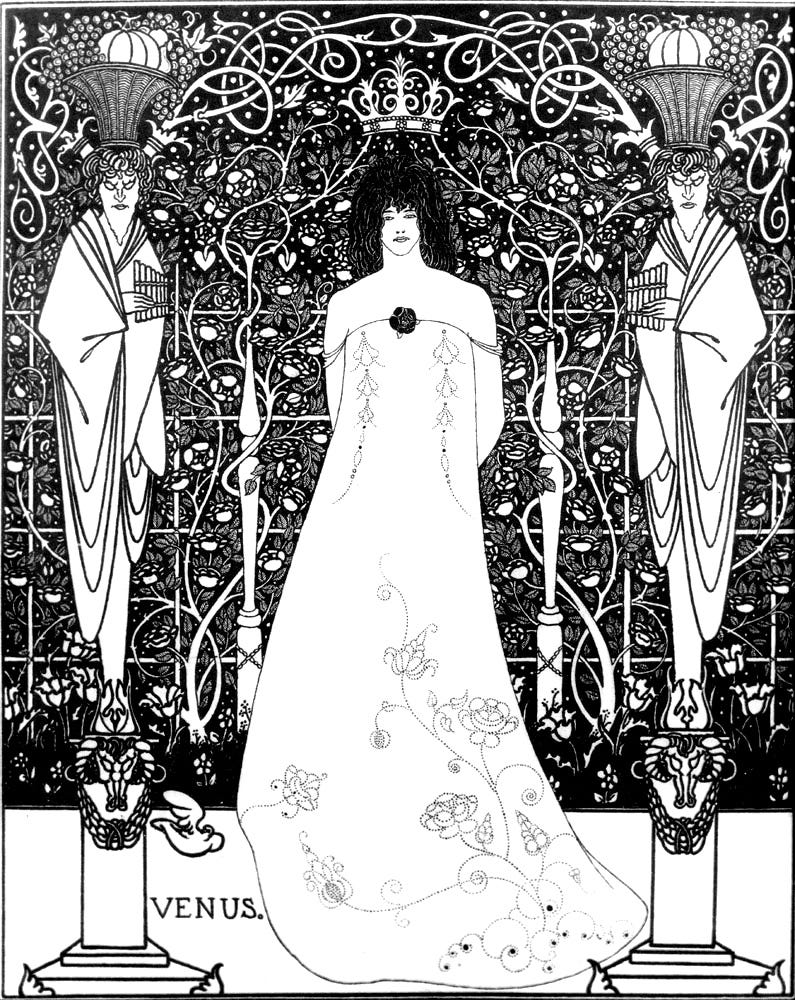
Beardsley was an author in his own right and, of course, illustrated his own writings. The frontispiece for his (unfinished) novel, Venus and Tannhauser (1895), is a fine example of his balanced and elegant design where figures are given form by the minimal use of lines which also expresses the textures of the surfaces contained within those lines.
The prominent forms themselves are simplified and rather abstract. They only become figures with the clever addition of a few small details. There is little to suggest that Venus has a human shape except for the superbly observed face and slope of shoulder — perhaps comprising a dozen marks. The faun-like ‘terminal gods’ are interesting shapes that would be read as architectural if not for a few lines to give them the faces and hands.
Although the forms are often left entirely devoid of detail in his work, the outlines denote what they may be made from. Are they rich velvet, furs, or in this case, I think, crisp linen and smooth flowing silk. When pattern is included, the quality of line can subtly indicate whether it would be embroidery or print… The gown of Venus is clearly decorated with delicate stitch-work.
The influence of Aubrey Beardsley is evident in the work of several more famous artists such as fellow Decadent, Henri de Toulouse-Lautrec, particularly his early posters such as one advertising Confetti (1894). This may well have been a two-way trade-off resulting from Beardsley’s visit to Paris in 1892.
Much of Gustav Klimt’s Symbolist work is allegorical, such as Nuda Veritas / The Naked Truth (1899), which has obvious echoes of Aubrey Beardsley. A prior connection with Beardsley’s art can be seen in Klimt’s integration of frame into the overall composition of many of his paintings such as the Portrait of Josef Pembaur (1890).
Following Beardsley’s pioneering use of line to suggest many qualities of the form they contain, Henri Matisse adapted his own use of line to liberate the duty of form, allowing shapes to exist as flatter elements within a composition in a very similar way.
Today, Beardlsey’s legacy is most apparent in the art of comics and graphic novels. His reductionist use of just a few well-chosen marks to give a character an expressive face can be seen throughout comics. The balance of stark black or white shapes to make a striking design is also widely used, and probably most dramatically demonstrated by Frank Miller in his Sin City series (1991–2000). I’d like to think Beardsley would have approved of its Decadent ambiguities and fascination with the more sordid aspects of its low-life characters, living on or beyond the fringes of acceptable societal norms...


