
Narratives of Colour and Form
Looking at Delacroix and Renoir — two pioneering artists who used structural colour to direct how our eyes move to reveal the narratives of their paintings…
Eugène Delacroix was a revolutionary French Romantic painter, heavily influenced by the British literary Romantics and, in turn, was a major influence on the French Impressionists. He’s credited as introducing the use of ‘structural colour’ as a method to govern the way the gaze of the viewer moves over the picture plane. He accepted that the ‘reading’ of a picture is not instantaneous and devised a method to direct how we actually look at his paintings and read the narratives they contain. To do that, he used a deliberate distribution of colour.
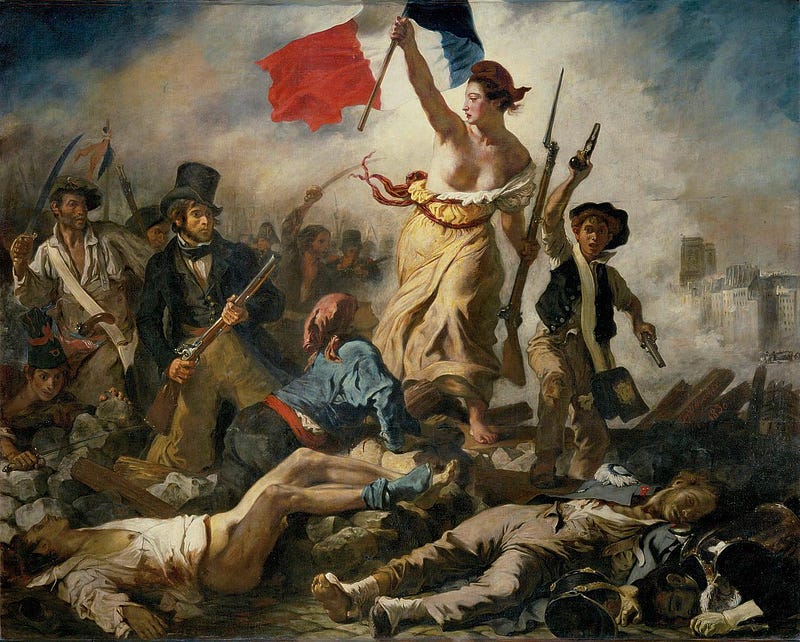
Probably the best illustration of his pioneering approach can be seen in his well-known work of 1830, Liberty Leading the People. Delacroix knew that the place that the average human viewer wants to rest their gaze within a composition is slightly left of centre. If you imagine this canvas divided in half horizontally and then in half vertically, you find the centre of the composition…. and slightly to its left, we find…
…nothing to hold our interest. There’s no reward. The indistinct browns of a man’s tunic or jacket. So, the eyes search for something more satisfying. In Liberty Leading the People, we’re attracted either to the yellow of the central figure’s dress, or the red section of the flag. This keys us into those colours and draws our gaze across the canvas to pick out the flashes of reds and yellows scattered around the composition.
This involuntary response is what gives the painting its sense of movement. Our eyes do not rest easy but are dragged from one key colour detail to the next. It’s the movement of our eyes that lends movement to the figures. They’re actually painted in a very posed manner, static as statues — which, in turn, gives the scene its sense of grandeur and historic import.
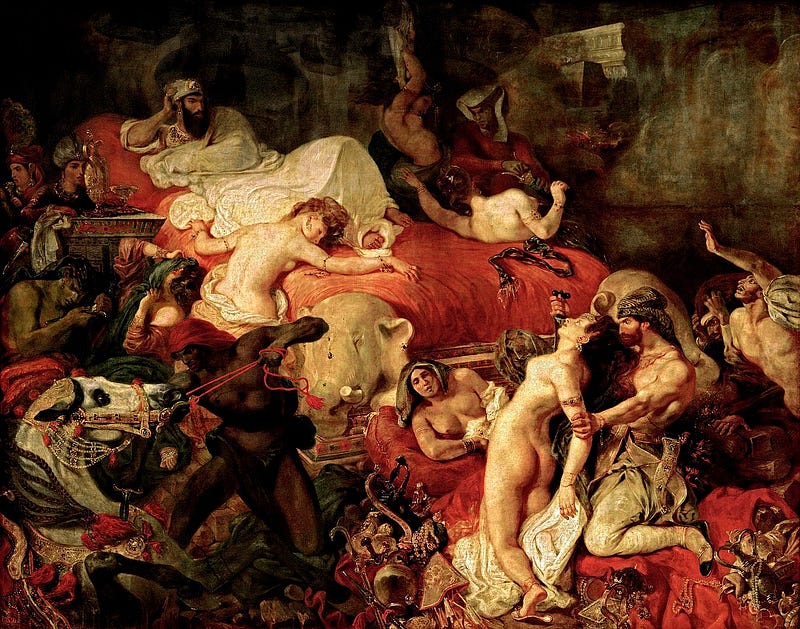
He had used the same technique with Sardanapalus: slightly left of centre, our eyes find nothing to ‘hold on to’, so it’s the red swathe that thrusts diagonally up through the composition, or the ivory white of the sultan’s robes that attract our attention. Then our eyes find the scattered rhythm of these two colours throughout the rest of the canvas. This gives the tableau of figure studies the atmosphere of a heaving, decadent orgy.
It also reveals the narrative of the image as the world-weary Sultan, perhaps knowingly, is about to drink from a poisoned chalice. He has explored and exhausted every desire to its limits, but remains unfulfilled as he finds that the thrill of the ‘peak experience’ is increasingly fleeting… evermore elusive.
It was inspired by Lord Byron’s epic poem retelling the legend of the Assyrian King as a Romantic paradigm of heroic excess and finally failure, rather than the tyrant outlined in more ancient texts. The scene can be read as the ultimate hedonistic extreme, whilst simultaneously portraying the ‘orgy of death’ as the kingdom falls around its unstirred ruler.
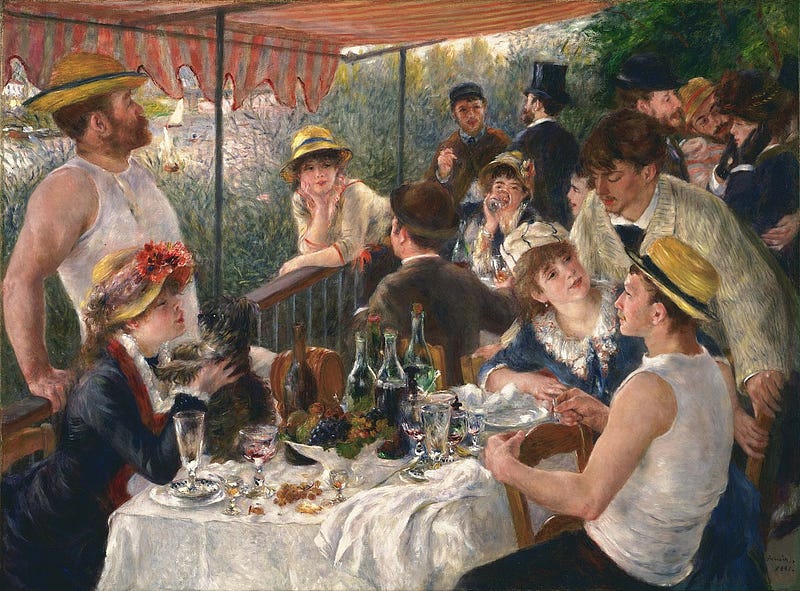
Some of Delacroix’s other paintings prefigure Impressionism and his work was probably the single most important influence on the later style. This is particularly evident in the Luncheon of the Boating Party, a strong structural composition painted by Pierre-Auguste Renoir, in 1881.
Pierre-Auguste Renoir is closely associated with Impressionism, but a focus on figures, and a fairly formal approach to painting them, is also evident. Renoir was tutored by Jean-Auguste-Dominique Ingres, who worked in the Neoclassical style and is usually seen as a rival, if not an opponent, of Delacroix and his more Romantic approach. Renoir manages to bring influences from both these important painters into his own work.
The ‘messy’ brushwork gives the impression of how the eyes actually perceive the world around us. We don’t see any real scene in uniform focus and detail as in many earlier, academic paintings. We only clearly see a relatively small area of our field of vision at any one time.
Through very astute observation Renoir has emulated this way of seeing by careful selection of the important details that give form to the people and objects. He’s paid particular attention to the play of light and shade, and to the reflective properties of the bottles and glasses on the table. The white table cloth almost fluoresces and provides under-lighting to soften the shadows on the faces of the people around it. This is a good example of the fascination with, and conscious use of, natural light that is a defining element of Impressionist paintings.
The space towards the viewer allows visual access to the composition and also implies a space has been left at the table for another to join in the conversation. The impression of a conversation is achieved through clever use of structural colour.
The rhythm of the yellow hats moves the eye around the canvas, and draws our attention to each person at a time, not only to the person, but specifically their head and face — which is where the voice would emanate. It’s as if one person speaks and attracts our attention, then another replies and we look to them in turn. This is a direct translation of the compositional style of Eugène Delacroix.
Again, the focal point of the picture, slightly left of centre, is the brown jacket of a man who has his back turned to the viewer. His hat is also dull brown, but we follow his attention to the lady he’s talking with and she wears one of the five straw-yellow hats that stand out against the predominantly blue and green tones that surround. For a moment, we find her as fascinating as the man clearly does, but then our attention is caught by another of the party, their yellow hat suggesting a nod as they chip-in with their remarks…
…should we butt-in, or remain content to eavesdrop?


