
The Awe of the Land
Examining spiritual connections between artists and landscape in two Classical Chinese scroll paintings
Classical Chinese landscape painting began around the time of the artist and poet Wang Wei, during the first half of the eighth-century. He’s known as the innovator responsible for introducing a poetic dimension to landscapes and for originating the discipline of brush and ink painting onto handscrolls, sometimes combining elements of calligraphy. None of his original landscape paintings are known to have survived, though there are a few ‘attributed’ to him and several copies made by other artists. His huge influence, elevating landscape painting from decoration into the realms of poetic art, can be detected in the epic handscrolls and monumental hanging-scrolls, produced over the ensuing four centuries or so. It remains clear in the refined works of early masters, such as Fan K’uan who was working at the close of the tenth-century and into the eleventh (Song Dynasty), and the later ‘Four Great Masters’ — Huang Gongwang, Wú Zhèn, Wáng Méng, and Ni Zan — operating around the turn of the thirteenth- to fourteenth-century (Yuan Dynasty).
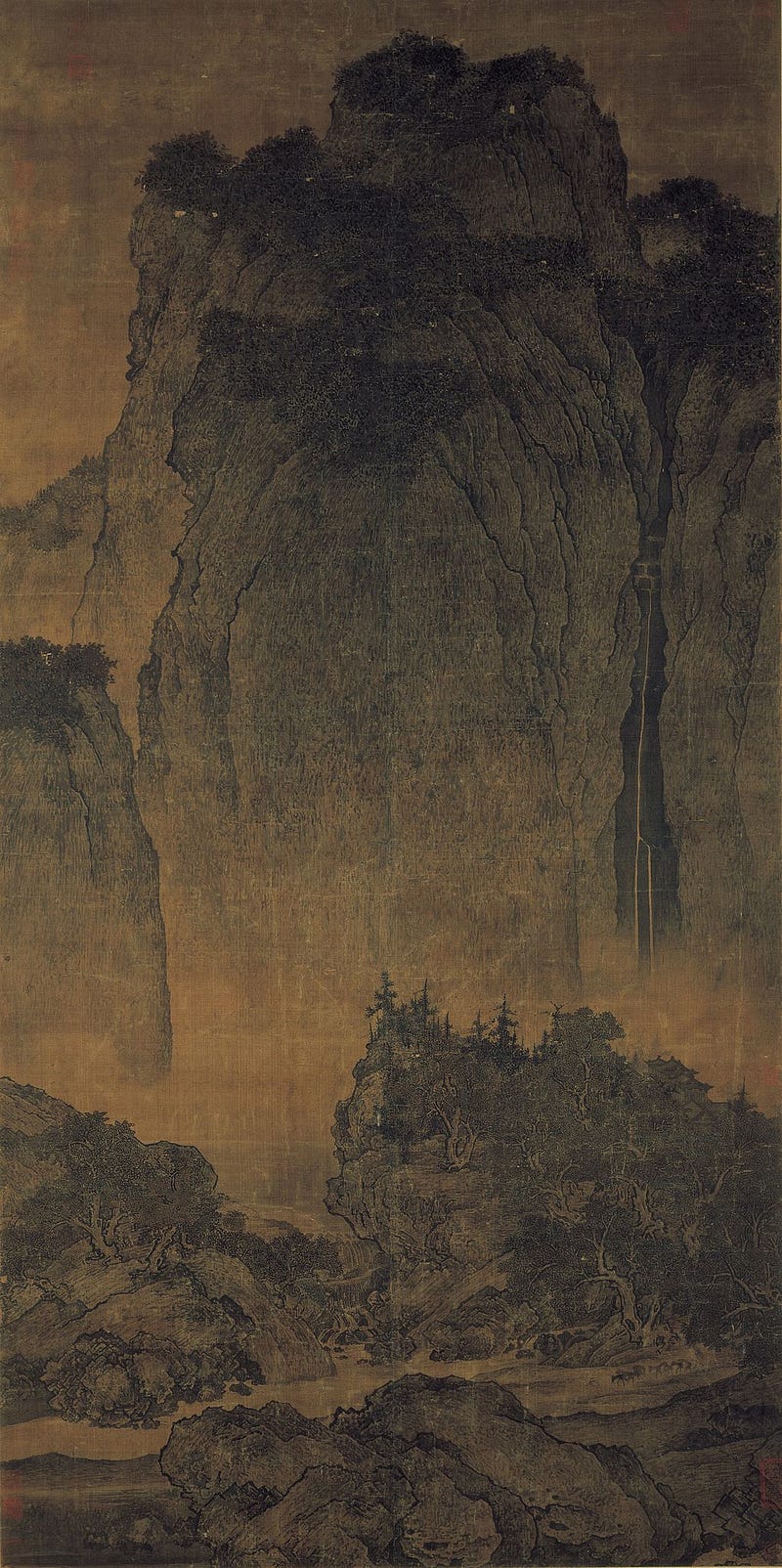
Fan K’uan is best remembered for painting the hanging-scroll titled Travellers Among Streams and Mountains (谿山行旅圖). It has been interpreted as a visually expressed philosophical response to times of great socio-political upheaval around the beginning of the eleventh-century. The Song Dynasty was attempting to reunify China and there were frequent military conflicts with peripheral provinces contested by nomadic clans and other established Dynasties.
At over two-metres high, his grand composition of sublime natural landscape dwarfing figures and buildings was a devotional work celebrating the restorative powers of eternal nature. By comparison, human affairs seemed trivial and fleeting whilst the natural world offered a wellspring of renewing energies and refuge from strife. His only surviving masterpiece is the earliest significant example of monumental landscape painting that established the format and left an indelible stylistic influence.
With Travellers Among Streams and Mountains, Fan K’uan fused concepts of poetry, philosophy, spirituality, with elements of traditional art, into an impressive new mode of visual expression. This places the work in the broad category of shān shuǐ (山水) a sub-genre of Chinese landscape painting, produced with traditional brushes and inks, depicting natural landscape. The term literally translates as ‘mountain [and] water’ so, these natural elements should always be represented in such compositions, but in a way that evokes their spiritual presence and not necessarily how they may appear to the eye.
Like much East Asian art, shān shuǐ paintings employ a triadic structure to imply depth. Parallel or vanishing-point perspective is very rarely present. Instead, the sense of distance is created by clearly separated foreground, middle distance, and background. Here, Fan K’uan places impressive boulders right at the fore of the composition that resemble a mountainous terrain themselves, perhaps referencing the art of suiseki — where ‘scholar stones’ are presented that seem to be miniature landscapes and can be explored through meditation. Even at the bottom of the scroll, the point of view is already elevated as if from a high ridge.
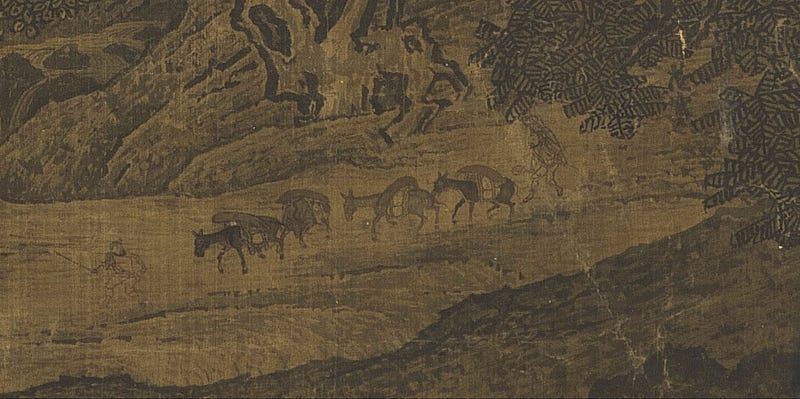
The lower section of a hanging-scroll is known as the ditou (地頭) which relates to ‘earth’ and in elemental terms this is often symbolized by stone, rock, or boulder. Fan K’uan cleverly uses the pale swathe of a riverside road to emphasise the outline of the boulders that ‘ground’ the composition. A steep drop down to the valley below is indicated by two tiny travellers with pack donkeys making their way along the road. Immediately, this changes perceptions of scale and expresses the monumental grandeur of the scene that now rises above the viewer.
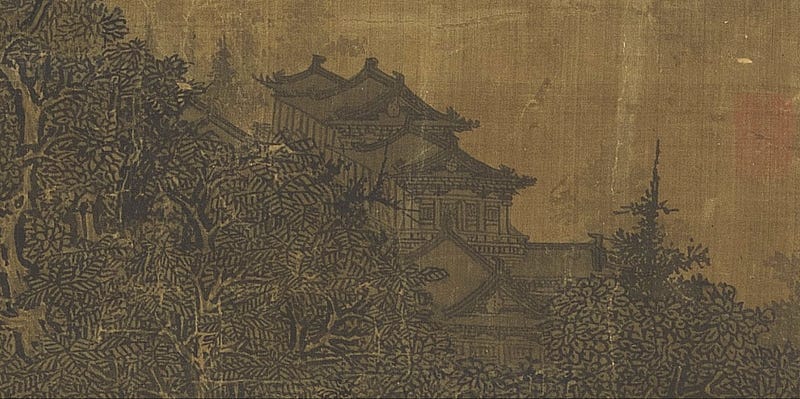
Craggy outcrops band across the middle-ground, crammed with gnarled, ancient trees. Careful inspection reveals rooftops of buildings nestling among the trees to the right of the scroll — perhaps a temple where pilgrims can stop to meditate on the vast vista beyond. A gap in the land allows a waterfall to cascade into the river and this natural pass draws the eye to a misty lake outlining the mid-ground and the delicately rendered foliage of the trees that crest the crags. Above this rise the austere cliffs that dominate the composition, the long, forked line of a waterfall providing visual cohesion and taking us up to the tiantou (天頭) the top of the scroll — symbolising heaven, the infinite, and all things spiritual — where dense forests crown the seemingly inaccessible peaks.
Fan K’uan painted this very large scroll on silk using inks, adding some very subtle colour with dyes. The ink used by Chinese scroll painters was typically made from a combination of soot, usually from pine, and animal-derived glue. Often, inks were dried into blocks or sticks and kept to mature, sometimes for years, their age affecting the characteristics. For use, the hard inks were ground into a fine powder on an ink-stone and mixed with water, preferably sourced from the place that is to be painted. This preparatory process was part of the art and an important period of creative contemplation.
As most artists knew how to make their own brushes, Fan K’uan would have likely used a variety, perhaps designing some to produce particular types of strokes, tones, and textures. As with the inks, brush-making was considered an integral part of the creative process. Usually, ink brushes were made by wrapping and strapping animal hair onto a bamboo handle, and then cutting the bristles into the desired shape. The type of hair used, and proportions if mixed, were not only practical choices, but also had symbolic meanings associated with the animals that may live within the habitats portrayed. There was also a magical significance as the bristles were thought to be imbued with attributes of the animal, empowering the marks left by brushes made of their hair.
For example, the hair of the wild wolf might be decisive, strong, and resilient, making bold, powerful strokes. The hair of the biddable goat, may be soft and flexible, for delicate, nuanced brushwork. Fox and weasel hair held shamanic connotations linking them with two of the ‘Five Great Immortals’ and their associated colours of red and yellow, respectively.
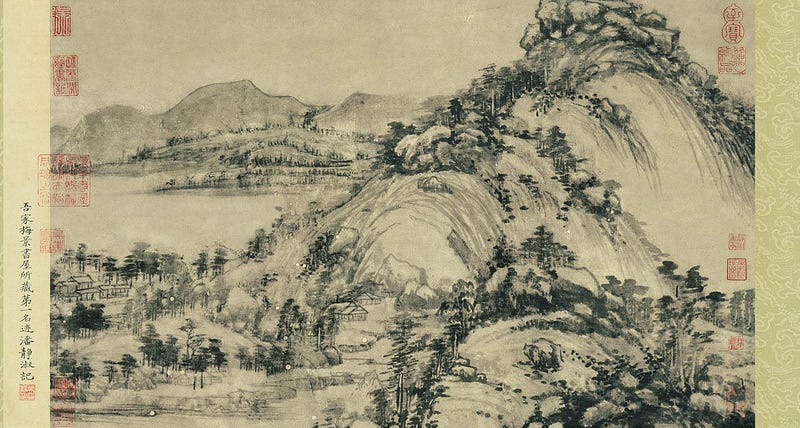
Dwelling in the Fu Ch’un Mountains (富春山居圖) by Huang Gongwang, is a handscroll that survives in two sections. The first, shorter piece measuring around half-a-metre, is known as The Remaining Mountain and the second, The Master Wuyong Scroll, is over six-metres long. The missing piece that would have bridged the two was destroyed by fire when one of the scroll’s historic owners ordered it to be burnt so it could ascend to the afterlife where he could continue to enjoy it for eternity. However, not all of the masterpiece went up in smoke and the two fragments were rescued.
What remains is one of the most famous and revered works of Classical Chinese landscape. During the Yuan Dynasty, Huang Gongwang was a notable figure in the literati tradition, a group of poet-scholars who worked across several creative disciplines, though mainly poetry and painting, and they valued self-expression and individual style over academic precision. Their approach could be understood in similar terms as the Romantic landscape painters of the west — such as JMW Turner — who followed some five centuries later…
Learned gentlemen in ancient China were expected to have an official state role and to pursue the arts as a path toward self-awareness and personal improvement. Huang Gongwang had been a minor tax supervisor involved with the census but seems to have been sacked and subsequently jailed over slanderous remarks made against a senior minister.
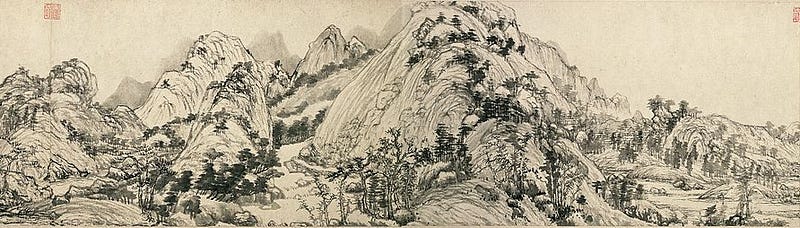
Upon his release, he retired to the mountains as a Daoist hermit. In his later years, painting became his principle way to explore nature in an ongoing quest to achieve spiritual balance — to align his inner microcosm of self with the expansive macrocosm of nature, as if at one. It’s this harmony he manages to express in the great panoramic scroll that captures the majestic grandeur of the Fu Ch’un mountain range which became his home and abode of his soul.
Huang Gongwang was known for his expressive style and for using small calligraphic brushstrokes in the texture and form of rocks, trees, and streams, in turn creating an underlying cohesion to the very large composition. The painting is also notable for its restricted palette, with a range of grey-tones used to create a sense of aerial perspective whilst maintaining an almost graphic clarity. The foreground details stand out in stark black, the mid-ground fades to greys, and the distant peaks are suggested by volumes of softer ink-wash. Although his approach was rooted in tradition, he introduced several techniques and brought a new aesthetic. Scholars agree that the clarity and balance of his compositions are among the most influential innovations in Chinese landscape painting.
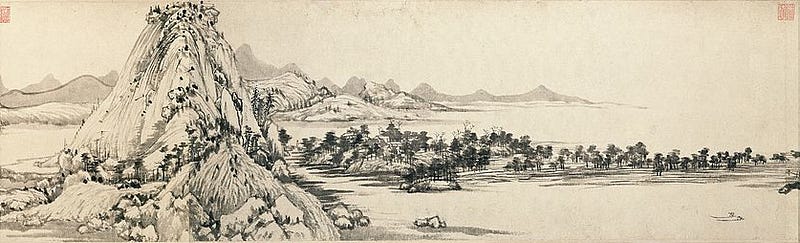
The treatment of landscape, mark-making, and use of triadic composition to conjure distance can all be seen here, placing Huang Gongwang’s handscroll in a shared lineage of shān shuǐ with Fan K’uan’s seminal hanging-scroll. There’s the same reverence for the spiritual aspects of unspoiled natural landscapes, the same poetic expression of Daoist philosophies. With a handscroll intended to be unrolled and revealed in sequence, there’s the added narrative of the journey through the land. Perhaps in a similar way to meditating upon a suiseki scholar stone, the viewer may enter the symbolic landscape with their spiritual body. Maybe we can empathise with the artist, walk in their footsteps, share their awe, and celebrate the restorative powers of eternal nature…
* Signifier and the author cannot be responsible for third-party content on external sites which may contain advertising and are subject to change without notice. All images are used with license.


.JPG)
.jpg)