
Nine Dragons in a Handscroll
Chen Rong’s epic scroll painting is a masterpiece of calligraphic brushwork, innovative painting technique, visual storytelling, and magic… all rolled into one!
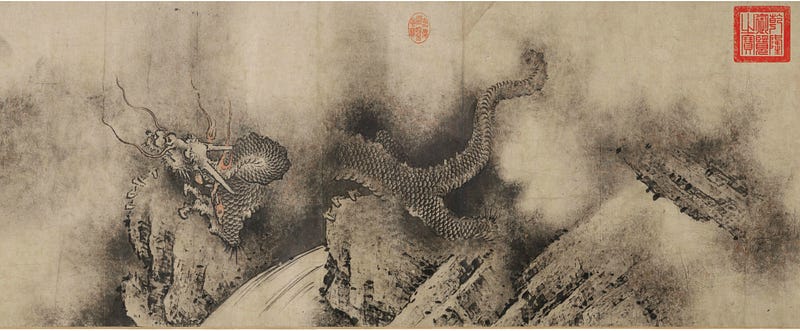
In thirteenth-century China, Chen Rong was recognised as the dragon-master. His legendary handscroll painting of The Nine Sons of the Dragon, imbued with magical powers to control the weather, was intended for a Taoist temple but would be coveted by collectors and Emperors. First catalogued in 1244, his masterpiece was famous throughout the land and became the reference work for other artists when rendering dragons. Indeed, the Dragon Screen of the Forbidden City itself was based on it, by Imperial decree. As were the many copies of that architectural feature that followed over the ensuing centuries.
The scroll itself is a big, beautiful illustration and despite being eight centuries old, the delicate yet dynamic style still appeals to the modern eye as an accomplished work of fantasy art. The nine dragons swirl in and out of amorphous clouds, waves, and waterfalls along its 11-metre length. Their sinuous curves and coils entwine land, sea, and sky. The face of each individual dragon dramatically expresses its distinct personality and attributes.
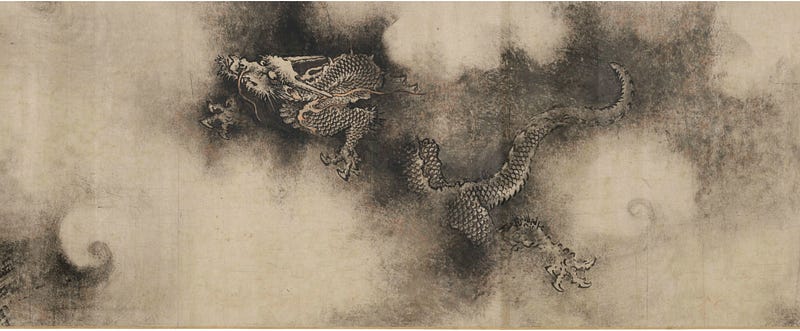
Referring to it as an ‘illustration’, though, is our contemporary conceit as, when it was produced, it would’ve been thought of as a narrative poem as much as the short piece of text that Cheng Rong accompanies it with. Scroll paintings in inks were seen as an extension of calligraphy and were executed using the same types of ink, brushes, and gestures. They were intended to be unrolled and read in a sequence from right to left, as any work of calligraphy would be.
Likewise, Cheng Rong was not thought of as an artist. He was described as a government official during a period when learned persons were denoted by their central civic role but were expected to be well-versed in various aspects of the arts and sciences. At the time, knowledge was knowledge and didn’t respect the compartmentalisation later imposed upon it. There were no clear boundaries between the likes of calligraphy, medicine, poetry, astrology, alchemy, divination, engineering, horticulture, history, folklore, economics…
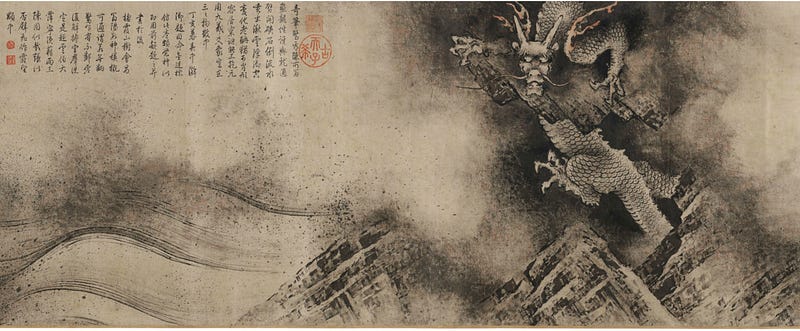
Handscroll format is usually around 40 cm in height with a length from a metre or so upward, with Chen Rong’s 11-metre Dragon Scroll being a rather impressive example. They are intended to be unrolled and viewed in sections as a sequential narrative like an ingenious single-panel graphic novel. There’s often a text preface or appendix that sets the scene or provides an ‘epilogue’ to signal and consolidate any intended meanings. These sections were usually made from an additional piece of stiffer material and acted as a protective cover as well as helping to maintain the scroll’s integrity when rolled in storage, preventing it from collapsing and developing ridges. It is thought that the first handscrolls were Buddhists texts brought to China from India before or during the first century — fans of the late-1970s Nippon TV series, Monkey, will already know this!
A similar format existed in China as early as the eighth-century BCE, which utilised many wooden or bamboo staves bound together for text-based recording. The vertical, right-to-left writing and reading convention of the East was established because of this early document format. Paper and silk scrolls became increasingly common during the first-century and the handscroll was the favoured format for the next millennia. The only other format to rival it was the hanging scroll painting, intended for wall display, with content that could be calligraphic, pictorial, or a balance of the two in one harmonious design.
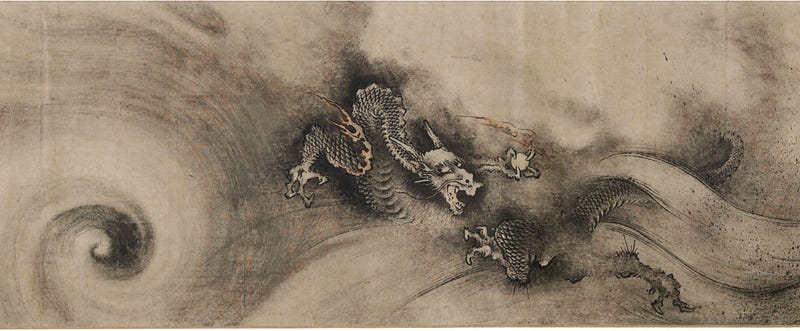
The Dragon Scroll is drawn with black ink, with a few highlights in coral pink on a scroll of high quality chuchih paper, made from bamboo fibre and the dragons occupy 10 metres. There are three columns of calligraphy bearing the work’s title at the leading, right-hand edge which was termed ‘The Heaven’, with the last section adding a further metre containing Cheng Rong’s poetic notes that refer to the legends it depicts. In it he references the power of the dragons to influence the elements and implies that the scroll channels such powers. Associated folklore claims that whenever scroll is fully unrolled, it will summon plenty of rain.
An extra ‘tail’ of stiffer paper, known as a colophon, has been attached to give the scroll its rolled bulk and to allow critics and connoisseurs to record their insights and place their red seals of approval. The practice was similar to having a quote from another author on the back of a bestselling paperback these days. Later, the scroll acquired a fine silk wrap sealed with a clasp of jade, probably when it entered the Imperial collections of Shunzhi, a seventeenth-century Qing-dynasty Emperor.
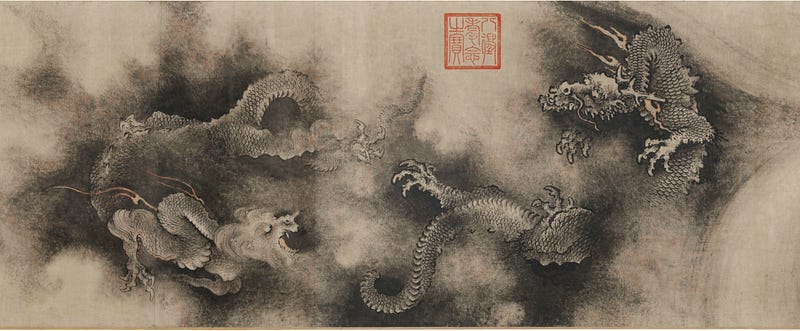
Chen Rong’s ‘poem’ describes the creation of the scroll according to Taoist principles using transcendental meditation and the abundant imbibing of alcohol to free up his creativity, making his style suitably fluid. He cites two earlier works — Nine Horses by the eight-century painter Can Ba and Nine Deer, attributed to Huichong — as influences. Nine is auspicious in traditional Chinese numerology.
He also introduced new techniques that involved overly diluting the ink and splashing it onto the paper without letting the tip of the brush touch. This prefigures what would be known as Action Painting some 800 years later. He also used his breath to blow ink through some sort of tube, probably similar to a spray-diffuser. The use of too much water, and his own breath to apply some of the ethereal textures would’ve had magical significance as the Chinese dragon is associated with water, clouds, rain and flow, and breath was thought of as an expression of Chi — the life essence, spirit, or animistic force that binds together all things in the cosmos.
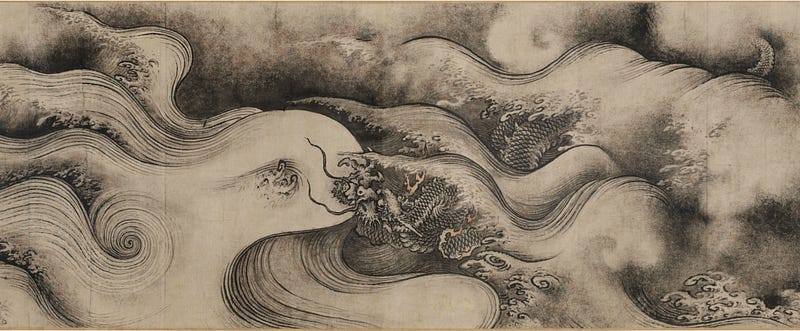
The softer, flowing moistures in balance with the dynamic dragons suggest the cosmic harmony of yin and yang. His notes imply that the making, and subsequence reading, of the scroll are ritualistic and commune with the essence of the dragons it depicts and the elemental forces they represent. Legends tell that the dragons that visit our realm are chimera sired by the great dragon father, or Dragon King, who had many offspring including his 19 sons. Chen Rong selected the nine most relevant for his scroll. With some proper scrutiny, one can have fun identify the following…
They are the eldest, Bìxì 贔屓, dragon of endurance and longevity, often found wrapped around the pillars of grand buildings. Chīwěn 螭吻, the second son, personifies water and can be seen carved on temple roofs as a protector. The third son is Púláo 蒲牢, whose roar can be heard in thunder or the rumble of earthquakes. his image is traditionally cast in bells and painted on ceremonial drums. Bì Àn 狴犴, the fourth son, metes out justice, often featured in the seals of legal administrators.
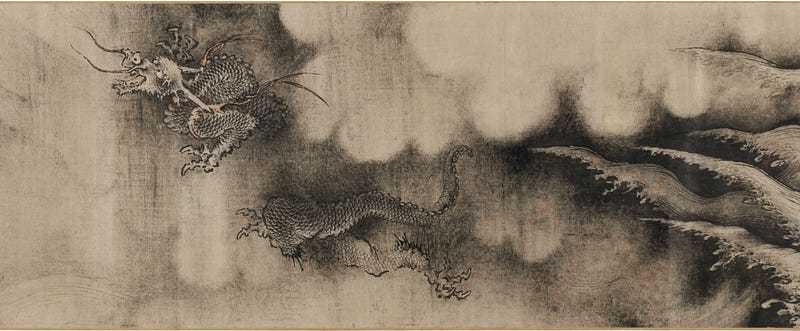
The sixth son, Gōngfù 蚣蝮 is the mighty river dragon who controls the flow of water and can protect against floods. Thus, he’s often incorporated into the decoration of bridges, buildings, and ships. Yázì 睚眦, the seventh son, is the god of battles and the flow of human fortunes. His fierceness is often depicted on shields, weaponry, armour, and banners. Suānní 狻猊, is the eighth son and god of wisdom. He’s the only Chinese dragon closely associated with fire and is often depicted calm and serene whilst surrounded by an aura of flame. A favoured statue in temples where he is invariably painted in reds and golds to imply the shimmering of firelight. Last but not least is the ninth son, Jiāotú 椒図, guardian and protector of homes and families. So, his image is popular on or near the entrances of domestic abodes.
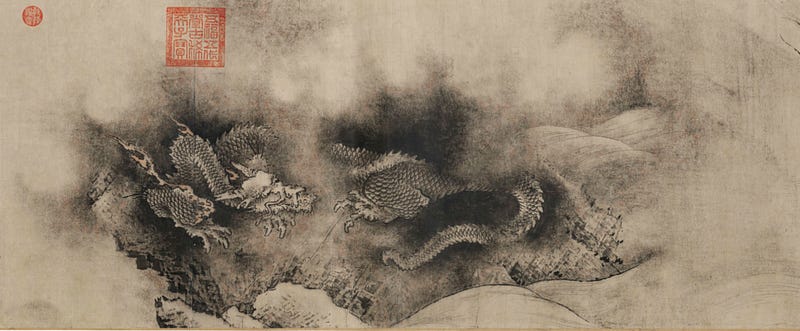
These dragons appear across an exclusive set of mugs available from our new Signifier Store at RedBubble — all profits from sales go directly to supporting our writers.
* All images are used with permission or presented here for educational purposes under fair usage policy — an excellent high-resolution scan of the entire scroll is available via zoomviewer at wikimedia.


