
Paints, Canvas, Action!
The large abstracts of Jackson Pollock are both jazz-dance notation and self-portrait…
Jackson Pollock took the connections between musical and visual compositions, that Wassily Kandinsky had famously explored, and ran — or more like danced — with them. Pollock’s early works had been distorted figurative paintings that were in keeping with the fashion of American Expressionism at the time which, in turn, had developed from a wider interest in the works of The Blue Rider, including Kandinsky and Gabriele Münter, and the Spanish-born styles of Joan Miró and Pablo Picasso.
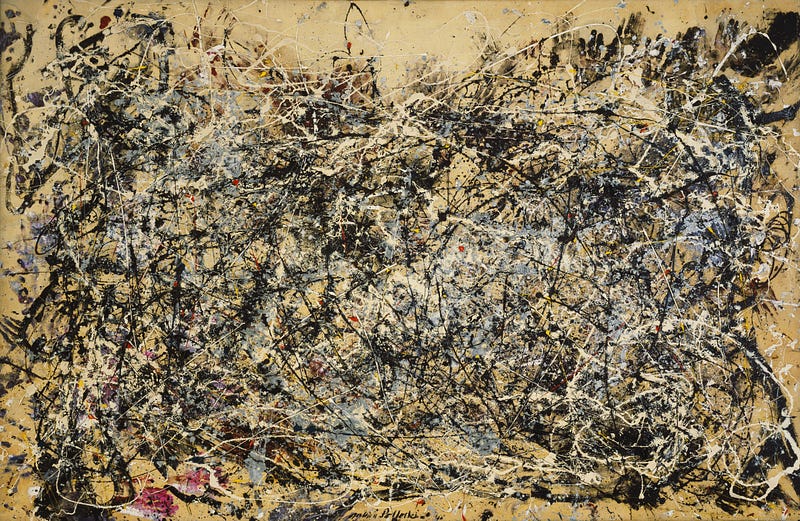
Like many of their antecedents, the Abstract Expressionists of the USA progressed from figurative, through distortion, towards the abstract. Kandinsky, the Russian artist who had taught at the influential Bauhaus, had approached canvas and paint purely as a means of composition. In much the same way, a great composer approaches an orchestra and its instruments where the music itself remains intangible and abstract, though often emotive. Pollock now looked to the musical emblem of the American Modern: Jazz.
At the heart of Jazz is a method of improvisation, composition and expression limited only by the physical properties of the instruments and the human interface with them. In many ways this closely parallels expressive visual art. Pollock was working in the golden age of Jazz and it was his soundtrack of choice when painting. The rhythms and energy of the music remain evident, captured within the dynamics of his large abstracts.
Jackson Pollock is seen as the ‘grand-daddy’ of Action Painting.
The term ‘Action Painting’ is often used incorrectly to refer to the energetic and expressive abstract styles of the mid-twentieth-century ‘New York Scene’, in general. Action Painting may have been a part of that scene, but it is a specific style that uses various techniques to record kinetic movement as a visual record in the mark-making process. The image appears as a result of motion made with meaning, or at least intention…
Pollock laid down big fibreboards on the floor of his work spaces, or spread huge canvasses, and then physically moved over them in a kind of Modern interpretive dance. It was a dance that expressed his feelings, his Chi (energy level), his aesthetic tastes at the time… along with his physical size and shape. Holding a pot of paint, often resin-based enamels, in one hand and a brush in the other, the picture plane became his dance floor.
His movements were intuitive and to some extent, automatic, but never wholly chaotic or completely random. There were choices and decisions being made, though perhaps not always intellectually driven. In this respect, his method aligns him with Automatist Surrealism.
He recorded this ‘dance’, by dripping, dribbling, and splashing paint down onto the surface, in arcs and slashes, as he went. Thus earning him the nickname, ‘Jack the Dripper’. This approach of using a brush that never, or rarely, touches the surface itself as a ‘conduit’ for the paint was a technical innovation on par with Seurat’s Pointillism.
In a sense, Pollock’s paintings in this style are an extension of life drawing.
Perhaps they are more accurate visual recordings of his physical being than a photograph could ever be. Sometimes, he covered his hands with paint and made prints of them within the paintings. This harks back to that prehistoric ‘print’ of a human hand found in the Chauvet Caves, but also gives the work a defined human scale. If reproduced at any smaller size, it remains very clear that the work is big as the hand prints act as a scale ratio, like you would find on a map. So, what we are left with is a recording not only of his body in terms of height, size of stride and length of limb, but also the speeds he moved, his gestures, his moods and then ‘on top of all that’, an expression of his intellectual and aesthetic interaction with the world.
As self-portraits go, these must rank among the most raw, honest and accurate. As a surface, these paintings are exciting, complex and energetic pieces. Any engagement with these works beyond that ‘surface’ relies on how interested we are in the self that was Pollock… and really, the same can be said of any sitter for any portrait… only Pollock certainly wasn’t sitting!
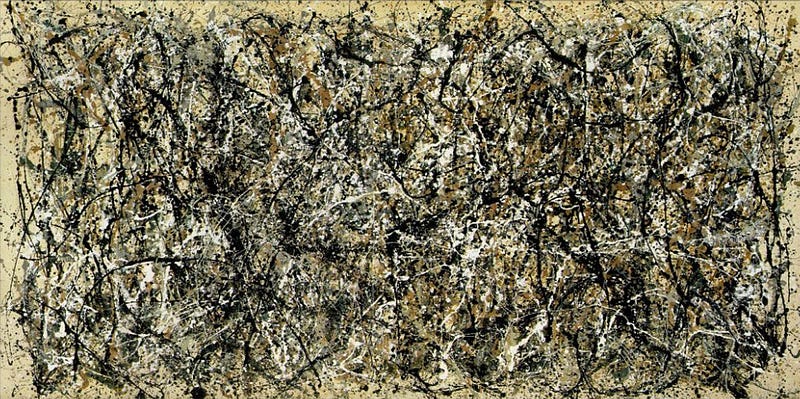
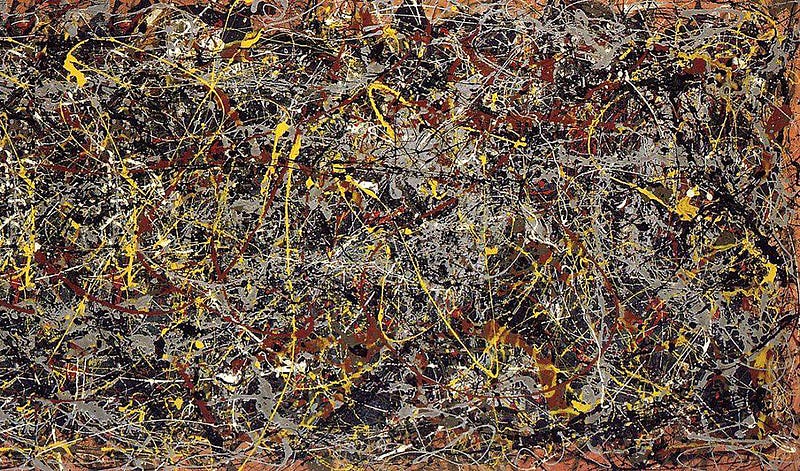
Jackson Pollock was heralded as one of the first truly ‘American Modern Artists’ as his innovative style was seen as a dramatic departure from European precedents. In 2004, a major survey of 500 top artists, curators, critics and dealers was undertaken by UK’s Turner Prize sponsors Gordon’s Gin. The survey asked these art world luminaries what they considered to be the top three most influential pieces of art of the twentieth century, rated in order. The clear favourite was Duchamp’s Fountain (1917) but a painting from Jackson Pollock’s ‘1’ series, 1:No 31, held the No.8 position.
In 2006, Jackson Pollock’s No.5 (1948) was, reputedly the most expensive painting ever sold at auction. Though details of this story have since been refuted, and no one seems sure who bought it, it’s generally accepted that the painting was sold for a record price of $140 million, which was not topped until Paul Cézanne's The Card Players (1895) sold for around $100 million more, in 2011…
More recently, the same painting, No.5, featured in Alex Garland’s film Ex Machina (2015) as a discussion point concerning the differences and similarities between human creative intuition and the logical reasoning of artificial intelligence.
* All images are used with license or presented here for educational purposes under fair usage policy.


