
Prehistoric Graffiti?
Why did our cave-dwelling ancestors decorate their walls with so many paintings of animals?
The Chauvet Caves, in France, contain excellent early examples of prehistoric ‘parietal art’, which is a term for wall paintings and murals. The paintings were made and added to over a long period from 28,000, perhaps earlier, to 17,000 BCE. They still have aesthetic value today, having a lovely sense of line. They are clear and very well observed, mainly depicting animals.
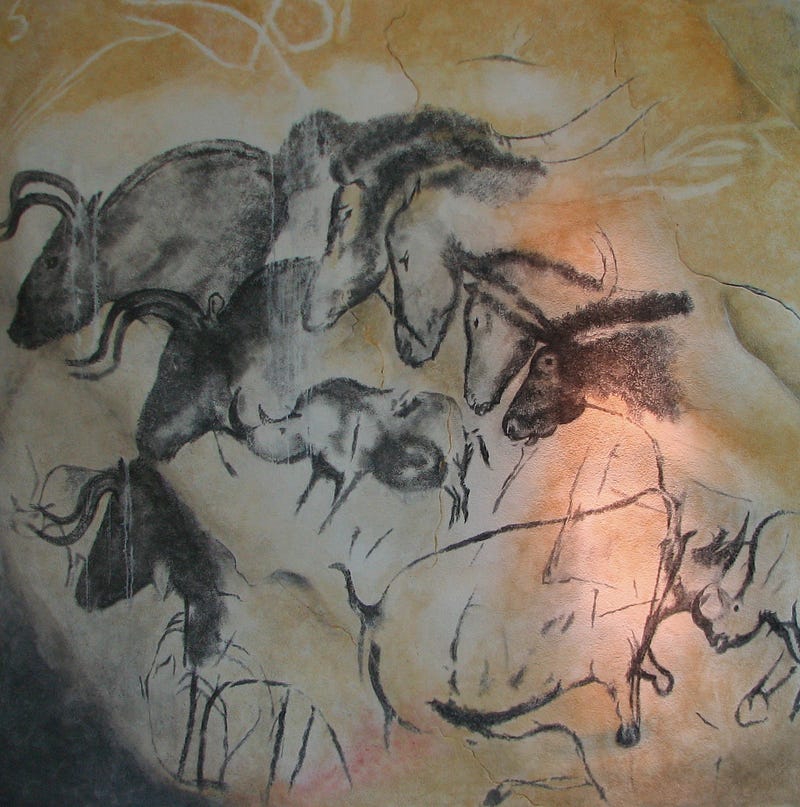
There is a particularly pleasing ‘sketch’ of a bear, rhinoceros, auroch and a row of different horses’ heads showing variations in the species, almost like a catalogue for identification. There is also a human hand print, using negative space to define the hand. This early kind of printing was achieved by the pigment being chewed and sprayed from between the teeth over the splayed hand that acted as a stencil.
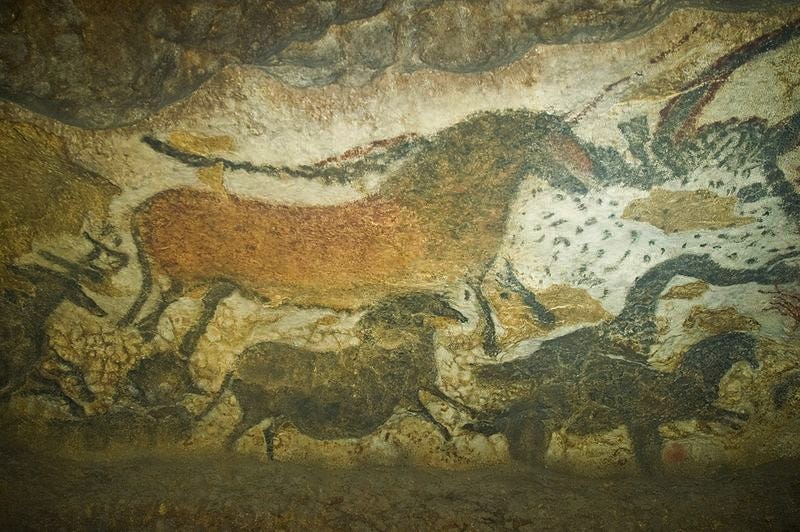
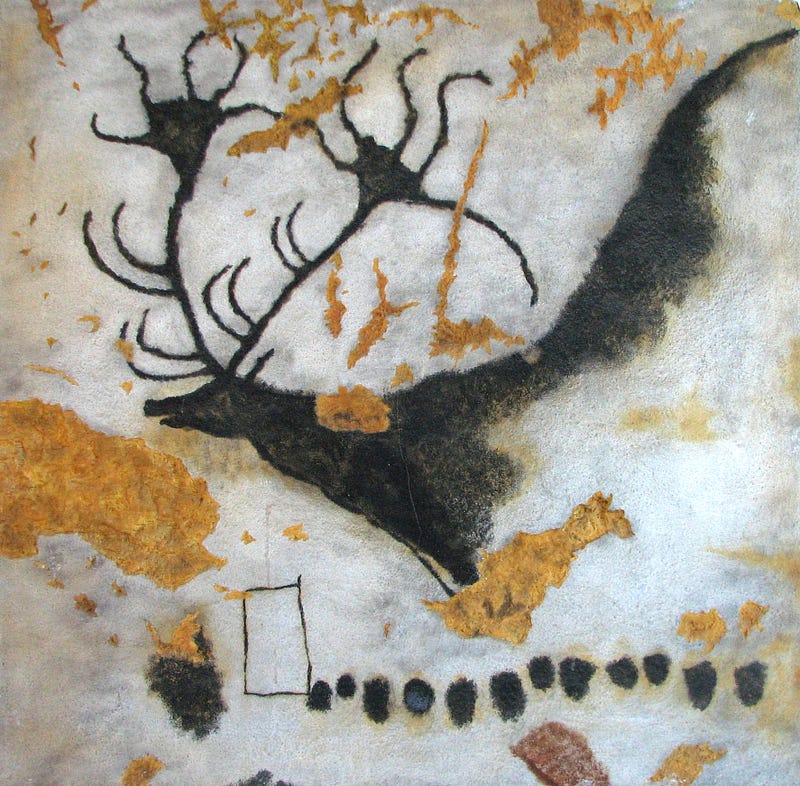
Some of the most famous and best examples of prehistoric cave wall art can be found in the Lascaux Caves, also in France. These paintings are similar to the parietal art at Chauvet Caves, but are more recent, being made over a period from around 16,000 to 14,000 BCE.
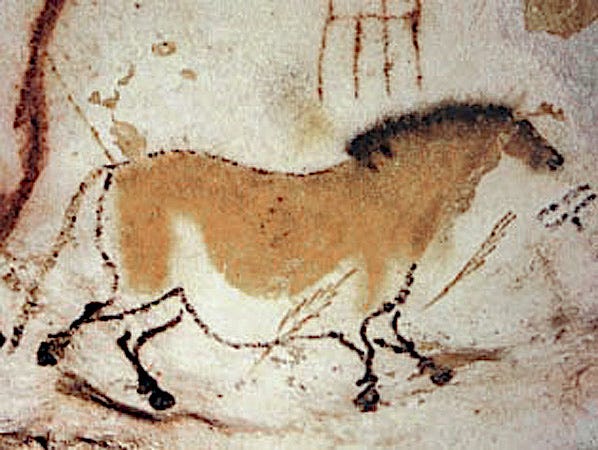
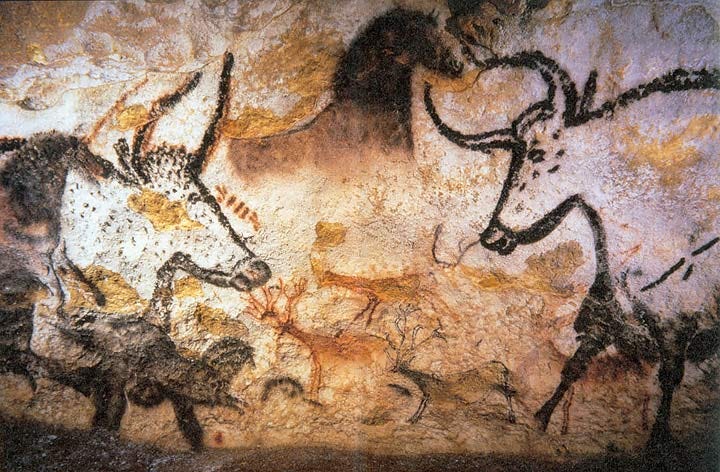
In both caves, the drawings overlap and are painted on the walls without any defined boundaries. At Lascaux, the pigment is perhaps stronger and the style a little more stylised. The forms are more ‘coloured-in’, yet the style remains fundamentally the same, almost as if done by one artist. However, this style of drawing spans a period of around 5,000 years, so it has actually been executed by many, many generations of artists.
So what can this tell us? This indicates that the cave art, though obviously executed with an aesthetic sense, is formulated in a similar way as a hieroglyphic language. Although the earlier cave paintings of beasts were obviously observed ‘from life’, eventually an accepted prescribed way to draw each of them developed. So, this is not ‘expressive’ art, it is more like a type of picture writing and follows a set of patterns that became meaningful to the culture that produced them.
This propensity to follow set-out methods and perpetuate a ‘template’ approach to visual art, seems to become ingrained in the human psyche and continues through countless generations until challenged by the Pharaoh Akhenaton… about another 15,000 years later (as the chronometer flies).
As with the earliest known carvings of the human form, the so-called ‘Three Venuses’, we don’t know for sure the reasons why those prehistoric people painted on their cave walls. There has been a lot of educated guesswork, sometimes supported by archaeological evidence. It could have been the graffiti of their time, or the equivalent of clip art… We have three main theories to consider:
Theory one: documentary…
One recurring motif in prehistoric cave art is the row of similar-though-slightly-different animals, very much like a type of identification chart. So perhaps one of the functions of the drawings was to document the different species of animals for instruction and education. “Hunt these, run away from those.” Perhaps it was simply a record of what they saw and how they lived. It certainly shows how important animals were to them.
Theory two: storytelling…
The images are painted onto the cave walls in a seemingly random order and some of them are in very dark recesses, and would only ever have been visible by firelight. This implies that the act of going to see them, or having them revealed, was meaningful in some way. Many of the beasts that are portrayed wouldn’t have been food animals, and some may have been seen only during their seasonal migrations. Perhaps the images were used as backdrops that set the scene in terms of seasons and the images were revealed in some sort of narrative order. The stories could have served to entertain, to educate, or both.
Theory three: magic…
In some caves, there are figures that combine human and animal attributes. Some human figures, on closer inspection, have hooves instead of feet. A stag rearing up on its hind legs, on closer inspection, is a human imitating the beast by wearing animal furs and horned headdress. This leads many to believe that the paintings of animals have some symbolic, if not magical significance.
One possible motivation is the practice of sympathetic magic, which is a form of superstition that leads to a belief that a representation of a thing can have an effect upon the real thing. (A current example would be a voodoo doll.) The people may have painted the animals in an attempt to exert some sort of influence over them. A possible scenario would be that the animals are seen, but then disappear. The cave dwellers paint pictures of those animals, and they re-appear. This may lead to a belief that the act of painting the animals caused them to come back. This then becomes self-fulfilling, “If you paint them, they will come.”
We, of course, would understand that the herds migrated away and then passed back through the area as the seasons changed… They would have (almost certainly) returned whether their effigies had been painted onto the cave walls or not. This seasonal theory seems to be supported by patterns of dots associated with some of the paintings, now identified as the earliest star charts, showing recognisable constellations.
Shamanism could be called a form of magic and is still widely practiced today. A shaman is a person of wisdom and power who is ‘in-tune’ with the natural world. Aboriginal Australians, Native Americans, Druids and some practitioners of Wicca philosophies are all examples of today’s shamanic cultures. Generally, shamanistic cultures believe that there are several different worlds that coexist and overlay each other — the world of the living, the world of the ancestors, the world of dreams and the spiritual realms. To a shaman, all of these worlds are equally ‘real’ and influence each other.
Shamanism is also closely associated with animism, a belief that there is a life force that unites everything, and that everything has a spirit. The shaman works with this life force in order to better understand the spirit of a thing, place or animal.
In the prehistoric period, early humans wouldn’t have seen themselves as very different from the animals around them, particularly the social carnivores such as wolves and big cat species, and would have closely observed them to learn from their behaviours. You want to hunt antelope? Then observe other successful hunters and learn the techniques of tracking, camouflage and stealth needed to catch such very fast prey.
The deep understanding of the behaviour of other animal species, both hunter and prey, would have been essential knowledge and the cave art could be a record of the on-going contemplation and discussion relating to this pursuit. Drawing something is a very good method of study as you have to observe and distill the essential features. This is why drawing from life is still at the core of art and design courses to this day, despite the development of photography and digital media.
The motivation to make cave wall paintings was probably a combination of all these ideas and could have been different from one clan to another, from one millennia to another. Then, as now, art had the potential to entertain, educate, document, challenge, change, and to transcend.


.jpg)


